Blog Customer FeedbackAha! Review (2026): Pricing, Pros, Cons & Verdict
Aha! Review (2026): Pricing, Pros, Cons & Verdict
An honest 2026 review of Aha! - real features, current pricing, user-backed pros and cons, and who should pick it versus a leaner alternative.

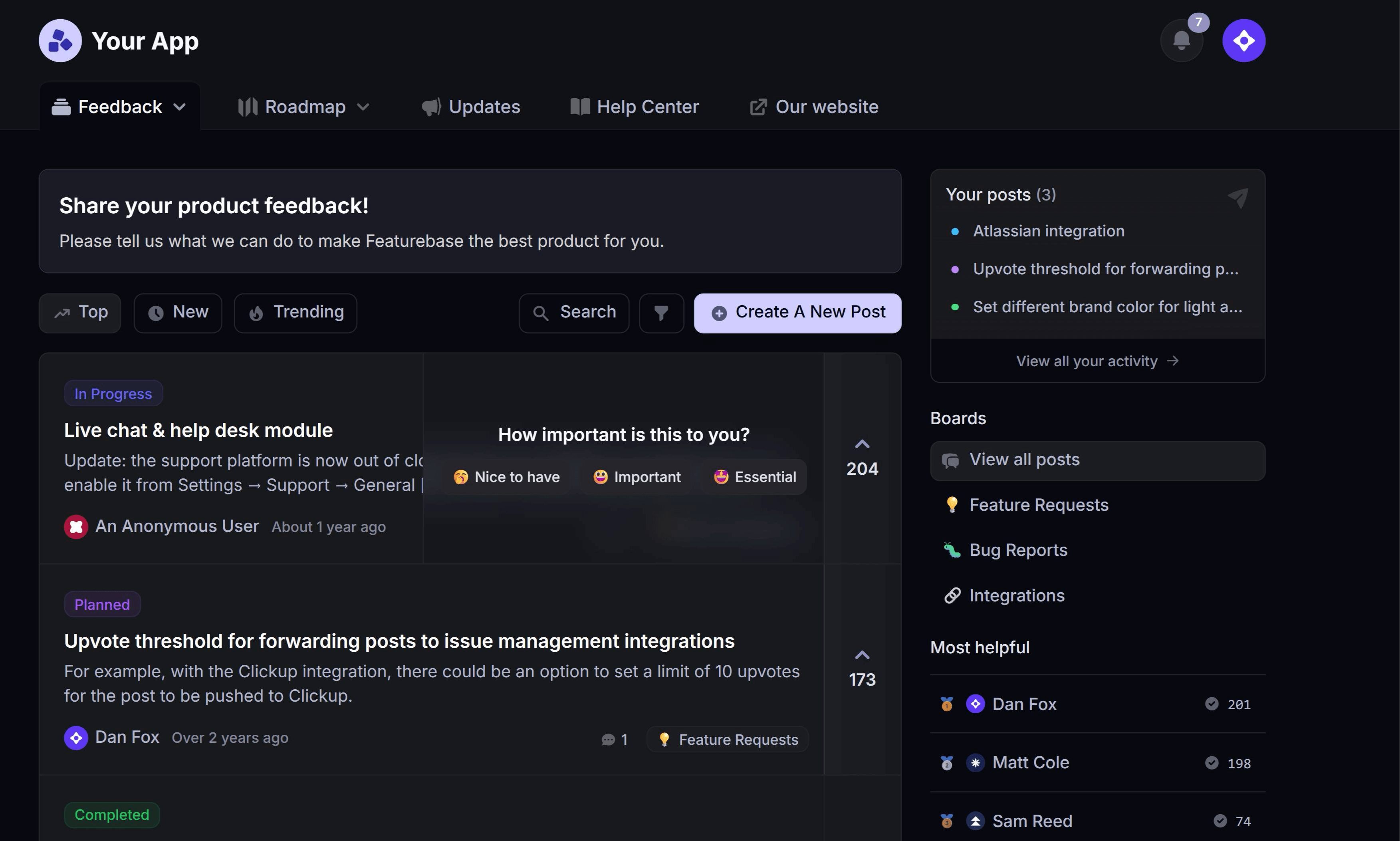

✨ Create internal & public roadmaps with Featurebase for free →
Aha! is one of the most powerful product roadmapping tools on the market, and one of the most divisive. Teams that adopt it either swear by its depth or quietly churn over the price and the learning curve.
So is it actually worth it in 2026? This review breaks down Aha!'s real features, current pricing, honest pros and cons, and who should pick it versus who should look elsewhere. 👇
Key takeaways:
- Aha! is a comprehensive product development suite built around roadmapping, strategy, and idea management.
- It is genuinely powerful, but it carries a steep learning curve and an interface that newer tools have moved past.
- Aha! Roadmaps starts at $59/user/month and climbs fast once you add other suite products. There is no free plan, only a 30-day trial.
- It fits larger, strategy-heavy product orgs best, and is often overkill for small teams that mainly need feedback and roadmaps.
- If you want Aha!'s feedback and roadmap strengths without the complexity or cost, Featurebase✨ is a modern, affordable alternative.
- Bottom line: Aha! is a strong tool for the right team, but the price and complexity make it a poor fit for many smaller product teams.
What is Aha!?
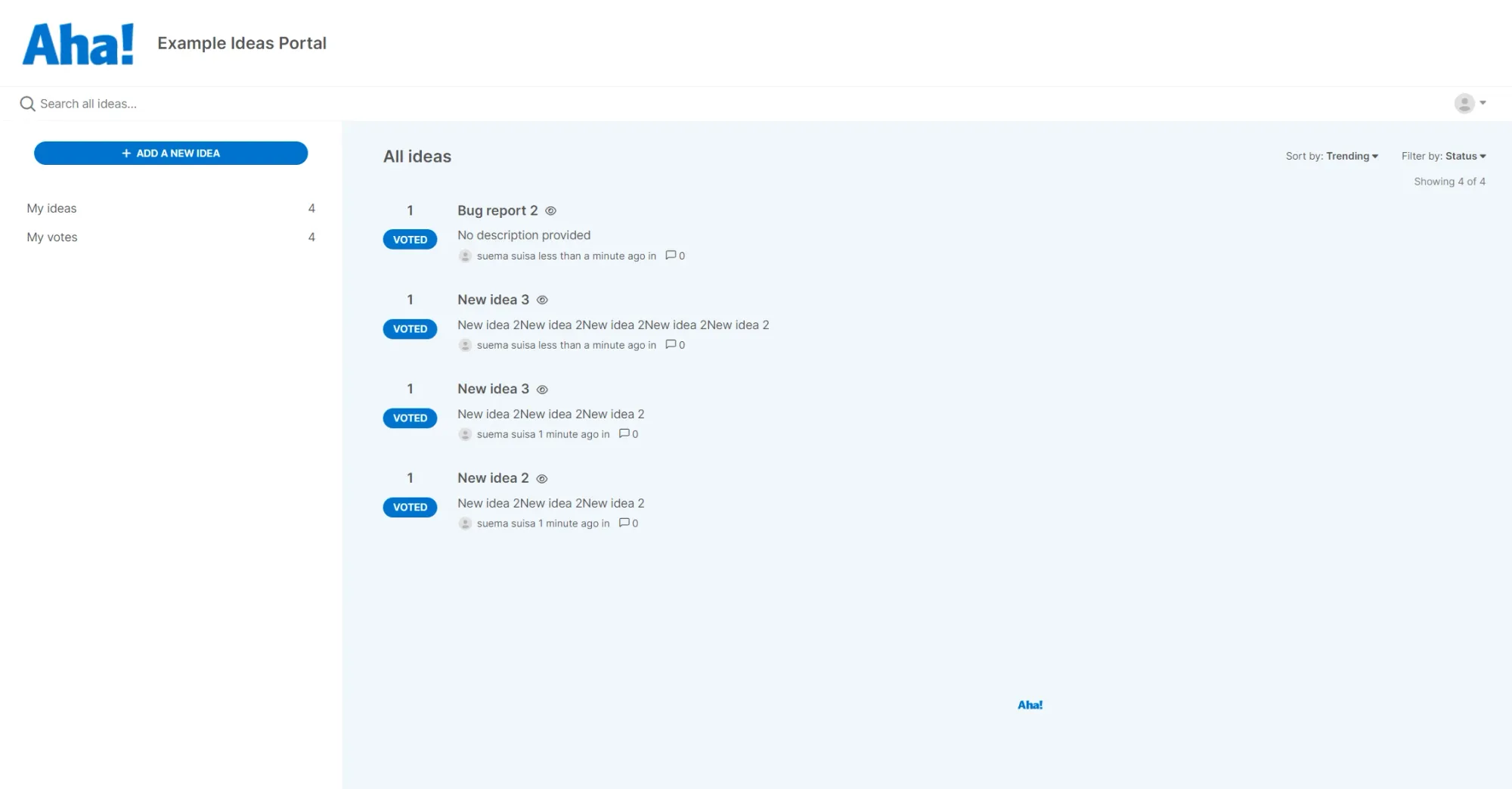
Aha! is a suite of product development software that helps teams set strategy, capture ideas, build roadmaps, and ship products. Founded in 2013 and still fully self-funded and remote, the company has grown into one of the best-known names in product management, with more than 700,000 users.
The flagship product is Aha! Roadmaps, but the platform now spans several connected products: Ideas for feedback, Discovery for customer interviews, Whiteboards for brainstorming, Knowledge for documentation, Develop for agile delivery, and the newer Builder for AI app prototyping. An AI assistant called Elle runs across the suite.
That breadth is Aha!'s biggest strength and its biggest source of friction. You can run your entire product process inside it, but you rarely need all of it, and you pay for the parts you do use.
Aha! key features
Roadmaps and strategy

Roadmaps is the core of Aha!, and it is where the tool earns its reputation. You start by setting strategy - goals, initiatives, and the business model behind them - then link every feature and release back to that strategy so plans stay connected to the "why."
From there you get visual roadmap templates, Gantt-style timelines with milestones, interactive dependency mapping, capacity planning, and prioritization scorecards that rank features against your strategic goals. For teams that want rigor, this is best-in-class.
Ideas and feedback management
Aha! Ideas gives you a branded ideas portal where customers and internal teams can submit and vote on requests. You can score ideas, send automatic status updates, and promote the strongest ones straight into your roadmap as features.
It works well, but the portal lives behind an add-on tier, and collecting feedback is only one part of what most teams actually need. If feedback collection and a public roadmap are your main goals, a dedicated tool like Featurebase lets you gather requests, prioritize them by customer revenue, and close the loop with users without buying into a full product suite.
Reports, dashboards, and presentations
Reporting is where Aha! shows its depth. It ships with 75+ example reports, dashboards, pivot tables, and hierarchy views, and you can turn any view into a polished, branded presentation without leaving the tool. Notes and whiteboards round out the workspace for early planning.
The trade-off is effort. Advanced reports often need manual setup, and finding the right report can be confusing the first few times.
The wider Aha! suite
Beyond Roadmaps and Ideas, the suite includes several products you can layer on:
- Aha! Develop: an agile development tool that connects engineering work back to the roadmap.
- Aha! Discovery: a research tool for running and storing customer interviews.
- Aha! Whiteboards: a collaborative canvas for diagrams, wireframes, and brainstorming.
- Aha! Knowledge: a documentation and internal knowledge base product.
- Aha! Builder: a newer AI tool for prototyping apps, powered by the Elle assistant.
The suite integrates with 40+ tools, including Jira, Azure DevOps, Slack, Salesforce, and Zendesk, plus an API for custom connections.
Aha! pricing
Aha! pricing is per product, and the headline numbers only cover Aha! Roadmaps. There is no permanent free plan - you get a 30-day free trial, and early-stage companies can apply for a discounted Startup pack.
Here is the current Aha! Roadmaps pricing (billed annually):
| Plan | Price (per user / month) | Best for |
|---|---|---|
| Premium | $59 | Teams that need full roadmapping and strategy |
| Enterprise | $99 | Orgs that need unlimited free reviewers and viewers |
| Enterprise+ | $149 | Large orgs needing OKRs, custom tables, and automation |
Monthly billing is more expensive (Premium is $74/user/month month-to-month). And Roadmaps is only the start. Most of the other products are paid add-ons on top:
- Aha! Ideas Advanced: +$20/user/month to fully customize the ideas portal and add Salesforce and Zendesk integrations.
- Aha! Develop: +$18/user/month for agile delivery.
- Aha! Discovery: $40/user/month, with a 3-user minimum.
- Aha! Whiteboards Advanced: +$9/user/month.
- Aha! Knowledge Advanced: +$20/user/month.
You will sometimes see Aha! listed as starting "from $9/user/month." That figure is the standalone Aha! Develop tier, not the Roadmaps product most buyers are actually evaluating. For the full picture across every product and add-on, see our Aha! pricing breakdown.
Aha! pros and cons
What users love
Aha! has a loyal user base, and the praise is consistent. G2 reviewers commonly highlight a few themes:
- Depth and structure: the strategy-to-execution model keeps roadmaps, goals, and dependencies in one organized place, which is hard to match in lighter tools.
- Visual roadmaps that align teams: stakeholders can see priorities, timelines, and the reasoning behind them at a glance.
- Responsive customer success: a recurring theme in Aha! feedback is how helpful and fast the support and onboarding team is, especially on annual plans.
- Strong integrations: connections to Jira, Azure DevOps, and Salesforce tend to work smoothly once configured.
Where Aha! frustrates teams
The complaints are just as consistent, and they cluster around weight and cost:
- Steep learning curve: users on G2 frequently call Aha! overwhelming at first. It is powerful, but you often have to adapt your process to fit Aha!'s way of doing things.
- Dated interface: a common criticism is that the UI feels older and less polished than newer product tools.
- Cost that stacks: because each product is priced separately, the total adds up quickly for small teams once you go beyond Roadmaps.
- Manual setup and reporting: getting initial configuration and advanced reports right takes careful, time-consuming work, and there is little in-app guidance to help.
Who Aha! is best for
Aha! is a great fit for larger, strategy-heavy product organizations - teams with dedicated product managers, multiple products or portfolios, and a real need to tie every feature back to high-level strategy. If you have the budget and the time to onboard properly, the depth pays off.
It is usually the wrong fit for small teams, early-stage startups, and anyone whose main need is collecting feedback and sharing a roadmap. For those teams, the price and complexity outweigh the benefit, and a leaner tool gets you there faster.
If you are weighing options, it is worth comparing Aha! against lighter tools before committing. Our guide to the best Aha! alternatives walks through the strongest options, and head-to-head breakdowns like Aha! vs Productboard help you see where each tool wins.
A modern, affordable alternative: Featurebase
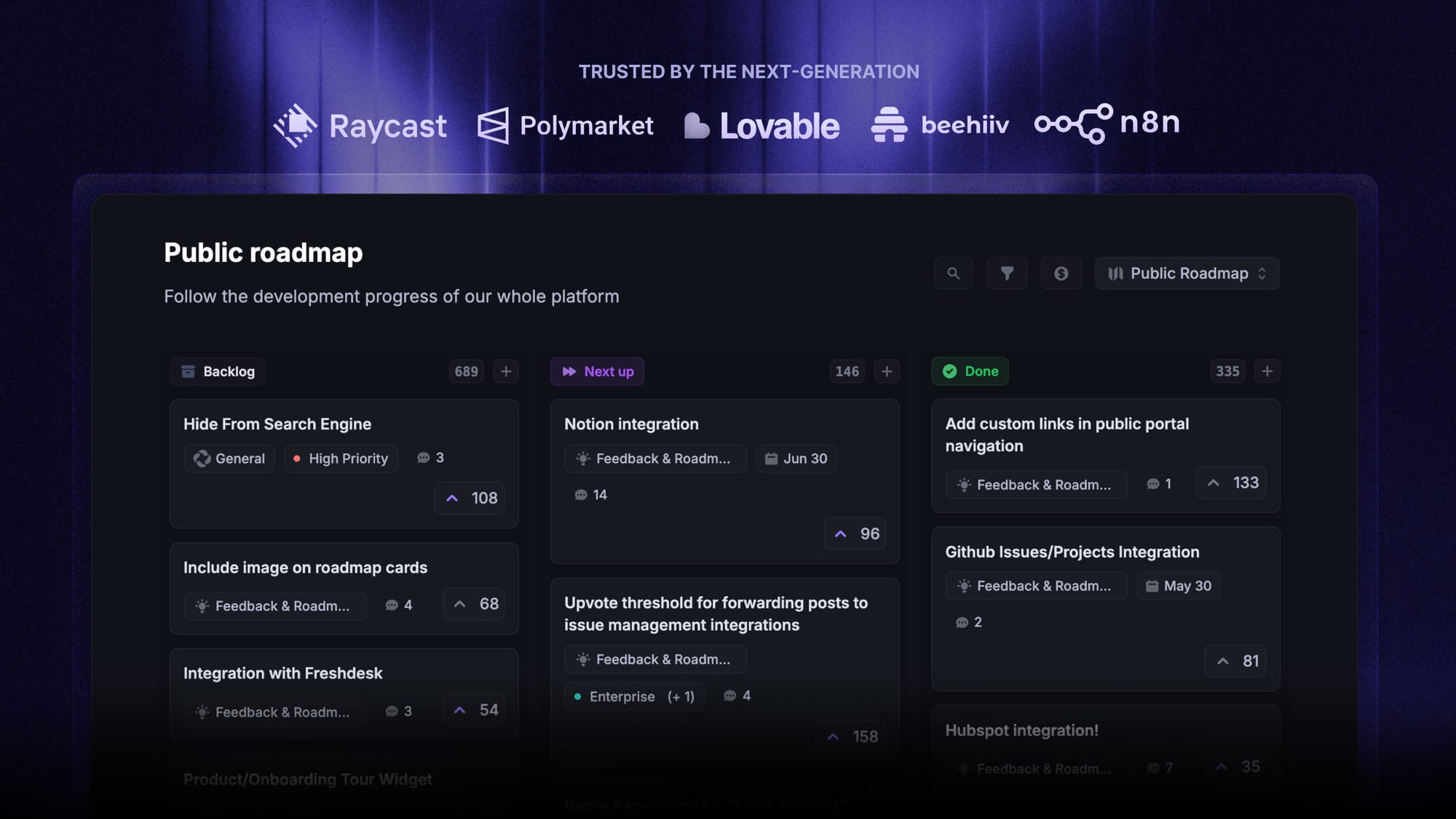
If Aha!'s biggest draw for you is the feedback and roadmap side, but its price and complexity are the sticking point, Featurebase is worth a look. It is a modern feedback and product platform built for that exact job: collecting feedback, prioritizing what to build, sharing a roadmap, and announcing updates, without the weight of a full enterprise suite. Teams at companies like Lovable, Raycast, and n8n use it for this. 💫
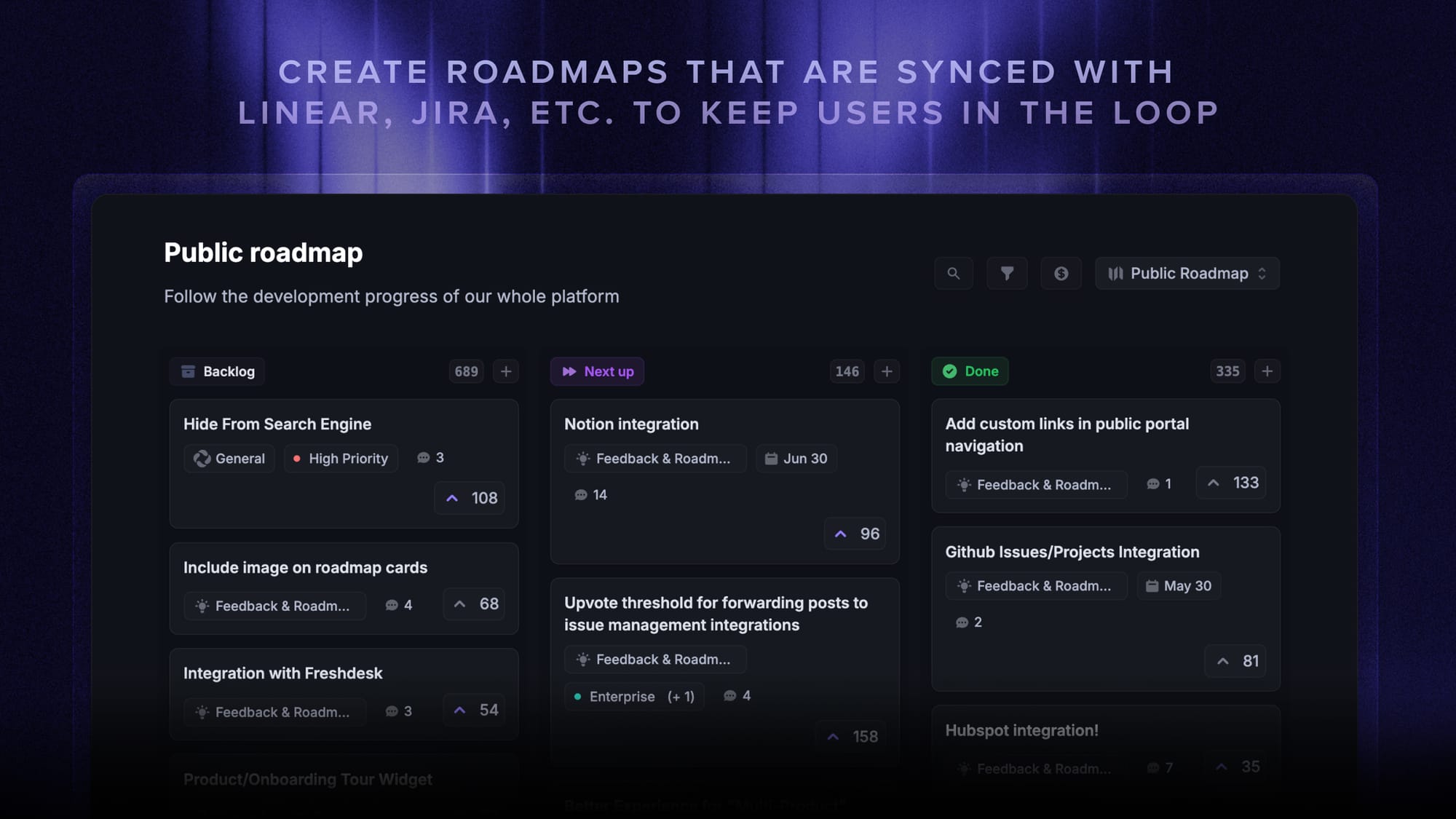
Where Aha! makes you piece together (and pay for) separate products, Featurebase keeps the essentials in one place:
- A public feedback forum where users submit and vote on ideas, so you can see what customers actually want
- The ability to prioritize by revenue, linking each request to customer value and company size instead of gut feel
- AI categorization that groups large volumes of feedback into themes automatically
- Internal and public roadmaps plus a changelog to close the loop and keep users in the know
- Surveys (NPS, CSAT, and more), in-app widgets, and integrations with Slack, Linear, Jira, and HubSpot
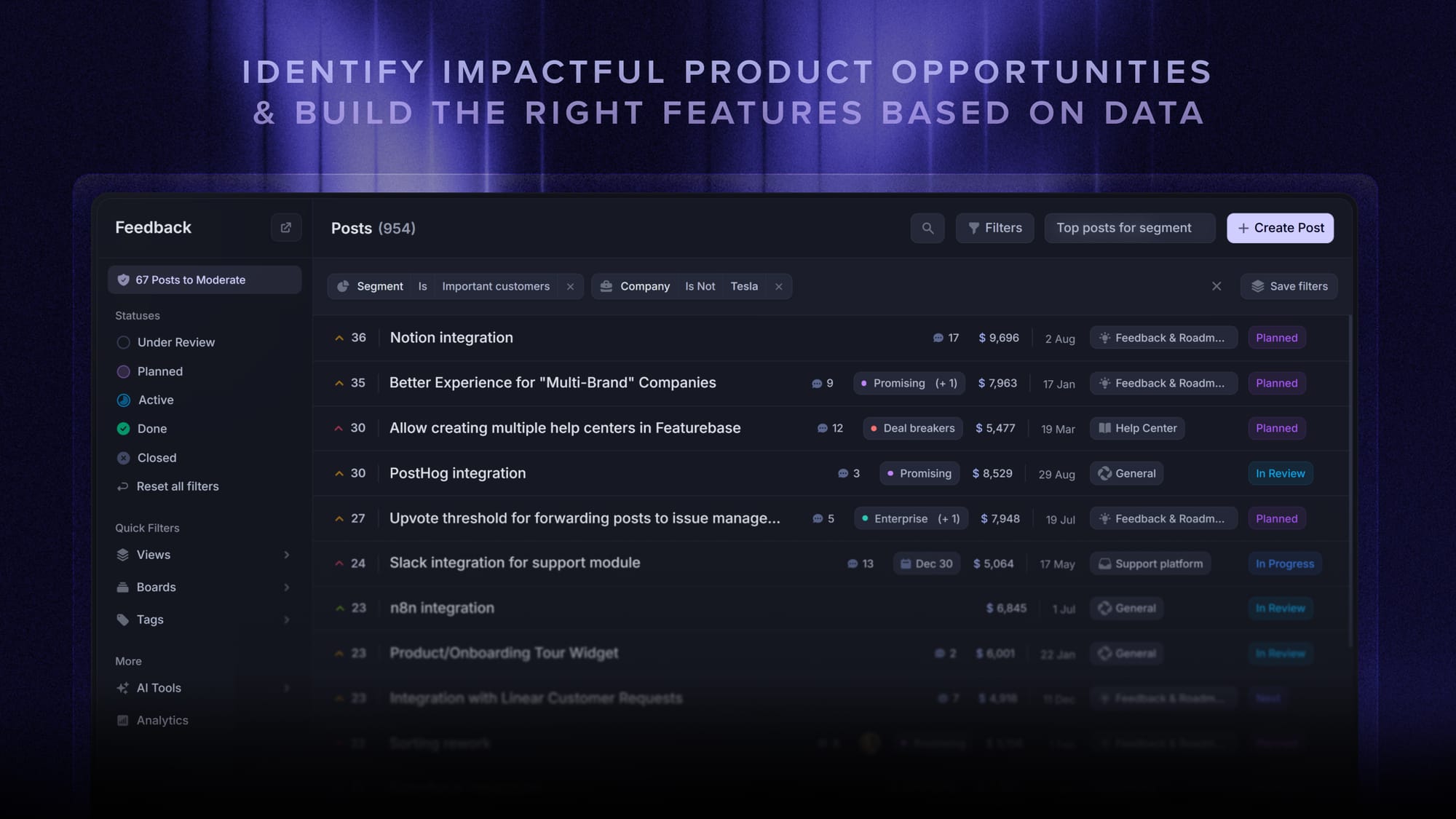
The practical difference comes down to fit. Aha! is built for large orgs that need to run every phase of product development in one tool. Featurebase is built for product teams that mainly need to listen to users and ship the right things, at a price that starts free and scales to $29/seat/month rather than $59 and up before add-ons.

Get the best Aha! alternative
Share what you’re building & keep teams and users aligned with modern roadmaps
Conclusion
Aha! is a genuinely powerful product development suite, and for large, strategy-driven teams it remains one of the best tools available. But that power comes with a steep learning curve, a dated interface, and pricing that stacks quickly once you move past Roadmaps. For many teams, especially smaller ones, that is more tool than they need.
Featurebase is a modern & powerful feedback tool. It helps you collect feedback with a feature voting forum, surveys, embeddable widgets, and integrations. You can then analyze all of that feedback in one place by connecting it to your customers' revenue and data to make better product decisions.
It comes with affordable pricing and a Free plan allowing unlimited feedback. The onboarding is incredibly quick and doesn't require a credit card, so there's no downside to trying it. 👇
✨ Start collecting & managing feedback with Featurebase for free →
FAQs
Is Aha! worth it?
For larger, strategy-heavy product teams with the budget and time to onboard, Aha! is worth it - few tools match its depth in roadmapping and strategy. For small teams or startups that mainly need to collect feedback and share a roadmap, it is usually more tool and more cost than the job requires.
How much does Aha! cost?
Aha! Roadmaps starts at $59/user/month for the Premium plan billed annually, with Enterprise at $99 and Enterprise+ at $149/user/month. Other products like Ideas, Develop, Discovery, and Whiteboards are paid add-ons on top, so the real cost depends on how much of the suite you use.
Does Aha! have a free plan?
No. Aha! offers a 30-day free trial rather than a permanent free plan, and early-stage companies can apply for a discounted Startup pack. If a free tier is important to you, tools like Featurebase offer a free plan with unlimited feedback collection.
Is Aha! hard to learn?
Aha! has a reputation for a steep learning curve. It is highly capable, but the depth means new users often feel overwhelmed at first and may need to adapt their existing process to fit how Aha! works. Most teams rely on the onboarding and customer success team to get up to speed.
Can you collect and prioritize customer feedback in Aha!?
Yes. Aha! Ideas gives you a branded portal where users submit and vote on requests, plus idea scoring and the ability to promote ideas into roadmap features. Keep in mind the more advanced portal features sit behind a paid add-on tier.
What are the best Aha! alternatives?
Popular Aha! alternatives include Featurebase, Productboard, and airfocus, depending on what you need. Featurebase is a strong pick for teams that want feedback collection, public roadmaps, and changelogs in one affordable tool, while Productboard and airfocus lean more toward prioritization for larger product orgs.