Blog Customer ServiceOpen.cx Pricing 2026: Costs, Fees, and What You Get
Open.cx Pricing 2026: Costs, Fees, and What You Get
Open.cx charges $0.75–$0.90 per AI-resolved ticket. This guide explains what counts as a resolution, what the rate includes, additional fees, and realistic monthly costs.


✨ Looking for a lower-cost AI support platform with a free plan? Check out Featurebase →
Open.cx pricing looks simple: pay $0.75–$0.90 when its AI resolves a ticket and nothing when a human takes over.
The calculation gets less simple once support volume, carrier costs, taxes, and the written definition of a resolution enter the picture. This guide breaks down what Open costs, what you get, and what to model before signing. 👇
Key takeaways
- Open.cx costs $0.75–$0.90 per resolution: Your rate depends on monthly volume and is locked in writing before launch.
- Human escalations are free: Open does not charge when its AI transfers the ticket to one of your agents.
- Most platform features are included: The rate covers the helpdesk, unlimited agent seats, support channels, voice tooling, outbound sequences, workflows, and onboarding.
- Carrier costs sit outside the headline rate: Telephony, WhatsApp, and email delivery expenses are passed through at cost, typically below $0.10 per resolution.
- High-volume accounts receive a custom quote: Published pricing stops above 100,000 monthly resolutions.
- The definition of a resolution matters: Open and the customer agree on the exact billable outcome during onboarding.
What is Open.cx?
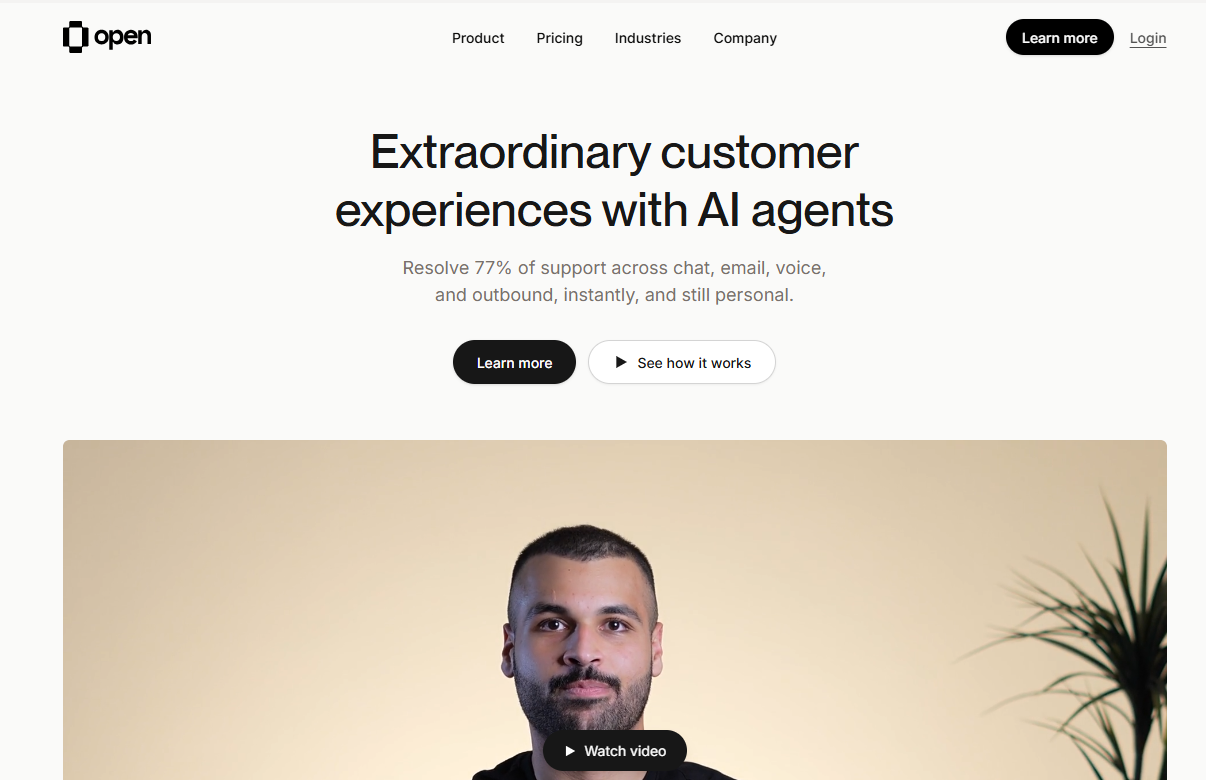
Open.cx is an AI customer support platform that handles tickets across chat, email, voice, WhatsApp, SMS, Slack, Teams, and social channels. It can answer questions, interact with connected systems, complete support workflows, and escalate cases that need a human.
OpenCX can work in 2 ways. You can use its included AI-native helpdesk, or connect the AI layer to an existing platform. That makes it relevant to both teams replacing a support stack and teams that want to add automation without migrating immediately.
The platform goes beyond a search-based chatbot. Its agentic workflows can call APIs and complete actions such as checking account information, updating records, or processing an approved refund.
Open.cx pricing in 2026
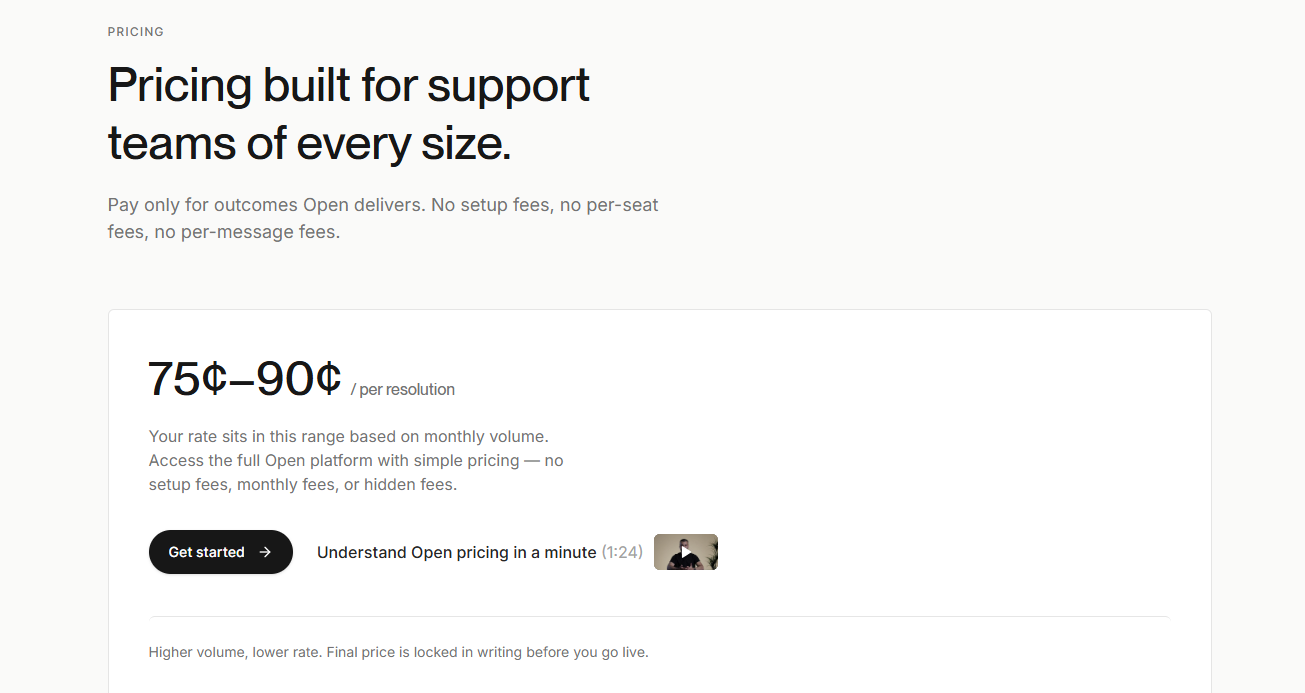
Open.cx charges between $0.75 and $0.90 for each ticket its AI resolves. There is no separate setup fee, platform subscription, agent-seat charge, or per-message fee.
The pricing model is outcome-based. Open gets paid when the AI completes the support job, not merely when it sends a message or starts a conversation.
| Pricing component | Published price |
|---|---|
| AI-resolved ticket | $0.75–$0.90 |
| Ticket transferred to a human | Free |
| Setup | Free |
| Agent seats | Unlimited |
| Platform subscription | No monthly fee |
| Volume above 100,000 resolutions/month | Custom quote |
| Carrier and delivery costs | Passed through at cost |
Open says higher monthly volume earns a lower per-resolution rate. The final number is agreed and locked in writing before the account goes live.
What counts as a resolution?
A resolved ticket is one Open closes end-to-end without a human teammate stepping in. The customer must either confirm the outcome or not reopen the ticket.
The exact definition is agreed during onboarding. This clause deserves close attention because it controls the bill.
Ask Open to define these cases before signing:
- Reopened tickets: Confirm how long a ticket must remain closed before it becomes billable.
- Repeat contacts: Clarify whether a customer returning with the same issue creates another resolution.
- Partial completion: Establish what happens when the AI answers part of the request but cannot complete the final action.
- Incorrect outcomes: Confirm how disputed resolutions and reversed actions are credited.
- Channel switching: Check whether one issue moving from chat to email or voice remains a single ticket.
The cleanest contract uses a resolution definition that your own customer service metrics can verify. It should also explain how disputes, reopenings, and quality failures affect the invoice.
What happens when Open escalates a ticket?
Open does not charge for a ticket transferred to a human agent. That includes cases where confidence is too low, the customer asks for a person, or the AI cannot finish the required action.
Your team still pays the labor cost of handling the escalation. The free handoff only removes Open's resolution fee.
How volume discounts work
Published rates sit within the $0.75–$0.90 range. Higher volume moves the account toward the lower end, but Open does not publish the individual volume tiers.
Accounts exceeding 100,000 monthly resolutions receive custom pricing. Ask for the complete rate schedule, including what happens when volume moves above or below the committed band.
Tip: Request cost projections using your normal month, busiest month, and expected volume 12 months from now. One average-volume quote is not enough for a usage-based contract.
What Open.cx includes
Open positions the per-resolution rate as an all-platform price. That makes the included product scope broader than AI add-ons that sit on top of separate helpdesk, seat, and channel subscriptions.
AI support channels
The same AI agent can operate across voice, chat, email, WhatsApp, SMS, Slack, Teams, and social channels. Open does not add a platform fee for each channel.
Delivery infrastructure can still create pass-through charges. The included channel access and the underlying carrier cost are separate parts of the bill.
AI-native helpdesk and unlimited seats
Open includes an AI-native helpdesk with an inbox, ticket routing, macros, service-level tracking, reporting, and unlimited human agent seats. Teams can use that system or bring an existing helpdesk.
Keeping your current platform avoids an immediate migration, but its license remains part of your total cost. Replacing it removes that subscription only after the migration is complete.
Voice and telephony
The platform includes its cloud telephony software, local numbers across many countries, recording, transcription, and SIP trunking. Open does not charge an additional platform license for AI Voice.
Carrier minutes are billed at cost. A phone-heavy support operation should model these charges separately instead of treating voice as completely free.
Outbound sequences
Outbound tooling is included. Teams can run AI-personalized sequences across email, SMS, WhatsApp, and phone, with bulk imports, response branching, and API access.
Open's pricing FAQ says customers pay for inbound tickets the AI resolves, not outbound sequences. Delivery and carrier charges may still apply to outbound activity.
Agentic workflows
Open includes a visual workflow builder, pre-built playbooks, and API actions. These tools let the AI complete work inside connected billing, CRM, inventory, and booking systems instead of stopping at an answer.
The software is included, but internal implementation work is not magically free. Your team still needs to define permissions, connect systems, test actions, and decide which customer service tasks to automate and which should remain human-controlled.
Knowledge management
Open can ingest documentation, identify knowledge gaps, and learn from resolved tickets. It also includes customer-insight and voice-of-customer capabilities.
AI performance will depend on the quality of the information and systems you connect. An included knowledge layer does not remove the work of cleaning outdated articles, resolving conflicting policies, and assigning content owners.
Implementation and support
The package includes white-glove onboarding, a named solutions engineer, an AI trainer, and 24/7 support. Open does not list a separate setup or implementation fee.
You should still budget internal time from support, operations, security, legal, and engineering. Included vendor onboarding and zero implementation effort are not the same thing.
Open.cx fees beyond the headline rate
The $0.75–$0.90 resolution rate is not always the final invoice. Carrier expenses and taxes can sit on top of it, while an existing helpdesk may remain a separate company expense.
Carrier and delivery costs
Open passes telephony, WhatsApp, and email delivery costs through at cost with no markup. Its pricing FAQ says these costs typically remain below $0.10 per resolution.
That is different from a per-channel platform fee. Open is not charging extra to unlock voice or WhatsApp, but the infrastructure provider still charges for delivering calls and messages.
Ask for separate estimates for:
- Inbound and outbound voice minutes
- Local and toll-free numbers
- SMS and WhatsApp delivery
- Email sending
- Country-specific carrier rates
Taxes
Open may charge tax depending on the customer's location, tax status, and the products or services purchased. Taxes should sit outside any cost comparison unless every vendor quote uses the same tax assumptions.
Existing software costs
Open can sit on top of an existing helpdesk, CRM, telephony provider, and internal systems. If you are still evaluating the underlying stack, compare the available help desk software options. Any software you keep paying for remains part of the total cost of ownership.
Build 2 versions of the business case. The first should assume Open supplements the current stack, while the second should assume its included helpdesk and telephony replace selected tools after migration.

Get the best affordable Open cx alternative
Automatically resolve 70% of customer requests & cut down manual support loads
Open.cx cost examples
Open's monthly platform cost is straightforward once you know the number of successful AI resolutions:
Monthly Open cost: AI-resolved tickets × contracted resolution rate
The following examples use the published $0.75–$0.90 range. They exclude taxes and show the possible pass-through carrier amount separately.
| Monthly AI resolutions | Open platform cost | Annualized platform cost | Possible carrier costs* |
|---|---|---|---|
| 1,000 | $750–$900 | $9,000–$10,800 | Below ~$100/month |
| 10,000 | $7,500–$9,000 | $90,000–$108,000 | Below ~$1,000/month |
| 50,000 | $37,500–$45,000 | $450,000–$540,000 | Below ~$5,000/month |
| 100,000 | $75,000–$90,000 | $900,000–$1.08 million | Below ~$10,000/month |
*The carrier column applies Open's “typically below $0.10 per resolution” statement as a ceiling-style illustration. Actual costs depend on channel mix, call duration, destination, and provider rates.
Example: 10,000 monthly support conversations
Suppose a team receives 10,000 support conversations and expects Open to resolve 60% without a human. That creates 6,000 billable resolutions.
At $0.75 per resolution: 6,000 × $0.75 = $4,500/month
At $0.90 per resolution: 6,000 × $0.90 = $5,400/month
The remaining 4,000 conversations may still require human labor, even though Open does not charge a resolution fee for them. A complete ROI model compares AI fees plus remaining labor against the current cost of handling all 10,000 conversations.
Model peak volume, not just the average
Outcome-based pricing becomes expensive in the same months when automation delivers the most work. An outage, product launch, billing change, or seasonal rush can sharply increase resolved volume.
Model at least 3 cases:
- Normal month: Your median ticket volume and realistic automation rate
- Peak month: Your busiest recent month with the same automation assumptions
- Growth case: Expected volume after 12 months of customer and channel growth
Also model a higher automation rate. Better performance reduces human workload, but it increases the number of outcomes Open bills.
How the $2 million refund guarantee works

Open advertises a 120-day satisfaction guarantee. If the customer is not fully satisfied during that period, Open says it will refund Open-related spend up to $2 million.
The headline lowers the perceived risk of a large rollout, but the contract controls the real protection. Ask the sales team to document:
- Which charges qualify as Open spend
- Whether carrier costs and taxes are included
- What “not satisfied” requires the customer to demonstrate
- The deadline and process for making a claim
- Whether service, integration, or migration expenses qualify
- How quickly an approved refund is paid
Treat the guarantee as contract protection, not as proof that the implementation will succeed. Your internal labor and third-party software costs may remain even if Open refunds its own fees.
Open.cx pricing limitations
Open's model is transparent at the unit-price level, but several variables still affect whether the final bill is predictable.
- No public volume tiers: Buyers know the rate range but not the resolution thresholds that produce each rate.
- A negotiated resolution definition: The bill depends on contract language around reopenings, repeat contacts, and disputed outcomes.
- Variable monthly cost: Successful automation and ticket spikes both increase spend.
- Pass-through communication costs: Carrier and delivery expenses sit outside the platform rate.
- Existing-stack overlap: Teams that keep another helpdesk or telephony platform continue paying for it.
- Internal implementation work: Vendor onboarding is included, but knowledge cleanup, API access, testing, and governance still consume team time.
None of these points makes outcome-based pricing inherently poor. They mean the headline rate should be evaluated as one component of a total support-cost model.
A lower-cost Open.cx alternative
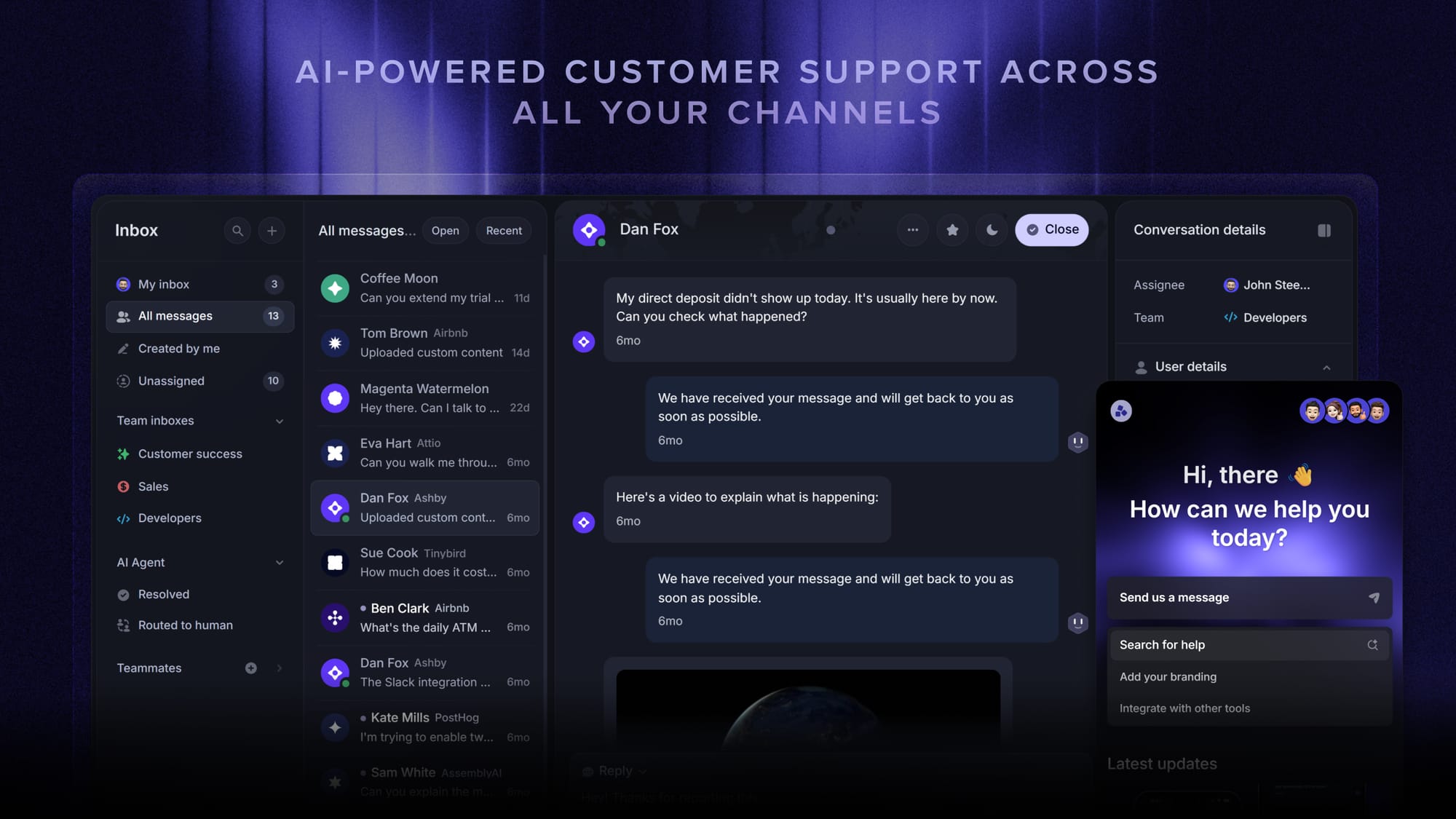
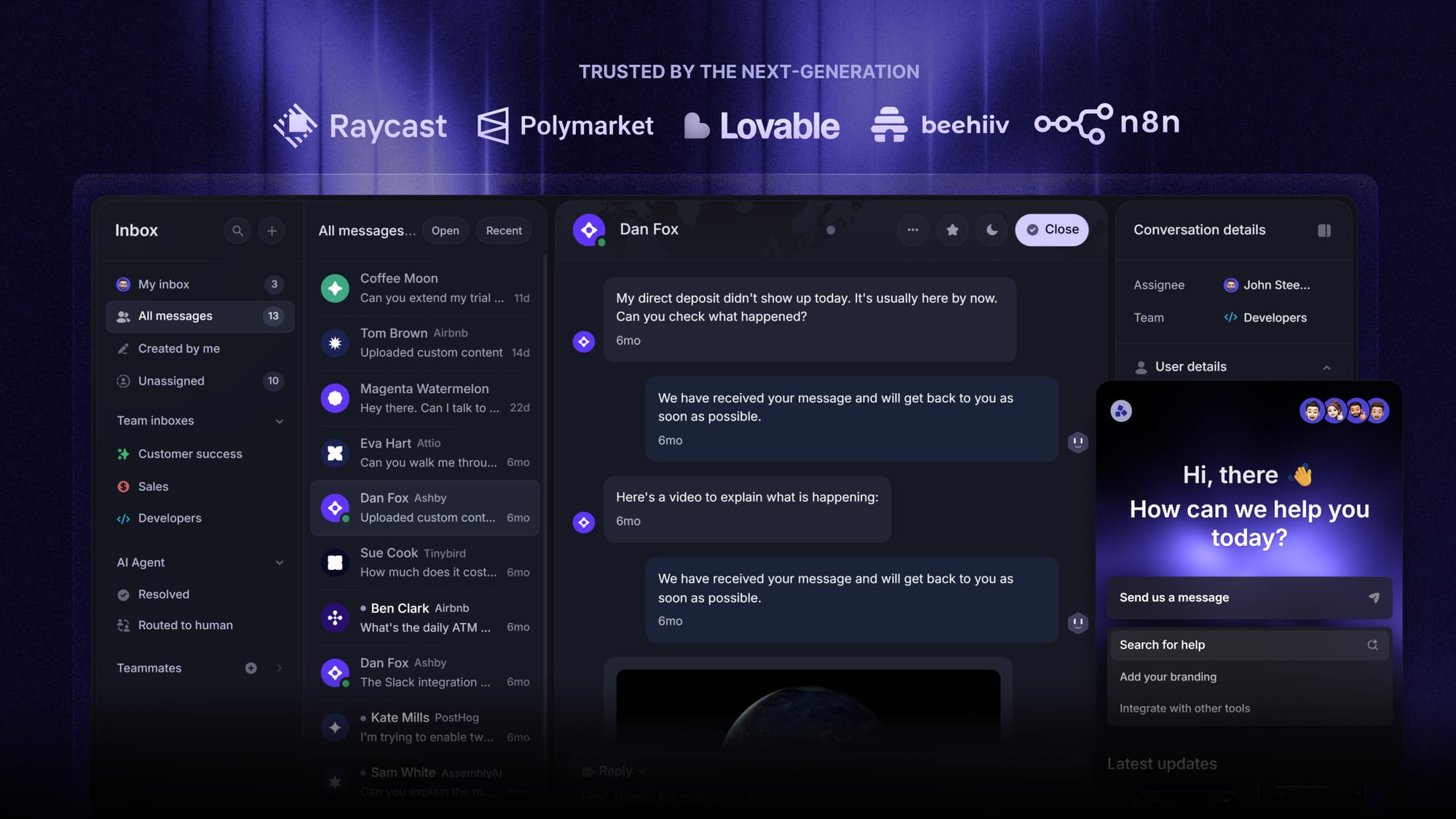
Featurebase is a modern AI customer support platform for product-led SaaS. It combines AI-powered support, help center, and feedback management into a single platform for startups that want all their customer-facing tools in one place. Featurebase is loved by thousands of support teams from companies like Lovable, Raycast, and n8n. 💫
Top features:
- Omnichannel inbox – Manage live chat, email, and Slack conversations from one AI-powered view
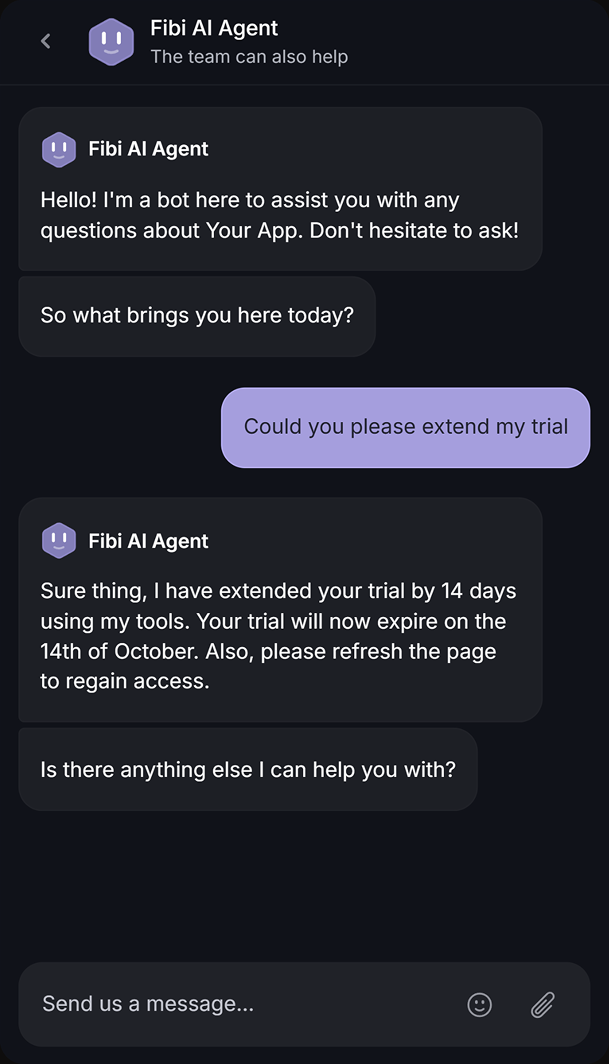
- Fibi AI Agent - Resolve customer issues on autopilot & run custom actions like trial extensions and refunds
- Help center with AI search – Provide instant, multilingual self-serve answers
- Workflows & automations – Auto-assign tickets, route conversations, collect customer data, and more
- AI Copilot – Help your agents answer customers faster with AI Copilot that uses your internal knowledge
- Multi-brand support – Manage multiple Help Centers and Live chats from a single workspace
- Automatic AI translations – Automatically translate all messages and help articles to your customers native language
- Service Level Agreements – Track SLAs to make sure your team responds to customers on time, every time
- Mobile app – Respond to customers, receive notifications, and unblock users on the go
- Feedback & roadmap tools – Collect feature requests and close the loop with updates
- Product updates – Publish release notes with a changelog page, in-app widget, and emails
- Integrations – Connects with Slack, Linear, Jira, HubSpot, and more
Pricing: Free plan available with unlimited conversations. Paid plans start at $29/seat/month with $0.49 per AI resolution.
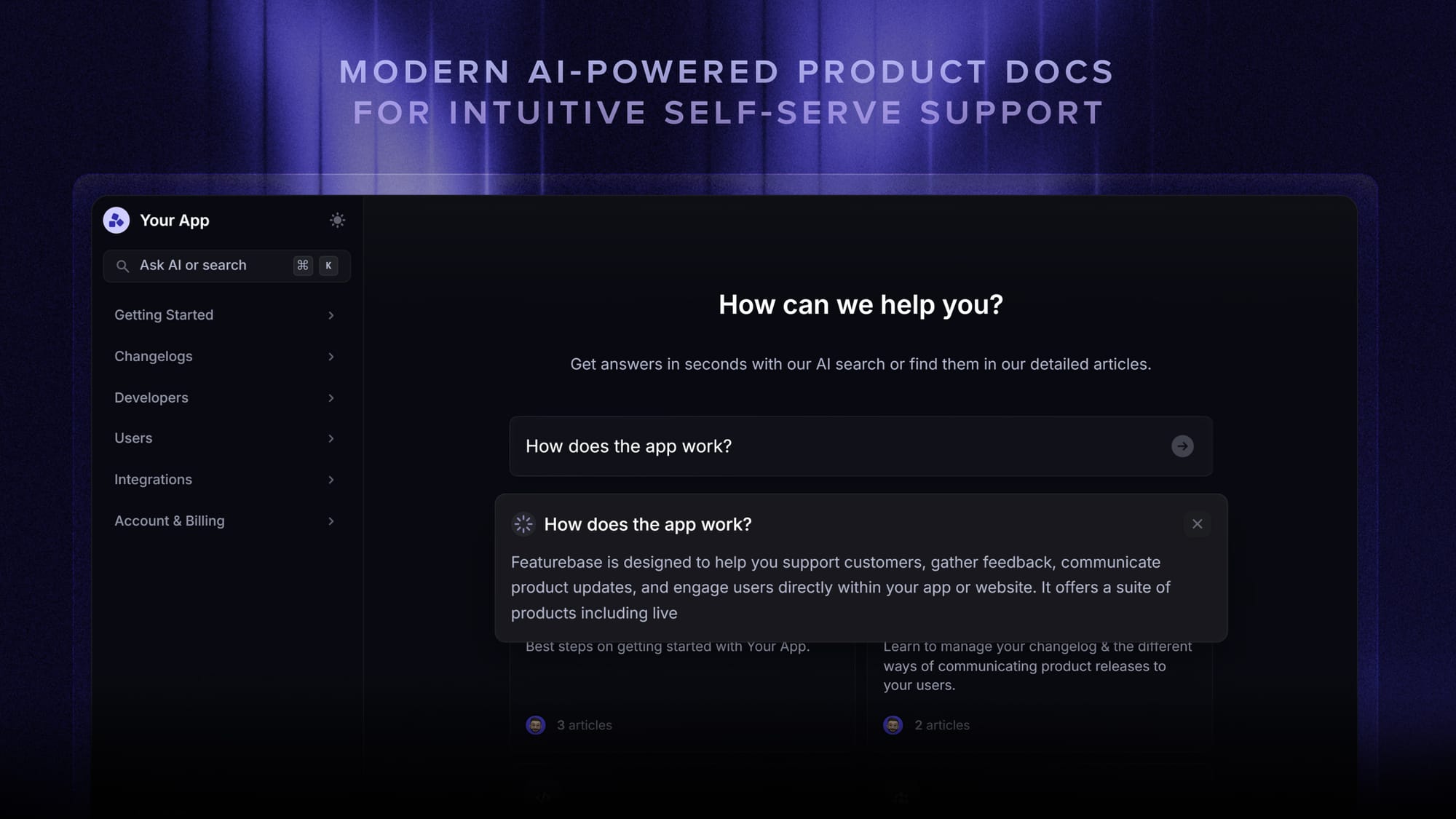
Featurebase covers all the basic support features that legacy platforms do, but with a much more modern approach. It comes with AI automations, a mobile app, and multiple channels such as email, live chat, and Slack.
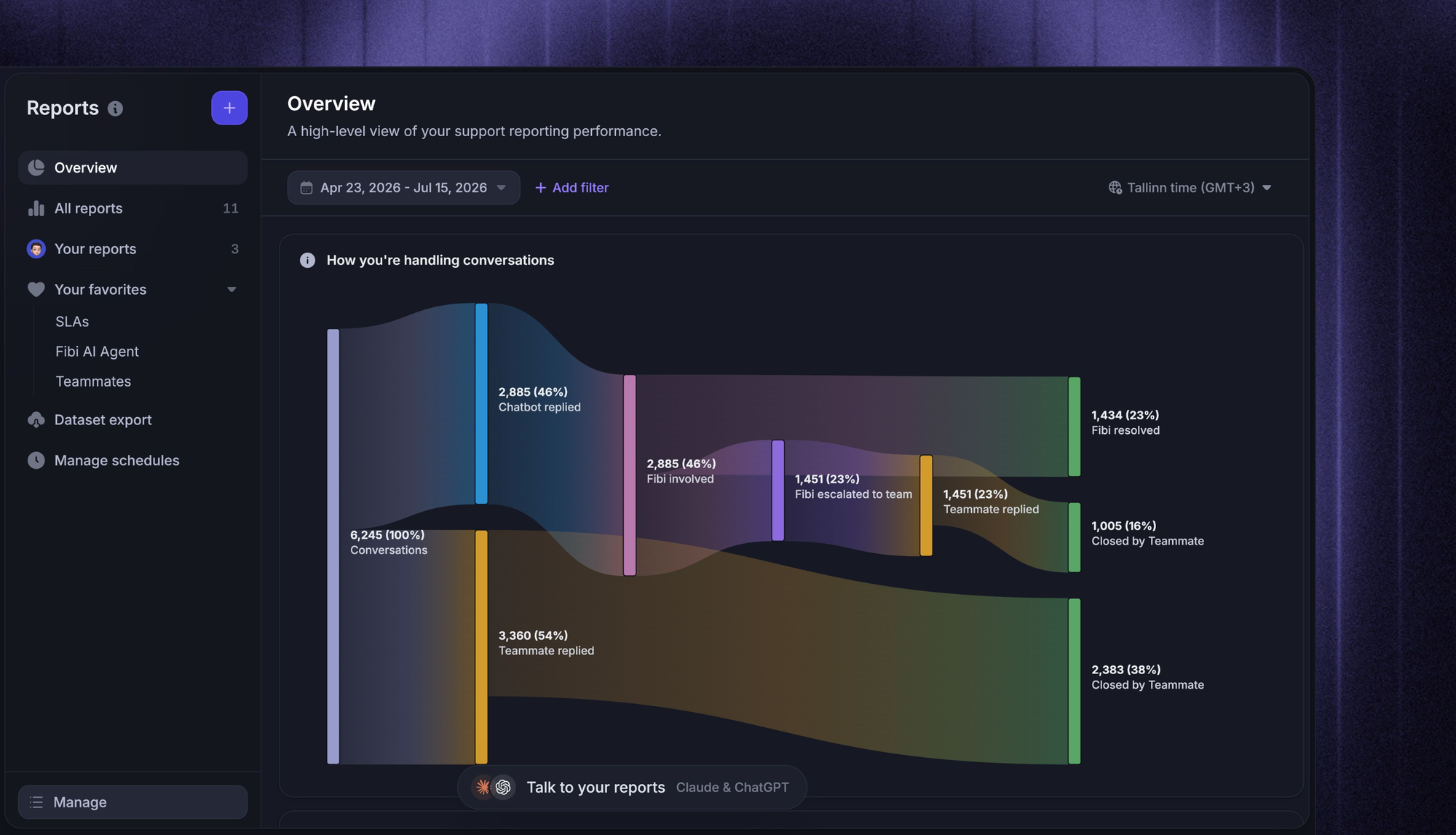
Professional costs $59 per seat per month when billed yearly and adds workflows, SLAs, Slack support, multilingual support, and more advanced team features. The better-value option depends on your number of human agents, AI-resolved volume, required channels, and whether Open's included voice and outbound tools matter to your operation.
✨ Explore Featurebase’s AI-powered support platform →
Is Open.cx pricing worth it?
Open.cx pricing makes the most sense for teams that expect substantial AI-resolved volume and want a broad support, voice, workflow, and helpdesk platform without separate seat or channel licenses. Paying only for completed outcomes also gives the vendor a clear incentive to make the automation work.
The trade-off is variable spend. Before signing, lock down the resolution definition, model peak volume, separate carrier costs, and decide whether Open will replace or supplement the current stack.
Featurebase offers a more startup-friendly route for SaaS teams that want a unified inbox, AI support, help center, workflows, and feedback tools with a Free plan and a lower $0.49 AI-resolution rate. You can start with the free helpdesk, then add Fibi AI when the economics make sense. 👇
✨ Automate your support with Featurebase’s AI-enhanced inbox today →
FAQs
Are there per-seat or per-message fees?
Open does not charge per seat, message, or channel. Its published platform charge is based on AI-resolved tickets, while carrier and delivery costs are passed through separately.
What happens when Open escalates to a human?
Open does not charge a resolution fee when it transfers a ticket to a human agent. Your organization still pays the labor and software costs involved in handling that ticket.
Is outbound support included?
Yes. Open includes bulk imports, multi-channel sequences, AI personalization, response branching, and API access. Its pricing FAQ says customers pay only for inbound tickets the AI resolves, although carrier and delivery charges may still apply.
Are telephony, WhatsApp, and email delivery costs included?
The platform capabilities are included, but the underlying carrier and delivery expenses are not. Open passes those costs through without markup and says they typically remain below $0.10 per resolution.
How does Open’s $2 million refund guarantee work?
Open advertises a refund of Open spend during the first 120 days when a customer is not fully satisfied, capped at $2 million. Buyers should confirm the covered charges, claim requirements, exclusions, and payment timeline in the signed contract.
Does Open.cx replace an existing helpdesk?
It can. Open includes its own AI-native helpdesk with unlimited agent seats, but teams can also connect an existing helpdesk and keep their current workflow.
Will Open.cx charge tax?
Open may charge tax depending on the customer's location, tax status, and purchased services. Ask for a quote that shows taxes separately so the platform cost remains comparable with other vendors.