Blog Customer Service11 Types of Knowledge with Practical Examples
11 Types of Knowledge with Practical Examples
Learn about the 11 most important types of knowledge, what they mean, and how to use them effectively in your team and business.


Your team knows a lot more than what's written down. Some of that knowledge lives in documents, some in habits, and some only in people's heads. The problem is that when key knowledge isn't captured or shared, teams make slower decisions, repeat mistakes, and lose context when people leave.
Understanding the different types of knowledge helps you figure out what to document, what to train for, and what to bake into your tools and processes.
In this guide, I'll walk you through the 11 most common types of knowledge, explain the differences, and show you practical examples of each. 👇
What is knowledge?
In this context, knowledge is the information, skills, and understanding people use to do their work, make decisions, and solve problems. It can be written down and easy to share, or it can live in people’s experience, judgment, and habits.
Knowledge is not just facts. It also includes knowing how to do something, when to do it, and why it works. In a company, knowledge can live in docs, SOPs, tools, workflows, onboarding materials, and the experience people build over time.
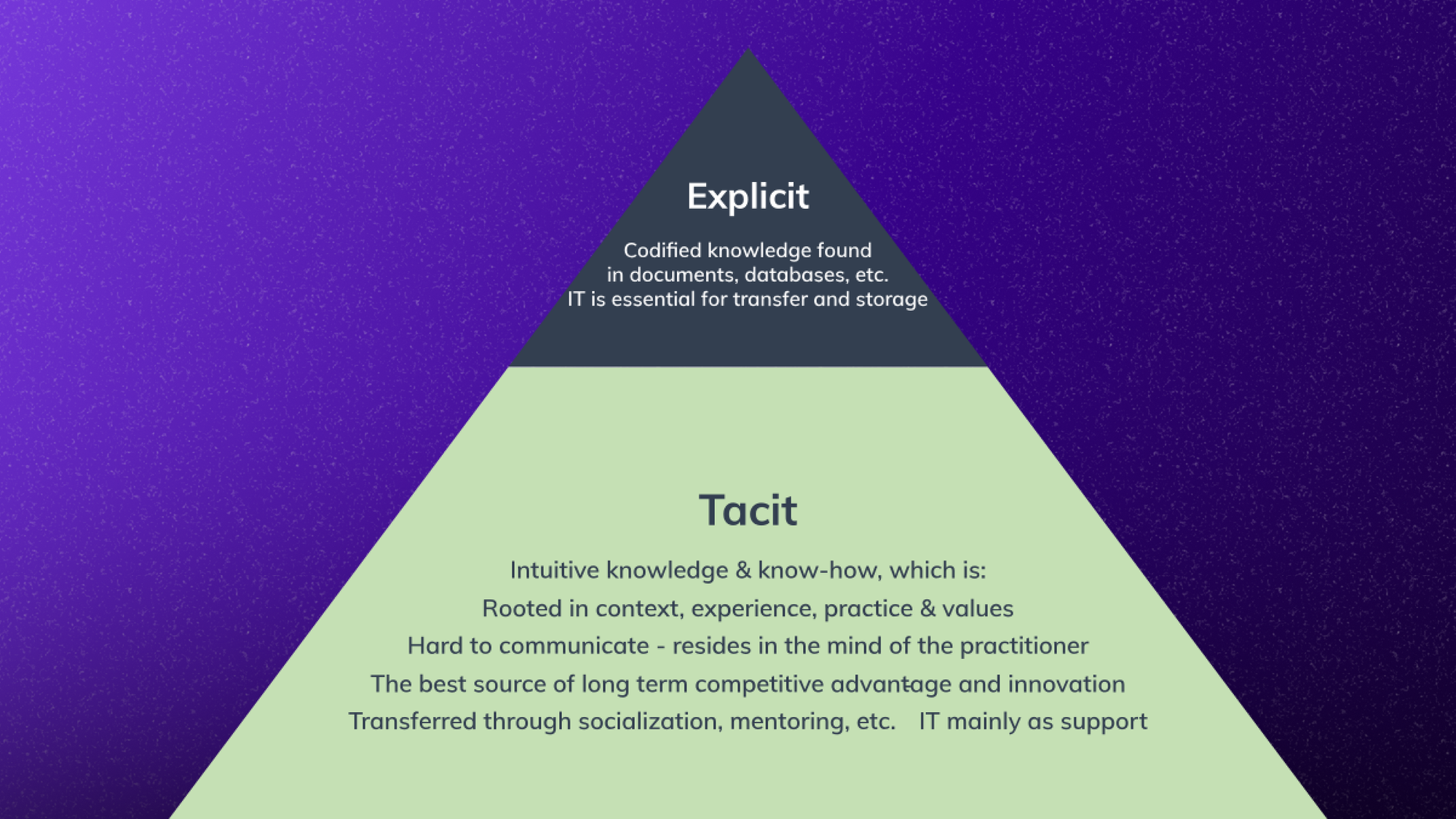
Some knowledge is structured and easily transferred, like a troubleshooting guide or training manual. This is called explicit knowledge. Other forms, like knowing how to handle a difficult client or making a judgment call under pressure, are based on experience and intuition. These are forms of tacit or implicit knowledge.
Understanding the different types of knowledge helps teams decide how to capture, organize, and apply what they know.
It also helps build better knowledge bases, support systems, onboarding flows, and decision-making processes. For example, turning tacit knowledge into something reusable, like documenting a sales technique that works, can improve outcomes across the entire team.
In short, knowledge is everything that helps people do their work better, whether it's written down or lived through experience.
11 different types of knowledge you need to know
If you don't have time to get into definitions and examples, here is a quick overview of the most important knowledge types.
| What it is | Why it matters | Examples | |
|---|---|---|---|
| Explicit knowledge | Documented, structured information | Easy to store, transfer, and scale across teams | Handbooks, SOPs, training manuals, knowledge base articles |
| Implicit knowledge | Learned through practice but not formally documented | Reflects instincts and learned behaviors that improve outcomes | Trial-and-error skills, messaging judgment, shortcuts |
| Declarative knowledge | Factual knowledge about concepts or definitions | Foundational for understanding topics and building skills | Definitions, facts, policy rules, terminology |
| Tacit knowledge | Personal, experience-based and hard to articulate | Drives expert-level performance and decision-making | Design intuition, leadership instincts, real-time decision making |
| Embedded knowledge | Built into systems, processes, or tools | Shapes workflows and persists beyond individual contributors | CRM automations, app tooltips, default templates |
| Empirical knowledge | Based on observation, experience, or experimentation | Supports evidence-based decisions and iterative improvements | User feedback, A/B tests, analytics, incident logs |
| Conditional knowledge | Knowing when and why to apply certain information | Enables context-aware and effective decision-making | Choosing pricing models, knowing when to escalate |
| Procedural knowledge | Knowing how to perform specific tasks or steps | Essential for consistent execution and training | Logging tickets, deploying websites, writing release notes |
| Conceptual knowledge | Understanding systems, relationships, or frameworks | Enables planning, problem-solving, and innovation | Agile methodology, customer journeys, business models |
| Strategic knowledge | Ability to plan and prioritize actions for long-term goals | Key to leadership, resource planning, and scaling efforts | Roadmaps, prioritization choices, competitive positioning |
| Domain expertise | Deep, specialized knowledge in a specific area | Builds authority, trust, and operational excellence | SEO strategy, backend debugging, financial forecasting |
1. Explicit knowledge
Explicit knowledge is information that can be easily documented, shared, and stored. It includes facts, written procedures, manuals, and databases. This type of knowledge is crucial for onboarding, training, and maintaining organizational memory. Because it's structured and accessible, it forms the backbone of most knowledge management systems.
For instance, when students or professionals need to document complex legal frameworks, they often rely on structured resources or a law essay writing service to help translate complex theories into clear, explicit formats.
Examples:
- Employee handbooks
- Product documentation
- Standard operating procedures
- Meeting notes
- Knowledge base articles

Create a beautiful AI-powered Help Center
Give customers the answers they need. AI-native, beautiful, and built for usability
2. Implicit knowledge
Implicit knowledge is not formally documented but can be inferred through actions or experience. Once it's recorded, it often turns into explicit knowledge. This type is important because it reflects practices and instincts developed over time that improve decision-making or efficiency.
Examples:
- Learning a software tool through trial and error
- Recognizing when a sales pitch isn't working
- Knowing the best time to follow up with a lead
- Adapting messaging for different audiences
- Using keyboard shortcuts you were never taught
Implicit and tacit knowledge are commonly mixed up. The main difference is this: tacit knowledge is internalized and hard to express; implicit knowledge is often visible in action but not yet written down. Once documented, implicit knowledge can become explicit.
3. Declarative knowledge
Declarative knowledge is about knowing "what": facts, definitions, and concepts, often from scientific research. It's foundational for learning any new topic and is easy to communicate or test. While it doesn't guarantee the ability to act, it's the basis for developing higher-order skills.
Examples:
- The capital of Canada is Ottawa
- JavaScript is a programming language
- The customer service department handles refunds
- GDPR stands for General Data Protection Regulation
- A triangle has three sides
4. Tacit knowledge
Tacit knowledge is personal, experience-based, and hard to articulate. It's deep expertise gained through practice and often shared through mentorship or observation. Its importance lies in its role in expert-level performance and intuitive decision-making.
Examples:
- A designer's eye for layout balance
- A manager's instinct for resolving conflict
- Knowing how to calm an upset customer
- Judging when a deal is close to closing
- Performing CPR effectively under stress
5. Embedded knowledge
Embedded knowledge exists within systems, processes, tools, and organizational routines rather than individuals. It's important because it shapes how work gets done and reflects institutional intelligence that persists beyond employee turnover.
Examples:
- Automated workflows in a CRM
- The default structure of a project template
- A sales funnel built into your website
- Team rituals like weekly retrospectives
- Tooltips baked into your app interface
6. Empirical knowledge
Empirical knowledge is based on observation, experience, or experimentation. It's critical for making informed decisions and building evidence-based practices. Unlike theoretical knowledge, it's grounded in real-world data.
Examples:
- User research findings
- A/B test results
- Customer feedback
- Bug reports and incident logs
- Analytics on feature adoption

7. Conditional knowledge
Conditional knowledge is knowing when and why to apply certain information or strategies. It's essential for problem-solving and adapting to new contexts. Without it, even skilled individuals may apply knowledge ineffectively.
Examples:
- Knowing when to use qualitative vs. quantitative research
- Choosing the right pricing model for a product
- Understanding when to escalate a support ticket
- Deciding whether to automate or do a task manually
- Knowing which marketing channel to prioritize
8. Procedural knowledge
Procedural knowledge is knowing "how" to do something. It involves steps, methods, and routines. This type of knowledge is vital for execution and performance, especially in task-driven roles.
Examples:
- How to log a support ticket
- Steps to deploy a website
- How to write a release note
- Conducting a performance review
- Creating a project timeline
9. Conceptual knowledge
Conceptual knowledge involves understanding systems, relationships, and underlying principles. It supports deeper reasoning and innovation because it goes beyond surface-level facts.
Examples:
- How market segmentation works
- The logic behind agile methodology
- Understanding customer lifecycle stages
- The concept of compounding interest
- Business model frameworks like the lean canvas
10. Strategic knowledge
Strategic knowledge is the ability to plan, prioritize, and make decisions that align with long-term goals. It's key for leadership and high-level decision-making. It enables people to allocate resources and attention effectively.
Examples:
- Planning a product roadmap
- Deciding which features to sunset
- Choosing between short-term and long-term investments
- Allocating team time across priorities
- Positioning your brand against competitors
11. Domain expertise
Domain expertise is deep, specialized knowledge in a particular field. It combines multiple types of knowledge, such as tacit, explicit, and procedural, to deliver strong performance and insight in a specific area. It's critical for credibility, trust, and innovation in that domain.
Examples:
- An SEO expert optimizing a content strategy
- A financial analyst interpreting market trends
- A developer debugging a complex backend issue
- A lawyer preparing a legal case
- A physician diagnosing rare conditions
Which knowledge types matter most to which roles in a business?
Different teams rely on different kinds of knowledge to do their jobs well. A support agent may need documented steps and customer history, while a product manager works with insights, strategy, and intuition.
Understanding which knowledge types are most relevant to each role helps you decide what to capture, document, and prioritize in your knowledge base.
| Role | Most relevant knowledge types |
|---|---|
| Customer support | Procedural, explicit, empirical, conditional |
| Product management | Strategic, conceptual, conditional, empirical, tacit |
| Engineering | Procedural, conceptual, embedded, domain expertise |
| Sales | Declarative, strategic, tacit, implicit |
| Marketing | Conceptual, empirical, declarative, strategic |
| HR and training | Declarative, procedural, explicit, tacit |
| Leadership | Strategic, conceptual, tacit, empirical |
Each team benefits from knowledge in different ways:
- Support teams needs well-documented workflows and past issue logs to resolve tickets efficiently.
- Product managers might draw from user research (empirical), apply it using strategic knowledge, and adapt based on team instincts (tacit).
- Sales teams often rely on a mix of documented assets (e.g., domain knowledge) and on-the-ground experience that hasn't yet been written down.
Wrapping up
Not all knowledge is created equal. Some of it lives in documents, some in habits, and some in people's heads. The more you understand these differences, the better your chances of capturing and sharing knowledge, which will help your team work smarter.
Featurebase is a modern AI-powered Help Center tool that lets you create a beautiful knowledge base with a custom domain, in-app widgets, automatic translations, and so much more. It also comes with feedback collection, survey, roadmap, and changelog features to help you build a product your users love.
It has affordable pricing and a Free plan, so there's no downside to trying it. Plus, we can help you seamlessly migrate from any existing knowledge base tools. 👇
✨ Create a beautiful AI-powered Help Center with Featurebase for free →