Blog Customer FeedbackCustomer Retention Rate Formula: How to Calculate It
Customer Retention Rate Formula: How to Calculate It
Learn the customer retention rate formula, calculate it with a worked example, and see how to move the number by acting on customer feedback.

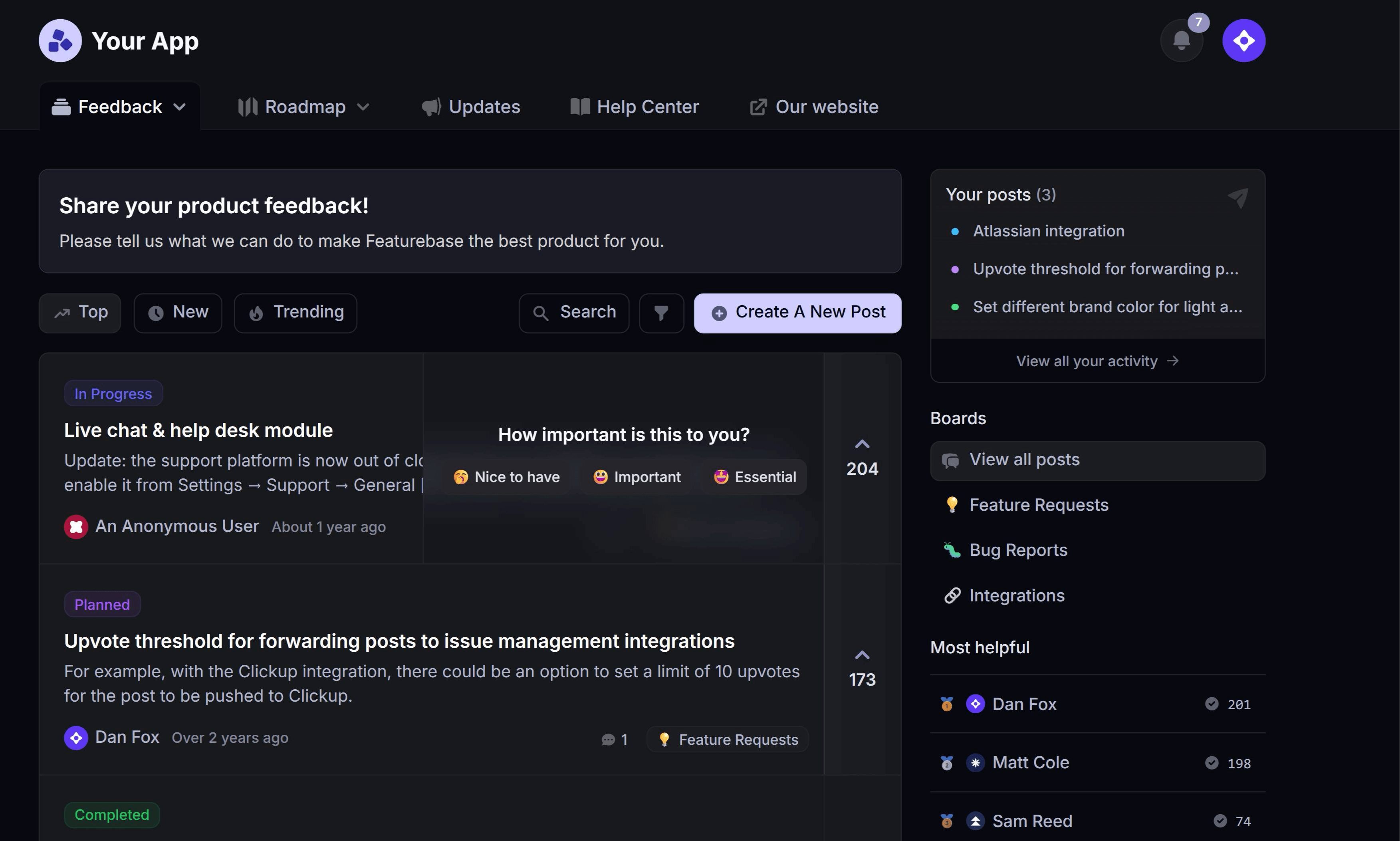

✨ Start collecting & managing feedback with Featurebase for free →
You can't improve a number you don't measure, and customer retention is one of the most important numbers your business has.
The customer retention rate formula tells you what percentage of customers stick with you over a given period. It's simple to calculate once you know which numbers to plug in, and it's one of the clearest signals of whether your product and service are actually working.
In this guide, I'll break down the formula, walk through a worked example, show the Excel version, and cover how to read and improve the number once you have it. 👇
Key takeaways
- Customer retention rate (CRR) is the percentage of existing customers you keep over a set period. The formula is [(E − N) / S] × 100, where E is customers at the end, N is new customers gained, and S is customers at the start.
- Retention rate and churn rate are two sides of the same coin. If your retention rate is 90%, your churn rate is 10%.
- A "good" retention rate depends heavily on your industry and business model, so benchmark against your own history and direct competitors rather than a universal target.
- Retention is far cheaper than acquisition, which is why small gains in the rate can have an outsized effect on profit.
- Featurebase✨ helps you lift retention by collecting customer feedback, running NPS and CSAT surveys, and closing the loop when you ship what customers asked for.
What is customer retention rate?
Customer retention rate is the percentage of customers a business keeps over a specific period of time. It measures how well you hold onto the customers you already have, rather than how many new ones you win.
If you started a quarter with 1,000 customers and 900 of those original customers were still with you at the end, your retention rate for that quarter is 90%. The other 10% churned.
Retention is usually measured over a fixed window - monthly, quarterly, or annually - and the right window depends on your billing cycle and how often customers interact with your product. A subscription SaaS tool often looks at monthly and annual retention, while a business with longer purchase cycles might only measure it once a year.
Why customer retention rate matters
Retention is where sustainable growth actually comes from. New customers are expensive to win, and the customers you already have are the ones most likely to buy again, upgrade, and refer others.
The economics are hard to argue with. According to research by Frederick Reichheld of Bain & Company, increasing customer retention rates by 5% can boost profits by 25% to 95%. Existing customers compound in value the longer they stay.
Acquisition, by contrast, is a costly treadmill. Winning a brand-new customer takes marketing spend, sales effort, and onboarding time, while an existing customer already knows and trusts you. When your retention rate is low, you're pouring money into replacing customers you could have kept.
Tracking the rate over time also gives you an early warning system. A retention rate that slips quarter over quarter is often the first sign of a product, pricing, or support problem that hasn't shown up in revenue yet.
The customer retention rate formula
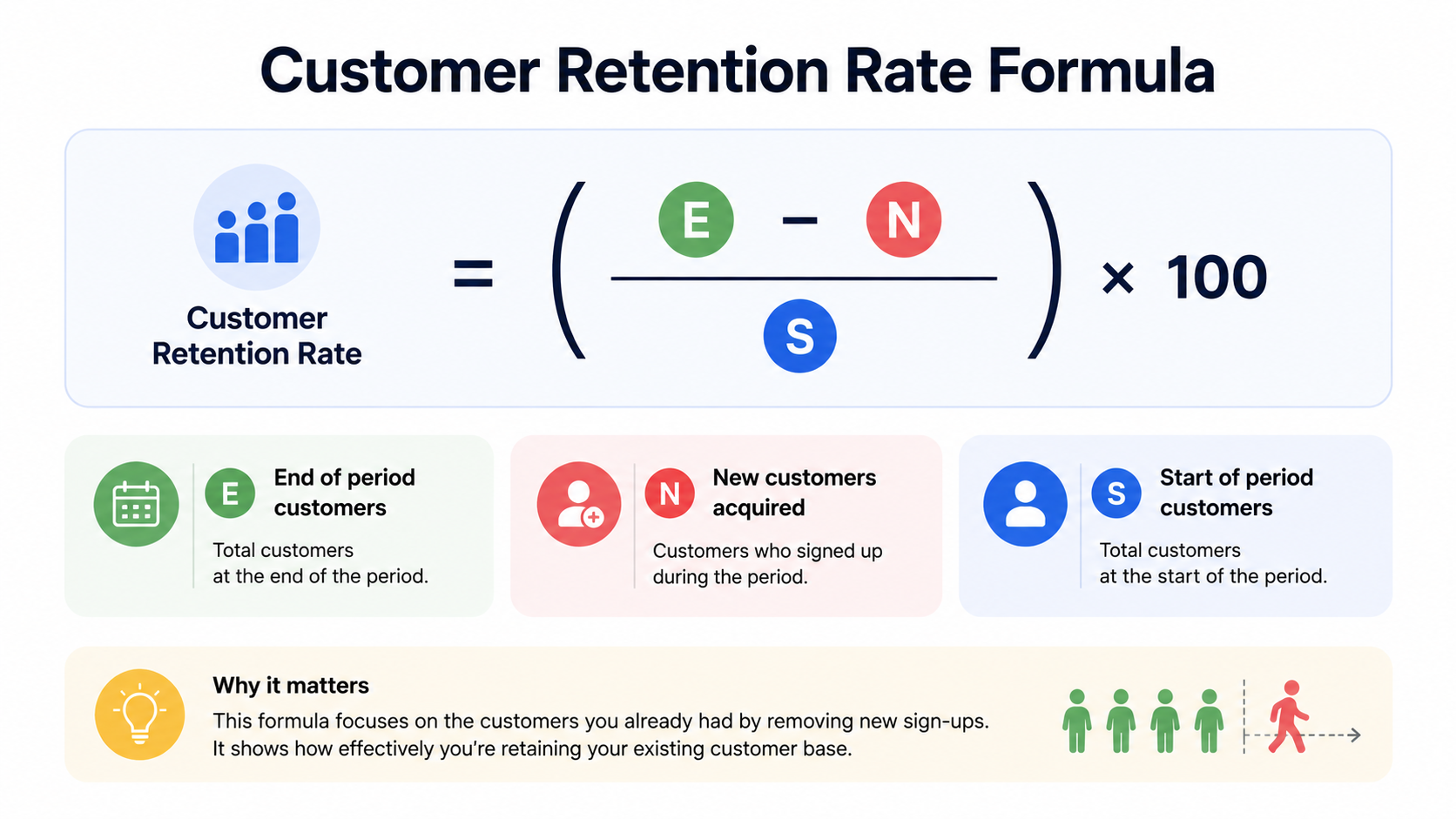
The customer retention rate formula is:
Customer retention rate = [(E − N) / S] × 100
Where:
- E - the number of customers at the end of the period
- N - the number of new customers acquired during the period
- S - the number of customers at the start of the period
Subtracting new customers (N) is the step people most often miss. You only want to measure how well you kept the customers you started with, so new sign-ups have to be removed from the ending count. Otherwise a strong sales month would hide the fact that you're leaking existing customers.
How to calculate customer retention rate step by step
Here's the calculation broken into 3 steps using a simple example. Say you start a quarter with 1,000 customers, gain 150 new ones, and end the quarter with 1,050 customers total.
- Subtract new customers from your ending total: 1,050 − 150 = 900. This is how many of your original customers are still around.
- Divide by your starting count: 900 / 1,000 = 0.9. This is the share of original customers you retained.
- Multiply by 100: 0.9 × 100 = 90%. Your customer retention rate for the quarter is 90%.
Even though you ended with more customers than you started with, your retention rate is 90%, not 105%. The formula deliberately ignores growth from new customers so you get a clean read on loyalty.
How to calculate retention rate in Excel
You don't need a special template to run the formula in a spreadsheet. Put your three inputs in their own cells and reference them in a single formula.
- Cell A2: customers at the start of the period (S)
- Cell B2: new customers acquired (N)
- Cell C2: customers at the end of the period (E)
Then in cell D2, enter: =((C2-B2)/A2)*100
Excel returns the retention rate as a number, so format cell D2 as a percentage or simply read it as a percent. Drop in a new row for each period and you have a running retention trend you can chart.
Retention rate vs. churn rate
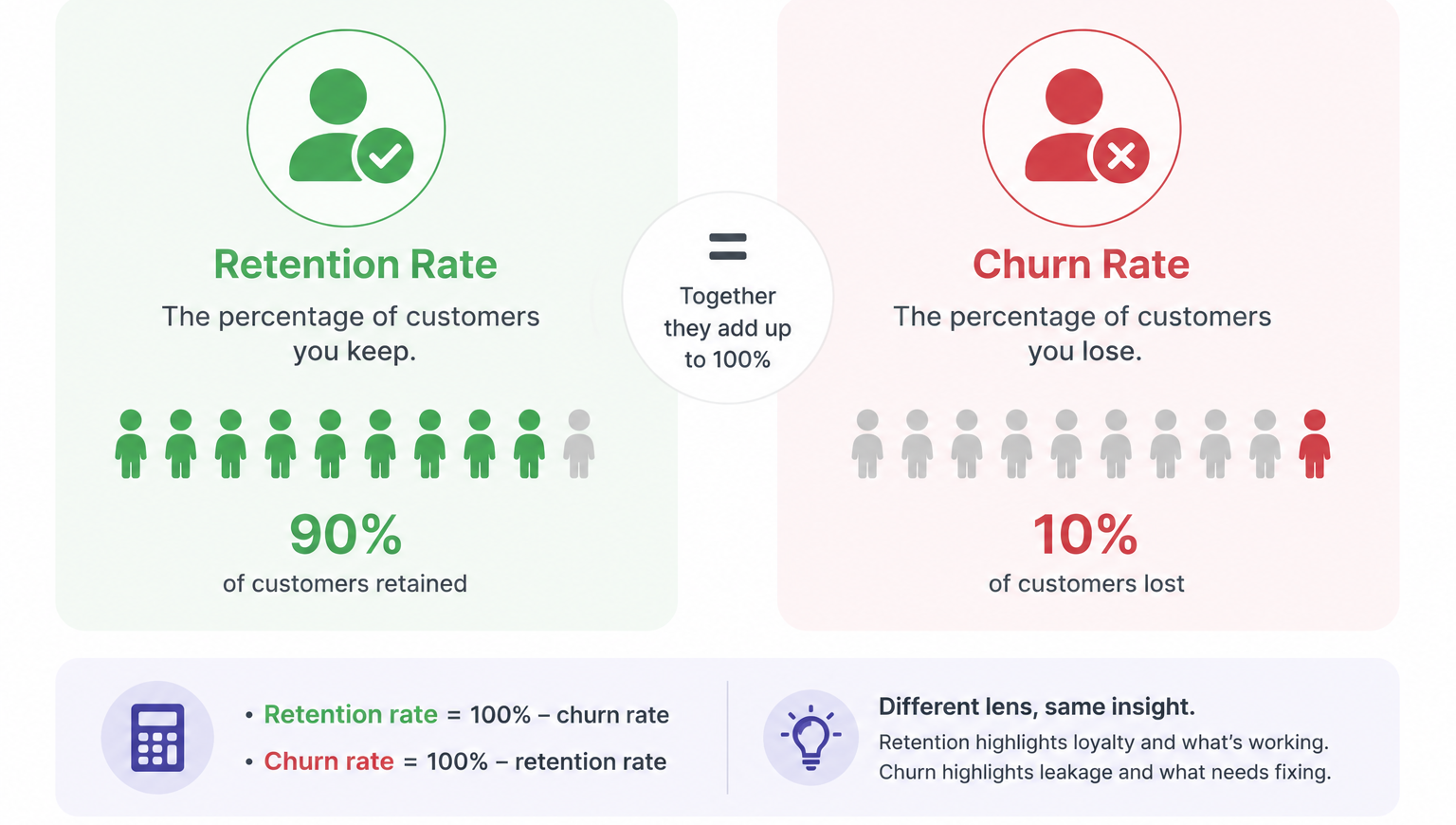
Retention rate and churn rate measure the same thing from opposite directions. Retention rate is the percentage of customers you keep. Churn rate is the percentage you lose. Together they add up to 100%.
So if your customer retention rate is 90%, your churn rate is 10%. If churn is 25%, retention is 75%. You can calculate one from the other with a quick subtraction:
- Retention rate = 100% − churn rate
- Churn rate = 100% − retention rate
The two metrics are useful in different conversations. Retention rate frames the story around loyalty and what's working, which is helpful for board updates and customer success goals. Churn rate frames it around the leak you need to plug, which is helpful when you're diagnosing problems. Most teams track both.
Other customer retention metrics to track
Retention rate is the headline number, but it doesn't tell the whole story on its own. A few related metrics add the context you need to act:
- Customer churn rate: The mirror image of retention, showing the percentage of customers who left during the period. It's the fastest way to quantify the size of your leak.
- Repeat purchase rate: The share of customers who buy from you more than once. It's especially useful for ecommerce and transactional businesses where "retention" is about repeat orders rather than an active subscription.
- Net revenue retention (NRR): The percentage of recurring revenue you keep from existing customers over a period, including upgrades and expansion but after downgrades and churn. NRR above 100% means your existing customers are growing in value even if you never added a single new account.
- Gross revenue retention (GRR): The percentage of recurring revenue you keep before counting any expansion, so it caps at 100%. It shows how much revenue you're holding onto without upsells masking the churn underneath.
- Customer lifetime value (CLV): The total revenue you can expect from an average customer across the whole relationship. Higher retention directly lifts CLV, which is what ties the metric back to the bottom line.
Customer retention rate counts logos, while revenue retention metrics count dollars. Watching both together stops a handful of large accounts from hiding a lot of small-customer churn, or the reverse.
What is a good customer retention rate?
There's no single "good" retention rate that applies everywhere. What counts as healthy depends heavily on your industry, business model, and how you count customers.
As a rough guide, subscription SaaS businesses often aim for annual customer retention in the 85% to 95% range, while high-churn categories like ecommerce and consumer apps run much lower. Revenue retention benchmarks tend to run higher: SaaS Capital's 2025 research found a median net revenue retention of around 102% for private B2B SaaS companies in the $25,000 to $50,000 ACV range, because expansion revenue from existing accounts offsets the losses.
Rather than chasing a universal number, benchmark against two things:
- Your own history: Is your retention rate trending up or down quarter over quarter? A rising trend matters more than hitting an arbitrary target.
- Your direct competitors and category: A 75% annual rate might be excellent in one industry and alarming in another, so compare against businesses with a similar model.
How to improve your customer retention rate
Once you know your retention rate, the goal is to move it. A few strategies do most of the work:
- Nail onboarding: Most churn happens early, before customers reach the "aha" moment where your product clicks. A guided first-run experience that gets people to real value quickly protects the relationship from day one.
- Deliver ongoing value: Retention is earned every renewal, not just at sign-up. Regular product improvements, useful content, and proactive check-ins remind customers why they chose you.
- Act on customer feedback: The customers who churn are usually telling you why long before they leave, if you're listening. Collecting feedback systematically and actually shipping against it is one of the most reliable ways to lift retention, and the right customer retention software makes it repeatable rather than ad hoc.
- Be proactive with support: Fast, helpful support turns frustrated customers into loyal ones. Reaching out before a customer has to complain is even better.
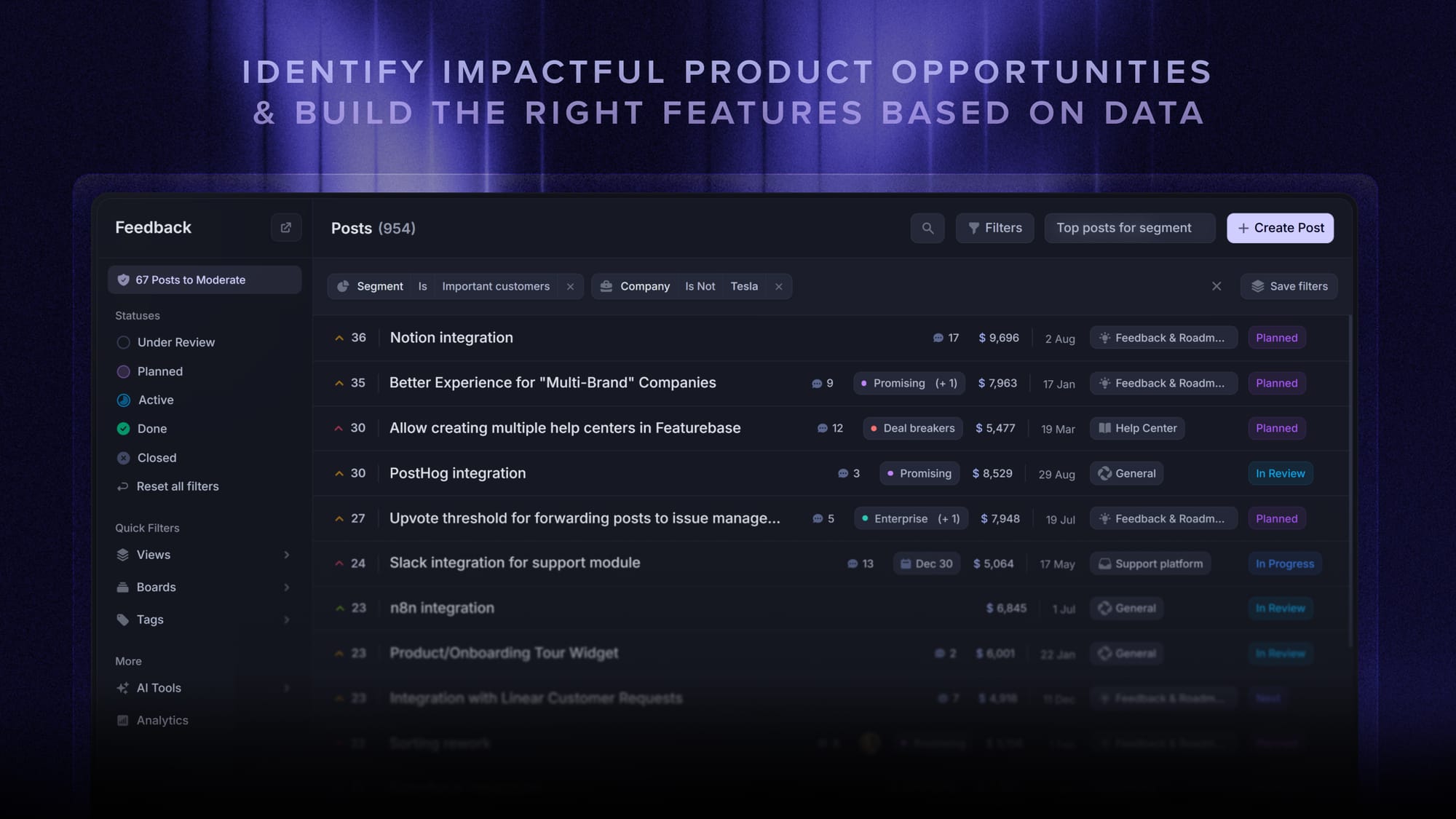
The feedback loop deserves special attention, because it's where measurement and action meet. When you can see what customers are asking for, prioritize it, and then tell them when it ships, you close the gap that quietly drives people away. With Featurebase you can run a public feedback forum where customers submit and vote on ideas, trigger NPS and CSAT surveys to catch dissatisfaction early, and automatically notify users when the feature they asked for goes live. That closed loop turns raw feedback into a retention driver instead of a backlog.

Turn feedback into products your users love
Centralize feedback, identify product opportunities, and build the right features
Improve retention by acting on feedback with Featurebase
Retention improves when you consistently build and ship what your customers actually want. That's exactly what Featurebase is built for.
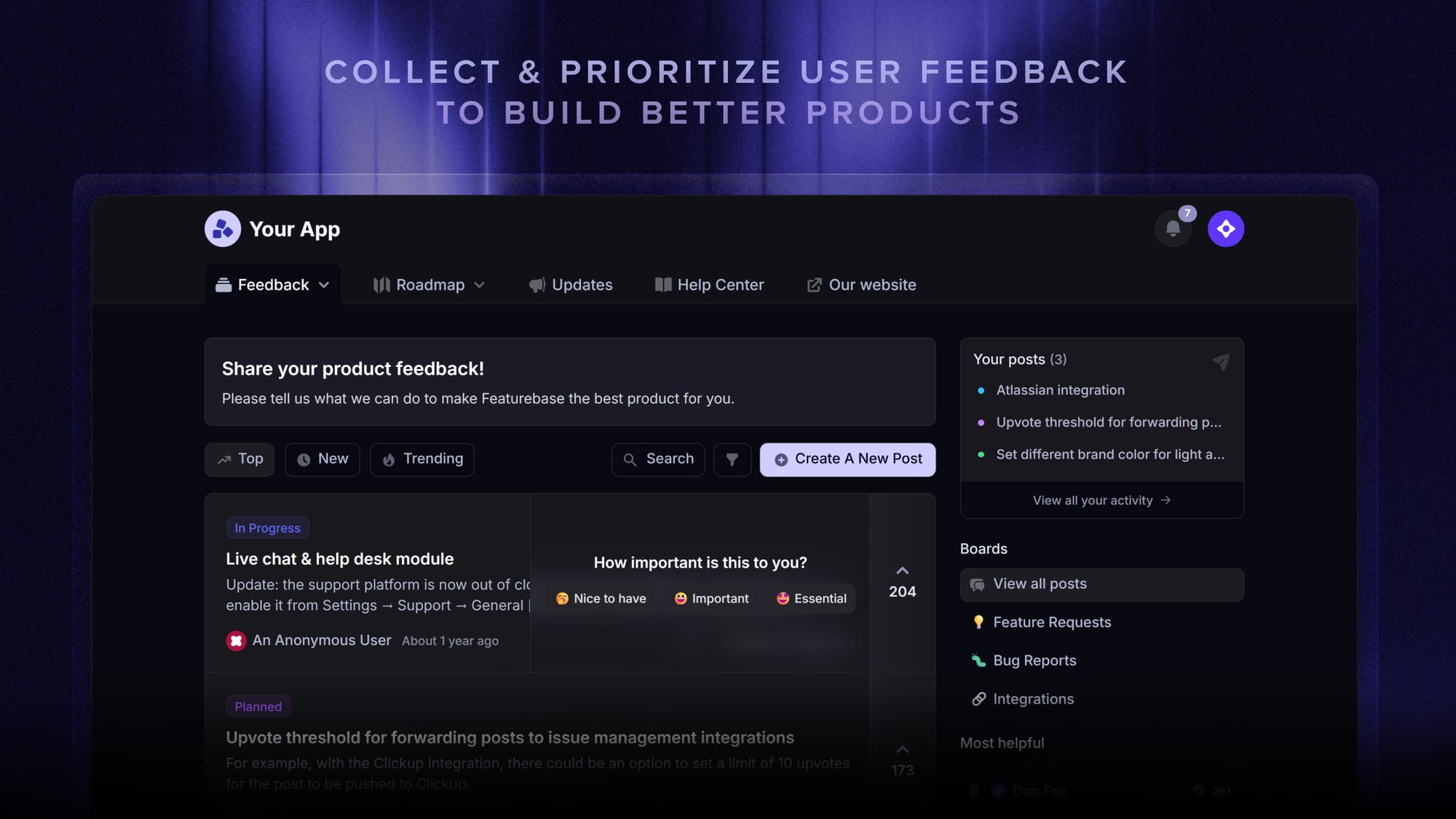
Featurebase is a modern feedback & support platform that helps product teams collect feedback, prioritize features, build roadmaps, and announce product updates - all in one place. It's loved by thousands of product teams from companies like Lovable, Raycast, and n8n. 💫
Top features:
- Feedback forum – Public feedback forum where users can submit ideas and vote on features helping you know what customers want
- In-app widgets – Embed feedback, changelog, and help center widgets directly in your product
- Prioritize by revenue – Link feedback with customer revenue, company size, and much more to better understand the impact of ideas
- AI feedback categorization - Automatically group large volumes of feedback into product areas, projects, or themes with AI
- Automated email updates – Automatically notify users when their requested features are implemented
- Roadmaps – Create internal & public product roadmaps to keep users informed and build engagement
- Product updates – Publish release notes with a changelog page, in-app widget, and emails
- Surveys (NPS, CSAT, etc) – Create targeted surveys to ask users anything and measure customer satisfaction
- Automatic AI translations – Automatically translate all feedback and comments to your customers / teammates native languages
- Integrations – Connects with Slack, Linear, Jira, HubSpot, and more
Pricing: Free plan available with unlimited feedback collection. Paid plans start at $29/seat/mo.

Instead of having 4+ different tools, Featurebase enables you to replace all your customer-facing tools by bringing your feedback collection, product updates, support, and help center together in one place to help you build products your users love.
Conclusion
The customer retention rate formula is simple: [(E − N) / S] × 100. Take your customers at the end of a period, subtract the new ones you gained, divide by what you started with, and multiply by 100. That single number tells you how well you're holding onto the customers you worked so hard to win.
But calculating it is only the first step. The real value comes from tracking the rate over time, pairing it with churn and revenue retention for context, and then acting on what the number is telling you.
Featurebase brings your feedback collection, surveys, roadmap, and product updates into one place, so you can hear what customers want, build it, and close the loop when it ships - the exact loop that keeps retention climbing.
It comes with a Free plan and onboarding takes minutes, so there's no downside to trying it. 👇
✨ Start collecting & managing feedback with Featurebase for free → featurebase.app
FAQs
How do you calculate customer retention rate in Excel?
Put your starting customer count, new customers, and ending customer count in three cells, then reference them in one formula. If S is in A2, N is in B2, and E is in C2, enter =((C2-B2)/A2)*100 in a new cell. Format the result as a percentage, and add a row per period to build a running retention trend.
What is a good customer retention rate?
It depends on your industry and business model, so there's no universal target. Subscription SaaS businesses often aim for 85% to 95% annual customer retention, while ecommerce and consumer apps typically run much lower. The most useful benchmark is your own trend over time, followed by direct competitors in your category.
Why is customer retention important?
Retaining customers is far cheaper than acquiring new ones, and existing customers are more likely to buy again, expand, and refer others. Even small improvements in retention compound into large gains in profit and lifetime value. It's also an early signal of product and service health, often flagging problems before they hit revenue.
What does an 80% retention rate mean?
An 80% retention rate means you kept 80% of your existing customers over the measured period and lost the other 20% to churn. For example, starting a quarter with 500 customers and keeping 400 of them (ignoring any new sign-ups) is an 80% retention rate. Whether that's good or bad depends entirely on your industry benchmarks.
What's the difference between gross revenue retention and customer retention rate?
Customer retention rate counts logos - the percentage of customers you keep - while gross revenue retention (GRR) counts dollars - the percentage of recurring revenue you keep before any expansion. GRR caps at 100% because it excludes upsells, whereas net revenue retention can exceed 100% when expansion outpaces churn. Watching customer and revenue retention together keeps a few big accounts from masking small-customer churn.
How often should you measure customer retention rate?
Match the measurement window to your billing cycle and how often customers use your product. Subscription businesses usually track it monthly and annually, while businesses with longer purchase cycles may only measure it quarterly or yearly. The key is consistency: use the same window every time so your trend line is comparable.