Blog Customer ServiceSalesforce Einstein AI: Features, Uses, and Agentforce
Salesforce Einstein AI: Features, Uses, and Agentforce
Salesforce Einstein AI combines predictive, generative, and agentic tools. Learn its features, Agentforce connection, benefits, and trade-offs.


✨ Automate your support with the fastest AI-enhanced Inbox today →
Salesforce Einstein AI covers predictive scoring, generated content, analytics, and the AI behind Agentforce. This guide explains what it includes, where Agentforce fits, and what to check before buying. 👇
Key takeaways
- Einstein is an AI layer: Salesforce uses the Einstein name for predictive, generative, and analytical capabilities embedded across its CRM products.
- Agentforce adds action: The Agentforce platform builds on Salesforce data, automation, models, and trust controls to run assisted or autonomous workflows.
- The value depends on your data: Clean records, connected systems, permissions, and current knowledge sources matter more than a long feature list.
- Featurebase✨ fits focused SaaS support workflows: It combines an AI agent, agent Copilot, omnichannel inbox, help center, workflows, and product feedback without requiring a broad CRM AI rollout.
- Start with one outcome: Prove a measurable workflow such as faster case resolution or better forecast accuracy before expanding.
What is Salesforce Einstein AI?
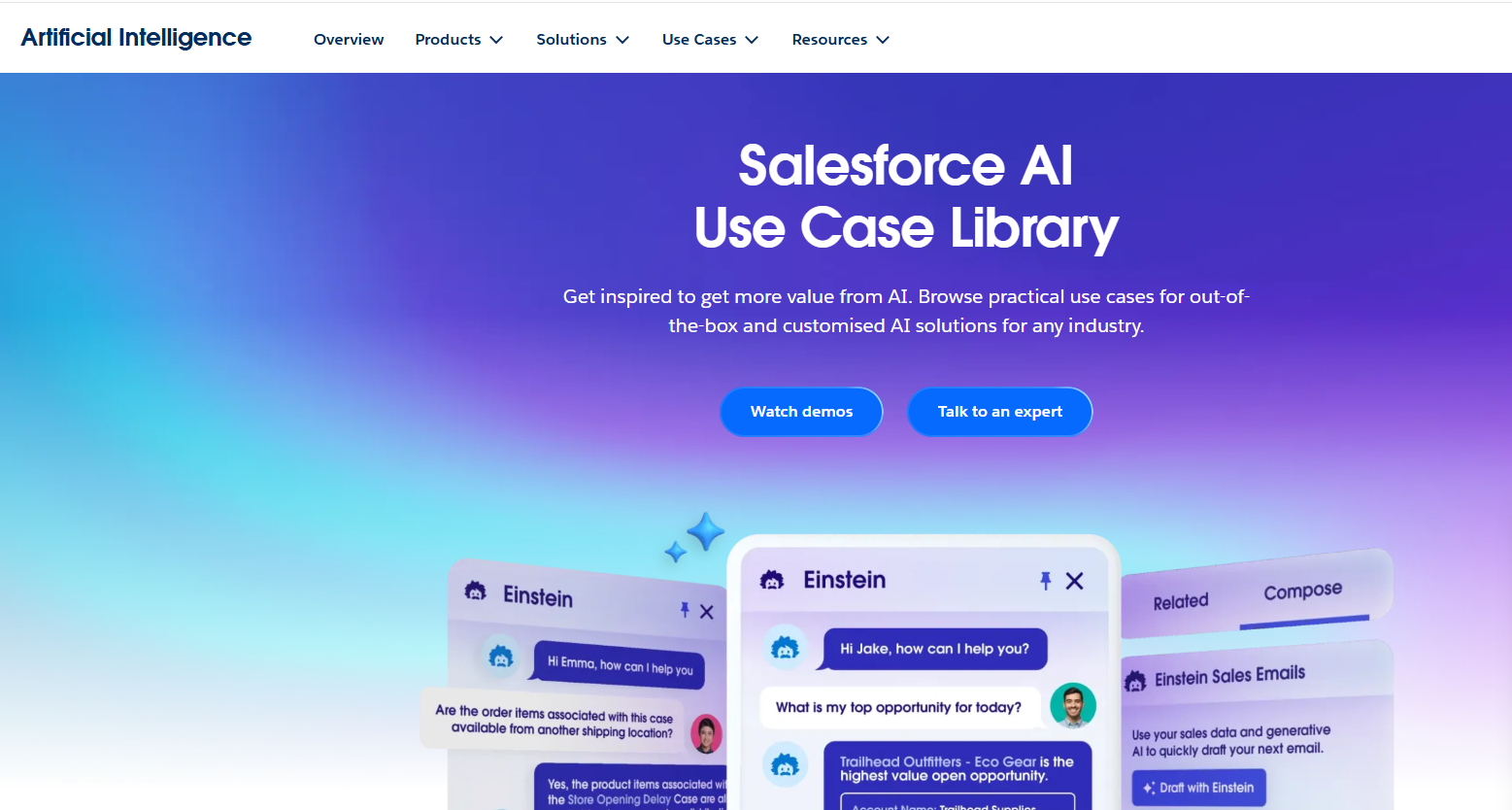
Salesforce Einstein AI is the intelligence layer embedded across Salesforce products. It uses CRM data to predict outcomes, generate content, recommend actions, surface insights, and power AI agents.
Salesforce reports that its platform processes 283.3 billion Einstein predictions in 24 hours. This is a vendor-reported platform figure, not a customer performance benchmark.
Predictive, generative, and agentic AI
Einstein covers 3 forms of AI:
- Predictive AI: Forecasts outcomes such as lead conversion, opportunity success, or product demand.
- Generative AI: Drafts and summarizes sales emails, service replies, and conversations.
- Agentic AI: Uses instructions, data, and approved actions to complete multi-step tasks through Agentforce.
How Einstein uses CRM data
Einstein connects AI outputs to customers, accounts, opportunities, orders, and cases. Its results still depend on accurate records, current knowledge, consistent fields, and correct permissions.
Salesforce Einstein vs. Agentforce
Einstein is Salesforce's broader AI foundation. Agentforce uses that foundation to build AI agents that reason over context and take approved actions.
What the Einstein name covers
The Einstein name covers scoring, recommendations, analytics, generative AI, and model tools. Einstein Analytics became CRM Analytics, Einstein Copilot became Agentforce, and Einstein Studio is becoming AI Models.
Where Agentforce fits
Agentforce moves from producing an output to completing a goal. A service agent can retrieve an answer, update a case, trigger an approved flow, and escalate at a defined boundary.
The distinction is practical:
- Choose Einstein for a focused prediction, recommendation, summary, or draft.
- Choose Agentforce for conversational, multi-step work across data and systems.
Salesforce Einstein AI features by business function
Einstein features are easiest to understand by business function.
Einstein for sales
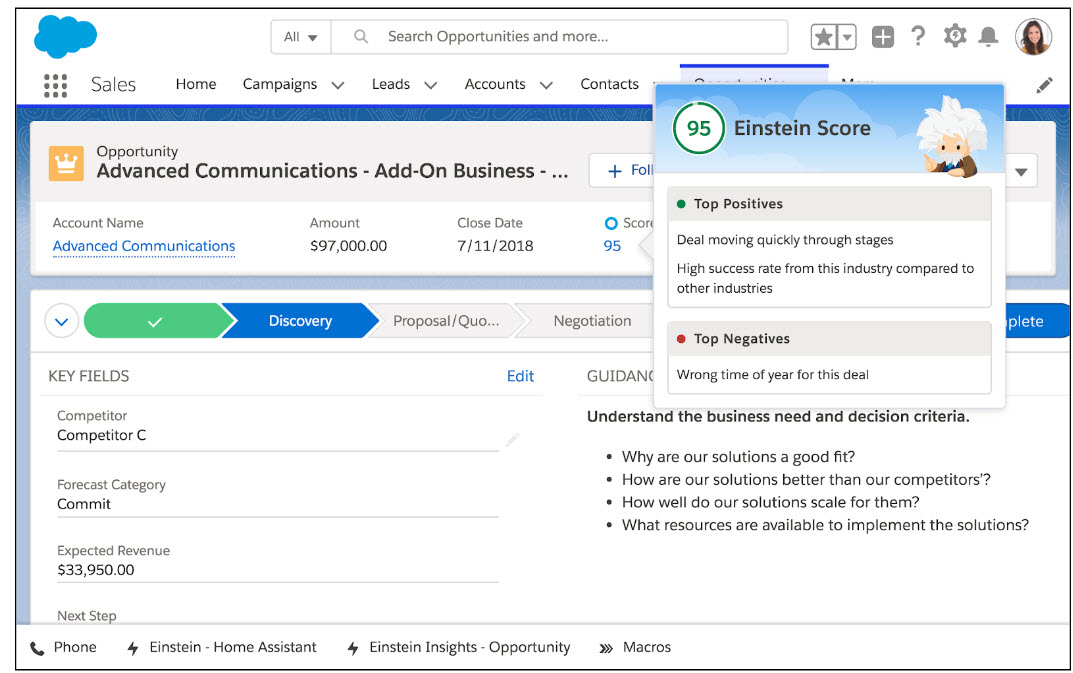
Einstein for sales covers lead and opportunity scoring, forecasting, activity capture, conversation insights, and generated outreach. Measure it through conversion rate, forecast error, response time, or reduced data entry, not AI usage alone.
Einstein for service
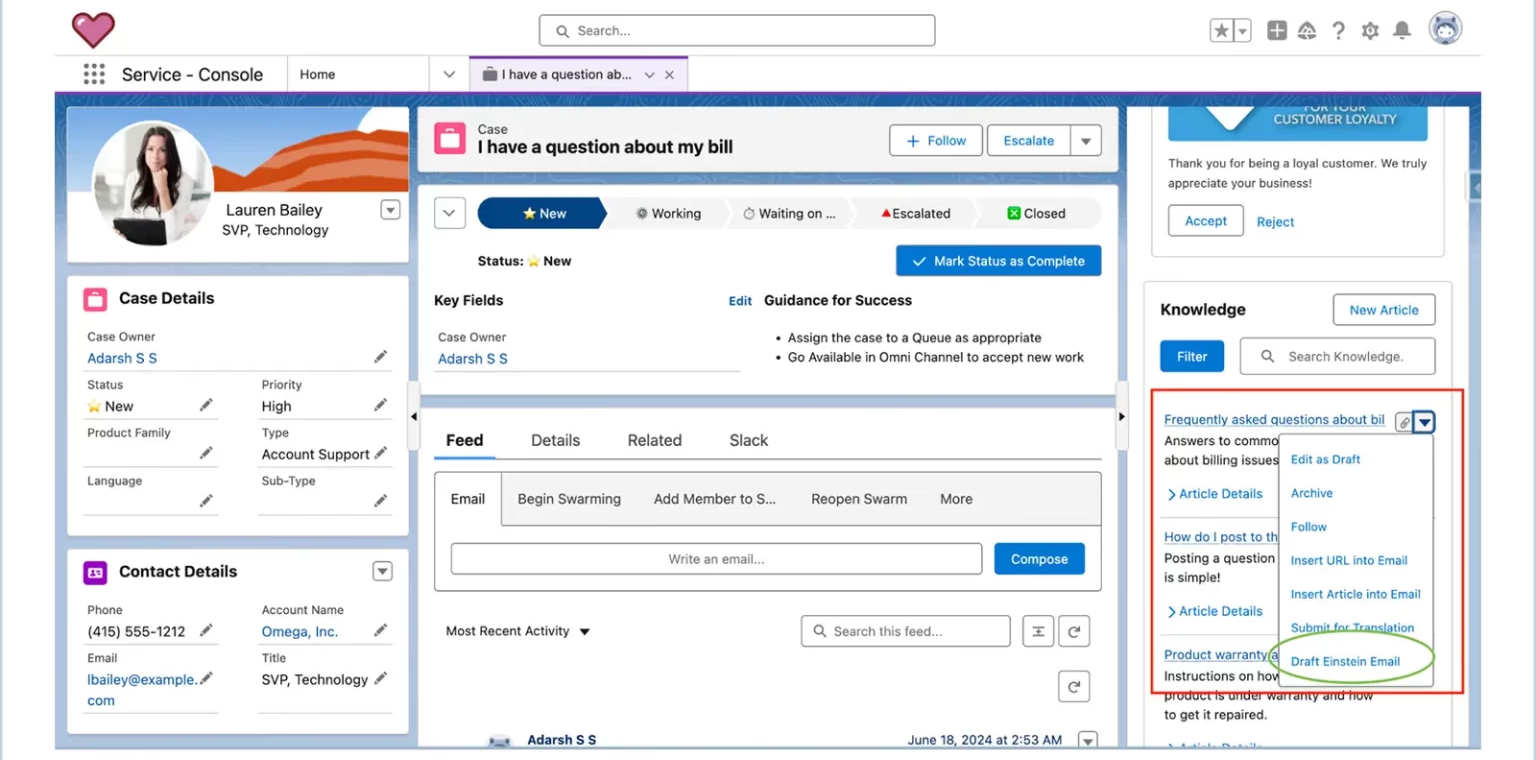
Einstein for service supports case classification, routing, reply generation, summaries, knowledge recommendations, bots, and agentic self-service.
Salesforce's 2025 survey of 6,500 service professionals found that 69% said their organization used at least one form of AI, including 39% using agentic AI. The same vendor study says respondents expect AI to resolve 50% of service cases by 2027, up from 30% in 2025.
These projections are not a guaranteed return. Automate frequent, well-documented requests and escalate sensitive or unusual cases.
Einstein for marketing
Einstein for marketing supports engagement scoring, send-time optimization, content selection, campaign insights, recommendations, and generated campaign assets. Teams still need consent controls and holdout tests to prove incremental impact.
Einstein for commerce
Einstein for commerce supports product recommendations, predictive sorting, search suggestions, and merchandising insights. It needs reliable interaction and catalog data plus controls for inventory, margin, and brand priorities.
Einstein for data and analytics
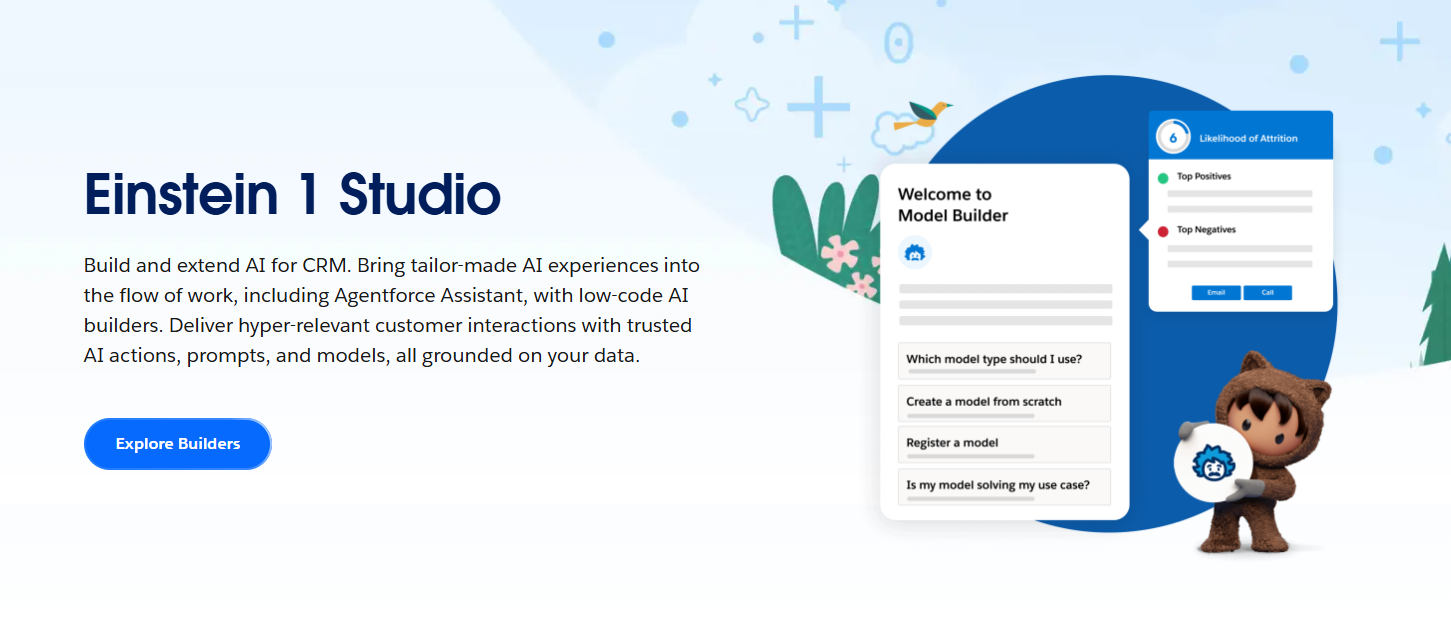
CRM Analytics and Data 360 support churn analysis, planning, segmentation, and forecasting. Einstein 1 Studio is Salesforce’s low-code AI builder suite, combining Copilot Builder, Prompt Builder, and Model Builder. Model Builder is now called AI Models and lets teams create no-code predictions or connect external models.
How much do Salesforce Einstein AI and Agentforce cost?
Salesforce Einstein AI and Agentforce have no single price. Your cost can combine a core Salesforce edition, an AI edition or add-on, user licenses, and usage credits.
| Product or pricing layer | Current list price | What it covers |
|---|---|---|
| Salesforce Foundations | $0 | Entry-level access to Agentforce Builder and Prompt Builder |
| Agentforce 1 Sales or Service | From $550/user/month | Cloud software plus predictive, generative, and agentic AI capabilities |
| Agentforce User License | $5/user/month | Employee access to Agentforce. Flex Credits are still required |
| Agentforce Flex Credits | $500 per 100,000 credits | Usage-based AI actions. A standard action uses 20 credits, equal to $0.10 |
| Einstein Predictions | $75/user/month | Custom predictions on Salesforce objects for eligible editions |
| CRM Analytics | $140 to $165/user/month | Growth costs $140, while Plus costs $165 and includes Einstein Discovery |
| Marketing Cloud Einstein Engagement | From $1,250/month | Engagement scoring, send optimization, and marketing insights |
| Data 360 | From $60,000/year for Starter | Data grounding and activation. Extra Flex Credits cost $500 per 100,000 |
These are USD list prices, and most per-user plans require annual billing. Actual cost depends on your Salesforce edition, users, AI actions, Data 360 consumption, model usage, and negotiated contract.
The practical rule is to price the full workflow. Include the base cloud license, AI access, credits, data processing, implementation, and ongoing administration.
How Salesforce Einstein AI works
Most Einstein implementations contain 5 layers:
- Data: CRM records, knowledge, documents, and connected sources.
- Models: Salesforce, third-party, or customer-managed AI.
- Controls: Permissions, grounding rules, and policies.
- Automation: Flow, Apex, MuleSoft, APIs, and agent actions.
- Experience: Records, analytics, assistants, or customer conversations.
Data grounding and the Einstein Trust Layer
Grounding adds approved CRM fields, knowledge, and Data 360 context to a prompt. The Einstein Trust Layer adds secure retrieval, prompt defenses, response checks, audit data, and zero-data-retention agreements with supported model providers. Protections vary by feature, so verify the controls for your exact workflow.
Packaged, no-code, low-code, and custom models
Use the least complex approach that meets the requirement:
- Packaged features: Fastest for standard scores, summaries, and recommendations.
- No-code builders: Create governed prompts and predictions with clicks.
- Low-code extensions: Combine prompts, Flow, APIs, and reusable actions.
- Custom models and code: Fit proprietary logic or specialized evaluation needs.
Benefits and limitations of Salesforce Einstein AI
Einstein works best when key customer workflows already run in Salesforce and the company can support the data and governance requirements.
Where the platform performs well
- CRM context: Connect outputs to existing records, permissions, and automation.
- Workflow placement: Put predictions and generated content where employees work.
- Cross-cloud reach: Apply AI across sales, service, marketing, commerce, and analytics.
- Extensibility: Combine packaged features with prompts, flows, APIs, and external models.
Setup, data, cost, and governance trade-offs
- Fragmented licensing: Availability depends on cloud, edition, add-on, usage, and contract.
- Data preparation: Connected systems can still contain stale knowledge, duplicates, and inconsistent identities.
- Agent risk: Autonomous actions need stricter testing, monitoring, and escalation than generated drafts.
- Ongoing ownership: Teams must maintain prompts, actions, permissions, knowledge, and evaluation.
How to decide whether Salesforce Einstein AI fits your team
Choose Einstein when a valuable workflow already sits in Salesforce and needs CRM context. Use this 5-step evaluation:
- Define the outcome: Choose a metric such as resolution time, conversion rate, or forecast error.
- Audit the data: Check coverage, freshness, permissions, duplication, and knowledge quality.
- Choose the smallest scope: Compare a packaged feature, Agentforce workflow, and focused external tool.
- Run a controlled pilot: Test representative cases, edge cases, human review, and a baseline.
- Price ongoing operations: Include licenses, usage, implementation, evaluation, and administration.
Choose the option that solves the job with acceptable cost, risk, and maintenance, not the longest AI feature list.

Get the best alternative to Einstein AI
Automatically resolve 70% of customer requests & cut down manual support loads
A focused AI support option for SaaS teams
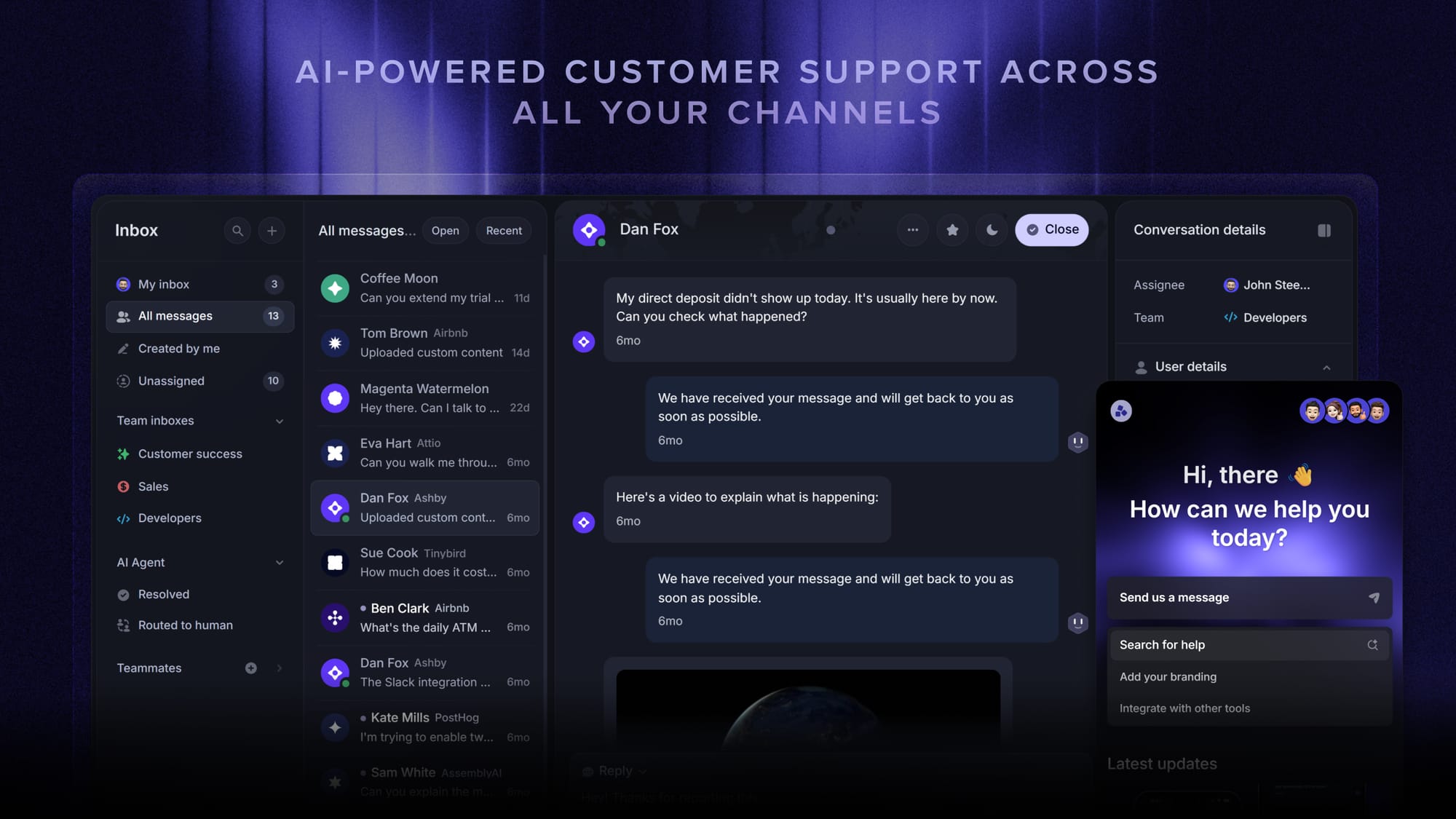
For a product-led SaaS team that mainly wants to automate customer support, a broad Salesforce AI rollout can be more platform than the job requires. Featurebase can sync customer context with Salesforce while keeping support conversations, AI answers, workflows, feedback, and roadmap signals together.
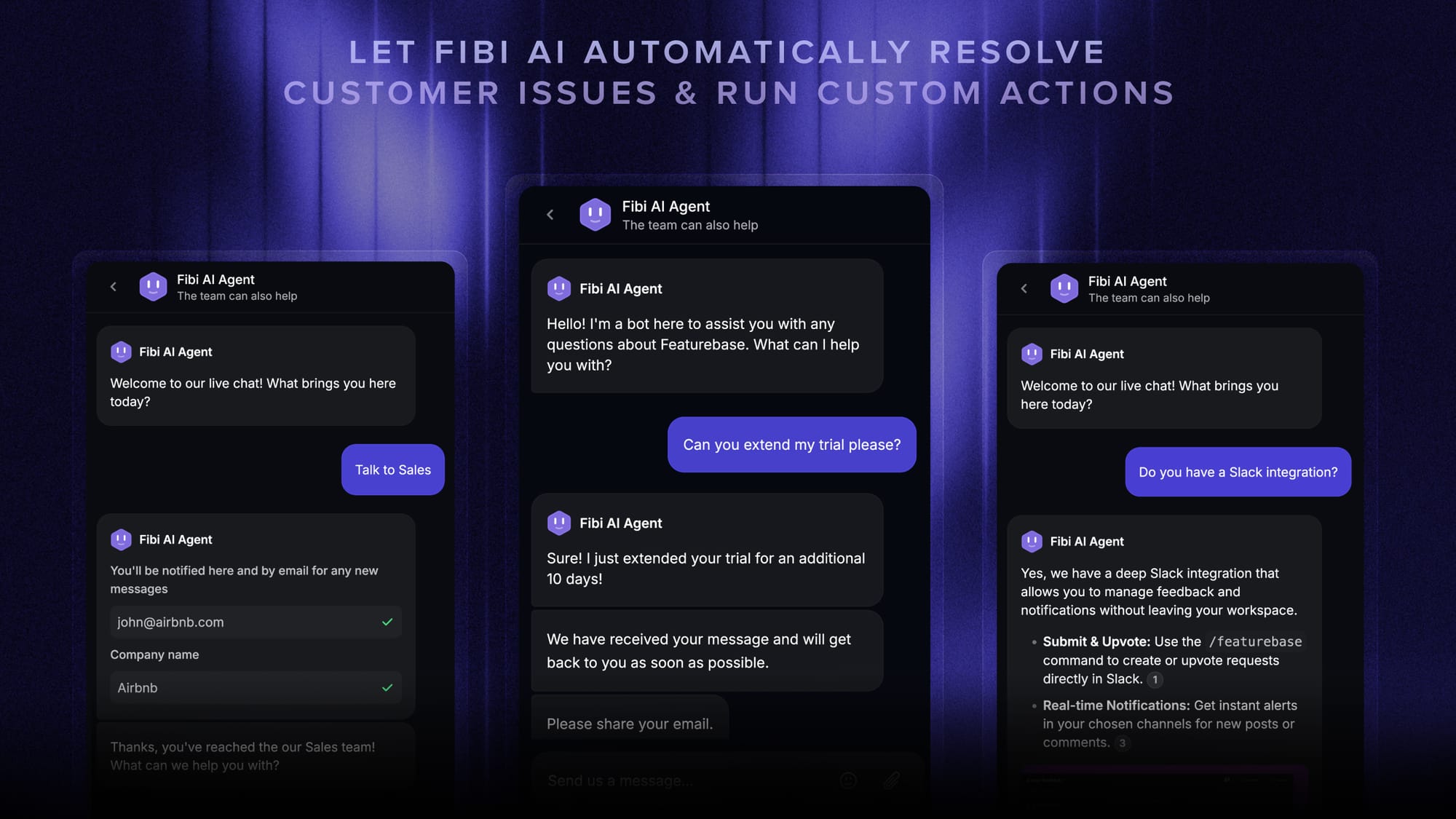
Featurebase is a modern AI customer support platform for product-led SaaS. It combines AI-powered support, help center, and feedback management into a single platform for startups that want all their customer-facing tools in one place. Featurebase is loved by thousands of support teams from companies like Lovable, Raycast, and n8n. 💫
Top features:
- Omnichannel inbox – Manage live chat, email, and Slack conversations from one AI-powered view
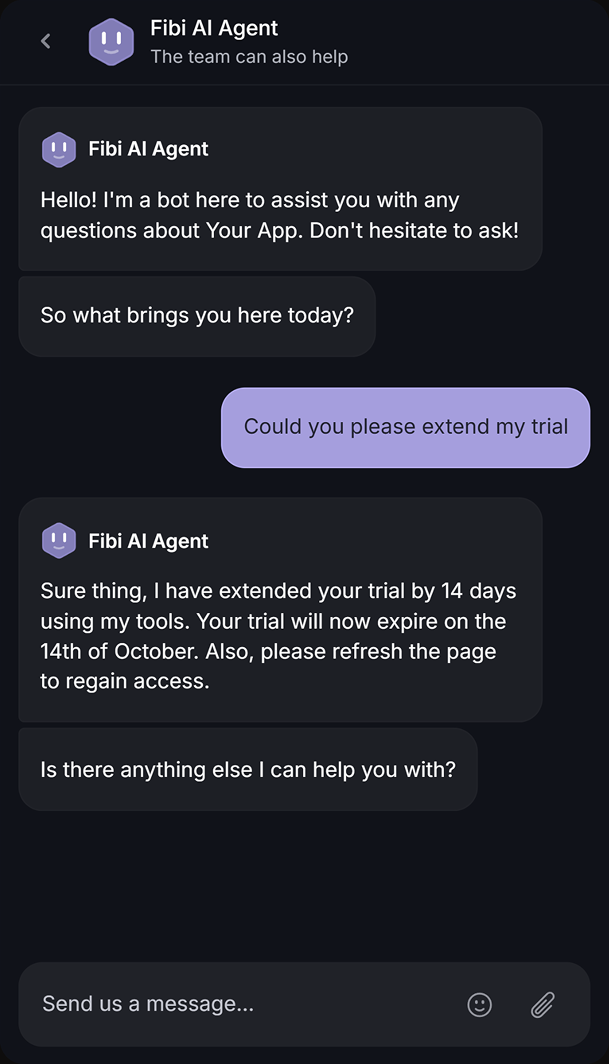
- Fibi AI Agent - Resolve customer issues on autopilot & run custom actions like trial extensions and refunds
- Help center with AI search – Provide instant, multilingual self-serve answers
- Workflows & automations – Auto-assign tickets, route conversations, collect customer data, and more
- AI Copilot – Help your agents answer customers faster with AI Copilot that uses your internal knowledge
- Multi-brand support – Manage multiple Help Centers and Live chats from a single workspace
- Automatic AI translations – Automatically translate all messages and help articles to your customers native language
- Service Level Agreements – Track SLAs to make sure your team responds to customers on time, every time
- Mobile app – Respond to customers, receive notifications, and unblock users on the go
- Feedback & roadmap tools – Collect feature requests and close the loop with updates
- Product updates – Publish release notes with a changelog page, in-app widget, and emails
- Integrations – Connects with Slack, Linear, Jira, HubSpot, and more
Pricing: Free plan available with unlimited conversations. Paid plans start at $29/seat/month with $0.49 per AI resolution.
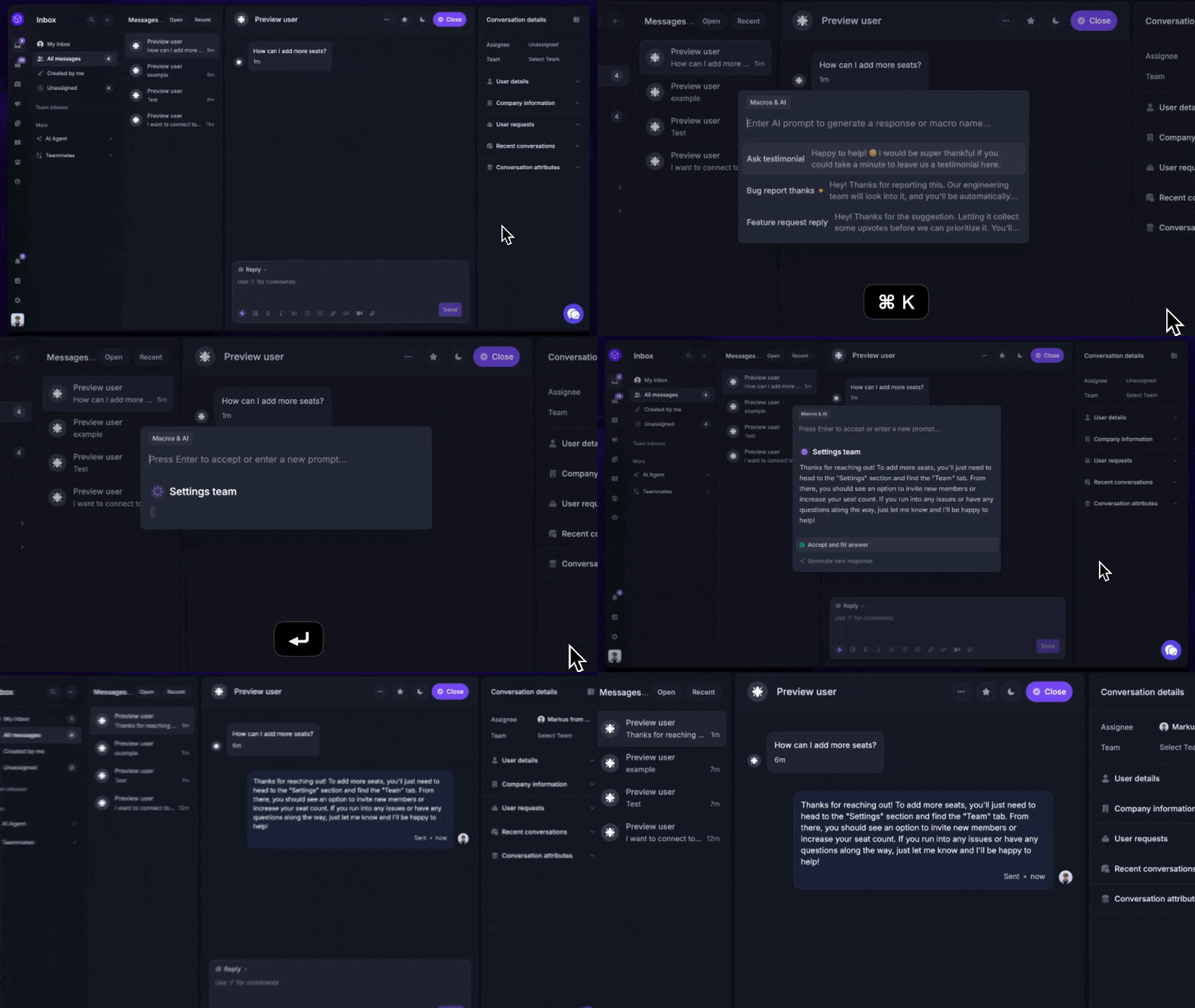
Featurebase covers all the basic support features that legacy platforms do, but with a much more modern approach. It comes with AI automations, a mobile app, and multiple channels (email, live chat, Slack, etc.).
✨ Automate your support, try Featurebase for free! →
Conclusion
Salesforce Einstein AI is a strong fit for companies that want AI embedded across Salesforce and can support it with reliable data, clear governance, and measurable workflows. Start with one outcome, prove it, and expand only when the next use case justifies the added scope.
Featurebase is a modern AI customer support platform that brings an omnichannel inbox, Fibi AI Agent, Copilot, workflows, help center, and product feedback together for SaaS teams. It gives you a focused path to faster support without requiring a cross-cloud AI program.
Featurebase has a Free plan with unlimited conversations, so there's no downside to trying the workflow before committing. 👇
✨ Automate your support with the fastest AI-enhanced Inbox today →
FAQs
How do you enable Einstein GPT in Salesforce?
Einstein GPT is now generally called Einstein generative AI, with many conversational capabilities under Agentforce. It requires the correct edition or add-on, provisioned data services, and organization-level enablement.
What is Einstein Activity Capture in Salesforce?
Einstein Activity Capture connects supported email and calendar accounts with Salesforce. Review its retention, sharing, reporting, and compliance behavior because captured activities do not always work like standard Salesforce records.
What does Pardot Salesforce Einstein do?
Pardot is now Marketing Cloud Account Engagement. Its Einstein features score behavior, identify important accounts, surface campaign insights, and improve send timing.
What is Salesforce Einstein Analytics?
Einstein Analytics is now CRM Analytics. It adds data preparation, dashboards, exploration, predictions, and workflow actions beyond basic Salesforce reporting.
How does Salesforce Einstein lead scoring work?
Einstein Lead Scoring uses historical lead and conversion data to identify patterns linked to successful outcomes. Monitor it when your market, sales process, or data collection changes.
What is Einstein Search in Salesforce?
Einstein Search uses context, natural language, personalization, and record access to return more relevant CRM results. Available capabilities depend on the Salesforce experience and enabled features.