Blog Customer Churn Rate: How to Calculate and Reduce It
Customer Churn Rate: How to Calculate and Reduce It
Learn what customer churn rate is, how to calculate it with a simple formula, what counts as a good rate, and the proven ways to bring it down.


You can sign up 100 new customers a month and still go nowhere. If the same number quietly walk out the back door, your growth is an illusion - you're just refilling a leaky bucket.
Customer churn rate is the metric that tells you which is really happening: healthy growth, or a slow leak you keep patching with expensive new sign-ups.
In this guide, I'll break down what churn rate is, how to calculate it, what a good rate actually looks like, and the concrete ways to bring it down. 👇
Key takeaways
- Customer churn rate is the percentage of customers who stop doing business with you over a set period (usually a month or a year).
- The basic formula is simple: customers lost during a period, divided by customers at the start, times 100.
- Customer churn counts lost logos. Revenue churn counts lost dollars. You need to watch both.
- Churn and retention are two sides of the same coin - they add up to 100%.
- Most software businesses run low single-digit annual churn, but a "good" rate depends heavily on your industry and price point.
- The biggest churn levers are onboarding, product fit, support quality, and actually acting on customer feedback.
- Featurebase✨ helps you cut churn at the source by collecting feedback, running NPS and CSAT surveys, and closing the loop when you ship what customers ask for.
What is customer churn rate?
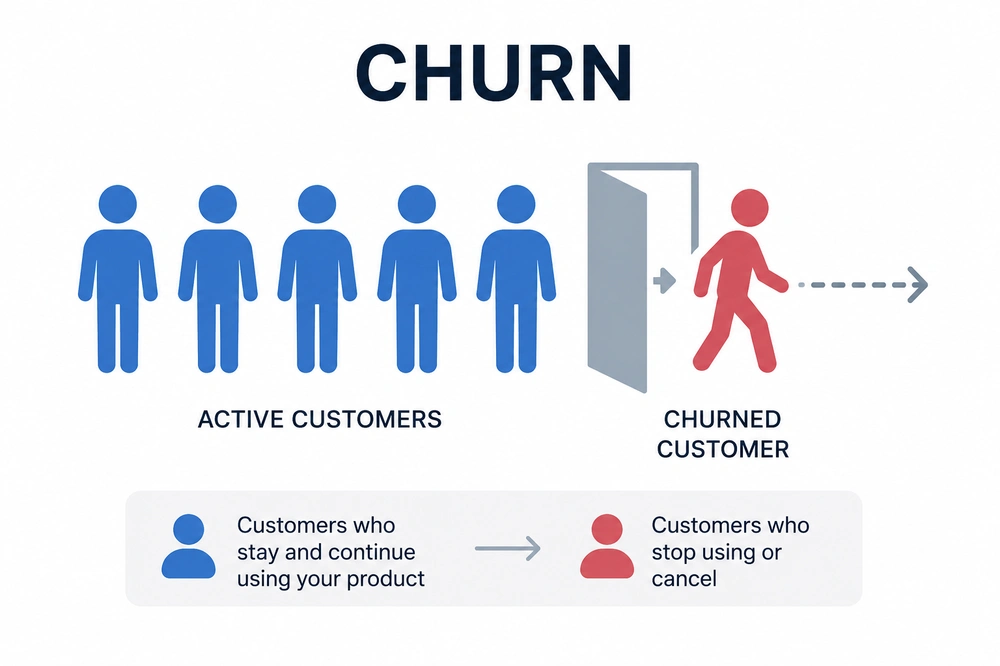
Customer churn rate is the percentage of customers who stop paying for or using your product during a specific period. It's the flip side of retention: the customers you didn't keep.
If you started the month with 500 customers and 25 of them cancelled, your monthly customer churn rate is 5%.
Churn matters because keeping customers is far cheaper than replacing them, and small improvements compound fast. According to research by Fred Reichheld at Bain & Company, a 5% increase in customer retention produces more than a 25% increase in profit. Every point of churn you shave off drops almost straight to the bottom line.
It's also the single clearest signal of whether customers actually value what you've built. You can hide weak retention behind a strong marketing engine for a while, but churn always tells the truth eventually.
How to calculate customer churn rate
The good news: the core calculation takes about 10 seconds. The nuance is in choosing your time period and being consistent about it.
Customer churn rate formula
The standard formula looks like this:
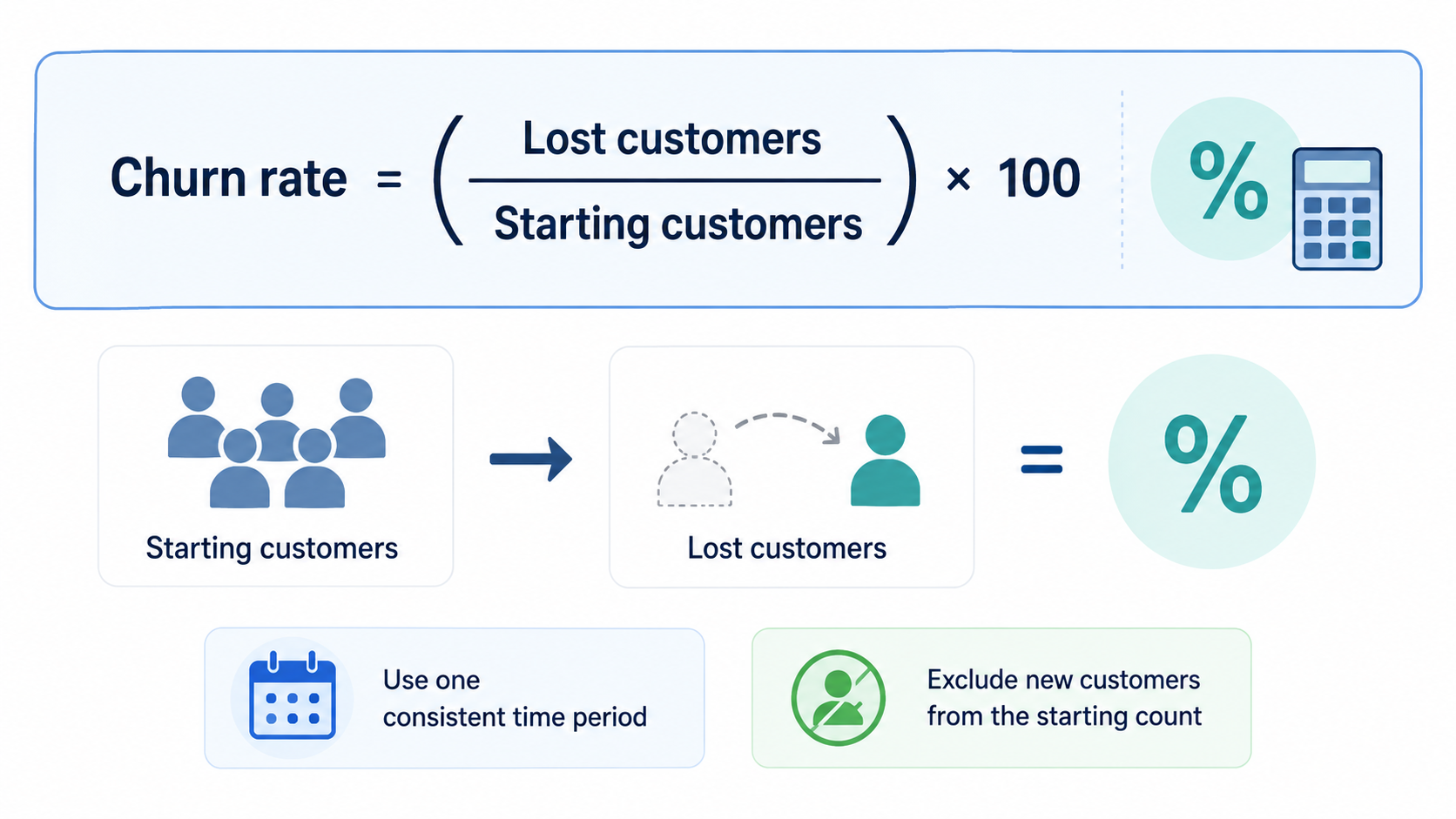
Customer churn rate = (Customers lost during the period ÷ Customers at the start of the period) × 100
Two rules keep the number honest:
- Pick one time period and stick with it: monthly, quarterly, or annual. Comparing this month's churn to last quarter's tells you nothing.
- Don't count new customers in the denominator: only measure customers who were already there at the start of the period, otherwise fresh sign-ups will mask the losses.
A worked example
Say you run a SaaS product and want your churn rate for March.
- You started March with 1,000 customers.
- During March, 40 of those customers cancelled.
- You also signed up 120 new customers, but those don't count here.
Your customer churn rate is 40 ÷ 1,000 × 100 = 4% monthly churn.
To turn a monthly rate into a rough annual figure, you can't just multiply by 12 (that overstates it, because your customer base shrinks each month). A quick approximation is 1 minus (1 minus monthly churn) to the power of 12. At 4% monthly, that works out to roughly 39% annual churn - a number that looks a lot scarier than "4%," which is exactly why annual framing is worth doing.
Customer churn rate vs revenue churn rate
Counting lost customers is only half the picture. A single enterprise account walking away can hurt more than 20 small ones, and customer churn alone won't show that.
That's why most subscription businesses track two numbers:
- Customer churn is the percentage of customers you lost. It treats every account as equal, which makes it easy to calculate but blind to account size.
- Revenue churn is the percentage of recurring revenue you lost. It weights each customer by what they actually pay, so it reflects the real financial damage.
Revenue churn also splits further. Gross revenue churn counts only the revenue you lost. Net revenue churn subtracts any expansion revenue (upgrades, seat additions, upsells) from that loss, which can even push the number below zero. More on that in the FAQ.
If you only have time to watch one number closely, watch revenue churn. It's the one investors care about, and it's the one that actually predicts whether the business is healthy.
Voluntary vs involuntary churn
Not all churn is a customer choosing to leave. Splitting it into two buckets tells you where to focus:
- Voluntary churn is when a customer actively decides to cancel - they found a competitor, stopped seeing value, or ran out of budget. This is the churn your product and experience can influence.
- Involuntary churn is when a customer leaves by accident, almost always because of a failed payment - an expired card, insufficient funds, or a declined transaction. They didn't mean to go anywhere.
Involuntary churn is easy to ignore and surprisingly large. For many subscription businesses it accounts for a meaningful slice of total churn, and most of it is recoverable with automated payment retries and dunning emails. It's often the fastest churn win available, because you're not trying to change anyone's mind - just get a valid card on file.
What is a good customer churn rate?
Everyone wants a benchmark, so here's the honest answer: it depends on your model, but lower is always better.
For software businesses, churn tends to be low. Recurly's subscriber-network data puts the median annual churn rate for software companies at around 3%, with top-quartile performers holding at 1.78% or below. Consumer subscriptions and ecommerce typically churn much higher, because switching costs are low and buying is impulsive.
B2B churn varies enormously by industry too. Sticky, deeply-integrated services see low churn, while categories with easy switching or seasonal demand run far higher. Comparing your rate to a company with a totally different price point and sales motion is a fast way to feel good or bad for no real reason.
A more useful habit than chasing a benchmark:
- Compare yourself to yourself: is this month better than last quarter?
- Segment your churn: a 6% blended rate might hide 1% enterprise churn and 15% self-serve churn, which are two completely different problems.
- Watch the trend, not the snapshot: one bad month is noise, three bad months is a pattern.
Why customers churn
You can't fix churn until you know what's driving it. The reasons cluster into a handful of predictable buckets:
- Poor onboarding: if customers never reach their first "aha" moment, they churn before they ever see the value. Early churn is almost always an onboarding problem.
- Weak product-market fit: sometimes the product just doesn't solve the problem well enough, and no amount of support saves an account that never needed you.
- Missing features: customers leave when a competitor does something you don't, or when the feature they keep asking for never ships.
- Bad support experiences: slow responses and unresolved issues erode trust fast, and a single painful ticket can be the final straw.
- Price and value mismatch: when the cost stops feeling worth it - often during a renewal or a budget review - customers walk.
- Failed payments: the involuntary churn from the section above, quietly cancelling customers who never intended to leave.
The tricky part is that customers rarely tell you which bucket they fall into unless you ask. Most churned customers never file a complaint. They just leave.
How to reduce customer churn rate
Reducing churn isn't one big move - it's a stack of small, compounding ones. Here are the levers that move the number most:
- Nail the onboarding: get every new customer to a clear first win as quickly as possible. The faster they see value, the less likely they are to bounce in the first 30 days.
- Collect feedback and actually act on it: the customers about to leave usually give you signals first. Centralizing feature requests and complaints in one place lets you spot patterns instead of reacting to one-off tickets. With Featurebase, you can run a public feedback forum where users submit and vote on ideas, so you always know what to build next to keep them around.
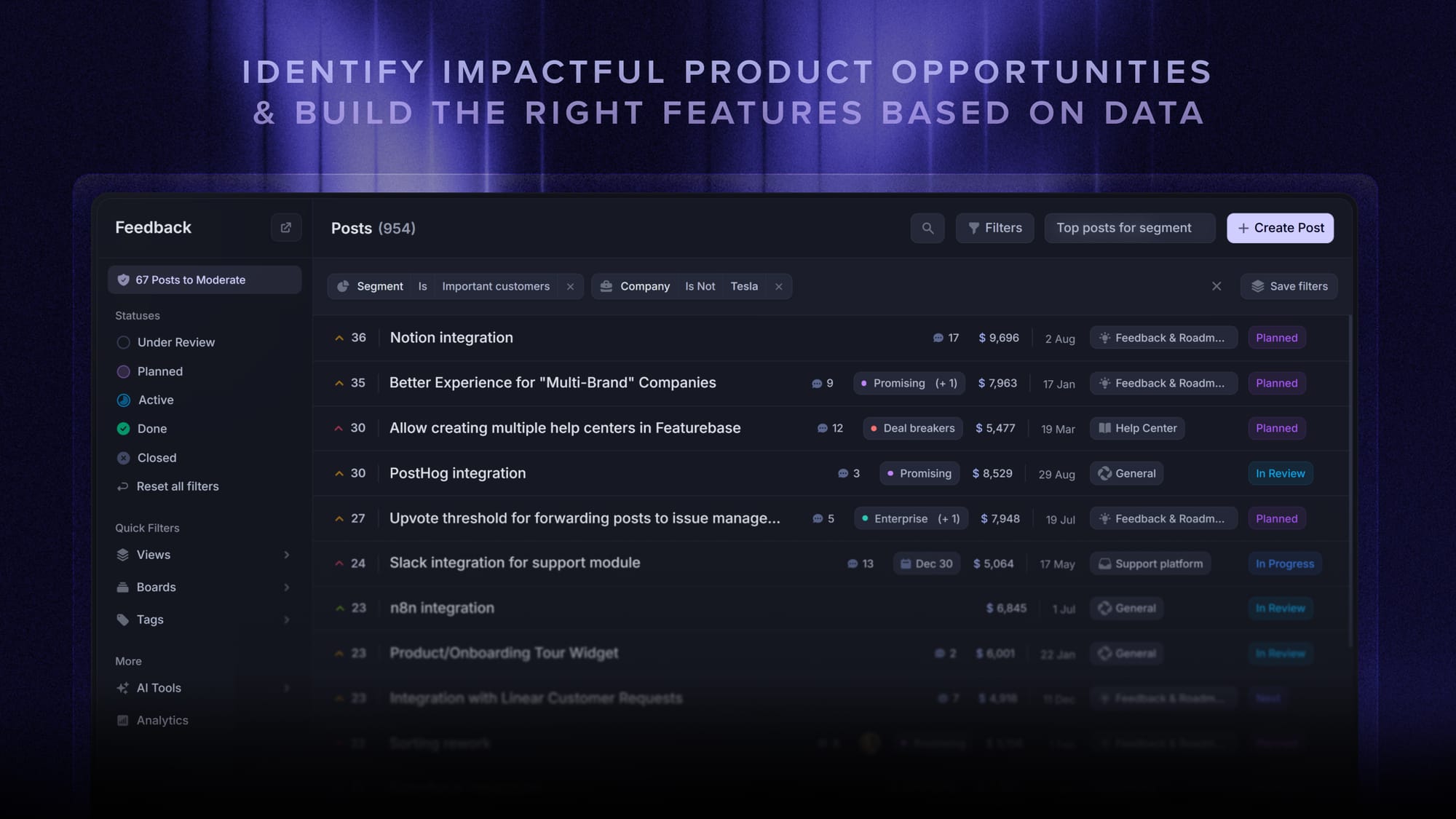
- Catch at-risk accounts early: don't wait for the cancellation. Running targeted NPS and CSAT surveys inside your product surfaces unhappy customers while you can still save them. Featurebase lets you trigger these surveys to specific user segments and route low scores to your team before they turn into churn.
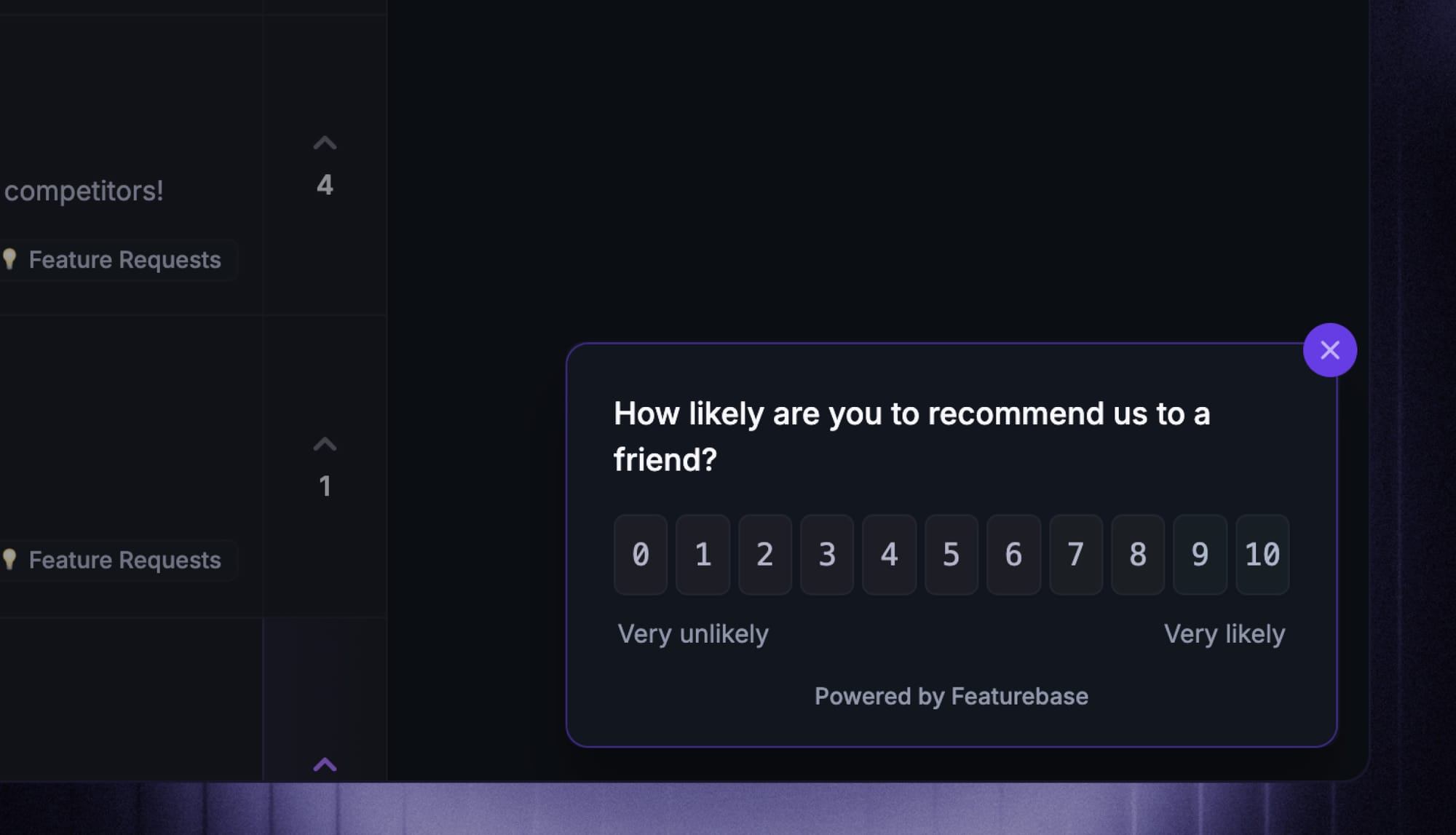
- Close the loop: when you ship the feature a customer asked for, tell them. Following up with the exact people who requested something turns a passive user into a loyal one, and it's one of the highest-ROI retention habits there is.
- Make support fast and human: quick, genuinely helpful support resolves the frustration that quietly pushes customers toward the exit.
- Fight involuntary churn: add automatic payment retries and dunning emails so an expired card doesn't cost you a customer who wanted to stay.
None of these are silver bullets on their own. Stacked together and run consistently, they're how churn goes from a leak to a trickle.

Turn feedback into products your users love
Centralize feedback, identify product opportunities, and build the right features
Conclusion
Customer churn rate is one of the most honest numbers in your business. It tells you whether people actually value what you've built, and whether your growth is real or just expensive motion. Calculate it consistently, segment it, watch the trend, and treat every point you save as profit you keep.
Featurebase is a modern & powerful feedback tool. It helps you collect feedback with a feature voting forum, surveys, embeddable widgets, and integrations. You can then analyze all of that feedback in one place by connecting it to your customers' revenue and data to make better product decisions - and stop churn before it starts.
It comes with affordable pricing and a Free plan allowing unlimited feedback. The onboarding is incredibly quick and doesn't require a credit card, so there's no downside to trying it. 👇
✨ Start collecting & managing feedback with Featurebase for free →
FAQs
What is the difference between churn rate and retention rate?
They're two views of the same thing. Retention rate is the percentage of customers you keep over a period, while churn rate is the percentage you lose. They add up to 100%, so if your annual retention rate is 92%, your churn rate is 8%. Teams often lead with retention because a high number feels better, but churn is usually the more actionable lens because it points straight at the problem.
How do you calculate customer lifetime value from churn rate?
Your churn rate is a shortcut to average customer lifetime: divide 1 by your churn rate. A 5% monthly churn rate implies an average customer lifespan of 20 months (1 ÷ 0.05). Multiply that lifetime by your average revenue per customer to get lifetime value (LTV). So a customer paying $50 a month with 5% monthly churn is worth roughly $1,000 in LTV - which is exactly why shaving churn down stretches every customer's value.
Is a high churn rate always a bad thing?
Not always, though it usually warrants a hard look. A low-priced, high-volume consumer product will naturally churn more than a locked-in enterprise contract, and some churn is seasonal or tied to free trials converting. What matters is the trend and the segment: churn that's rising over time, or concentrated in your most valuable accounts, is always a red flag. Churn that's stable and sits in your lowest-value tier is more of a fact of life.
How often should you measure your churn rate?
Most SaaS and subscription businesses track churn monthly, since that matches their billing cycle and catches problems fast. Businesses with longer contracts or slower buying cycles often measure quarterly or annually. The key is consistency - pick a cadence and a definition, then stick with them so your numbers stay comparable over time.
What is the difference between customer churn and attrition?
In most contexts they mean the same thing: customers leaving your business. "Churn" is the term you'll hear most in SaaS and subscription businesses, while "attrition" shows up more in finance, telecom, and HR. If someone draws a distinction, attrition sometimes implies a more gradual, natural decline, whereas churn covers any customer loss - but for everyday use, you can treat them as synonyms.
What is a negative churn rate?
A negative churn rate applies to revenue, not customer count. It happens when the extra revenue you earn from existing customers - through upgrades, add-ons, and seat expansions - is greater than the revenue you lose to cancellations. The result is that your recurring revenue from a given group of customers grows even if you never add a single new one. It's the holy grail of subscription metrics and a strong sign of a genuinely sticky product.