Blog ComparisonsServiceNow Pricing 2026: Modules, Licenses, and Total Costs
ServiceNow Pricing 2026: Modules, Licenses, and Total Costs
Explore ServiceNow pricing estimates for 2026 - the new Foundation, Advanced, and Prime tiers, per-module costs, hidden fees, and cheaper alternatives.


✨ Psst… Looking for a modern & powerful alternative to ServiceNow? Check out Featurebase →
ServiceNow is a leading platform for IT service management, HR service delivery, and customer service management. It does not publicly disclose fixed pricing - costs depend on your users, selected modules, and specific requirements.
In April 2026, ServiceNow also repackaged its ITSM licensing into three new AI-native tiers - Foundation, Advanced, and Prime - with its Now Assist AI bundled into every tier. That makes understanding the real ServiceNow pricing more important than ever.
User-reported estimates put essential modules around $10,000-$20,000/year for some teams, though quotes vary. Below, we break down ServiceNow's pricing model, license and implementation costs, and the hidden fees so you know what to expect. 👇
Key Takeaways
- ServiceNow modules are powerful but expensive. Even basic ITSM or HR modules can push your costs into five figures annually.
- In April 2026, ServiceNow moved ITSM to three AI-native tiers - Foundation, Advanced, and Prime - with Now Assist AI now bundled into every tier instead of sold separately.
- Contract minimums and role-based licenses can make the real cost higher than the reported "per user/month" estimates.
- Analytics and integration entitlements vary by package, and AI usage runs on consumption-based pools that may require additional capacity.
- Free Personal Developer Instances support learning and development. Ask sales about evaluations for specific products.
- If budget matters, there are smarter, more transparent alternatives like Featurebase✨, which offers AI-powered support automation, flexible licensing, and clear pricing tiers.
What is ServiceNow?

ServiceNow is a cloud-based enterprise platform built to support service delivery, IT service management, HR service delivery, and business operations. It centralizes various business processes, automates workflows, and connects teams across IT, HR, and customer service.
Unlike traditional ITSM tools, ServiceNow focuses on workflow automation, service performance, and a unified platform that integrates with existing systems like Slack, Microsoft Teams, Jira, Salesforce, and more.
It is powerful, but ServiceNow costs can increase quickly depending on modules, ServiceNow licenses, and implementation cost.
Important note: ServiceNow does not publicly disclose fixed pricing. The pricing estimates retained in this guide come from user reviews and third-party reports, not an official ServiceNow price list. They are directional benchmarks and may reflect older packages or different contract terms. Your organization will need a custom quote for exact ServiceNow license costs.
ServiceNow pricing in 2026
ServiceNow pricing is modular, meaning you pay for each module or service delivery feature your organization needs. The total cost depends on:
- User type and license: IT, HR, or Customer Service. ServiceNow licenses vary by role. Fulfillers are the agents who resolve work, while requesters submit tickets or use self-service. Count these groups separately and confirm their entitlements in your agreement rather than treating every employee as a paid agent.
- Modules selected: ITSM, ITOM, HR Service Delivery, Customer Service Management, Field Service Management, and more. Each module adds to the total ServiceNow costs, so it's important to only start with what your team needs.
- AI and advanced capabilities: Now Assist generative AI is now bundled into the ITSM tiers, but usage runs on consumption-based "Assist" pools, and analytics and integration entitlements vary by package.
The 2026 ITSM tiers: Foundation, Advanced, and Prime
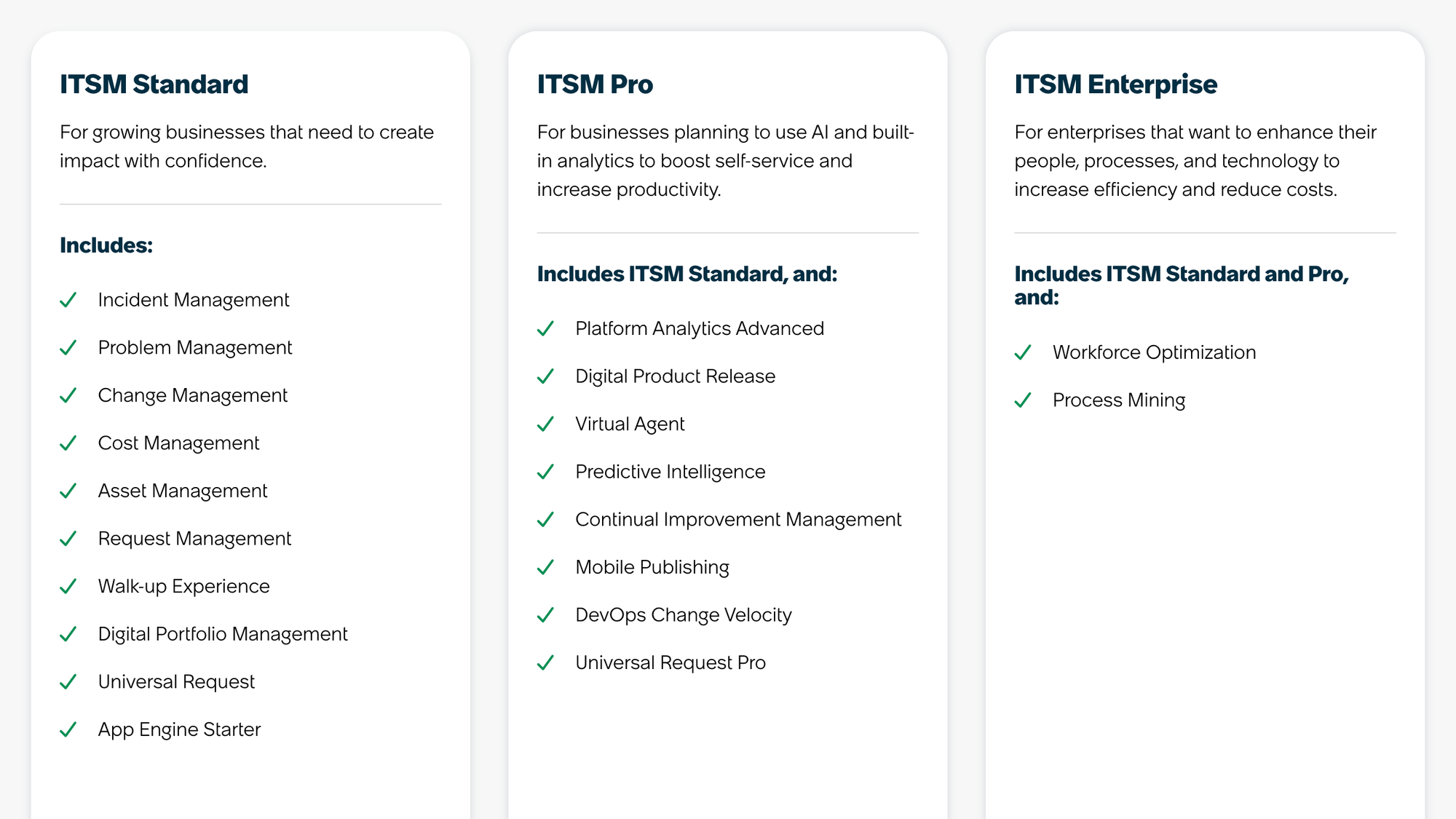
The biggest 2026 change is how ITSM is packaged. Its current public pricing page lists three AI-native tiers. Existing customers should check their contracted package and entitlements. The three tiers are:
- Foundation: The entry tier, covering incident management, service catalog and request management, asset management and CMDB, Virtual Agent, and Now Assist for ITSM at an out-of-the-box level.
- Advanced: Adds change and problem management, AI voice agents, process mining, on-call management, Platform Analytics Advanced, and Now Assist at Advanced level.
- Prime: The top tier, adding AI Agents for ITSM and the L1 Service Desk AI Specialist, with Now Assist at Prime level.
Two shifts matter most for budgeting. First, Now Assist generative AI is now bundled into all three tiers rather than sold as a separate add-on. Second, following ServiceNow's roughly $2.85 billion acquisition of Moveworks completed in December 2025, each tier also includes a matching Moveworks for ITSM package. ServiceNow still publishes no dollar figures, so every tier is custom-quoted (as of September 2026).
If your team needs change or problem management, the current ITSM packages place those capabilities in Advanced or higher.
Here are general pricing estimates based on user reviews and third-party reports. Treat them as budgeting benchmarks rather than official quotes for the current packages:
IT Service Management (ITSM) - $100-$150 per user/month
Designed for IT teams managing incident, asset, and change management. Estimates run roughly $70-$100 per user for Foundation-level access up to $160-$200+ for Prime, before AI consumption. Key features include:
- Incident management, problem, and change management
- Knowledge management and configuration management database (CMDB)
- SLA tracking and reporting dashboards
- Basic workflow automation
At the $100/user/month estimate, 10 users would cost $12,000/year before implementation or additional modules. This is an illustrative calculation, not a verified minimum purchase.
IT Operations Management (ITOM) - reported estimate: $150-$200 per user/month
ITOM uses subscription-unit licensing and currently offers Advanced and Prime packages. The reported per-user range is a historical benchmark, not the billing metric to use for a current ITOM quote.
Ideal for monitoring, discovery, and operations management. Core features:
- Event management and automated remediation
- Asset management and dependency tracking
- Operations management dashboards
HR Service Delivery - $120-$180 per user/month
Automates HR service delivery, case management, and workflow automation for HR requests:
- Employee onboarding and offboarding
- Employee service center and knowledge base
- Workflow automation for HR requests
Customer Service Management (CSM) - $150-$200 per user/month
For teams managing customer service management at scale:
- Case automation and self-service portals
- Customer portals and knowledge base
- AI recommendations and predictive insights
AI capabilities and Now Assist - bundled, with consumption-based usage
Now Assist is included in current ITSM packages at Foundation, Advanced, or Prime level. Included capabilities do not mean unlimited usage. Confirm your AI allocation, consumption rules, and additional-capacity pricing in the quote, and model AI as a variable line item.
User reports suggest AI consumption can add meaningful costs. In an August 2026 discussion, one commenter estimated $2.50-$7.50 for a small ServiceNow agent execution. This is an individual, unverified estimate rather than a published rate, so ask ServiceNow to model your expected workflows against your contracted Assist allowance.
💡 Pro tip: Start with essential modules for your team and scale gradually. Paying for every module and the highest tier upfront can quickly push your ServiceNow costs beyond budget, especially with annual maintenance fees, ServiceNow license costs, and implementation cost factored in.

Get the best modern ServiceNow alternative
Automatically resolve 70% of customer requests & cut down manual support loads
Hidden costs and limitations
While ServiceNow pricing might seem straightforward, the actual ServiceNow costs can be significantly higher once you factor in enterprise requirements and add-ons:
- ServiceNow license costs and user minimums: Enterprise modules often require a minimum number of paid users. Even small teams can see the total cost increase sharply due to role-based licensing models.
- Approver and stakeholder seats: Check whether managers who view reports or approve requests need paid entitlements under your specific agreement.
- Annual maintenance fees and ongoing maintenance: Budget for ongoing administration and upgrade testing. Check which support services are included in your subscription before assuming a separate mandatory maintenance fee.
- Annual contract escalators: Check the renewal and price-increase clauses in your agreement. Reported increases of 3-7% should be treated as contract-specific examples, not a universal annual charge. Additional fulfillers, new modules, and expiring introductory discounts can also increase your renewal cost.
- Consumption-based AI overages: Current subscription documentation describes annual AI entitlement pools that reset on the contract anniversary. Confirm additional-capacity terms rather than assuming monthly caps and automatic per-unit overages.
- Integration costs for existing systems: Connecting ServiceNow to other tools like Slack, Salesforce, or Jira can require additional integration hub licenses or custom work, driving up implementation cost.
- Implementation cost, consultation fees, and professional services: Configuring modules, migrating existing data, and training staff typically requires professional services, adding substantial one-time expenses.
- Deployment requirements: ServiceNow also offers Private Stack for customer- or partner-operated infrastructure. Confirm availability, responsibilities, and feature coverage for your requirements.
💡 Tip: Start with essential modules and scale gradually. Planning your ServiceNow implementation carefully while accounting for license costs, annual maintenance fees, integration costs, workflow automation, and AI agents helps you manage the total cost effectively.
Pricing examples (user-reported estimates)
These are directional estimates from user reviews and third-party reports. They may reflect older packages or different contract terms. The 10-user examples illustrate the arithmetic, not a confirmed minimum purchase or a current ServiceNow quote.
| Module / Tier | Price (per user/month) | Example quantity | Key features | Illustrative annual cost |
|---|---|---|---|---|
| ITSM Foundation | $70-$100 (est.) | 10 users (example) | Incident, request, asset & CMDB, Virtual Agent, bundled Now Assist | $8,400-$12,000/year |
| ITSM Advanced | $120-$150 (est.) | 10 users (example) | Adds change, problem, AI voice agents, process mining | $14,400-$18,000/year |
| ITSM Prime | $160-$200+ (est.) | 10 users (example) | Adds AI Agents for ITSM and L1 Service Desk AI Specialist | $19,200-$24,000+/year |
| ITOM | $150-$200 | 10 users (example) | Event management, automation, operations management, asset tracking | $18,000/year |
| HR Service Delivery | $120-$180 | 10 users (example) | Employee workflows, HR service delivery | $14,400/year |
| CSM | $150-$200 | 10 users (example) | Case automation, customer service management, AI insights | $18,000/year |
Now Assist is included in current ITSM packages, but additional AI capacity may add to these estimates. For ITOM, use the quoted subscription-unit metric rather than the table's historical per-user benchmark (as of September 2026).
Other things to keep in mind
- Free plan or trial: Limited or unavailable, so annual commitments are usually required. Teams should understand the real ServiceNow pricing before committing.
- Implementation and integration complexity: Enterprise setups often require professional services, data migration, and external support, which can significantly increase total costs.
- Room to negotiate: ServiceNow pricing is always negotiable. Enterprise buyers routinely secure 40-50% off list for core ITSM, and timing a deal near the end of ServiceNow's fiscal quarter tends to unlock deeper discounts.
- Discounts and pricing tiers: Negotiated on a per-organization basis. Smaller teams or startups may not qualify for lower rates, so ServiceNow costs can be higher than expected.
- Security and compliance: Security operations and security incident response modules may require additional licenses, which can increase both ServiceNow license costs and annual maintenance fees.
What if ServiceNow is too expensive?
If ServiceNow costs are above your budget, there are modern tools that can support service delivery, asset management, and workflow automation without the same level of complexity or total cost.
Some organizations fully replace parts of ServiceNow, while others add lighter platforms alongside it to improve the customer experience layer without changing core enterprise systems.
- ✨Featurebase - AI-powered support and workflow automation that can replace traditional helpdesk tools or work alongside ServiceNow as a modern customer-facing layer, helping teams automate repetitive tasks, improve service delivery, and introduce transparent pricing without enterprise overhead.
- Zendesk - Multi-channel customer service management platform with enterprise features, automation, and a large integration ecosystem.
- Freshservice - Cloud IT service management solution with modular pricing, asset management capabilities, and faster onboarding compared to traditional enterprise platforms.
- Jira Service Management - Popular ITSM and service management platform for teams already using Atlassian products, offering flexible workflows and strong developer integrations.
- Intercom - Customer messaging and support platform focused on conversational support, automation, and AI-powered customer engagement.
- Help Scout - Lightweight helpdesk with email-based support, knowledge base tools, and a simpler pricing structure for growing teams.
- Zoho Desk - Budget-friendly customer support platform with automation, omnichannel capabilities, and strong integration within the Zoho ecosystem.
Our guide to enterprise help desk software compares the leading options.
So, is ServiceNow worth the investment?
ServiceNow is a powerful enterprise platform, but the costs for modules, ServiceNow licenses, AI capabilities, and implementation can quickly add up. For teams that want to optimize service delivery, automate workflows, and manage ITSM and customer service management efficiently without hidden fees, there's a smarter way.
Featurebase is a modern AI customer support platform that brings AI-powered support, a help center, and feedback management into one place - with transparent pricing you can actually see up front. It comes with an omnichannel Inbox, the Fibi AI Agent to resolve customer issues on autopilot, an AI-powered help center, and workflows to automate repetitive tickets and route conversations.
Unlike ServiceNow's custom quotes, Featurebase comes with a Free plan and paid plans starting at $29/seat/month, billed yearly, with $0.49 per AI resolution. The Free plan includes 1 seat and unlimited conversations. 👇
✨ Try Featurebase and streamline IT and support workflows with AI →
FAQs
Why doesn't ServiceNow publish its pricing?
ServiceNow builds every deal as a custom enterprise quote shaped by which modules you buy, how many fulfiller licenses you need, and which integrations you require. There is no public price list, only a "contact sales" process. Third-party estimates help fill the gap, but the only exact number comes from a quote.
How much does ServiceNow cost per year?
User reviews and third-party estimates put smaller ITSM deployments around $10,000-$20,000 per year, with an average contract estimate near $130,000 and total-cost estimates of 3-5 times the license fee. These are directional benchmarks, not official prices or guaranteed costs for your deployment. Request a quote and budget separately for implementation, administration, and training.
What are ServiceNow's Foundation, Advanced, and Prime tiers?
In April 2026, ServiceNow replaced its older ITSM tiers with three AI-native ones. Foundation covers core incident, request, and asset management with bundled Now Assist. Advanced adds change and problem management plus process mining, and Prime adds AI Agents for ITSM and the L1 Service Desk AI Specialist.
Is Now Assist AI included or a paid add-on?
As of the April 2026 repackaging, Now Assist generative AI is bundled into every ITSM tier rather than sold as a separate SKU. However, AI usage is consumption-based, so confirm included allocations and additional-capacity terms in your agreement.
Does ServiceNow have a free plan or free trial?
ServiceNow offers free Personal Developer Instances for learning and development, not production use. Ask sales whether an evaluation is available for the specific products and capabilities you need.
What's a cheaper alternative to ServiceNow?
If you mainly need modern support, a help center, and feedback tools rather than full enterprise ITSM, lighter platforms cost a fraction of ServiceNow and publish their pricing openly. Featurebase, for example, has a free plan and paid plans from $29/seat/month billed yearly, plus $0.49 per AI resolution.