Blog Customer FeedbackWhat Is Product-Market Fit? How to Find and Measure It
What Is Product-Market Fit? How to Find and Measure It
Product-market fit is the point where enough of the right customers want your product to pull it out of your hands. Here's what it means, why it matters, and how to find and measure it.


Every founder asks the same quiet question in the early days: do people actually want this, or am I just convincing myself they do?
Product-market fit is the answer to that question. It's the difference between a product people tolerate and one they can't stop using, and it's the single biggest predictor of whether a startup survives.
This guide breaks down what product-market fit really means, why it matters so much, and how to both find it and measure it. 👇
Key takeaways
- What it is: Product-market fit means you've found a market that genuinely wants your product and you're the best option to serve it. The term was coined by Andy Rachleff and popularized by Marc Andreessen.
- Why it matters: Poor product-market fit is one of the top reasons startups fail. Scaling before you have it just burns cash faster.
- How to find it: Narrow your target market, talk to real customers, ship an MVP, and iterate until retention and demand actually show up.
- How to measure it: Use the Sean Ellis 40% test, retention cohorts, NPS, and organic word-of-mouth rather than gut feel.
- Featurebase✨ helps you find fit faster by centralizing customer feedback, letting users vote on what to build, and running NPS and CSAT surveys, so you're building against real demand.
- It's not permanent: markets and expectations shift, so product-market fit is something you keep measuring, not a box you tick once.
What is product-market fit?
Product-market fit is the point at which your product satisfies a strong market demand. In plain terms, you've found a group of people with a real problem, you're solving that problem better than the alternatives, and those people want your product enough that growth starts to feel like it's pulling you forward.
The concept was coined by venture capitalist Andy Rachleff and made famous by Marc Andreessen, who described it as "being in a good market with a product that can satisfy that market." Andreessen's most memorable framing is that when you have it, you can feel it: customers are buying as fast as you can make the product, usage is growing, and you're hiring sales and support as fast as you can.
Three things have to line up for real fit:
- A specific market: a defined group of people who share a real, urgent problem.
- A product that solves it: your solution does the job better than the alternatives, including the alternative of doing nothing.
- Evidence of pull: those people adopt it, stick around, and tell others, without you having to drag them along.
The last point is what separates product-market fit from wishful thinking. Plenty of products get polite interest. Fit is when demand outpaces your ability to keep up.
Why product-market fit matters
Product-market fit matters because almost nothing else works without it. You can have a talented team, a slick interface, and a big marketing budget, but if the underlying product doesn't solve a problem people care about, all of that spend just helps more people discover that they don't want it.
The data backs this up. In a CB Insights analysis of 431 venture-backed companies that shut down, poor product-market fit was the second most common reason for failure at 43%, behind only running out of capital. And two-thirds of those product-market fit failures were early-stage companies that never found a market in the first place.
That's the trap. Running out of money is usually the final cause of death, not the root problem. The root problem is spending heavily to scale a product before you've proven that a market genuinely wants it. Once you have fit, growth compounds and mistakes are forgivable. Before you have it, growth spending mostly accelerates the burn.
This is why experienced founders treat finding fit as the real job of an early-stage company. Everything else, from pricing to positioning to hiring, is easier to fix later.
How to find product-market fit
Finding product-market fit is less about a flash of genius and more about a disciplined loop: understand a specific problem, build the smallest thing that solves it, and refine based on how real people respond. Here's how that plays out in practice.
- Narrow your target market: Resist the urge to build for "everyone." Pick the segment that feels the pain most acutely and win them first.
- Talk to real customers: Run interviews to understand the problem in their words, not to pitch your solution. You're looking for patterns in what frustrates them.
- Define your value proposition: Get specific about the outcome you deliver and why it beats the current alternatives.
- Ship an MVP: Build the smallest version that actually tests whether people want it, then get it into real hands quickly.
- Iterate through selling: Keep refining based on who buys, who stays, and who refers others. Real usage tells you more than any survey.
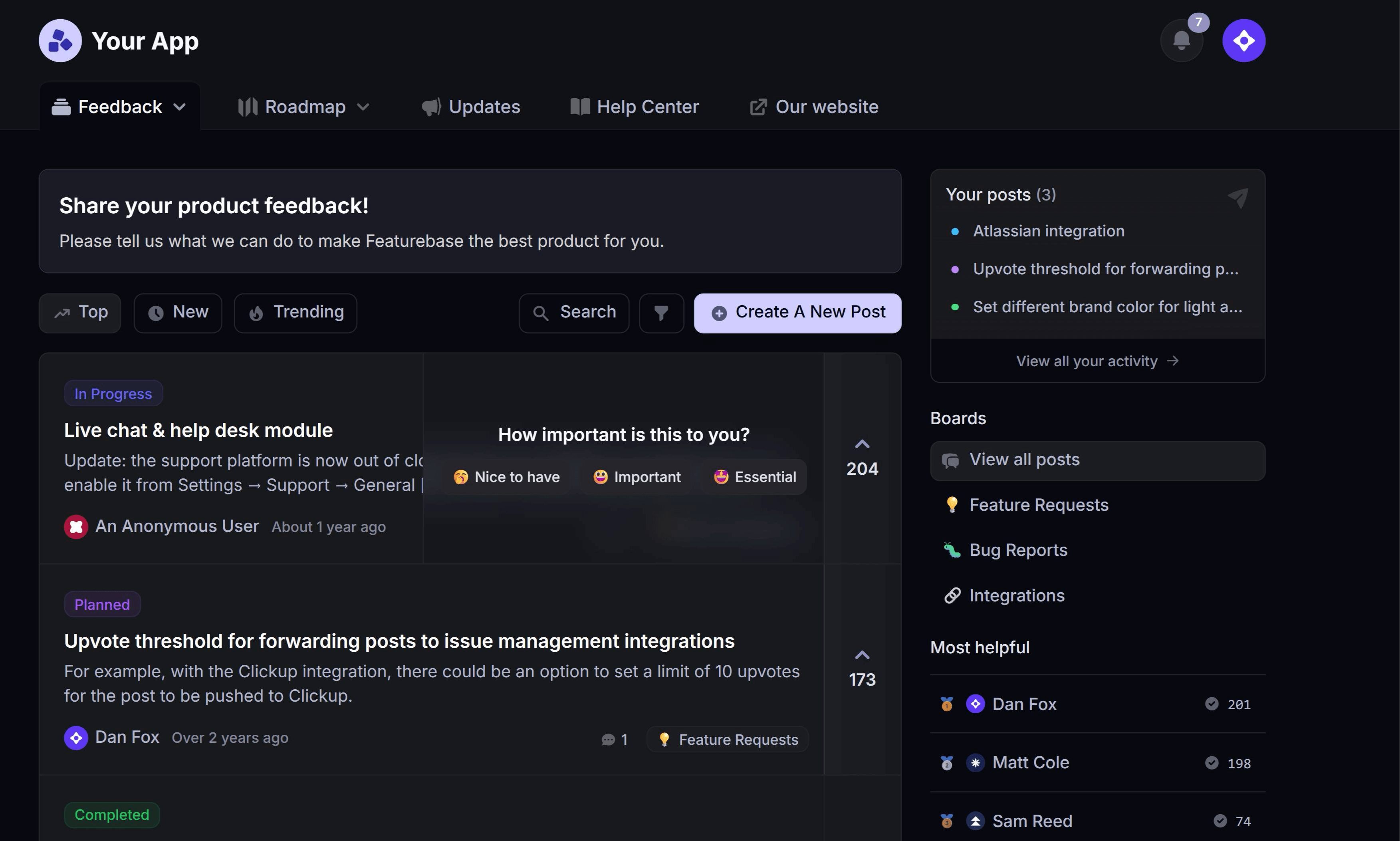
The hardest part of this loop is staying honest about what customers are actually asking for, rather than reacting to the loudest few or your own favorite ideas. This is where a feedback tool earns its keep. With Featurebase, you can run a public feedback board where users submit ideas and vote on each other's requests, so the problems that show up again and again rise to the top and you build against real demand instead of guesses.
How to measure product-market fit
"You can feel it" is a nice line, but founders need something more concrete. The good news is that product-market fit leaves measurable fingerprints. No single number proves it, so the strongest read comes from looking at a few signals together.
- The Sean Ellis test: Ask users "how would you feel if you could no longer use this product?" If 40% or more say they'd be "very disappointed", that's the widely used benchmark for strong fit.
- Retention and cohort curves: Track whether users who sign up keep coming back. A retention curve that flattens out instead of decaying to zero means people are sticking around.
- Net Promoter Score (NPS): Measure how likely users are to recommend you. Consistently high scores signal that your product is worth talking about.
- Organic growth: Watch for word-of-mouth, inbound signups, and demand you struggle to keep up with. When growth happens without you pushing, the market is pulling.
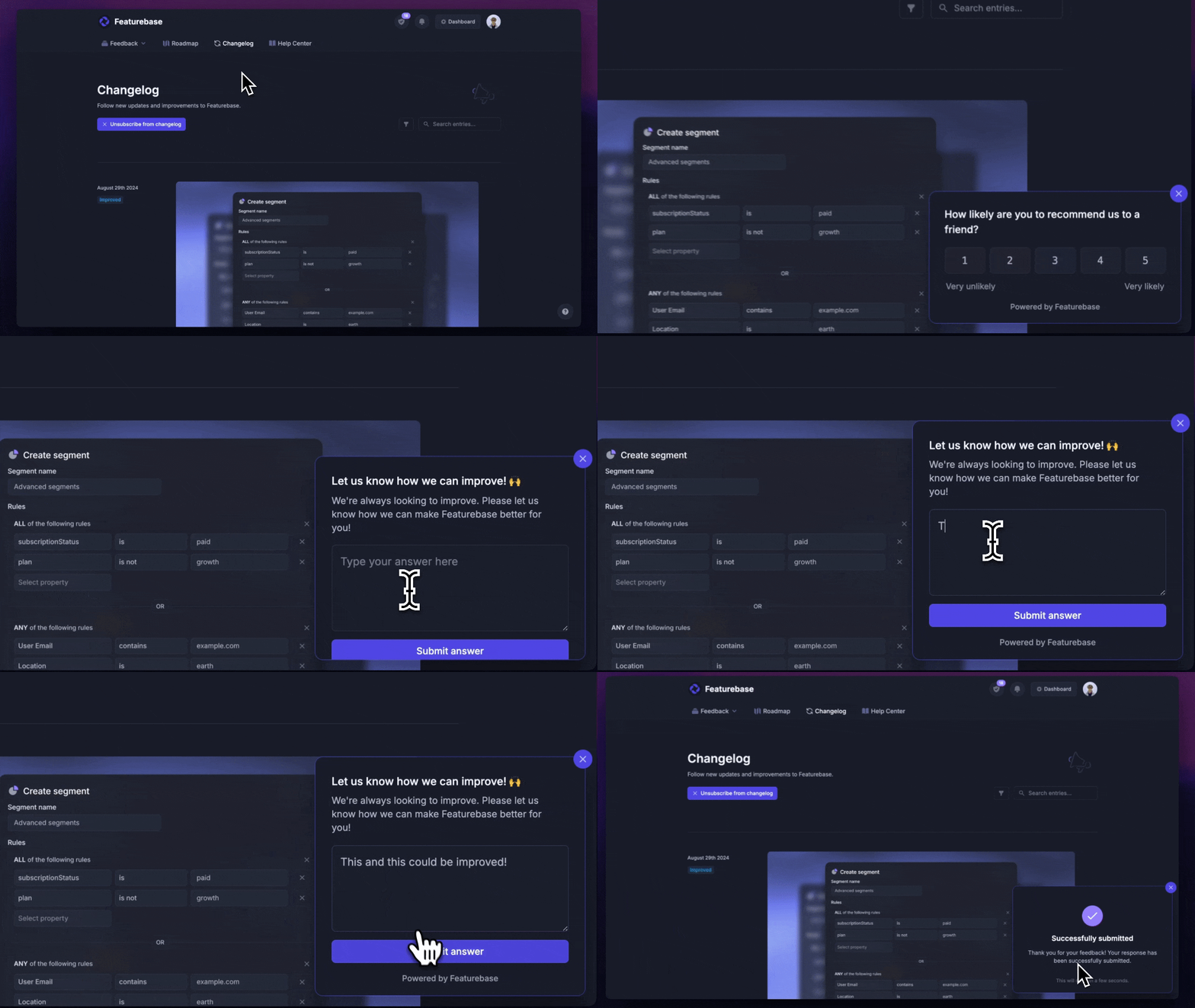
The most practical way to run these checks is with surveys you can send to the right users at the right moment. Featurebase lets you launch targeted in-app surveys, including NPS, to specific user segments, so you can put a real number on that 40% signal and watch it move as you iterate rather than guessing whether you're getting closer.
One caution: retention and word-of-mouth are lagging indicators, so pair them with direct conversations. The numbers tell you whether fit is improving. Talking to customers tells you why.
Product-market fit examples
The clearest way to understand product-market fit is to see it in action. A few well-known examples show what it looks like when demand finally clicks.
- Slack: Built originally as an internal tool for a games company, Slack solved team communication so well that the team realized the tool was more valuable than the game. When they opened it up, demand was immediate and viral inside companies.
- Airbnb: Rather than chasing "all travelers," the founders started narrow, offering air mattresses to people who couldn't find hotel rooms during sold-out conferences. That focused wedge proved real demand before they expanded.
- Superhuman: The email client famously measured its way to fit using the Sean Ellis survey, iterating on the product until the share of users who would be "very disappointed" to lose it climbed well past the 40% benchmark.
- Netflix: A reminder that fit can be lost. Netflix had strong product-market fit with DVD-by-mail, then had to find it all over again as customer expectations shifted to streaming. Reading that shift early is what kept the company alive.
The pattern across all 4 is the same: a specific market, a product that clearly beat the alternatives, and demand strong enough to build a business on.
What to do after you reach product-market fit
Reaching product-market fit is a milestone, not a finish line. Once you have it, the job shifts from finding demand to serving and protecting it.
Now is the time to scale the things that were too manual before, like sales, onboarding, and support. But scale carefully, because growing too fast can dilute the experience that earned you fit in the first place. Keep measuring the same signals you used to find fit, since a slipping retention curve or falling survey score is an early warning that the market is moving.
Most importantly, stay close to your customers. The feedback loop that got you here is the same one that will tell you when it's time to expand into an adjacent segment or defend against a competitor who just raised the bar.
Find and measure product-market fit with Featurebase
Finding product-market fit comes down to listening to the right customers and measuring whether they actually want what you're building. That's exactly what Featurebase is built for.
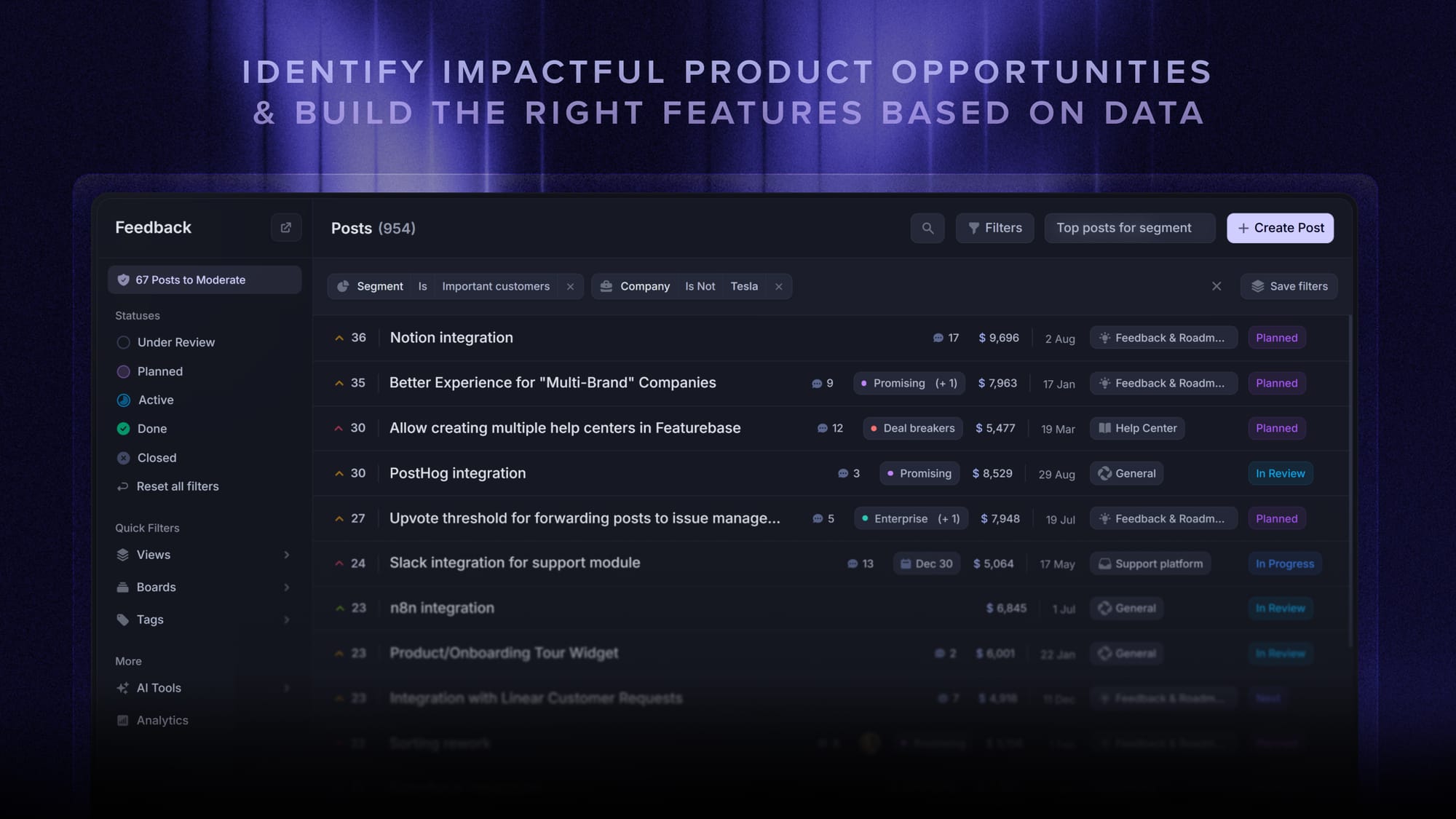
Featurebase is a modern feedback & support platform that helps product teams collect feedback, prioritize features, build roadmaps, and announce product updates - all in one place. It's loved by thousands of product teams from companies like Lovable, Raycast, and n8n. 💫
Top features:
- Feedback forum – Public feedback forum where users can submit ideas and vote on features helping you know what customers want
- In-app widgets – Embed feedback, changelog, and help center widgets directly in your product
- Prioritize by revenue – Link feedback with customer revenue, company size, and much more to better understand the impact of ideas
- AI feedback categorization - Automatically group large volumes of feedback into product areas, projects, or themes with AI.
- Automated email updates – Automatically notify users when their requested features are implemented
- Roadmaps – Create internal & public product roadmaps to keep users informed and build engagement
- Product updates – Publish release notes with a changelog page, in-app widget, and emails
- Surveys (NPS, CSAT, etc) – Create targeted surveys to ask users anything and measure customer satisfaction.
- Automatic AI translations – Automatically translate all feedback and comments to your customers / teammates native languages
- Integrations – Connects with Slack, Linear, Jira, HubSpot, and more
Pricing: Free plan available with unlimited feedback collection. Paid plans start at $29/seat/mo.
Instead of having 4+ different tools, Featurebase enables you to replace all your customer-facing tools by bringing your feedback collection, product updates, support, and help center together in one place to help you build products your users love.

Turn feedback into products your users love
Centralize feedback, identify product opportunities, and build the right features
Conclusion
Product-market fit isn't a single moment you cross once. It's something you find, measure, and protect as your market changes. The founders who get there fastest are the ones who stay close to their customers and let real feedback, not gut feel, guide what they build next.
That's where Featurebase comes in. It brings your feedback collection, feature voting, roadmaps, and NPS and CSAT surveys into one place, so you can see what your market actually wants and measure how well you're serving it.
There's a free plan and onboarding takes minutes, so there's no downside to trying it. 👇
✨ Start collecting & managing feedback with Featurebase for free →
FAQs
At what stage should a startup focus on product-market fit?
As early as possible, and before spending heavily on growth. Product-market fit should come after you have a working MVP but before you pour money into marketing, sales hires, or paid acquisition. Scaling first and hoping fit follows is the most common and most expensive mistake early-stage teams make.
How long does it take to reach product-market fit?
There's no fixed timeline. Some products find fit in months, while many take 1 to 3 years of iteration, and some never get there. What matters is not the calendar but the loop: how quickly you can talk to customers, ship changes, and measure whether demand is improving.
Can a company lose product-market fit?
Yes. Markets shift, customer expectations rise, and competitors change what "good" looks like. Netflix is the classic example, moving from DVD-by-mail to streaming as demand changed. This is why fit is something you keep measuring rather than a milestone you clear once and forget.
Who is responsible for finding product-market fit?
In the early days it usually falls to the founders and the product team, but it's genuinely cross-functional. Sales hears why deals stall, support hears what frustrates users, and marketing sees which messages land. Pulling those signals together is what turns scattered feedback into a clear read on fit.
Does product-market fit guarantee a startup will succeed?
No. Product-market fit is necessary but not sufficient. You still need a viable way to reach customers, healthy unit economics, and strong retention to build a lasting business. Fit gets you a market that wants your product, but you have to serve it profitably to win.
What tools can help you find product-market fit?
The most useful tools are ones that help you collect customer feedback and measure satisfaction over time. Featurebase covers both, giving you a feedback forum where users vote on what to build plus NPS and CSAT surveys to quantify demand, so you can track your progress toward fit in one place instead of stitching together spreadsheets.