Chatbot Self Service: Complete 2026 Guide + Top Tools
Chatbot self-service: a full guide on how to purchase, what features to look for and the best chatbot tools you can pick in today's market.


On this page
At the time of writing this article, ChatGPT has been around for almost 4 years. And while artificial intelligence has been around for longer than that, OpenAI really blew the doors open and showed what is possible with AI. One of the things that got a major upgrade was chatbots. Thanks to AI, chatbots can now get more context and provide more helpful answers.
A self-service chatbot can help you enhance customer satisfaction, speed up the time it for takes customers to get an answer, and, in general, help your business grow.
Here's how self-service chatbots work and why you need them. But first, let's cover the basics. 👇
Short overview
The best chatbot platforms for efficient customer experience in 2026:
- ✨ Featurebase: Best AI support chatbot for modern teams, costing just $0.29 per successful resolution
- Yellow.ai: Best for large organizations that need advanced conversational AI across voice and messaging channels.
- Voiceflow: Best for teams that want to design and deploy custom chat and voice bots with a visual builder.
- NICE Cognigy: Best for enterprises that require NLP-powered bots to handle complex conversations and routine tasks across multiple channels.
- eesel.ai: Best for support teams that want AI trained on their own knowledge to automate replies and triage tickets.
- DevRev: Best for companies that want support and product aligned so customer issues directly inform development.
- Document360: Best for teams focused on building and maintaining robust self-service knowledge bases.
- Quiq: Best for businesses that want seamless messaging across SMS, web chat, and social apps in one platform.
- ManyChat: Best for small to mid-sized businesses that want multichannel chatbot automation for social and messaging channels.
- LiveChat: Best for companies that want a mix of live agent conversations and automated chat responses on their website.
What does self-service mean for customer experience?
Self-service customer support happens when customers resolve problems on their own instead of talking to a customer support rep, sending you an email, or writing a message.
Zendesk's research shows that 91% of customers would use a knowledge base if it met their needs rather than talking to a human support rep. All around the web, you'll find similar statistics highlighting that customers prefer troubleshooting on their own.
Self-service could mean a few things:
- Asking a self-service chatbot to resolve a problem
- Guiding users through troubleshooting steps
- Completing simple actions such as password resets or subscription changes
- Collecting information before escalating to a human agent
In most cases, self-service chatbots resolve simple issues, and when necessary, they escalate to human agents who take over and fully resolve problems. The end result is an improved customer experience and agent productivity.
But how do you know what features (not) to look for?
For the full picture across every self-service channel, see our guide to customer self-service.
Buyers' guide: what to shop for when purchasing chatbot tools
The first step to implementing self-service chatbots is understanding what features really matter and what's nice to have.
The first and most important is natural language processing and the ability to understand customer queries clearly. While AI will never be on a completely human level, the latest language models can give quick and accurate responses on a level that meets customers' needs.
Look for the ability to recognize intent and handle varied phrasing, as well as contextual awareness that spans multiple platforms.
Next, look for a seamless integration with a knowledge base, ideally one that is proprietary to the chatbot system. Knowledge bases are the foundation for all the self-service interactions, and they should store all the data about your product, how it works, and the problems that commonly arise.
Ideally, the tool should offer automated workflows or customer service automation that go beyond answering customer inquiries. It should be able to handle simpler business processes, such as updating account settings, resetting passwords, or looking up an order. This is the same capability that defines the best automation tools for support teams.
Smooth human escalation is next, and not just for the customer. When the bot registers that it's time for human intervention, the customer shouldn't even notice the change. But more than that, the agent working the case should see relevant customer data, past interactions, and the context around the issue so they don't land mid-conversation, unprepared.
Analytics and reporting are fairly important, too. The platform should tell you the most common user queries and failed responses, either by agents or chatbots. It should tell you the deflection vs. escalation rate, as well as provide insights into key metrics like time to first resolution.
Last but not least, it should be fully multichannel and cover website live chat, email, messaging platforms like WhatsApp, in-app widgets, and more.
Finding such tools isn't impossible, and we prepared 10 of them, based on our research and personal experience.
If you'd rather buy these capabilities than assemble them, dedicated AI customer support software bundles the chatbot, knowledge base, and inbox in one tool.
The best chatbot self-service tools to improve customer satisfaction in 2026
Looking to add self-service capabilities to your customer support or simply pass some customer interactions to AI instead of real agents? Here are some of the best choices for self-service chatbot tools in today's market.
1. Featurebase ✨
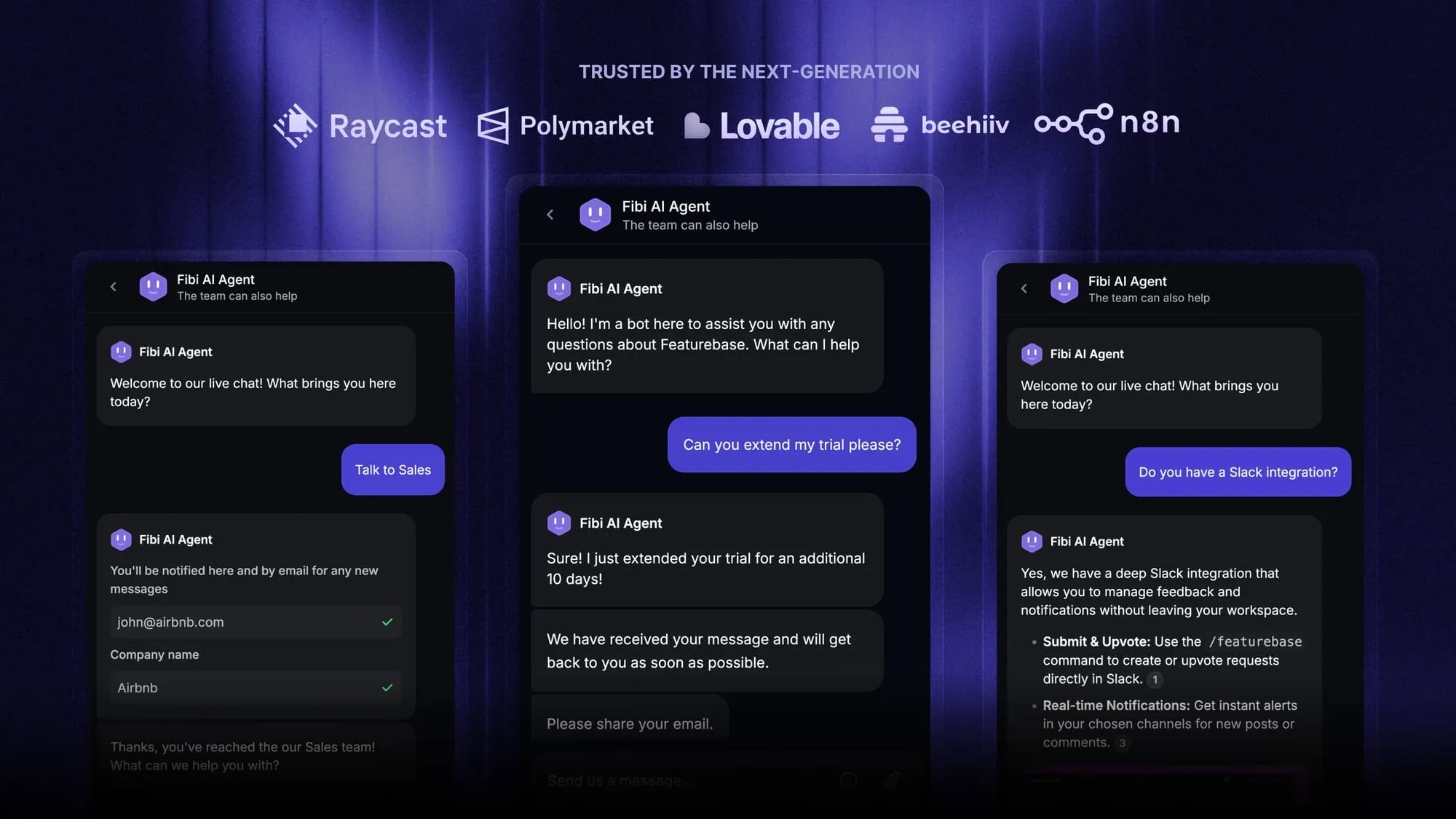
Featurebase is a modern AI customer support platform for product-led SaaS. It combines an AI-powered omnichannel inbox, help center, and feedback management into a single platform for startups that want all their customer-facing tools in one place. Featurebase is loved by thousands of support teams from companies like Lovable, Raycast, and n8n. 💫
Top features:
- Fibi AI Agent – Resolve customer issues on autopilot & run custom actions like trial extensions and refunds
- Omnichannel inbox – Manage live chat, email, and Slack conversations from one AI-powered view
- AI Copilot – Help your agents answer customers faster with AI Copilot that uses your internal knowledge
- Workflows & automations – Auto-assign tickets, route conversations, collect customer data, and more
- Help center with AI search – Provide instant, multilingual self-serve answers trained on your content
- Multi-brand support – Manage multiple Help Centers and Live chats from a single workspace
- Automatic AI translations – Automatically translate all messages and help articles to your customers native language
- Service Level Agreements – Track SLAs to make sure your team responds to customers on time, every time
- Integrations – Connects with Slack, Linear, Jira, HubSpot, and more
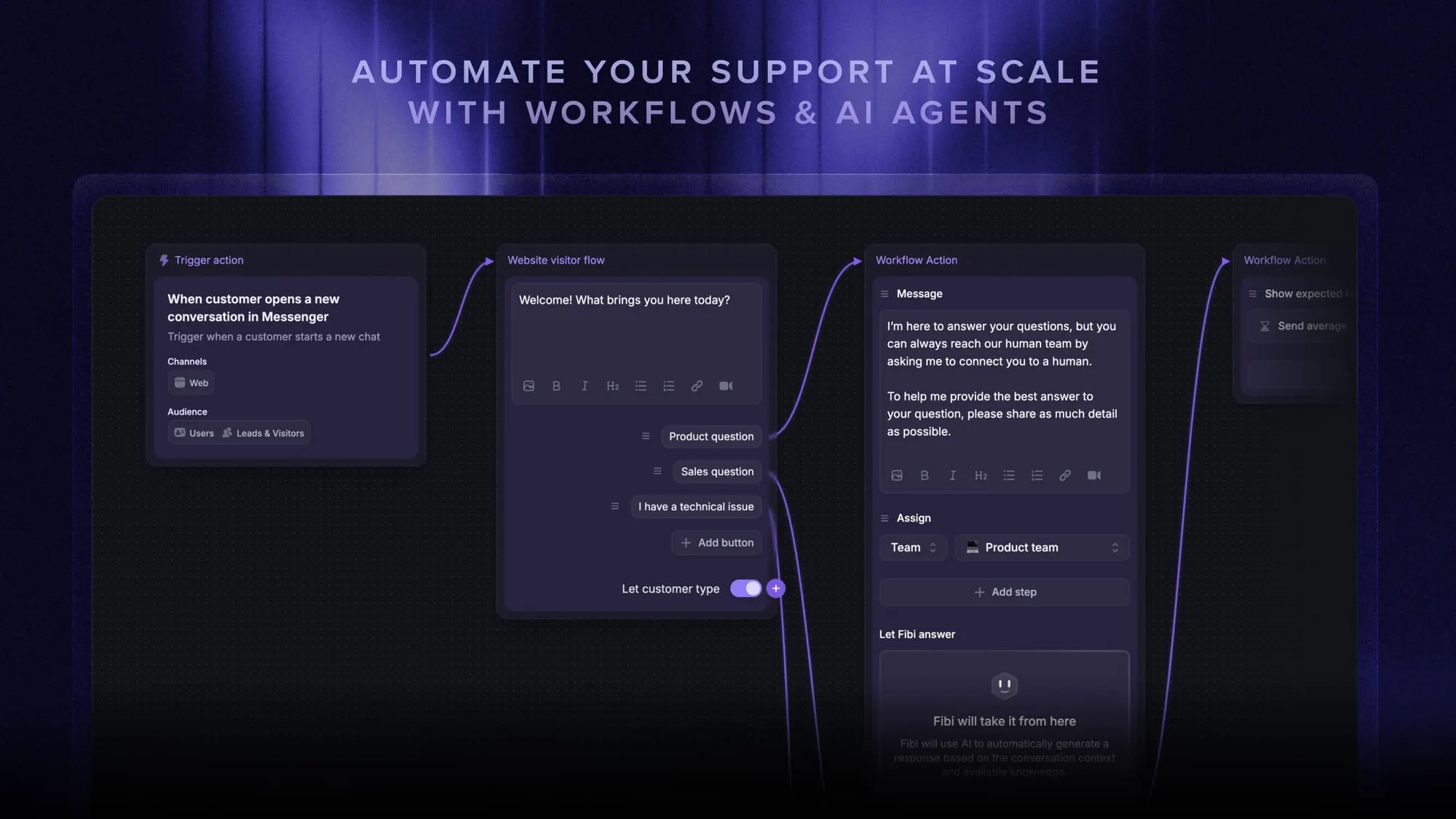
Pricing: Free plan available with unlimited conversations. Paid plans start at $29/seat/month with $0.29 per AI resolution (the lowest AI resolution cost in the industry).
Featurebase covers all the basic chatbot and self-service features that legacy platforms do, but with a much more modern approach. Customers get instant answers from your help center, and when Fibi can't resolve an issue, the handoff to a human agent is smooth and contextual.
2. Yellow.ai
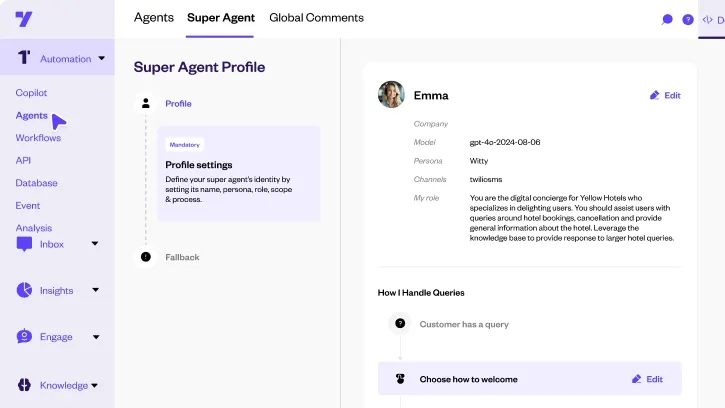
Yellow.ai is a conversational AI platform that helps teams build chatbots and voice bots to serve customers across web, mobile, messaging apps, and voice channels.
It focuses on using automation and natural language understanding to handle routine tasks and enable more advanced conversations, giving customers self-service options while still allowing seamless handoffs to human agents when needed throughout their interaction.
Top features
- Conversational AI bots powered by natural language processing across channels
- Omnichannel deployment on websites, apps, WhatsApp, Messenger, and other messaging platforms
- Automated workflows that trigger actions and route requests based on bot outcomes
- Self-service knowledge access through bot-driven help content or FAQs
- Analytics and insights on bot performance, user behavior, and common issues
Pricing is custom, so you'll have to reach out and get a quote.
3. Voiceflow
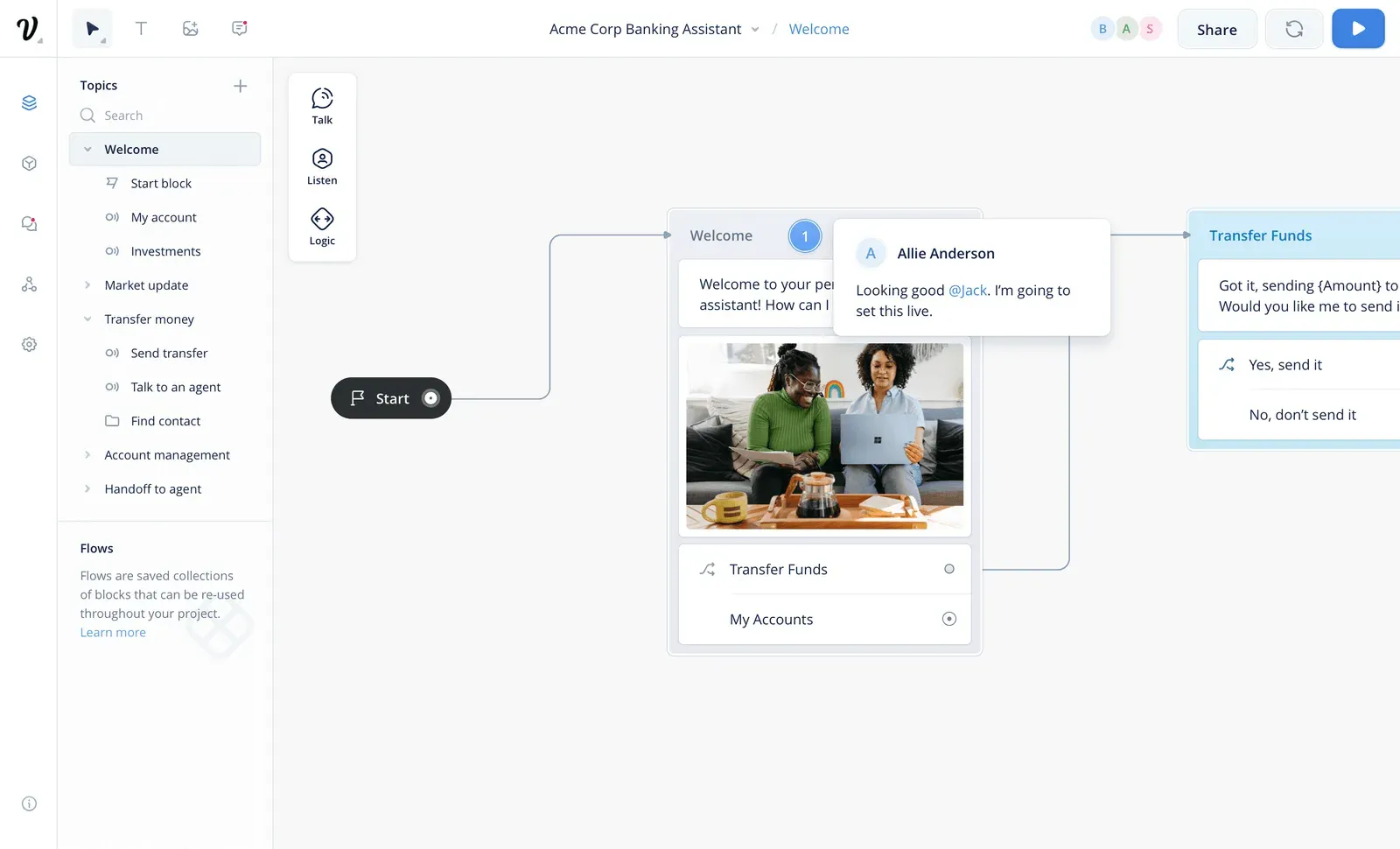
Voiceflow is a conversation design platform that helps teams build and launch chatbots and voice assistants without coding. It's often used by support teams, product teams, and customer experience groups that want to create automated interactions for websites, apps, and voice platforms.
By designing flows visually and connecting them to backend systems, teams can deliver self-service experiences that answer questions, guide users, and reduce routine tasks.
Top features
- Visual bot builder with a drag-and-drop interface for rapid design
- Multichannel deployment to web chat, mobile apps, voice assistants, and messaging platforms
- API integration to connect bots to backend systems and databases
- User testing and preview tools to simulate conversations before launch
- Analytics and feedback to track performance and improve bot flows over time
Voiceflow pricing is not available publicly, but there is a free trial available.
4. NICE Cognigy
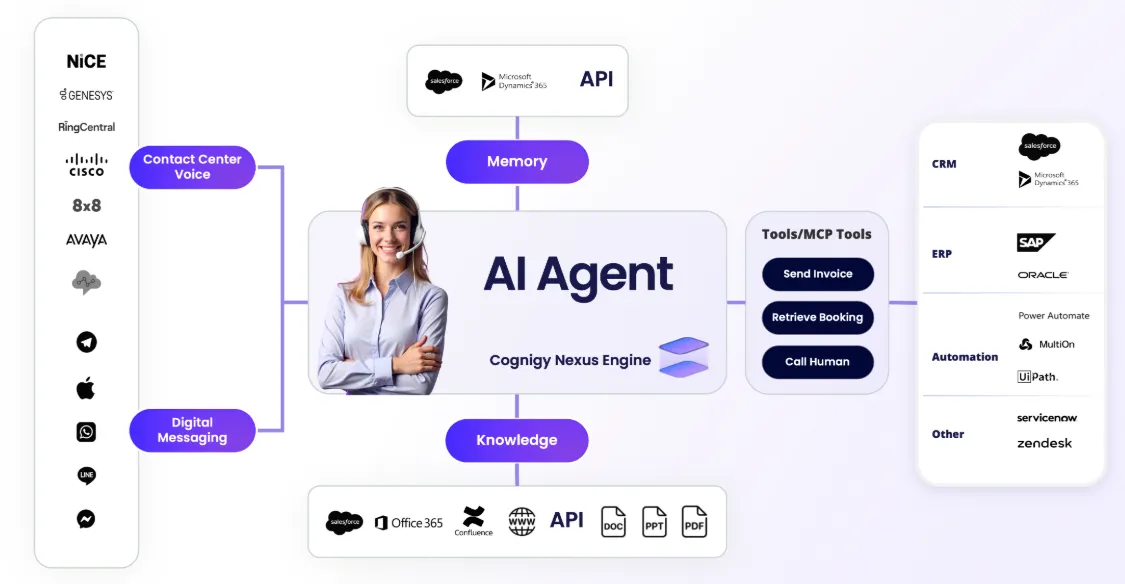
NICE Cognigy is an enterprise conversational AI platform designed for large customer service organizations that need advanced chatbot and voice bot automation. It specializes in utilizing natural language processing to handle both simple and complex conversations across channels.
The platform can help customers interact with automated AI agents and guide them through self-help flows or hand off to human support, creating efficient self-service experiences and reducing the load on support teams.
Top features
- Conversational AI agents that understand and respond to customer queries in chat and voice
- Multichannel support across web chat, voice, messaging, and other contact points
- Context awareness that remembers previous interactions for complex conversations
- Self-service flows that let companies create guided paths without human intervention
- Analytics and optimization to refine bot logic and improve outcomes over time
Pricing is not publicly available, but our research shows that it starts at around $2,500 per month, with custom enterprise contracts based on usage and features.
5. eesel AI
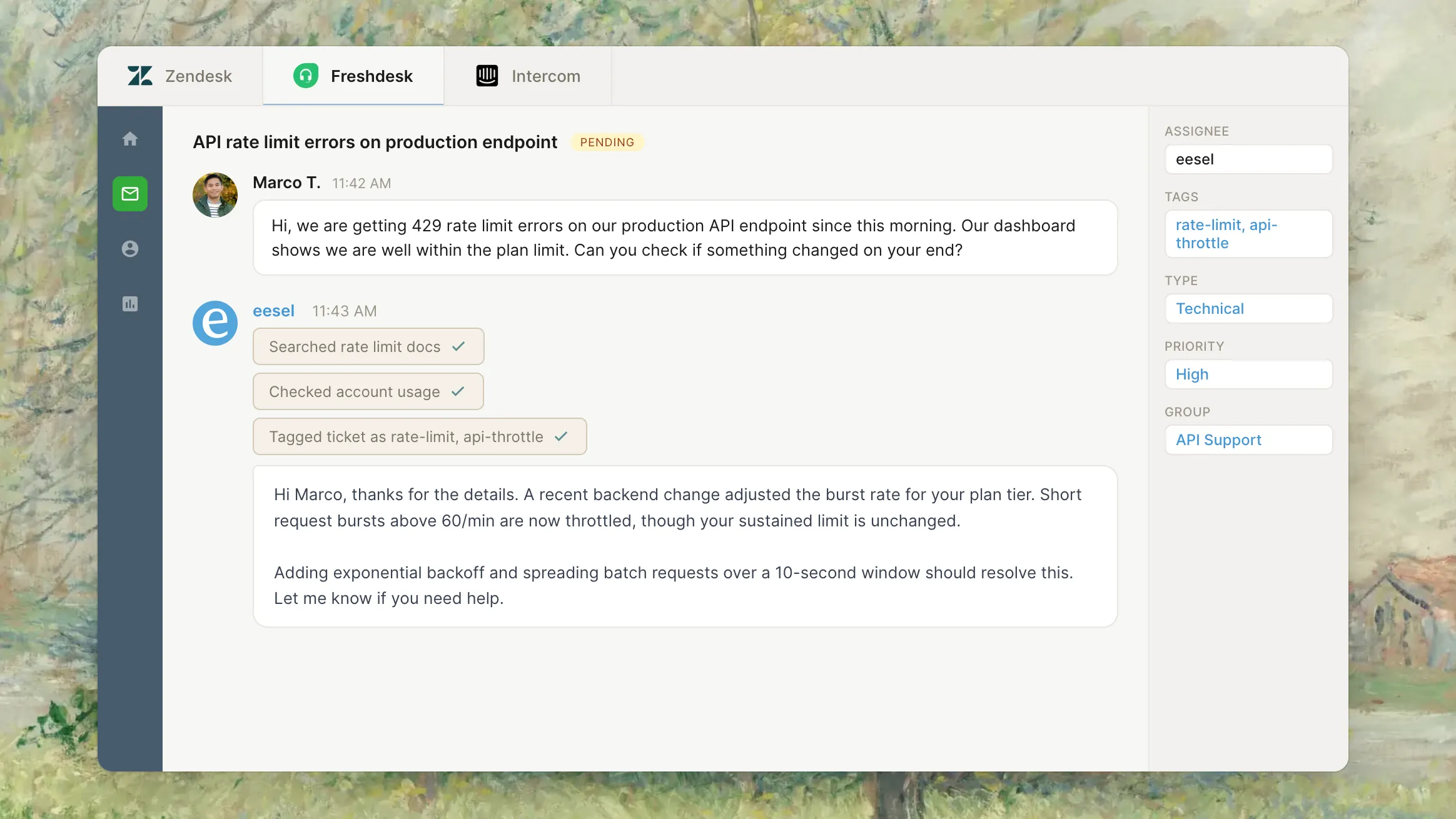
eesel AI is an AI-driven support automation platform that helps customer support teams automate common questions and triage incoming requests using trained AI agents. It lets customers interact with an AI chatbot or agent that learns from documentation, help centers, and past replies so support teams can serve customers faster and offer self-service experiences without building everything themselves.
Top features
- AI-trained chatbot that replies to common queries using your past responses and knowledge base
- Helpdesk integrations with Zendesk, Freshdesk, Intercom, and others
- Automated triage that sorts and categorizes incoming tickets
- Custom bot training using your own docs, spreadsheets, and help articles
- Interaction analytics to track AI performance and identify gaps
eesel pricing starts at $239 per month for the Team plan, which is one of the many reasons users look for eesel alternatives.
6. DevRev
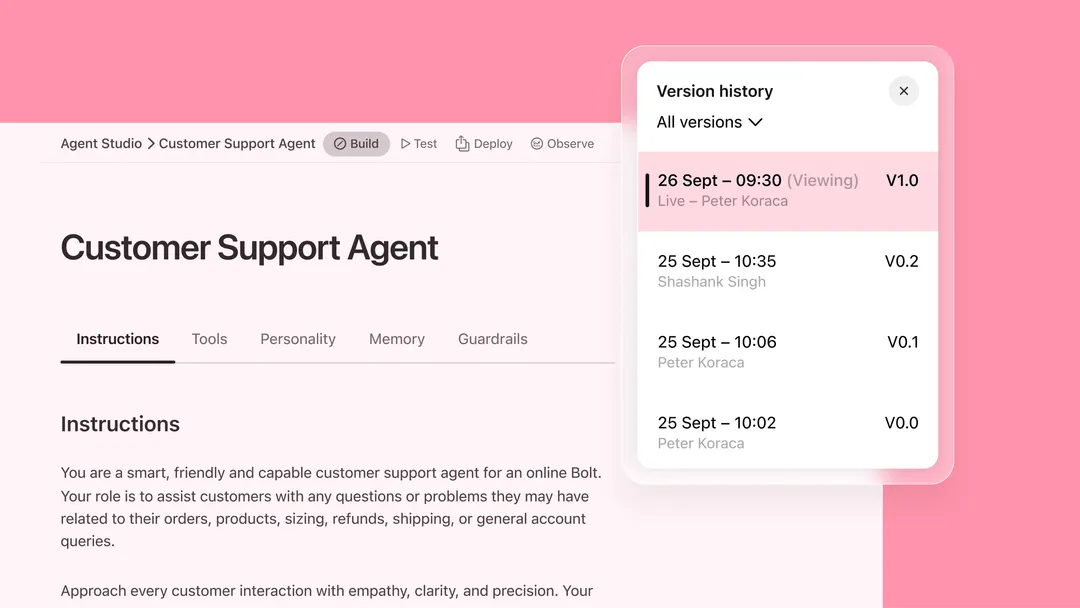
DevRev is an AI-driven platform that connects support, product, and engineering teams around customer conversations and issues. It helps customers interact with support and product teams through chat and AI, and offers a self-service portal so users can find answers on their own and build consistent self-service experiences without separate tools.
Top features
- AI chatbot that answers common questions and hands off to a human when needed
- Self-service portal where customers can search help content and solve simple issues
- Unified inbox bringing chat, email, and other channels into one workspace
- Customer timeline showing all past interactions and context
- Automation workflows that route requests, create tickets, and trigger actions
Pricing is not available publicly, and you can book a demo to get started.
7. Document360
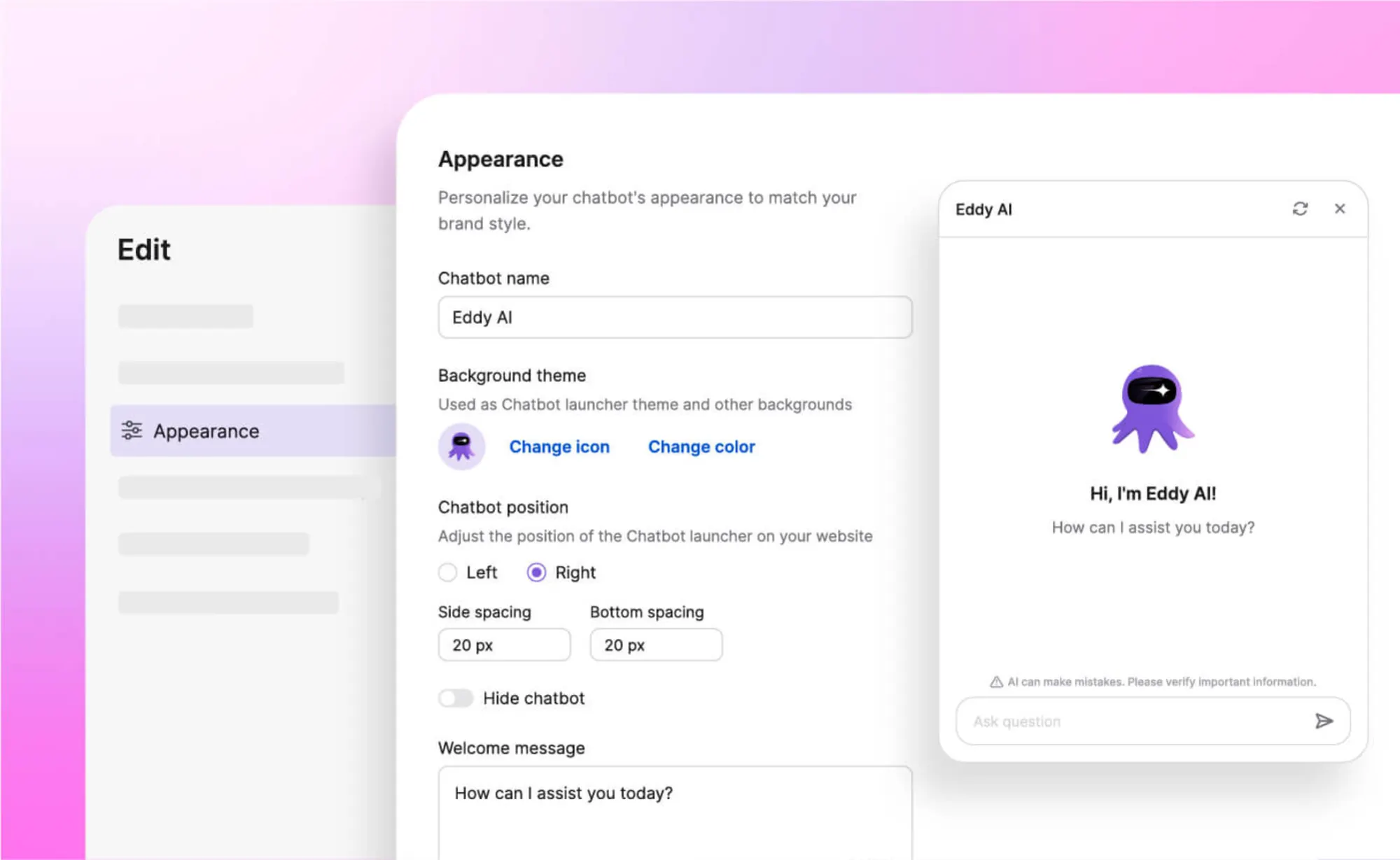
Document360 is a knowledge base and self-service platform that helps teams build and manage searchable help centers, product documentation, FAQs, and internal manuals. It's used by customer support, product, and technical writing teams that want to reduce support tickets and give customers and employees reliable self-help resources in one place.
Top features
- Knowledge base portal with a branded help center for customer self-service
- AI-assisted search that surfaces relevant answers instantly
- Article editor with Markdown, rich text, revision history, and media support
- Embeddable widget that adds help content inside your product or website
- Analytics and feedback on what users search for and which articles are most used
Document360 pricing is not publicly available at the moment of writing.
8. Quiq
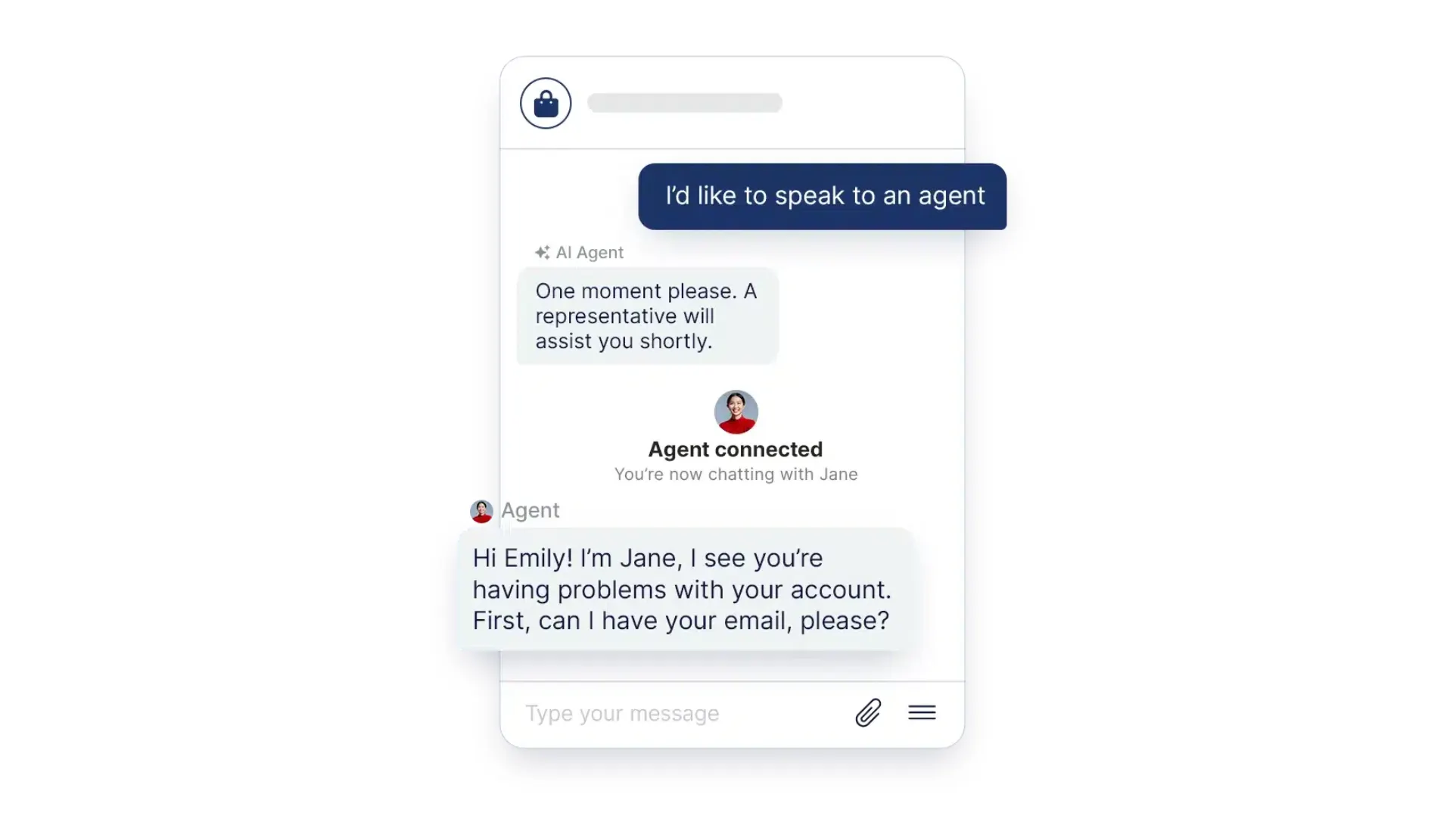
Quiq is an enterprise customer messaging and conversational AI platform that helps brands manage customer communication across web chat, SMS, social platforms, and other channels in one place. It uses AI-powered bots alongside human agents to resolve routine questions, triage issues, and guide conversations efficiently so customers can get help where they prefer and teams can scale service without adding a lot of overhead.
Top features
- Omnichannel conversational messaging across SMS, web chat, social, and other channels
- AI-powered assistants that automate routine inquiries before handing off to live agents
- Human agent collaboration for fluent transitions from AI to human when needed
- Integration tools that connect with CRM systems and existing support stacks
- Conversation analytics for insights on interactions, performance, and customer satisfaction
Pricing is not available publicly, but research shows that it leans towards the enterprise side.
9. ManyChat
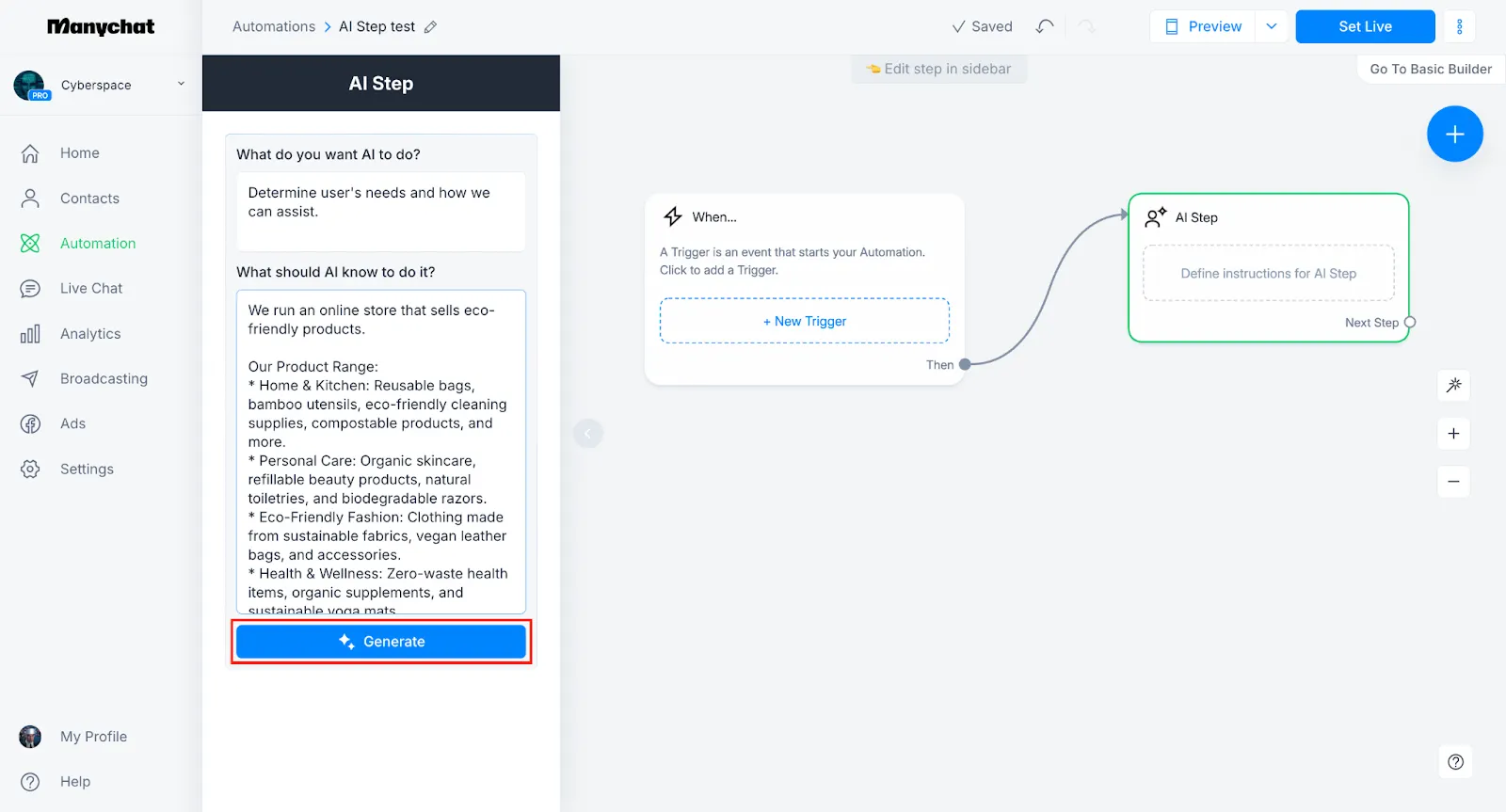
ManyChat is a messaging automation and chatbot platform that helps businesses create automated conversations and self-service flows across social and messaging channels.
It is used by small and mid-sized brands that want to serve customers on platforms like Instagram, Facebook Messenger, WhatsApp, SMS, and email while leveraging customer data in the conversation to tailor responses and offer self-service options without manual work.
Top features
- Multichannel bot builder for Messenger, Instagram, WhatsApp, SMS, and email
- Visual flow editor with drag-and-drop controls instead of coding
- Audience segmentation using tags and custom fields to tailor replies
- Live chat handoff that lets customers move from a bot to a human agent
- Broadcast and campaign tools that send targeted messages based on triggers and schedules
ManyChat pricing starts at $15 per month for the Pro plan, with a free tier that supports basic bot building up to 1,000 contacts.
10. LiveChat
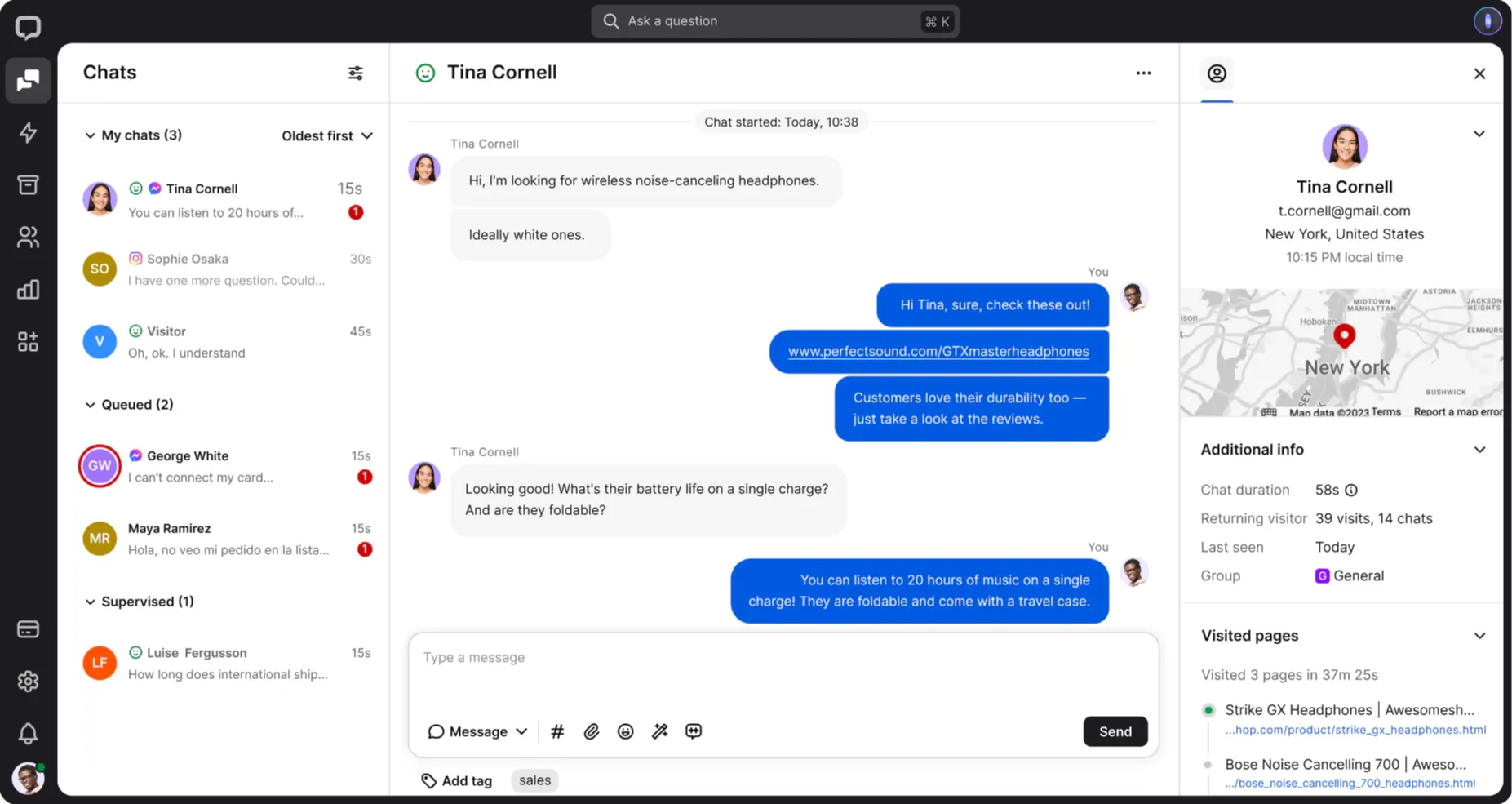
LiveChat is a live chat and self-service chatbot tool that helps businesses handle customer conversations from websites and other online channels. It offers a customizable chat widget for real-time messaging, AI-assisted responses using its ChatBot integration, and features to automate common questions so teams spend less time on repetitive support. It works well for small and mid-sized businesses that want a mix of live agent support and automated chat responses.
Top features
- Live chat widget that adds a chat box to your website for instant conversations
- ChatBot automation using AI-driven bots to answer common queries and collect info
- Visitor tracking that shows what page a visitor is on for context-aware responses
- Integrations with CRMs, ecommerce platforms, and help desks for unified support data
- Customizable messaging to tailor greetings, responses, and widget appearance
LiveChat pricing starts at $19 per agent per month.
Wrapping up
The end goal is never to replace human agents, but to significantly enhance the way simple problems are solved. That way, the agents can focus on more complex issues that even the best AI-powered chatbot won't be able to fix.
Featurebase is a modern AI customer support platform for product-led SaaS. It combines an AI-powered omnichannel inbox, help center, and automations into a single platform, so your customers get instant answers from Fibi AI. It's loved by thousands of support teams at companies like Lovable, Raycast, and n8n. 💫
It comes with a Free plan and paid plans starting at just $29/seat/month with $0.29 per AI resolution (the lowest in the industry). Setup takes minutes and doesn't require a credit card, so there's no downside to trying it. 👇
Automate your support with the fastest AI-enhanced Inbox today


