Blog Customer ServiceChatbot vs Live Chat: Key Differences & When to Use Each
Chatbot vs Live Chat: Key Differences & When to Use Each
Chatbots answer instantly and scale cheaply. Live chat brings human empathy to hard problems. Here's how they differ and when to use each.

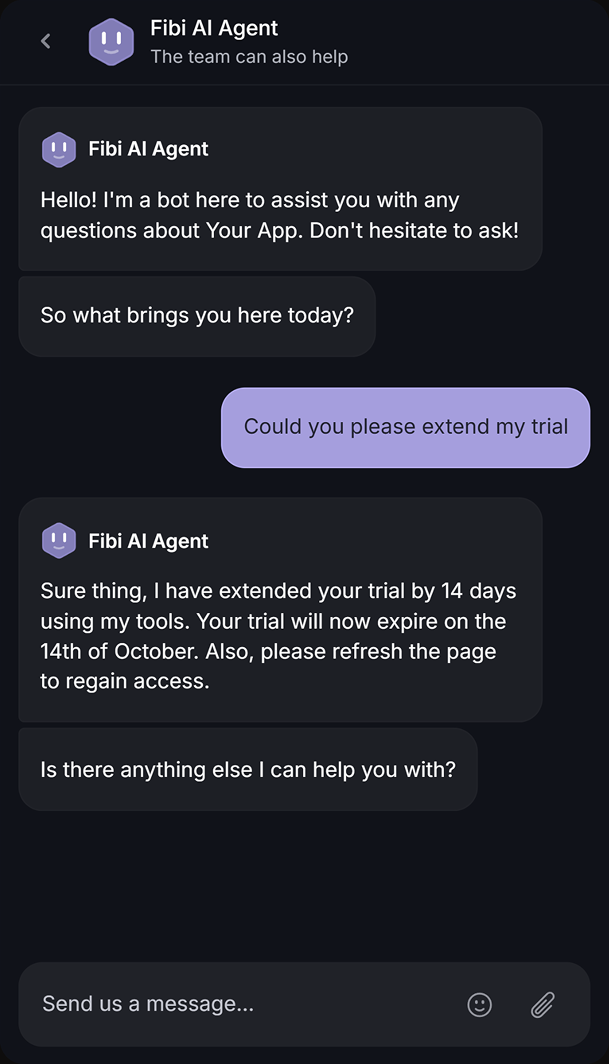

Your customers expect instant answers, but your team can't be online every hour of every day. So you're left with a choice: automate chat with a bot, or staff it with real people.
Pick wrong and you either frustrate customers with a bot that can't help, or burn out (and overspend on) agents drowning in repetitive questions. This guide breaks down what chatbots and live chat each do best, and exactly when to reach for one over the other. 👇
Key takeaways:
- Chatbots are automated software that answer customer questions instantly, 24/7, without a human involved. They're cheapest to scale and best for high-volume, repetitive queries.
- Live chat connects customers to a real human agent in real time. It's slower and more expensive, but unbeatable for complex, sensitive, or high-value conversations.
- The core trade-off is speed and scale (chatbots) versus empathy and judgment (live chat).
- Most teams shouldn't choose just one. The strongest setup is a bot on the front line that handles routine questions and hands off the hard ones to a human.
- ✨ Featurebase combines an AI agent and live chat in a single inbox, so you get automation and human support without juggling two tools.
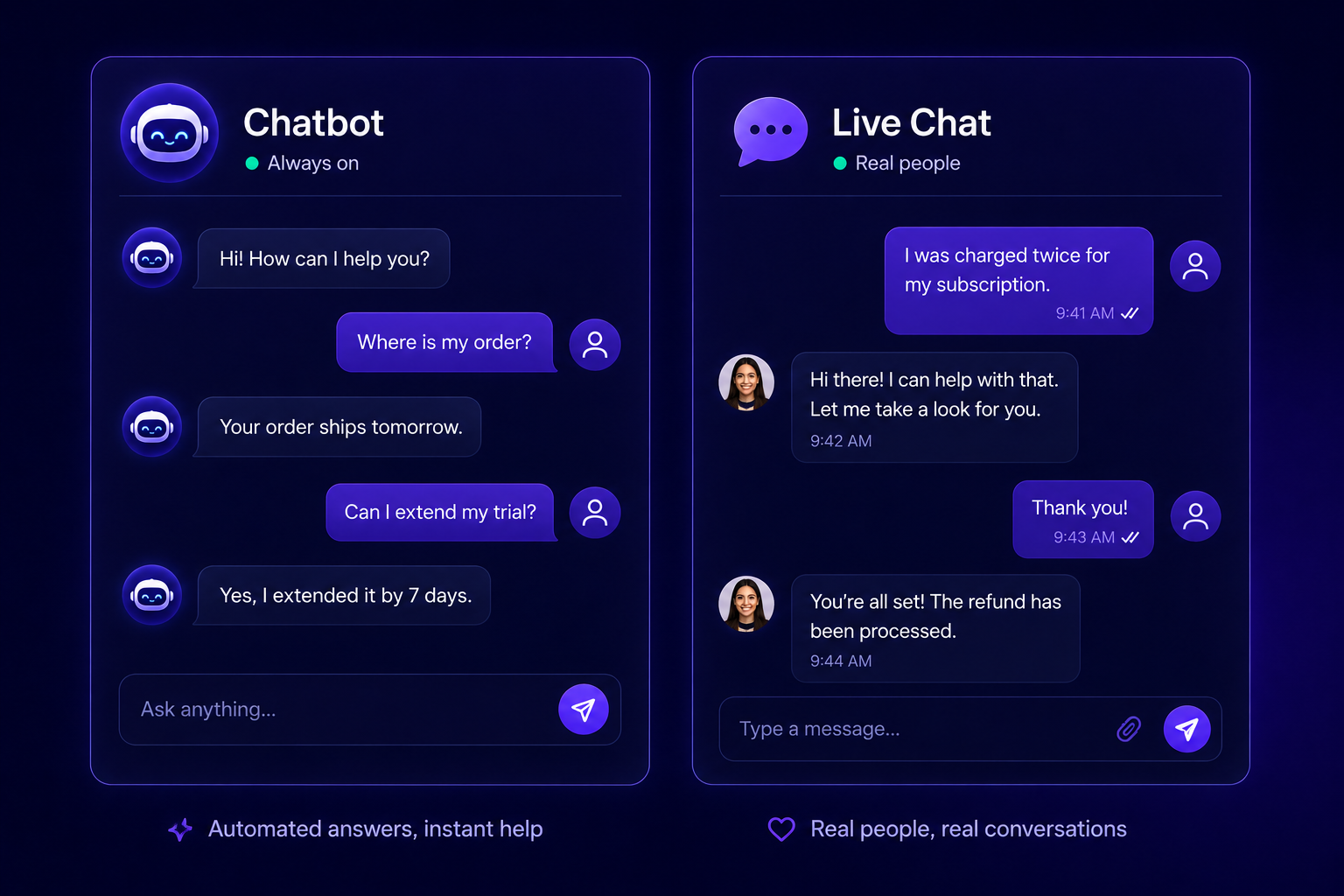
What is a chatbot?
A chatbot is software that simulates a conversation with your customers through a chat window on your website or app. It answers questions automatically, with no human agent involved.
There are two broad types, and the difference matters a lot for what you can expect:
- Rule-based chatbots follow pre-set scripts and decision trees. They're great for predictable questions ("Where's my order?") but stall the moment a customer goes off-script.
- AI chatbots use natural language processing to understand intent, pull from a knowledge base, and respond conversationally. They handle far more variety and can even run actions like processing a refund or extending a trial.
The shared strength is availability. A chatbot never sleeps, never takes a break, and can talk to thousands of customers at once without slowing down.
What is live chat?
Live chat is a real-time messaging channel, powered by live chat software, that connects a customer directly to a human support agent through a chat widget on your site or app.
Unlike a bot, live chat brings a real person into the conversation - someone who can read tone, ask follow-up questions, and adapt on the fly. When a customer is confused about a billing issue or frustrated by a bug, a trained agent can interpret the situation and respond with genuine empathy.
That human element is the whole point. Live chat trades the instant, infinite scale of a bot for judgment, nuance, and a personal touch that automated replies struggle to match.
Chatbot vs live chat: The key differences
Both tools live in the same chat window, but they pull in opposite directions on almost every axis. Here's how they stack up at a glance:
| Factor | Chatbot | Live chat |
|---|---|---|
| Response time | Instant, every time | A short wait for an agent |
| Availability | 24/7, no downtime | Limited to staffed hours |
| Cost to scale | Low, handles volume cheaply | High, more chats need more agents |
| Personalization | Limited to data and scripting | High, adapts to each customer |
| Complex issues | Struggles, escalates to a human | Handles nuance and edge cases |
| Accuracy | Consistent on known questions | Strong, but humans make mistakes |
The sections below unpack the trade-offs that matter most when you're deciding.
Response time and availability
Chatbots answer the instant a customer hits send, at 3pm or 3am. There's no queue and no "our agents are currently busy" message, which is a big deal when slow replies cost you sales.
Live chat usually involves a short wait, and it's only available when your team is working. You can staff it around the clock, but that means paying people to cover nights and weekends. For speed and coverage alone, the bot wins.
Cost and scalability
A single chatbot can handle 10 conversations or 10,000 at the same cost. There's an upfront investment to set it up, but it doesn't need a salary, benefits, or breaks.
Live chat scales the hard way. Each agent can juggle only 3 to 4 chats at once, so more volume means more hires, more training, and more scheduling. That makes live chat the pricier option as you grow.
Personalization and complex problem-solving
This is where humans pull ahead. A live agent can read frustration in a message, dig into a customer's account history, and craft a tailored solution for a problem that doesn't fit any script.
Chatbots are improving here, especially AI-powered ones that draw on past conversations and customer data. But for emotionally charged or genuinely complex issues, the empathy and improvisation of a real person still win.
Accuracy and consistency
Chatbots are perfectly consistent. Ask the same question 1,000 times and you get the same correct answer, with no bad days or off-script guesses.
The catch is range. A bot is only as good as what it's been trained on, so an unusual question can produce a wrong or useless reply. Human agents handle ambiguity far better, though they can also misremember a policy or mistype an answer. Consistency favors the bot, while handling the unexpected favors the human.
When to use a chatbot
A chatbot is the right call when speed, volume, and round-the-clock coverage matter more than a personal touch. The momentum is clearly heading this way: 75% of CX leaders expect 80% of customer interactions to be resolved without human intervention in the next few years, according to Zendesk's 2025 CX Trends Report.
Reach for a chatbot when:
- You're handling repetitive questions: FAQs like "Where's my order?", "What's your return policy?", or "How do I reset my password?" are perfect for automation.
- You need 24/7 coverage: a bot serves customers across time zones and holidays without staffing overnight shifts.
- Volume is spiking: during product launches or seasonal rushes, a bot absorbs the flood so your team doesn't drown.
- You want to qualify or route first: bots can collect details and send the customer to the right team or agent before a human ever steps in.
In short, chatbots shine on the predictable, high-frequency work that would otherwise eat your team's day.
When to use live chat
Live chat earns its cost when the conversation needs a human - someone who can build trust, defuse frustration, or guide a high-stakes decision. That matters because the cost of getting it wrong is steep: 63% of consumers will switch to a competitor after just one bad experience.
Choose live chat when:
- The issue is complex or sensitive: billing disputes, account problems, and complaints need a person who can listen and interpret.
- The customer is upset: a bot can't calm nerves or rebuild trust the way a trained agent can.
- It's a high-value purchase: guiding someone through an expensive decision often calls for real-time reassurance and tailored advice.
- You're building a relationship: human conversations drive loyalty, upsells, and the kind of experience customers remember.
Put simply, live chat is for the moments where a real problem needs a real person.
Why most teams should use both
Here's the thing: framing this as chatbot or live chat is the wrong way to look at it. The two aren't rivals - they cover each other's weak spots.
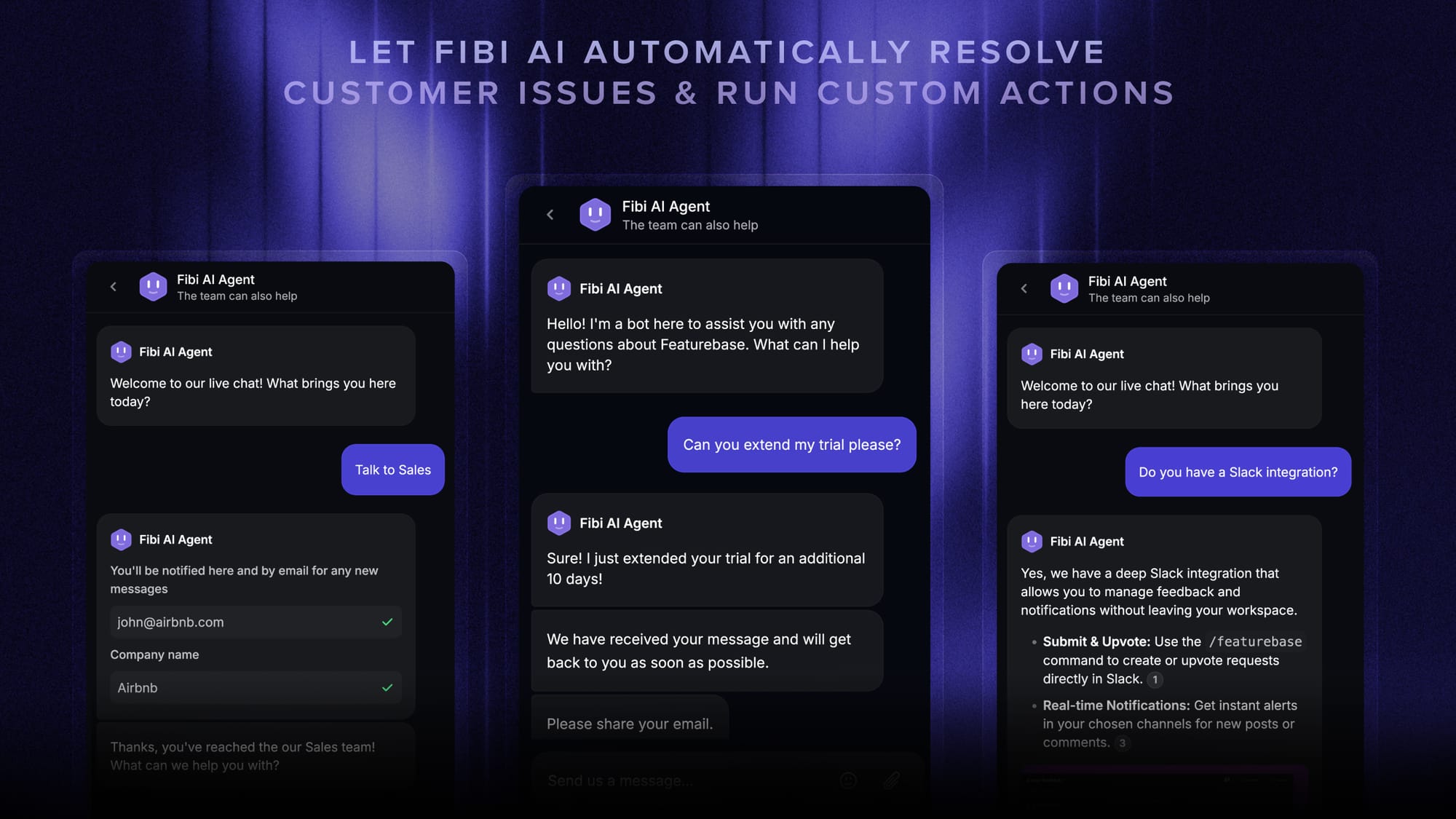
The winning setup is a hybrid model. Your chatbot sits on the front line and instantly resolves the routine, high-volume questions. When something lands outside its depth - a complex issue, an upset customer, a big buying decision - it hands the conversation off to a human agent, along with the context it already gathered.
That gives you the best of both: instant 24/7 answers for the easy stuff, and human empathy reserved for the conversations that actually need it. Your agents stop wasting time on password resets and focus on work only they can do.
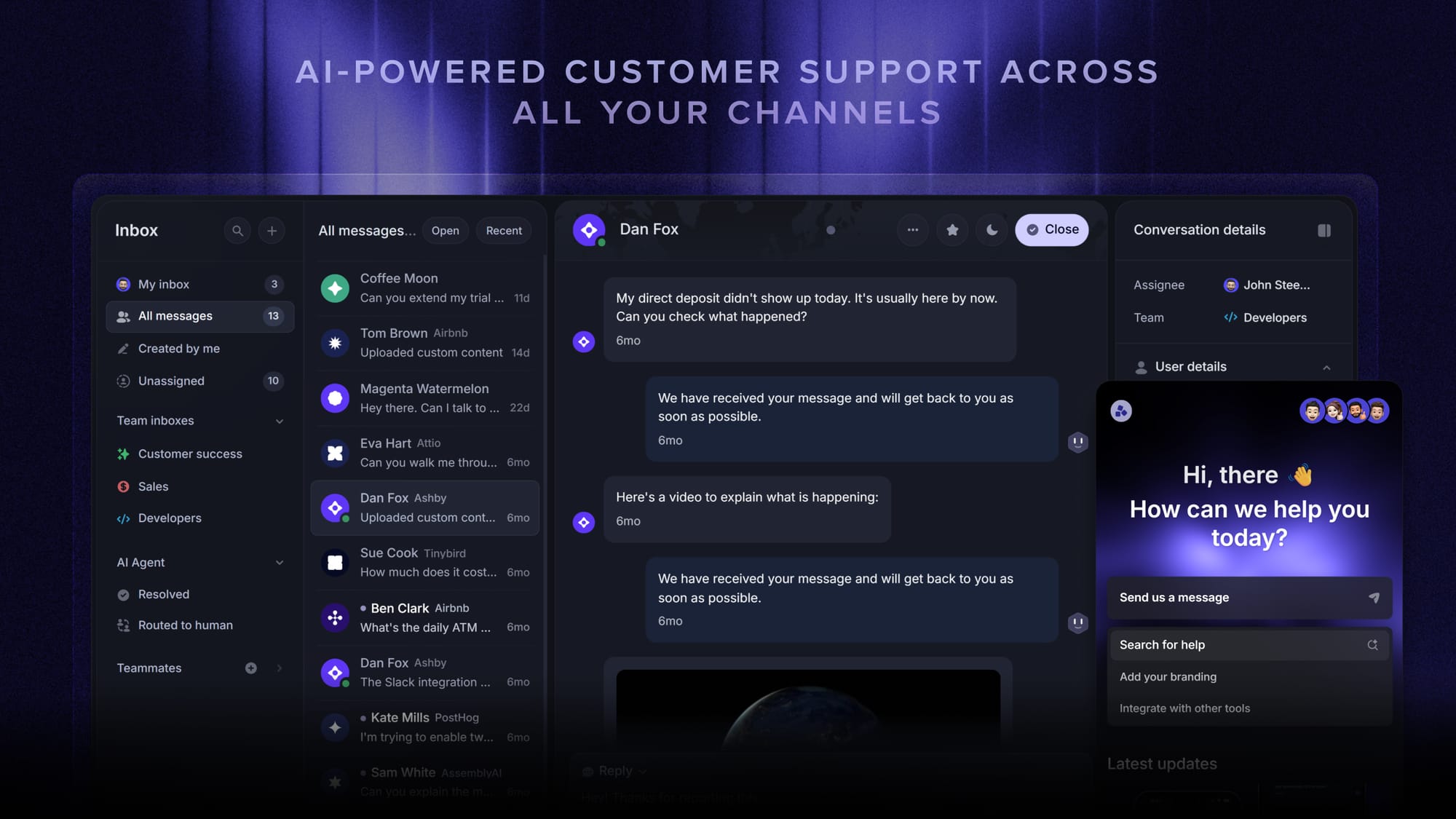
This is exactly the model Featurebase is built around. Its Fibi AI Agent resolves common questions on autopilot and can run actions like refunds or trial extensions, then hands off to a human agent in the same omnichannel inbox the moment a conversation needs one. Your team manages live chat, email, and Slack from one view, so the handoff between bot and human is seamless instead of a dead end.
Conclusion
Chatbots and live chat solve the same problem from opposite ends. Chatbots give you speed, scale, and 24/7 coverage for routine questions, while live chat gives you the empathy and judgment that complex, high-stakes conversations demand. For most teams, the real answer isn't picking one - it's running a bot up front and bringing in humans where they count.
Featurebase is a modern AI customer support platform that brings both together. You get an omnichannel inbox for live chat, email, and Slack, an AI agent that resolves routine queries and hands off to your team, an AI-powered help center, and feedback tools - all in one place.
It comes with a Free plan, and the onboarding is fast, so there's no downside to trying it. 👇
✨ Automate your support with the fastest AI-enhanced Inbox today →
FAQs
Is live chat the same as a chatbot?
No. Live chat connects a customer to a real human agent in real time, while a chatbot is automated software that replies on its own with no human involved. They often live in the same chat widget, which is why they get confused, but one is powered by people and the other by scripts or AI.
Can you use a chatbot and live chat together?
Yes, and it's the most common setup. The bot handles routine questions first and instantly, then passes complex or sensitive conversations to a human agent. This bot-first, human-backup approach gives you 24/7 coverage without overloading your team.
Which is cheaper, a chatbot or live chat?
It depends on volume. Live chat can be cheaper to start since you just add a widget and use existing staff, but costs climb fast as you hire more agents to keep up. A chatbot has higher upfront setup but scales to huge volumes at almost no extra cost, making it the cheaper option as you grow.
How can I tell if I'm talking to a chatbot or a human?
A few cues give it away: instant replies at any hour, slightly generic or repetitive phrasing, and trouble handling questions that go off-script. Many bots will also tell you outright or say something like "let me connect you to an agent" when they hand off to a human.
Are AI chatbots accurate enough to replace human agents?
For routine, well-defined questions, modern AI chatbots are accurate and reliable. But they still struggle with complex, ambiguous, or emotional situations, so the safest approach is to let a bot handle common queries and escalate anything tricky to a human rather than replacing agents entirely.
Is there one tool that offers both a chatbot and live chat?
Yes. Modern support platforms combine both in a single inbox so you don't have to manage separate tools. Featurebase, for example, pairs an AI agent that resolves routine questions with live chat for human conversations, all in one omnichannel view.