Blog Customer FeedbackContinuous Customer Feedback: How to Build a Loop That Actually Closes
Continuous Customer Feedback: How to Build a Loop That Actually Closes
A practical guide to building a customer feedback program that runs continuously, makes shipping decisions easier, and closes the loop where your customers can actually see it.

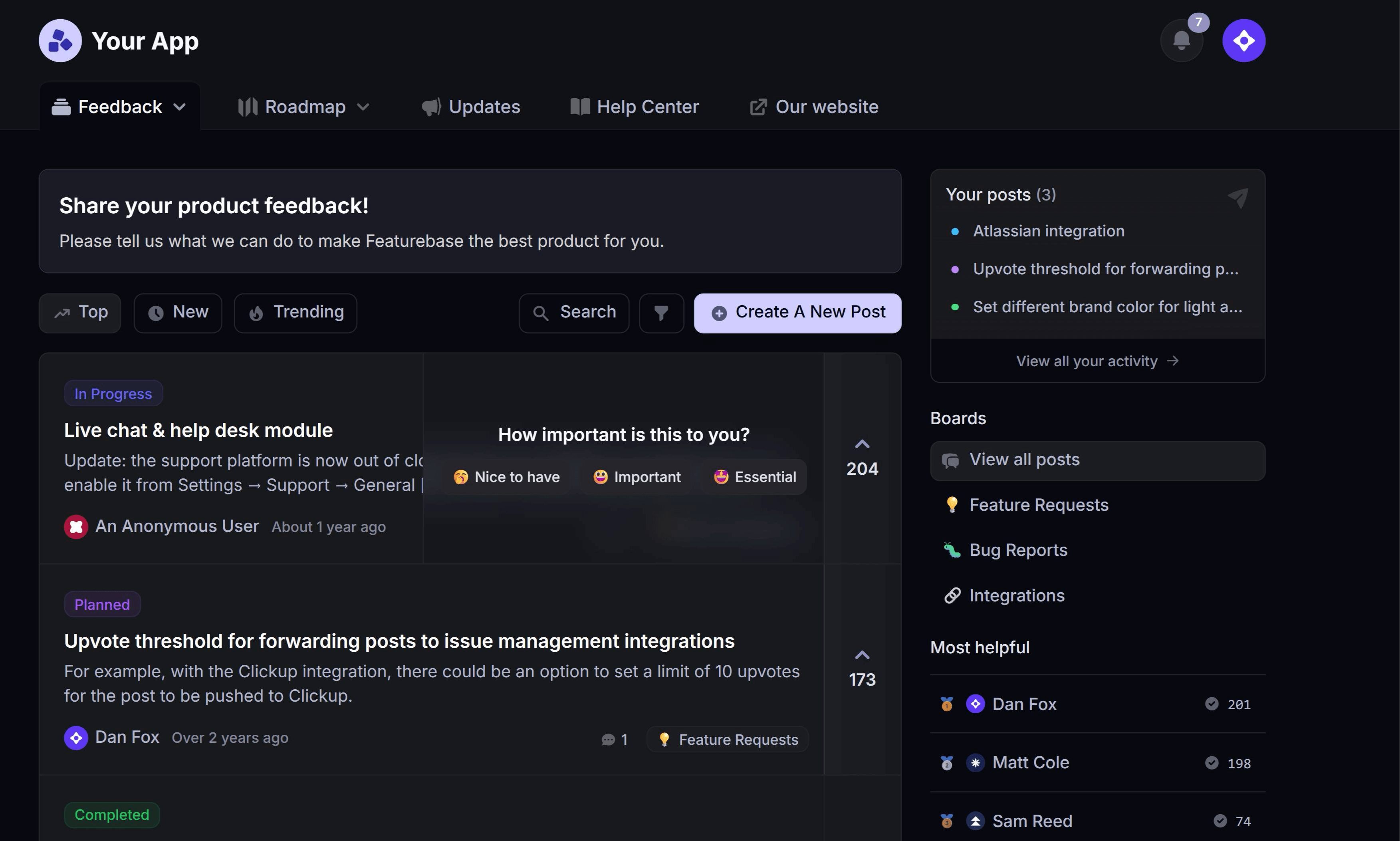

Most "customer feedback" programs are really one feedback program: an annual NPS survey, a quarterly research sprint, a flurry of interviews before a launch.
Continuous customer feedback is the opposite. It turns every channel - in-app, support, sales, reviews - into a loop your customers can see and trust, and ships their input back as real product changes.
Here is how to actually build one. 👇
Key takeaways
- Continuous customer feedback is a system, not a survey. It runs across in-app widgets, support tickets, sales calls, reviews, and surveys, and it produces decisions on the same cadence.
- The loop has 5 stages: collect, centralize and tag, analyze and prioritize, build and ship, then close the loop publicly. Skipping the last stage is the most common reason feedback programs feel pointless to customers.
- Forrester's 2024 CX Index found customer-obsessed companies grow revenue 41% faster, but only 3% of companies qualify as customer-obsessed. The gap is execution, not intent.
- Closing the loop in public matters more than collecting more feedback. A visible roadmap and a changelog that names the customers who asked for each feature does the work that a "we're listening" email cannot.
✨ Featurebase brings the full loop - feedback portal, in-app widgets, surveys, public roadmap, and changelog - into a single workspace, with a free plan to start.

Turn feedback into products your users love
Centralize feedback, identify product opportunities, and build the right features
What is continuous customer feedback?
Continuous customer feedback is the ongoing process of collecting, organizing, prioritizing, and acting on what your customers tell you, then reporting back when their input changes the product.
The "continuous" part is the operative word. It is what separates a real feedback program from a one-off survey:
- A one-off program runs on a fixed cadence (annual NPS, quarterly customer interview week) and treats feedback as a research input. Most of it ages out before anyone acts on it.
- A continuous program runs every day, across every channel where customers already are. Feedback is captured the moment a customer has the thought, routed to whoever can act on it, and visibly tied to product decisions.
Continuous customer feedback is also distinct from internal employee feedback, which is about performance management between managers and direct reports. This guide is strictly about feedback from your customers about your product or service.
The shorthand most teams use is the customer feedback loop, but the loop only closes if all 5 stages happen. We will get to those.
Why continuous beats one-off feedback
The honest answer is that one-off feedback is a research artifact, while continuous feedback is a decision-making system. The two do not produce the same thing.
A few specific reasons it pays off:
- Decisions get easier When every product debate has six months of customer evidence behind it, the question stops being "what should we build?" and starts being "which of these obvious requests do we ship first?" That alone removes a huge amount of internal friction.
- Customers can feel the loop A customer who submitted a feature request 3 months ago and got an email when it shipped is far more loyal than a customer who answered an NPS survey and heard nothing. The visible response is what makes the program a retention tool, not just a research tool.
- Compounding signal, not point-in-time noise Single surveys catch a mood. Continuous capture catches patterns - which segments are unhappy, which features are repeatedly requested, which onboarding step quietly loses people every week.
- It outperforms the alternative by a wide margin Forrester's 2024 US Customer Experience Index, based on 98,000 US customers across 223 brands, found that customer-obsessed companies reported 41% faster revenue growth, 49% faster profit growth, and 51% better customer retention than non-customer-obsessed peers. But only 3% of companies qualified as customer-obsessed. The gap between knowing customer focus pays off and actually doing it every day is exactly what continuous feedback is built to close.
The next section is how to build the loop without burning out your team.
The 5-stage continuous customer feedback loop
Five stages, each owned by someone, each running continuously. If any one of them breaks, the loop breaks.
1. Collect across channels
Customer feedback shows up wherever customers are paying attention - inside the product, in support tickets, on sales and customer success calls, in app store reviews, in your community. The collection stage is about catching it everywhere, not just the channels that are convenient for you to run.
The two failure modes here are equally bad:
- Collecting in only one place Surveys give you a slice. Support tickets give you a different slice. Sales calls give you a third. Relying on any single channel hides the other two-thirds of what your customers think.
- Collecting everywhere with no plan Five inboxes, three spreadsheets, and a Notion doc do not equal a feedback system. Volume without structure means nothing makes it to a decision.
Pick 3-5 channels you can keep up with, then go to stage 2. We list the most common ones in the channels section below.
2. Centralize and tag
Every piece of feedback - widget submission, support thread, sales call note, review - lands in one place, tagged by theme and linked to the customer who said it.
This is the stage where most homegrown feedback programs collapse. Spreadsheets do not scale past a few hundred entries. The system you choose has to do three things:
- Deduplicate 20 customers asking for the same feature should look like 1 entry with 20 upvotes, not 20 separate tickets.
- Tag by theme Onboarding, billing, mobile, integrations, AI - whatever categories your roadmap actually uses. Tags are how you go from "5,000 pieces of feedback" to "37 themes ranked by impact."
- Link to customer context A feature request from a 5-seat trial and a feature request from your largest customer should not be weighted equally. The system needs to know who is asking, on what plan, and at what revenue.
3. Analyze and prioritize
With everything centralized, the analysis pass becomes a question of which themes deserve product time. Most teams run this monthly with a simple scoring pass:
- Reach - how many customers asked
- Revenue impact - how much MRR sits behind the request
- Strategic fit - how well it lines up with what you are already building
- Effort - rough engineering cost
A frequent mistake is over-engineering this step. A 30-minute monthly review with the head of product, head of CS, and head of support - looking at the top 20 themes by volume - beats a 2-hour formal RICE workshop that happens twice a year and never again.
4. Build and ship
The prioritized themes feed your roadmap. This is where most of the visible work happens - design, engineering, QA, release. From the feedback loop's perspective, the important thing is that prioritized customer requests get tagged inside your product management tool, so when the feature ships you know which customers to tell.
5. Close the loop publicly
This is the stage most teams skip, and it is the one that turns a feedback program into a retention engine.
Closing the loop means:
- Publishing what you shipped A public changelog entry, written for customers rather than for the changelog itself. "We added X because dozens of you asked - here is how to use it" beats "Released version 2.4.7" every time.
- Notifying the customers who asked If 38 customers upvoted a feature request, those 38 customers get a personal-feeling email or in-app note when it ships. This is the single highest-leverage thing you can automate in a feedback program.
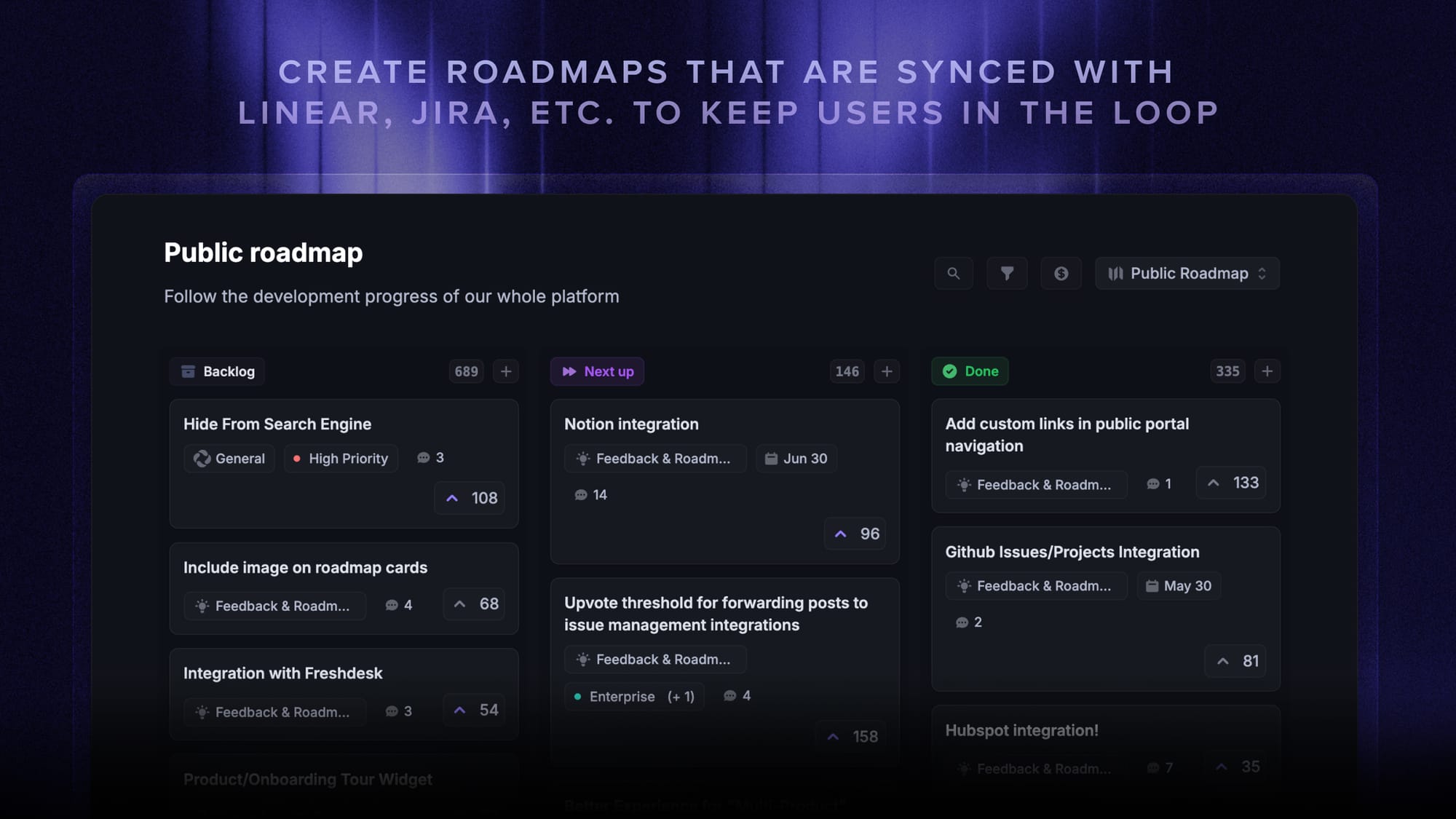
- Showing what is next on a public roadmap Customers who know what is in progress submit better feedback. They stop reporting the same thing 5 times and start telling you about the next problem.
The reason this stage matters disproportionately: trust compounds. Qualtrics XM Institute's 2025 Customer Trust Indices, based on 10,000 US consumers across 354 brands, found that consumers with a high Trust Index rating in a brand gave an average NPS of 49 - a score 104 points higher than consumers with low trust in that brand. The visible follow-through is what builds the trust that drives the NPS that drives the growth. The loop is not metaphorical.
With Featurebase, this stage is wired together by default. The public roadmap shows what is in progress and what is shipping next. The changelog announces what just went live. When you mark a feedback post as "Completed," the customers who upvoted it get notified automatically, with a link back to the post and to the changelog entry. 3 of the 5 stages run themselves.
6 channels for collecting continuous customer feedback
The right channel mix depends on your business, but most B2B SaaS feedback programs draw from these 6. None of them works alone.
In-app feedback widgets
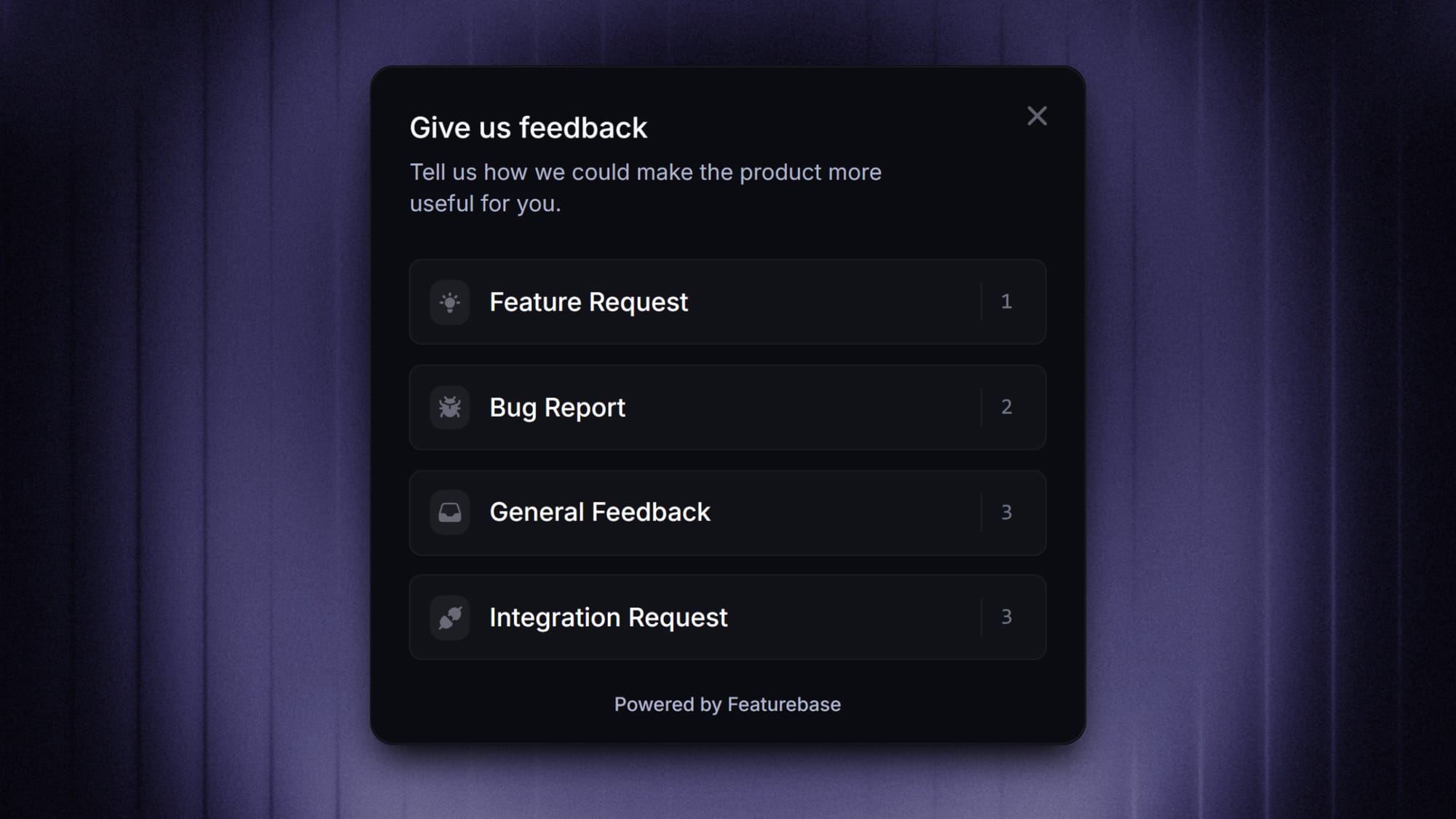
The single highest-signal channel for product feedback. A small button or sidebar inside your app that lets users submit ideas, bug reports, or comments without leaving what they were doing.
In-app widgets work because they catch feedback at the moment of friction. A user who runs into a confusing UI element will leave a one-sentence note in a widget that they would never have written if you asked them later in an email.
With Featurebase's feedback widget, users submit feedback with screenshots attached, see similar existing posts before they file a duplicate, and stay logged in to their context the whole time. Bug reports become 5x more useful when they arrive with a screenshot and the user's session attached.
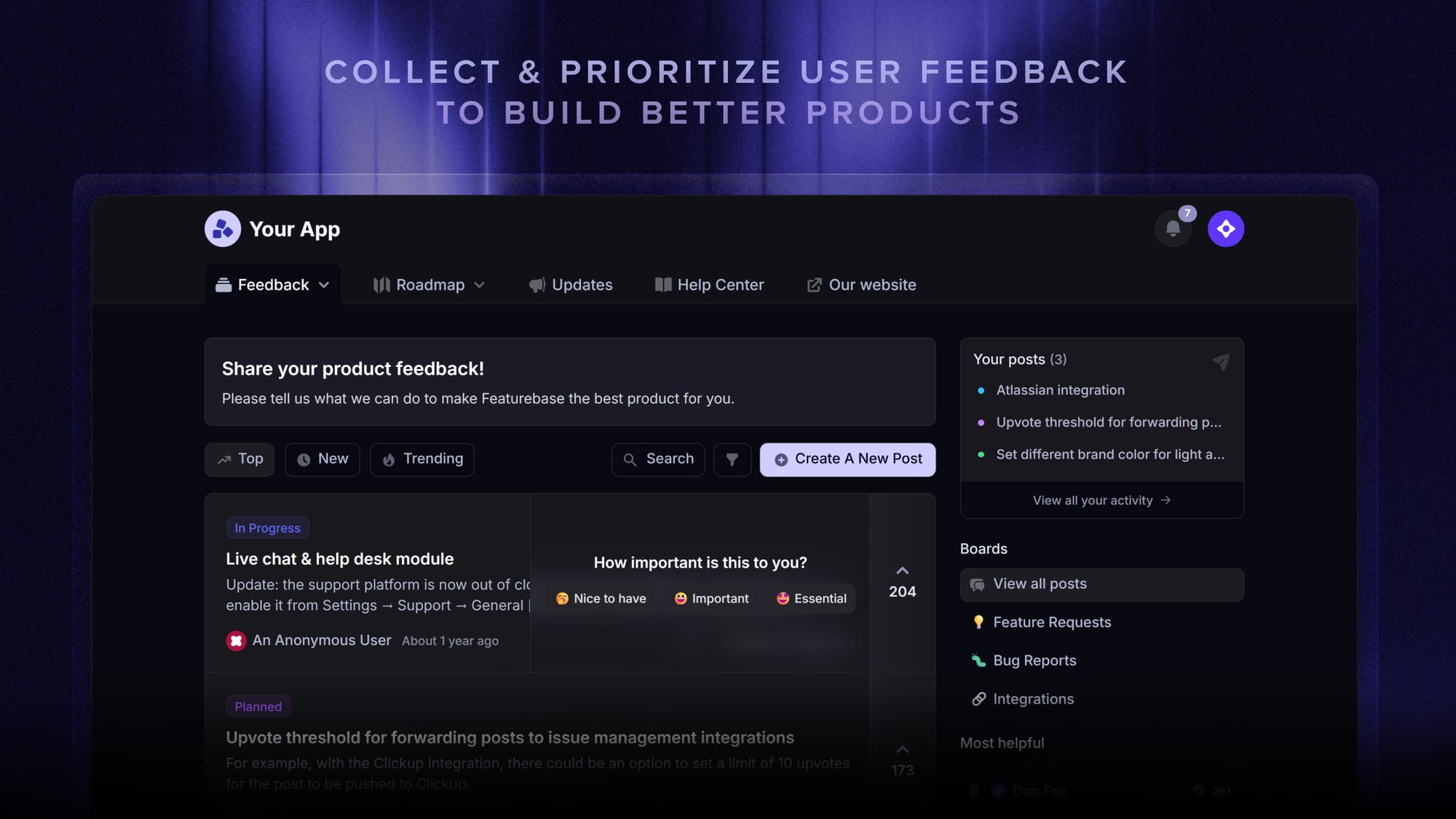
Public feedback portals
A public page where customers can browse other people's feedback, upvote what they agree with, and submit their own. Portals do two things that widgets cannot:
- Show the social graph of demand Customers can see that 200 other people want the same thing they do. That sometimes stops a one-off request from being filed (which would be noise) and sometimes accelerates a real demand signal that would have stayed hidden.
- Reduce duplicate intake A customer about to submit "dark mode please" sees there are already three open posts about dark mode, upvotes one, and moves on.
Public portals also become a passive marketing surface - prospects evaluating your product can see that you ship requests, which is a quiet but powerful trust signal.
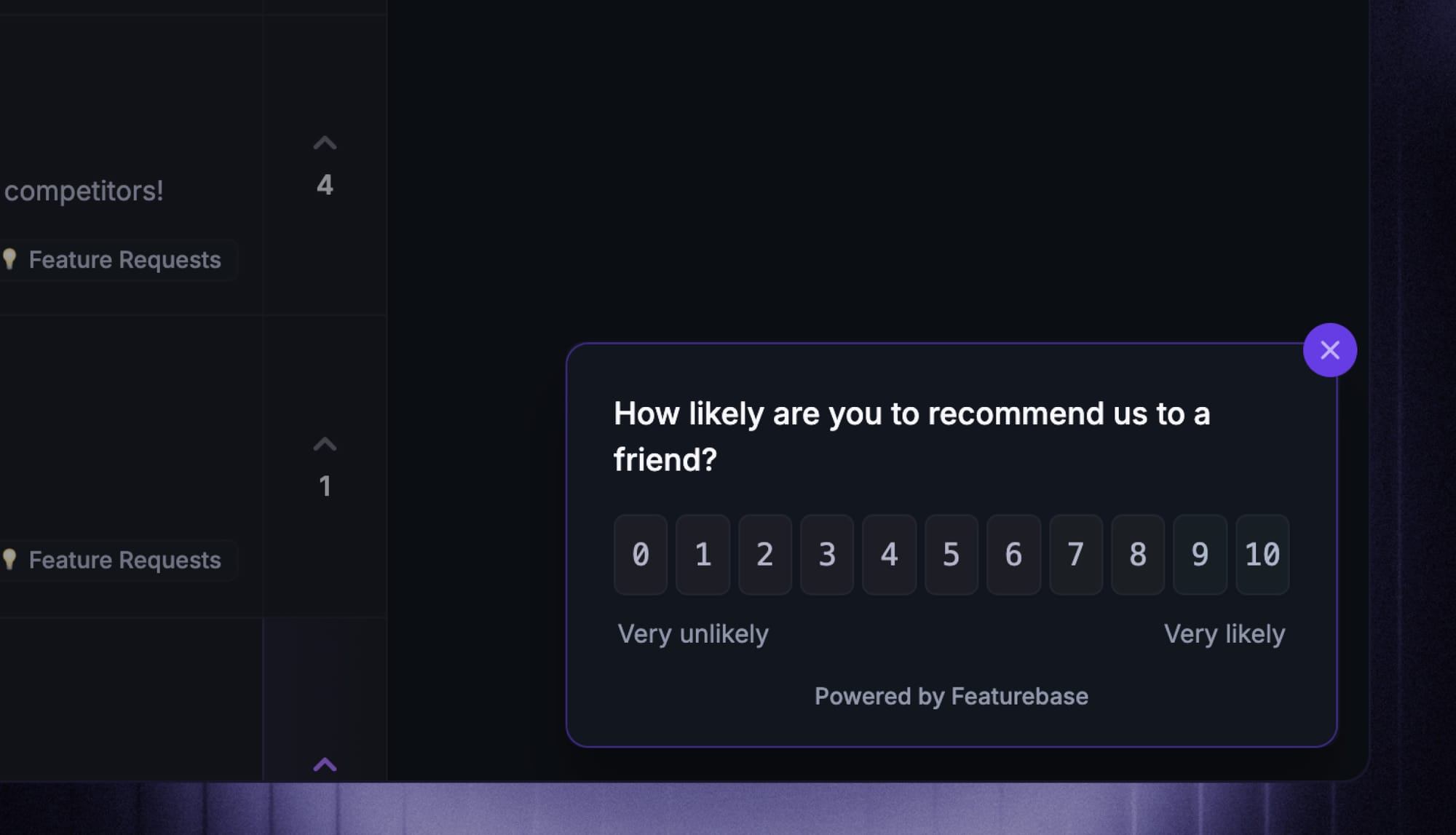
In-app surveys (NPS, CSAT, idea polls)
Surveys remain essential, but the modern version is in-app and event-triggered, not blast-email-quarterly.
Common deployments:
- NPS sent 14 days after activation, then every 90 days for active accounts
- CSAT sent after a support resolution
- Idea polls sent to subsets of customers when product is deciding between two roadmap directions
- Onboarding micro-surveys at the end of each onboarding step
The shift toward multi-step surveys with conditional logic means a low NPS can branch to an open-ended "what went wrong?" question, while a high NPS can branch to a testimonial request. Same survey, two completely different downstream actions.
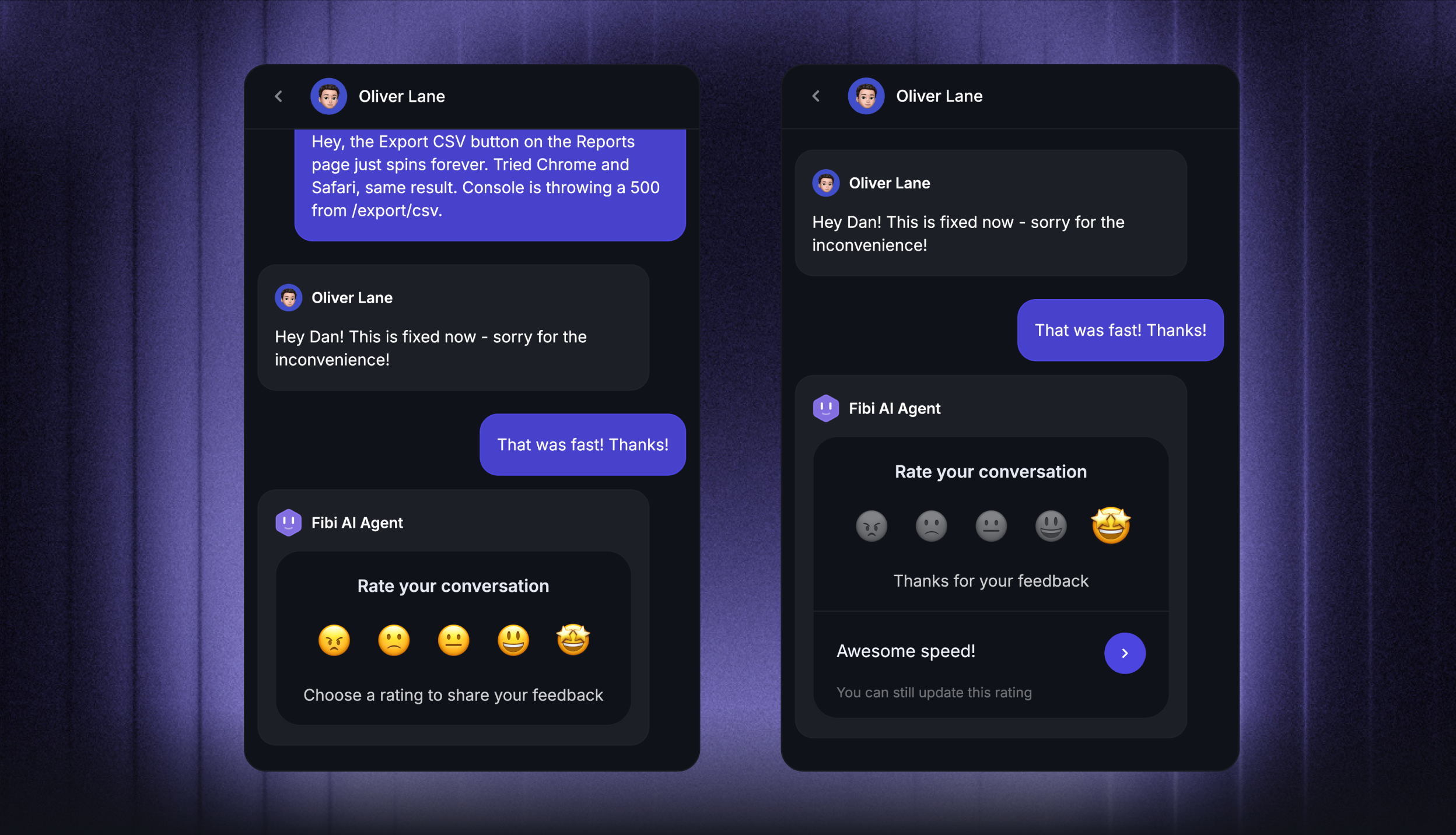
Customer support conversations
Every support ticket is a piece of feedback. The team that talks to the most customers per day is sitting on the richest stream of insight in the company, and most companies fail to plug it into the loop.
The fix is mechanical: support tools that let agents tag a ticket with a feedback theme and link it to a roadmap item, so when product runs the monthly prioritization, support volume is one of the inputs. A feature that is generating 30 tickets a week deserves to be on the radar even if no one filed it as a "feature request."
Sales and CS calls
Pre-sale calls and renewal conversations expose objections, feature gaps, and competitive comparisons that customers never write down in a portal. 2 underused practices:
- Lost-deal analysis Every closed-lost deal has a reason. If you log it consistently for 3 months, themes emerge that change what you build.
- Quarterly CS account reviews Once a quarter, CS picks the top 5 accounts at risk and the top 5 expansion candidates, lists what each is asking for, and routes it to product. Beats every "voice of customer" report.
This can be achieved through in-person workshops or online platforms. For example, you can choose one of HR learning management system to make learning more convenient and effective.
Reviews and social listening
Public reviews on G2, Capterra, app stores, and Reddit/X threads add an unfiltered channel that your existing customers do not always use. Reviews skew negative (happy customers do not always remember to write them), which is useful - it surfaces the friction you have made invisible to yourself.
The trick is treating reviews as feedback, not as a marketing problem. Tag them, route them, and reply to them with the same workflow you use for in-product feedback.
4 mistakes that quietly kill the loop
These show up in almost every feedback program that stalls. Spotting them is half the fix.
- Collecting without acting Volumes grow, dashboards look healthy, nothing ships in response. Customers eventually notice and the inflow drops to near zero. The cure is a public roadmap and a changelog. If customers can see what is moving, they keep contributing.
- Treating feedback as a marketing project A "voice of customer" deck that lives in a folder no one opens is not a feedback program. The loop has to belong to product, with support and CS as the primary feeders, and marketing as a consumer of insights rather than the owner of the program.
- Weighting all feedback equally 20 trial users and your 3 largest enterprise customers should not have equal say in the next quarter's roadmap. A feedback system that does not show you customer revenue, plan, and seat count next to each post will quietly steer you toward features that do not move the business.
- Closing the loop only with the customer who asked Sending one email to the one person who filed the request misses the upvoters and the other customers who care about the same thing. Close the loop with the audience, not the author. A public changelog entry plus auto-notifications to upvoters is the right shape.
How Featurebase makes the continuous loop visible
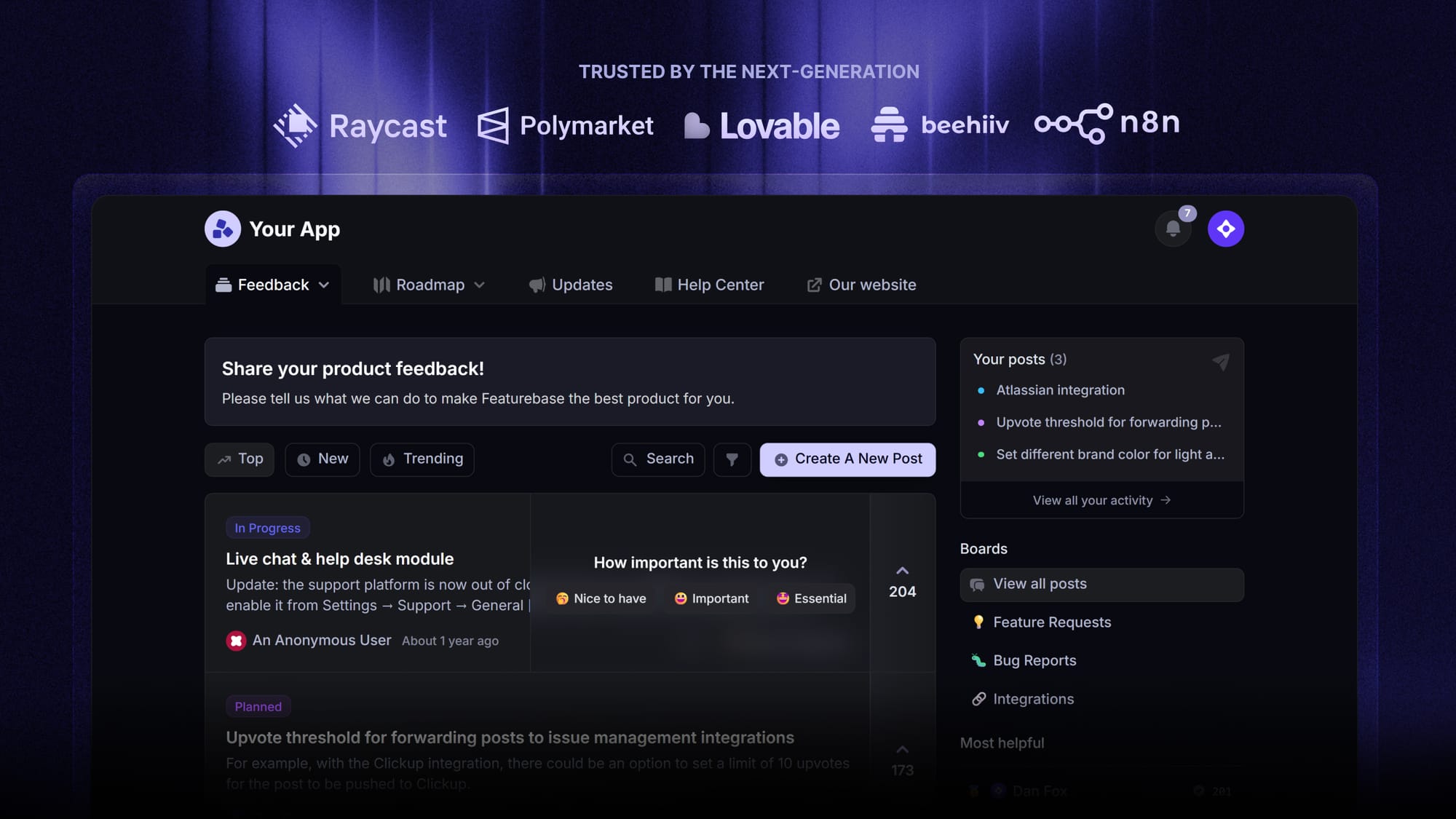
Featurebase is a modern feedback & support platform that helps product teams collect feedback, prioritize features, build roadmaps, and announce product updates – all in one place. It's loved by thousands of product teams from companies like Lovable, Raycast, and n8n. 💫
Top features:
- Feedback forum – Public feedback forum where users can submit ideas and vote on features helping you know what customers want
- In-app widgets – Embed feedback, changelog, and help center widgets directly in your product
- Prioritize by revenue – Link feedback with customer revenue, company size, and much more to better understand the impact of ideas
- AI feedback categorization - Automatically group large volumes of feedback into product areas, projects, or themes with AI.
- Automated email updates – Automatically notify users when their requested features are implemented
- Roadmaps – Create internal & public product roadmaps to keep users informed and build engagement
- Product updates – Publish release notes with a changelog page, in-app widget, and emails
- Surveys (NPS, CSAT, etc) – Create targeted surveys to ask users anything and measure customer satisfaction.
- Automatic AI translations – Automatically translate all feedback and comments to your customers / teammates native languages
- Integrations – Connects with Slack, Linear, Jira, HubSpot, and more
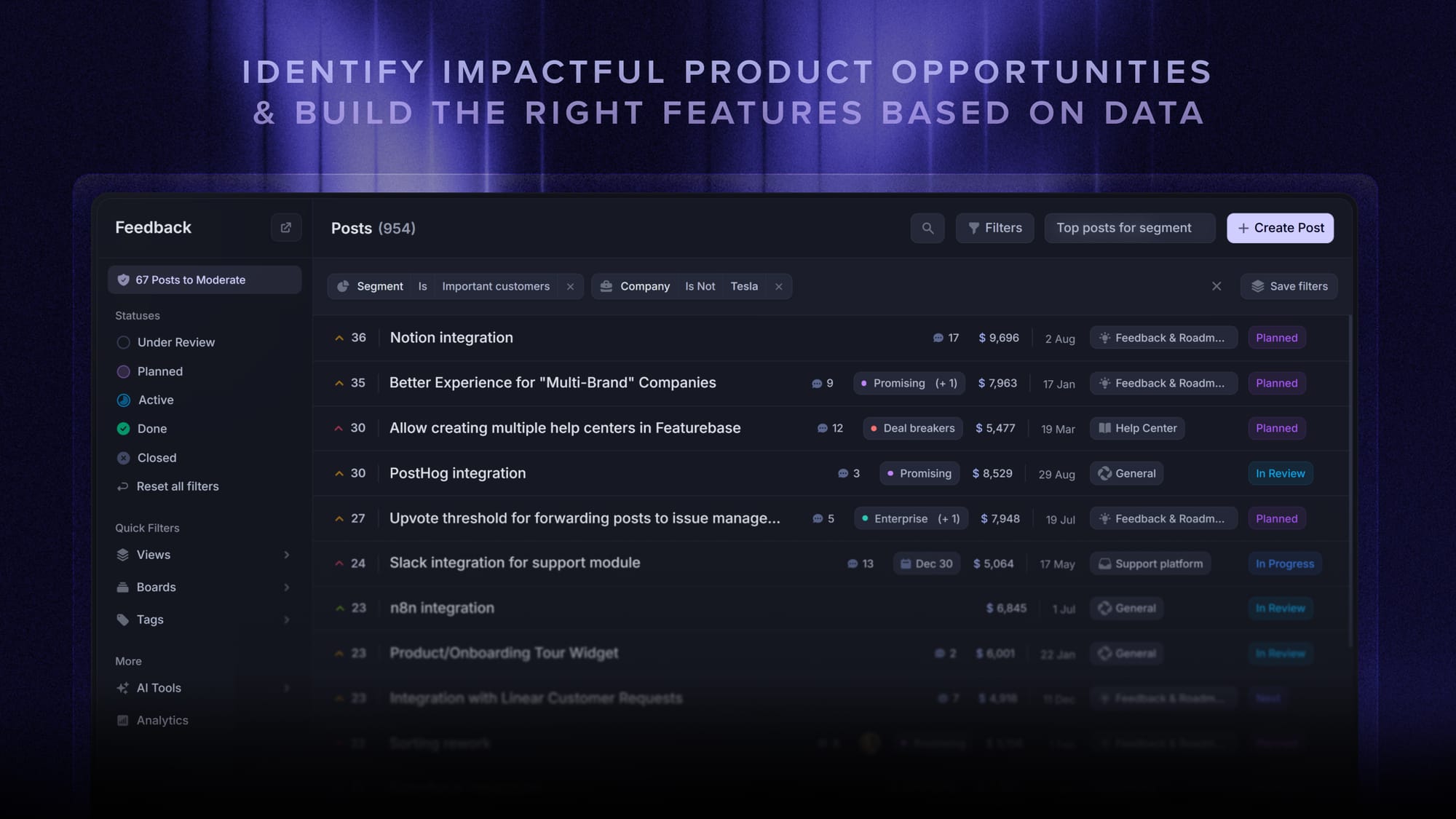
Pricing: Free plan available with unlimited feedback collection. Paid plans start at $29/seat/mo.
Instead of having 4+ different tools, Featurebase enables you to replace all your customer-facing tools by bringing your feedback collection, product updates, support, and help center, together in one place to help you build products your users love.
Turn feedback into products your users love
Centralize feedback, identify product opportunities, and build the right features
Turn feedback into a habit, not a project
The companies that win on customer experience are not the ones that run the best annual survey. They are the ones that have wired feedback into their daily operations - collected in the product, centralized in one workspace, prioritized monthly, shipped against, and announced back to the customers who asked.
Featurebase gives you all 5 stages of that loop in one place: feedback portal, in-app widgets, surveys, public roadmap, and a changelog that auto-notifies the customers whose requests just shipped. It is built specifically for product-led SaaS teams who want feedback to drive shipping decisions, not just dashboards.
The setup takes under an hour, and the Free plan covers unlimited feedback collection while you decide if it fits. There is no downside to trying it. 👇
✨ Start collecting & managing feedback with Featurebase for free →