Blog Customer ServiceCustomer Attrition Rate: Formula, Benchmarks & Fixes
Customer Attrition Rate: Formula, Benchmarks & Fixes
Learn how to calculate customer attrition rate, compare meaningful benchmarks, and use customer feedback and support insights to reduce preventable losses.

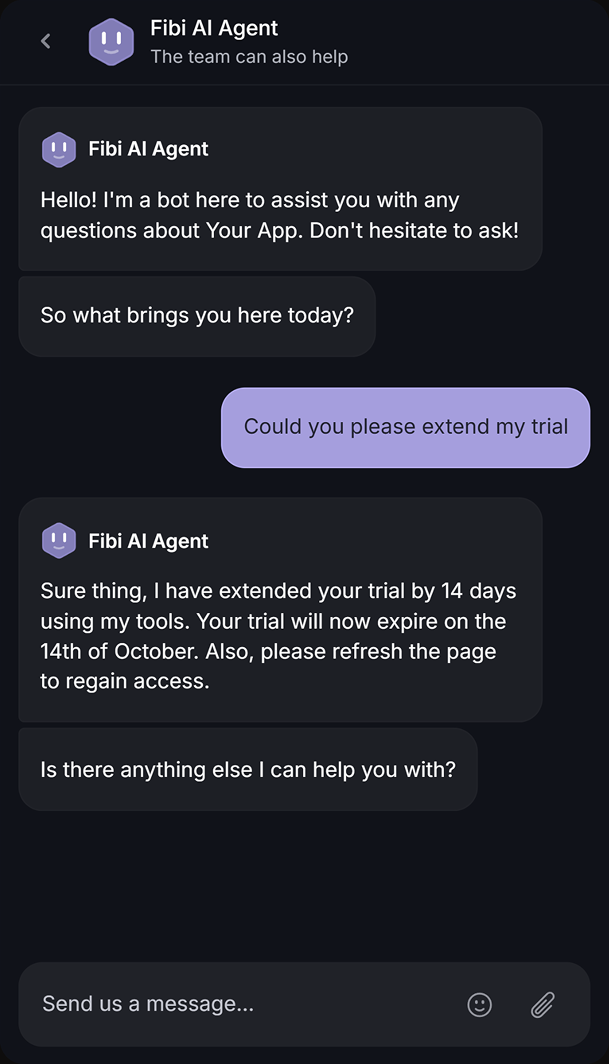

✨Want to reduce customer attrition? Give customers a reason to stay with fast, 24/7 AI support.
New signups are coming in, but so are cancellation requests. Your customer count might still be growing, which makes it easy to miss how many existing customers you're losing.
Customer attrition rate makes those losses visible. I'll walk through the formula, explain how customer losses differ from revenue losses, and show how everyday support conversations can help you decide what to fix. 👇
Key takeaways
- Customer attrition rate: Divide the customers lost from your starting group by the number you started with, then multiply by 100.
- New signups don't erase cancellations: Acquisition and attrition answer different questions. You can grow while struggling to keep customers.
- Benchmarks need context: A monthly rate for a low-cost subscription won't tell you much about annual contracts with a different customer base.
- The reason determines the fix: A missing integration, an unresolved refund, and an expired payment card call for different responses.
- Featurebase✨ suits SaaS teams that receive product feedback through support and need to connect those conversations to requests and customer updates.
What is customer attrition rate?
Customer attrition rate is the percentage of your starting customers who leave during a specific period. Businesses usually measure it monthly, quarterly, or annually.
For a software subscription, a customer might count as lost when their paid service ends. For a service business, it could be when a client doesn't renew. You'll also see the terms client attrition rate and customer turnover rate.
Losing 20 customers means something very different when you started with 200 rather than 20,000. The rate puts that cancellation count in perspective.
Customer attrition vs. churn and retention
In subscription businesses, customer attrition and customer churn usually mean the same thing. What's more important is agreeing on what counts as a customer and when they've actually left.
Customer retention rate measures how many stay. When both calculations use the same starting group, reporting period, and treatment of returning customers:
Customer retention rate = 100% − customer attrition rate
Keep the unit consistent. If a company removes 3 seats but keeps its subscription, you've lost users or seat revenue, not necessarily a customer account.
Voluntary and involuntary attrition
Voluntary attrition happens when someone chooses to leave. They might cancel because your product lacks an integration they need or because an unresolved support problem has worn out their patience.
Involuntary attrition happens without that intention. A customer may still want the subscription, but their service ends because a failed payment wasn't resolved.
I'd keep voluntary churn and involuntary churn separate. Better onboarding won't fix an expired card, and payment reminders won't persuade someone who needs a feature you don't offer.
How to calculate customer attrition rate
The customer attrition rate formula is:
Customer attrition rate = (Customers lost from the starting group ÷ Customers at the start of the period) × 100
The starting customer count is the denominator, consistent with J.D. Power's churn measurement guidance. The result changes if you count different groups or treat a cancellation request as an immediate departure.
Choose your period and define a lost customer
A monthly report is a useful starting point for spotting changes. Longer periods help you see whether those changes last.
Before calculating the rate, settle these definitions:
- Customer unit: Count accounts, contracts, or subscribers consistently. Removing a seat or switching to a cheaper paid plan doesn't necessarily mean the customer has left.
- Loss event: A customer who cancels on April 10 might still have paid access until April 30. Decide whether you're reporting cancellation requests or the end of paid service.
- Starting group: Use the customers active at the beginning of the period. Keep new signups separate.
- Reactivations: Show returning customers separately. In an end-of-period retention view, a starting customer who's active again at the end counts as retained.
Cancellation events can still be useful to your support team. Just give that report its own label, so an account that cancels twice doesn't look like 2 lost customers.
Apply the formula with a worked example
Imagine your software business starts April with 1,200 paying accounts. By month-end, 36 of those accounts have left and remain inactive. You also gain 80 new accounts, all still active at the end of April.
| April customer movement | Accounts |
|---|---|
| Paying accounts at the start | 1,200 |
| Starting accounts lost | 36 |
| New accounts still active at month-end | 80 |
| Total paying accounts at the end | 1,244 |
April customer attrition rate = (36 ÷ 1,200) × 100 = 3%
You finished the month with more customers, but lost 3% of the group you started with. Retention for that group was 97%.
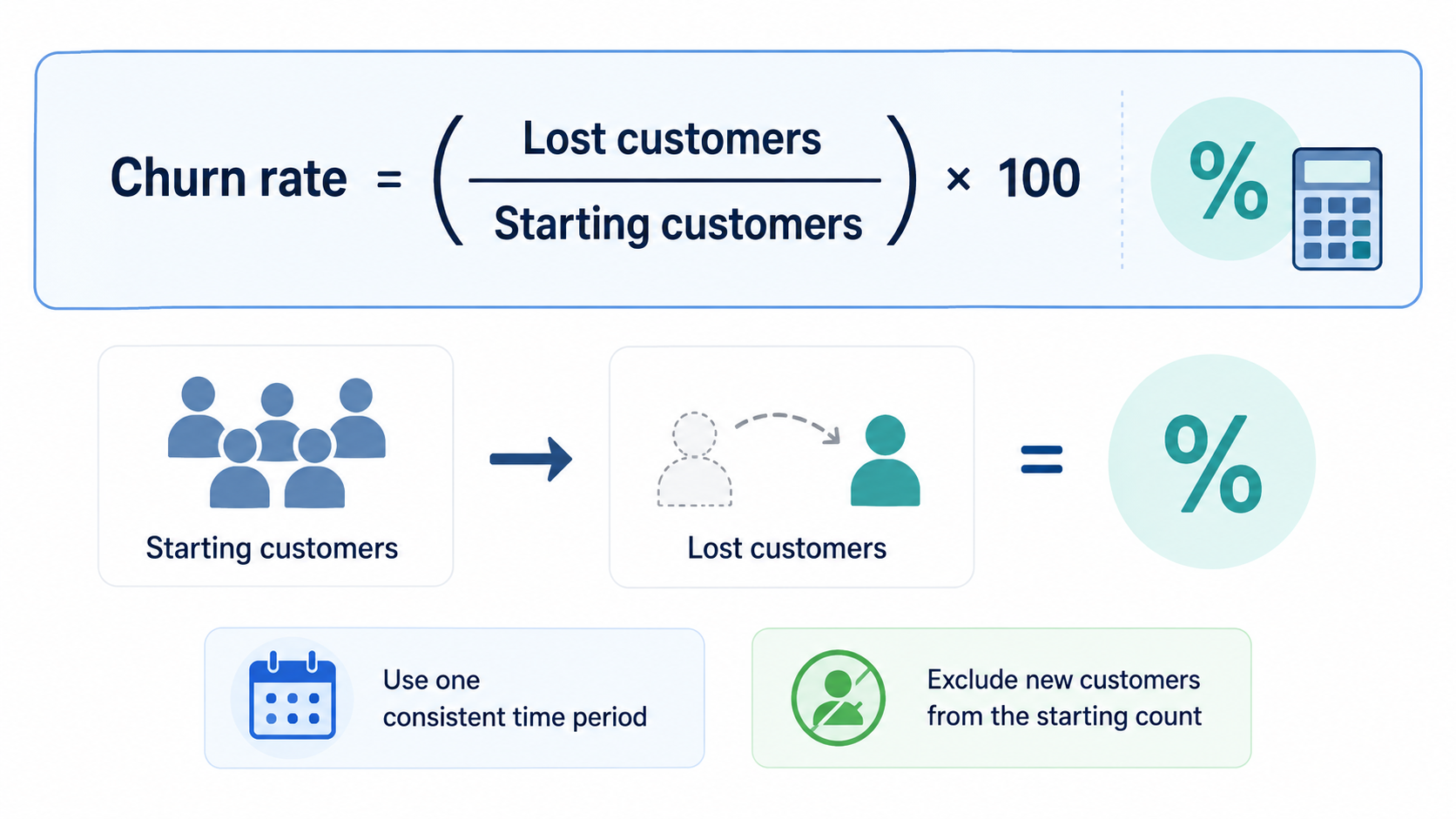
Keep new customers separate from customer losses
Subtracting the ending count from the starting count would hide those 36 departures. It tells you the net change in customer numbers, including acquisition.
New customers belong in their own signup cohort, meaning a group that joined during the same period. Someone who signs up, requests a refund, and leaves within April still matters. They just weren't part of the opening group in this calculation.
If you started with zero customers, the rate is undefined because you can't divide by zero. Report the customer movements until you have a starting group to measure.
Customer attrition vs. revenue attrition
Customer attrition counts lost relationships. Revenue attrition measures lost revenue. Losing a $100 subscription and losing a $1,000 subscription each count as 1 customer departure, but the financial impact is different.
Why equal customer losses can have different revenue impacts
Take 2 hypothetical businesses with 100 customers and $20,000 in monthly recurring revenue each. Both lose 5 customers:
| Metric | Business A | Business B |
|---|---|---|
| Customer attrition rate | 5% | 5% |
| Monthly revenue from each lost customer | $100 | $1,000 |
| Monthly recurring revenue lost | $500 | $5,000 |
| Revenue lost to those cancellations | 2.5% | 25% |
Both report the same customer churn rate. Business B, however, has lost a quarter of its monthly recurring revenue. This example assumes no other revenue changes.
Subscription changes matter here, too. A customer who downgrades from $500 to $300 a month has stayed, but you've lost $200 in recurring revenue. Gross revenue churn includes that contraction alongside cancellations.
Net revenue churn also accounts for expansion from existing customers, such as an upgrade to a larger plan. Revenue from brand-new customers stays outside both calculations.
I'd review customer and revenue losses together. They show how widespread a problem is and what it's costing you, without making account value the only reason to fix a serious defect.

Keep more customers with AI-powered support →
Automatically resolve customer issues & cut down support loads for your team
What is a good customer attrition rate?
There's no single “good” customer attrition rate for every business. A useful target reflects your customers, contracts, and economics, with improvement measured against comparable periods.
Compare the same periods and customer segments
A tool someone buys for a short project has a different job from software their team uses every day. Their retention patterns won't necessarily look alike, even if both products serve their customers well.
A meaningful benchmark should match these basics:
- Measurement period: Monthly, quarterly, or annual.
- Customer definition: Paying accounts, individual subscribers, or another consistent unit.
- Billing and renewal model: Monthly plans, annual contracts, or repeat purchases.
- Customer mix: Similar uses, average account values, and lengths of customer relationships.
- Loss definition: Departures during the period, inactivity at its end, or a measure adjusted for returning customers.
Without that context, a lower percentage might simply reflect a different contract or counting method.
Understand monthly and annual attrition
Multiplying a monthly percentage by 12 won't give you measured annual attrition. For that, follow the customers you had at the beginning of the year.
Here's a hypothetical compounding example: the same starting group loses 3% of its remaining customers each month, with no reactivations.
Annual attrition = [1 − (1 − 0.03)¹²] × 100 = 30.6%
That isn't a forecast for your business. It shows how a monthly rate that looks small can add up to a substantial loss over a year.
Use published benchmarks with their original context
ChartMogul's 2025 SaaS Billing Report, using 2024 data, found median customer retention of 62% on annual plans versus 41% on monthly plans among businesses with average monthly revenue per account below $25. The full report analyzed over 2,500 SaaS companies.
That comparison excludes companies below $300,000 in annual recurring revenue and companies using only 1 billing model. Its retention definition also uses net churned customers, so differences in how you count reactivations can affect the comparison.
These figures describe that particular segment. They don't prove that moving your customers to annual billing will make them stay.
I'd use them as context, then spend more time on your own results by plan, acquisition channel, and customer tenure. Those comparisons are closer to the decisions your team can make.
Why customers leave
A cancellation reason rarely tells the whole story. “Too expensive” might follow weeks of unresolved support conversations, even when the price hasn't changed.
Customer attrition analysis means putting those pieces together: the reason someone gave, what happened in support, and whether they could use the product successfully.
Product fit and unmet expectations
Imagine a team signs up expecting a direct connection to its billing system. Halfway through onboarding, it discovers that the integration doesn't exist. A friendly support reply won't close that gap.
When customers repeatedly arrive with the same mistaken expectation, the signup page or sales conversation may need changing. When the need fits the customers you want to serve, it may belong on the product roadmap.
Onboarding friction and unresolved support problems
A customer trying to change their subscription gets an automated answer, then repeats the problem to an agent, then gets passed to billing. Even if each reply is quick, the customer still hasn't changed their plan.
Fast replies help, but customers also need someone to carry the issue through to a useful answer. A human handoff should move the problem forward without making the customer start over.
Pricing, payment failures, and changing needs
A customer asking for a cheaper plan may still want your product. They might need fewer seats, use only part of the service, or have less budget than before.
That's different from an expired card, which calls for payment recovery. It's also different from a customer whose business closed or whose project ended. Those situations belong in separate categories because your team has different options in each.
7 ways to reduce customer attrition rate
The best customer retention strategies address the reason someone is leaving. A discount won't replace a missing integration, and another onboarding email won't resolve a refund that's been stuck for a week.
1. Collect specific reasons for cancellation
Use specific feedback questions, such as “What led you to cancel?” A short list makes it easy to answer, while an optional text field gives customers room to explain.
Useful categories include:
- Product gap: A capability or integration the customer needs is missing.
- Usability problem: They couldn't complete an important task.
- Support experience: An issue stayed unresolved or required too much effort.
- Price or budget: The cost no longer fits their budget or the value they receive.
- Changed need: Their project ended or their requirements changed.
Keep “other” available and the survey optional. The answer becomes more useful alongside the conversation history: “support experience” means more when you can see the unanswered refund request behind it.
2. Help customers reach their first useful outcome
An onboarding milestone should show that the product has helped someone do their work. For a support platform, that might mean connecting an inbox and resolving the first real conversation, including a handoff when a person is needed.
Finishing a tour doesn't tell you the same thing. A customer can click through every screen and still be unable to receive messages.
When improving onboarding, compare similar signup groups and track both that useful milestone and later retention. Progress may show up in setup completion before customers reach their next renewal.
3. Resolve recurring support problems
Repeat support conversations can reveal where the product or its guidance is letting people down. If customers can't find the subscription-change page, clearer navigation may help. If the page fails when they submit it, it needs a product fix.
AI can help with questions that have a reliable answer. Featurebase's Fibi AI Agent can draw on help content and workspace context, including requests and product updates, when answering customers.
A refund-policy question and a disputed charge still need different treatment. The first may be answered from documentation, while the second may need a person with the authority to resolve it. I'd judge the support experience by whether the customer can move forward, including after a handoff, rather than by whether the conversation was closed.
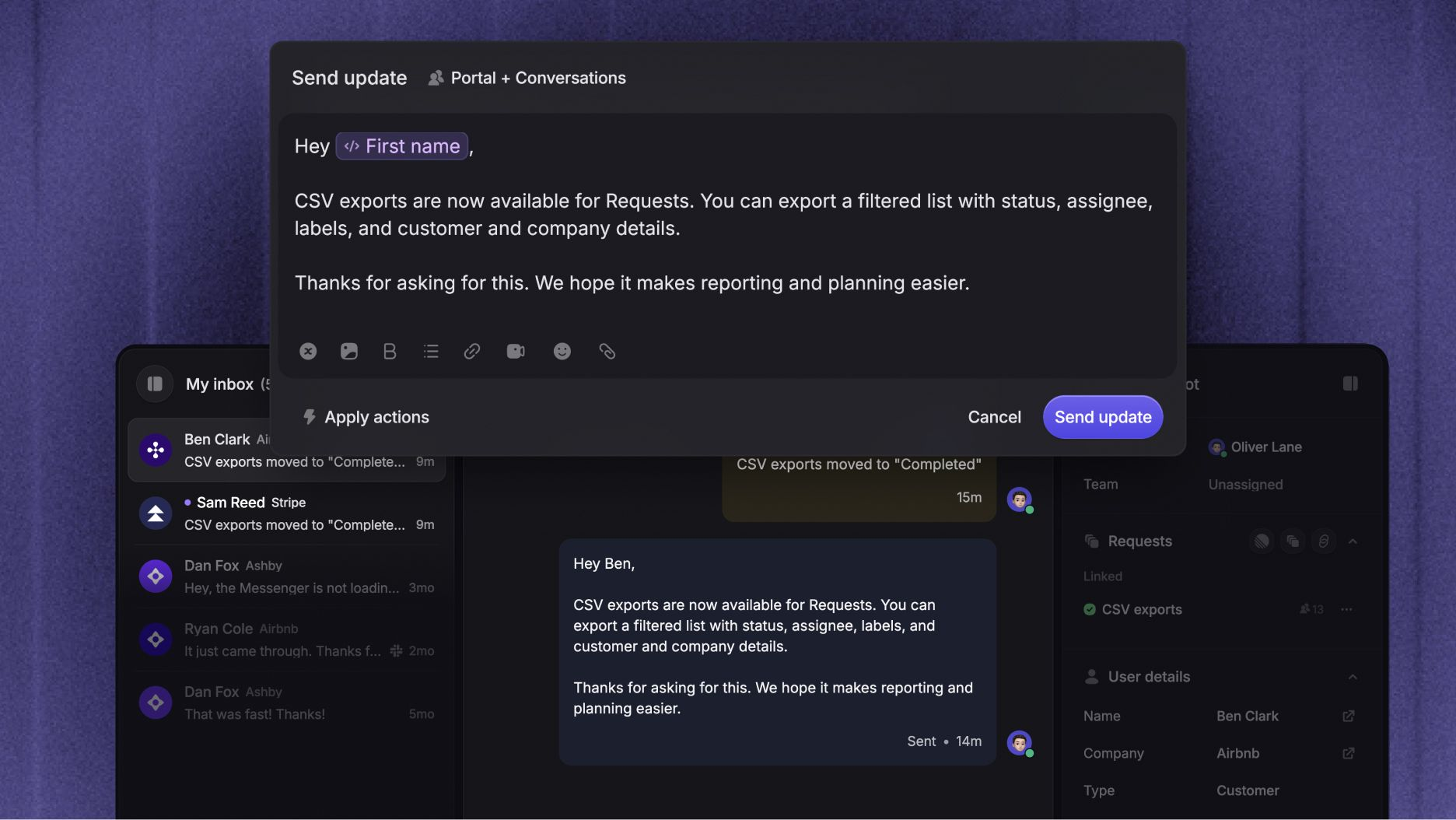
4. Act on feedback and tell customers what changed
Customer feedback is easier to act on when you know who raised it and what they were trying to do. “Add better exports” is vague. A conversation explaining that a customer needs a particular report for month-end billing gives the product team something concrete.
Featurebase lets you connect support conversations to Requests, keeping that context attached. Your team can then send updates to interested customers and follow up through linked conversations as the work progresses.
That's a practical reason for a SaaS team to choose it over a support-only inbox. When product gaps keep surfacing in support, connecting the conversation to the request makes it easier to carry the issue beyond the reply.
Closing the customer feedback loop means explaining what's changed and how to use it. If you aren't building the request, a clear answer is more useful than leaving the customer waiting on an implied promise.
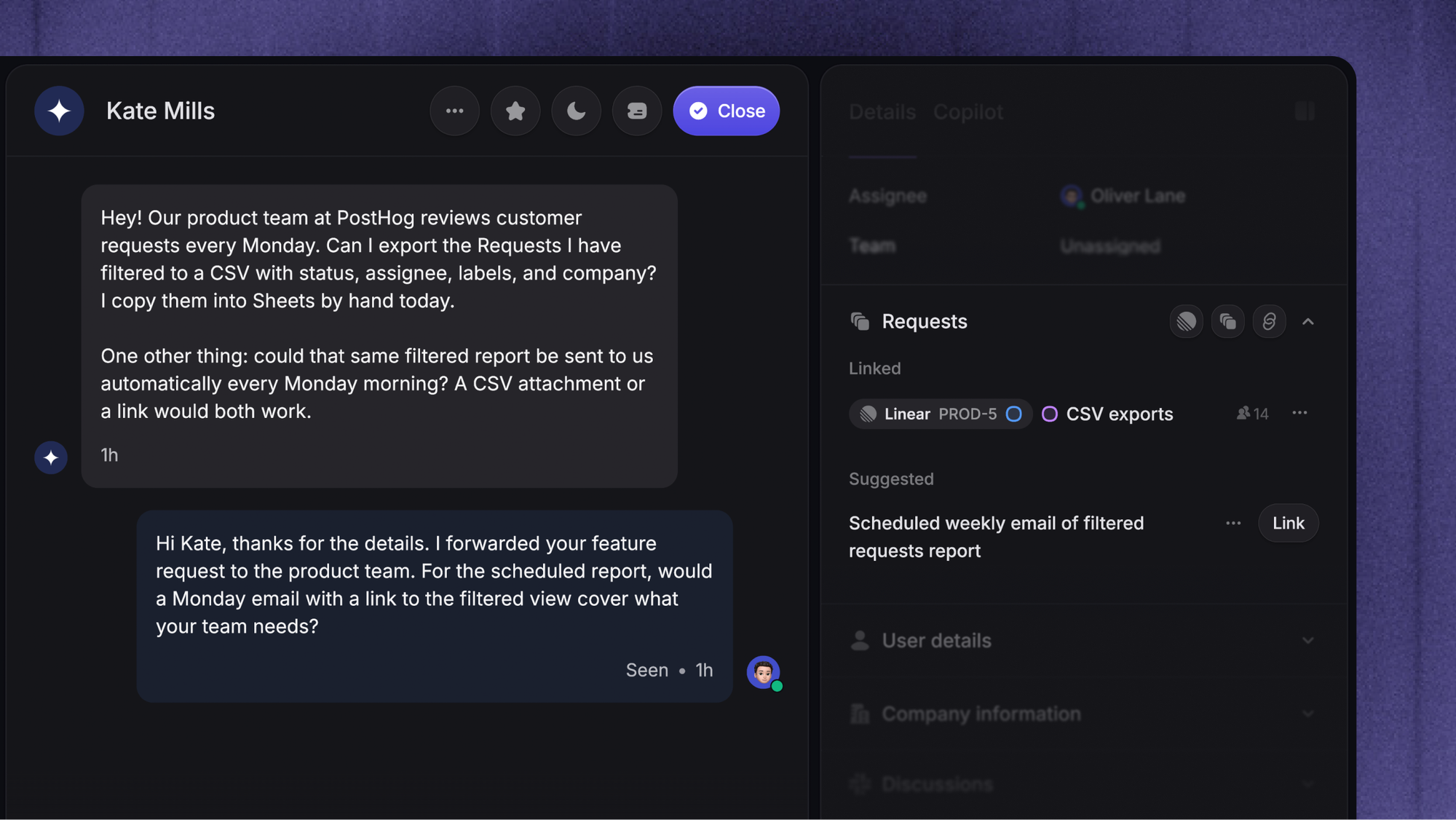
5. Investigate declining engagement
Less activity can signal trouble, but it can also mean a project ended or an integration is doing the work in the background. The meaning depends on how the customer normally uses your product.
| Signal | What it might mean | Useful response |
|---|---|---|
| A core workflow stops | The customer is blocked, or the project has paused | Help with the blocker if the workflow is still needed |
| The same ticket keeps reopening | The earlier answer didn't resolve the problem | Give someone ownership through resolution |
| Satisfaction drops after a handoff | The customer had to repeat themselves or lost track of progress | Restore the context and explain the next step |
| Account spending falls | They need fewer seats, have a smaller budget, or see less value | Help them find a plan that fits their current needs |
I'd put more weight on a broken workflow or a repeatedly reopened ticket than on login frequency alone. A customer who rarely logs in may still rely on your product every day, so that number by itself doesn't prove churn risk.
6. Recover failed payments
Involuntary churn needs a billing response. Clear payment-failure notices, sensible retry rules, and an easy way to update card details give willing customers a way to keep their service.
A failed payment that's later recovered shouldn't be treated like an unresolved loss. Reporting them separately shows whether your recovery process is working.
Keep the messages focused on the payment problem, and stop reminders once it's resolved. Offering a discount won't fix an expired card.
7. Review results by customer cohort
Cohort analysis groups customers by something they share, such as their signup month. That lets you compare retention after the same amount of time.
Suppose you simplify a confusing subscription-change process in May. Comparing May signups after 3 months with April signups after 3 months is more useful than comparing customers who've had different amounts of time to leave.
Review those results alongside revenue churn and cancellation reasons. That's how churn prevention becomes more than a list of changes your team shipped.
Give each change an owner and a review date that leaves time for the relevant renewal or usage milestone. Retaining customers can increase customer lifetime value, but keeping an account through discounts that remove its margin isn't automatically a win.
Conclusion
Customer attrition rate tells you how many customers you're losing. The useful next step is understanding why: a missing capability, a difficult support experience, and a failed payment each need a different fix.
I'd favor Featurebase over a support-only tool for SaaS teams whose customer conversations regularly turn into product requests. It combines AI-powered support, a help center, and feedback management, so your team can connect the original conversation to a Request and follow up when there's an update.
Featurebase has a Free plan, and you can get started without a credit card. 👇
✨ Bring support and product feedback together with Featurebase →
FAQs
How do active and passive customer attrition differ?
Active attrition is an explicit departure, such as canceling a contract. Passive attrition is when someone quietly stops buying or using the service without formally ending the relationship. These terms describe how the departure appears, while voluntary and involuntary describe whether the customer intended to leave.
Can customer attrition be completely eliminated?
You can have a period with no losses, but I'd avoid planning around permanent zero attrition. Customers can close their businesses, finish projects, or develop needs your product doesn't meet. Focus on the departures your team has a realistic chance of preventing.
Who should own customer attrition?
Give 1 leader responsibility for the metric and the review process, often in customer success, revenue, or general management. The fixes will still need owners across support, product, marketing, and billing. That leader's job is to make sure the work has owners and gets followed through.
Can customer attrition rate be negative?
Gross customer attrition can't be negative because you can't lose fewer than zero customers. Net revenue churn can be negative when expansion from existing customers exceeds the revenue lost to cancellations and downgrades. Growing your total customer count doesn't make customer attrition negative.
How do you measure attrition without subscriptions?
Set an inactivity threshold based on how often customers normally buy or use the service. Someone who buys seasonally shouldn't count as lost just because they haven't ordered recently. This is an inferred loss, so compare the threshold with actual returning-customer behavior and apply it consistently.