Blog Customer FeedbackChurn Management: A Practical Guide to Retaining Customers
Churn Management: A Practical Guide to Retaining Customers
Learn how churn management helps SaaS teams spot at-risk customers, measure churn, and build a practical retention process that tackles why customers leave.


Customers often show signs of leaving before they cancel. Usage drops, problems stay unresolved, or renewal conversations go quiet.
But spotting those signs only helps if someone knows what to do next. A dashboard full of at-risk accounts won't fix a broken onboarding experience or recover a failed payment.
In this guide, I'll explain how churn management works, which metrics to track, and how to build a process that turns customer insights into retention actions. 👇
Key takeaways
- Churn management connects insight to action: Understand why customers leave, identify risk early, and address the underlying problem.
- Track customers and revenue separately: Losing several small accounts can have a different impact from losing a major customer.
- Match the fix to the cause: Onboarding help, product improvements, and payment recovery solve different problems.
- Measure lasting retention: Check whether customers stay after the intervention, including after any discount ends.
- Featurebase✨ helps you collect customer feedback, understand product gaps, and keep users informed about improvements.
What is churn management?
Churn management is the ongoing process of understanding, predicting, and reducing customer loss. It combines customer data, feedback, and targeted actions to help customers keep getting value from your product.
For a SaaS business, churn usually means a paying customer cancels or doesn't renew. Define exactly when you count that loss, such as when paid access ends, and use the same definition across reports.
Customer retention is the broader goal. Churn management gives your team a process for identifying and addressing the problems that put that goal at risk.
Voluntary and involuntary churn
Voluntary churn happens when a customer chooses to leave. They might struggle to adopt your product, need a missing feature, or decide the value doesn't justify the price.
Involuntary churn happens when a customer loses their subscription without intending to cancel, often because a payment fails and isn't recovered.
The distinction matters. A product walkthrough can help a confused customer, while a billing problem needs payment recovery. Sending both customers the same retention email misses the point.
Why churn management matters
Churn removes recurring revenue and makes growth harder. You need new customers just to replace the revenue you've lost before you can grow beyond it.
Keeping customers longer also gives you more time to recover acquisition costs and increase customer lifetime value. But that only works when the relationship remains worthwhile for both sides.
In ChartMogul's H1 2024 analysis, companies with at least 100% net revenue retention had median annual growth of 48%, more than twice that of companies below 100% NRR. The growth comparison excluded businesses below $1 million ARR. These are observed relationships in SaaS revenue data, not a guarantee that improving retention alone produces that growth.
Churn analysis also helps you find recurring product problems. If customers repeatedly leave after the same setup step, fixing that step can help future customers as well as the accounts you're trying to save today.
How to measure customer and revenue churn
Start with a consistent reporting period and customer definition. Then look at both how many accounts leave and how much recurring revenue disappears.
Customer churn rate
Your customer churn rate measures the share of your starting customers lost during a period.
Customer churn rate = Customers lost from the starting customer base ÷ Customers at the start × 100
For a hypothetical example, start with 500 paying customers and lose 20 of those accounts during the month. Your monthly customer churn rate is 4%.
Keep new customers acquired during that month outside this calculation. Track their early cancellations separately so they don't disappear from your analysis.
Gross revenue churn and net revenue retention
Revenue metrics show the financial impact of customer losses and plan changes:
- Gross revenue churn: The percentage of starting recurring revenue lost through cancellations and downgrades, before expansion.
- Gross revenue retention (GRR): The percentage retained after those losses, excluding expansion revenue.
- Net revenue retention (NRR): The percentage retained after losses and expansion within the starting customer base.
For a simple monthly example, assume you start with $50,000 MRR, lose $2,000 to cancellations and $1,000 to downgrades, and gain $4,000 from existing customers upgrading. Assume no reactivations.
| Metric | Calculation | Result |
|---|---|---|
| Gross revenue churn | ($2,000 + $1,000) ÷ $50,000 × 100 | 6% |
| GRR | ($50,000 - $2,000 - $1,000) ÷ $50,000 × 100 | 94% |
| NRR | ($50,000 - $2,000 - $1,000 + $4,000) ÷ $50,000 × 100 | 102% |
Your existing customer base generates more revenue overall, even though some customers leave. That's why net revenue retention should sit beside customer churn and GRR on your dashboard.
Segment your results before drawing conclusions
An average can hide the group that needs attention. Break down churn by:
- Customer age: Separate onboarding losses from established accounts leaving.
- Plan and account value: Compare customers with similar needs and spending.
- Acquisition source: Check whether certain channels bring in poor-fit customers.
- Billing cadence: Compare monthly and annual subscriptions over appropriate periods.
- Reason for leaving: Separate product, service, budget, and payment problems.
Use cohort analysis to compare groups that started in the same period. Show customer counts alongside percentages, especially when a segment is small.
How to build a churn management process
A useful churn management strategy gives your team a clear route from finding a problem to checking whether the fix worked. Here's how I'd structure it.
1. Establish your baseline and retention goal
Choose the customer segment and metric you want to improve first. Trying to fix every source of churn at once makes it difficult to tell which changes helped.
A hypothetical goal might be: reduce monthly customer churn among established self-serve accounts from 4% to 3% over the next quarter. That's a 1-percentage-point drop, or a 25% relative reduction.
Assign a person to coordinate the work. Customer success might lead the review, with product, support, and billing owning the fixes in their areas.
2. Find out why customers leave
Combine cancellation reasons with what customers actually experienced. An exit survey answer such as "too expensive" might reflect a budget cut, an unused subscription, or a feature that never delivered enough value.
Review support conversations and product usage alongside customer feedback surveys. Ask focused follow-up questions:
- What were you hoping to accomplish?
- Where did you get stuck?
- What changed before you decided to cancel?
Record the customer's explanation separately from your team's interpretation. That prevents an assumption from becoming a supposed fact in your churn report.
For earlier feedback, Featurebase Surveys let you ask relevant customer segments short questions inside your web app. Pair a satisfaction rating with an open-ended question so you can understand what's behind the score.
3. Identify early warning signs
Look for changes that tend to appear before your own customers leave. Useful churn risk signals can include:
- Falling usage: An account stops completing its usual core workflow.
- Stalled activation: New customers never reach the outcome they signed up for.
- Unresolved support issues: A problem keeps blocking useful work.
- Lower satisfaction: Feedback becomes more negative or highlights repeated frustration.
- Stakeholder changes: Your main contact leaves and nobody takes over.
- Billing trouble: Payments fail or billing contacts become unreachable.
A customer health score can combine these signals, but the underlying evidence should stay visible. A single score doesn't tell a customer success manager which problem to solve.
Compare behavior with each account's normal pattern. A seasonal product user going quiet means something different from a daily user suddenly disappearing.
4. Match each risk to an intervention
Build a small set of retention playbooks that specify the action, owner, and follow-up. The response should address the customer's obstacle.
| Risk | First action | Suggested owner | Success signal |
|---|---|---|---|
| Onboarding stalls | Help the customer complete their first useful task | Customer success | Activation milestone completed |
| A bug blocks work | Escalate the issue and agree on an update schedule | Support and engineering | Customer resumes the workflow |
| A product gap threatens renewal | Clarify the requirement and evaluate feasible options | Product and account owner | Customer confirms an acceptable path |
| Subscription no longer fits | Discuss a suitable plan or pause, if available | Customer success | Continued use on an appropriate plan |
| Payment fails | Start payment recovery and request updated details when needed | Billing | Payment recovered |
Don't default to discounts. A lower price won't make a broken integration work, and a temporary save can hide the same cancellation a month later.
For high-value accounts, agree on a concrete recovery plan with the customer. For smaller accounts, use targeted guidance and clear escalation paths when automated help doesn't resolve the issue.
5. Act on feedback and communicate progress
When the same issue appears across multiple accounts, bring it into product planning. Customer feedback analysis helps you group recurring problems and distinguish widespread friction from isolated requests.
Prioritize using the severity of the problem, affected customers, revenue exposure, and fit with your product direction. A cancellation threat deserves investigation, but it doesn't automatically justify a custom feature.
Then close the feedback loop. Tell customers what you're doing, explain limits honestly, and follow up when the improvement is available.
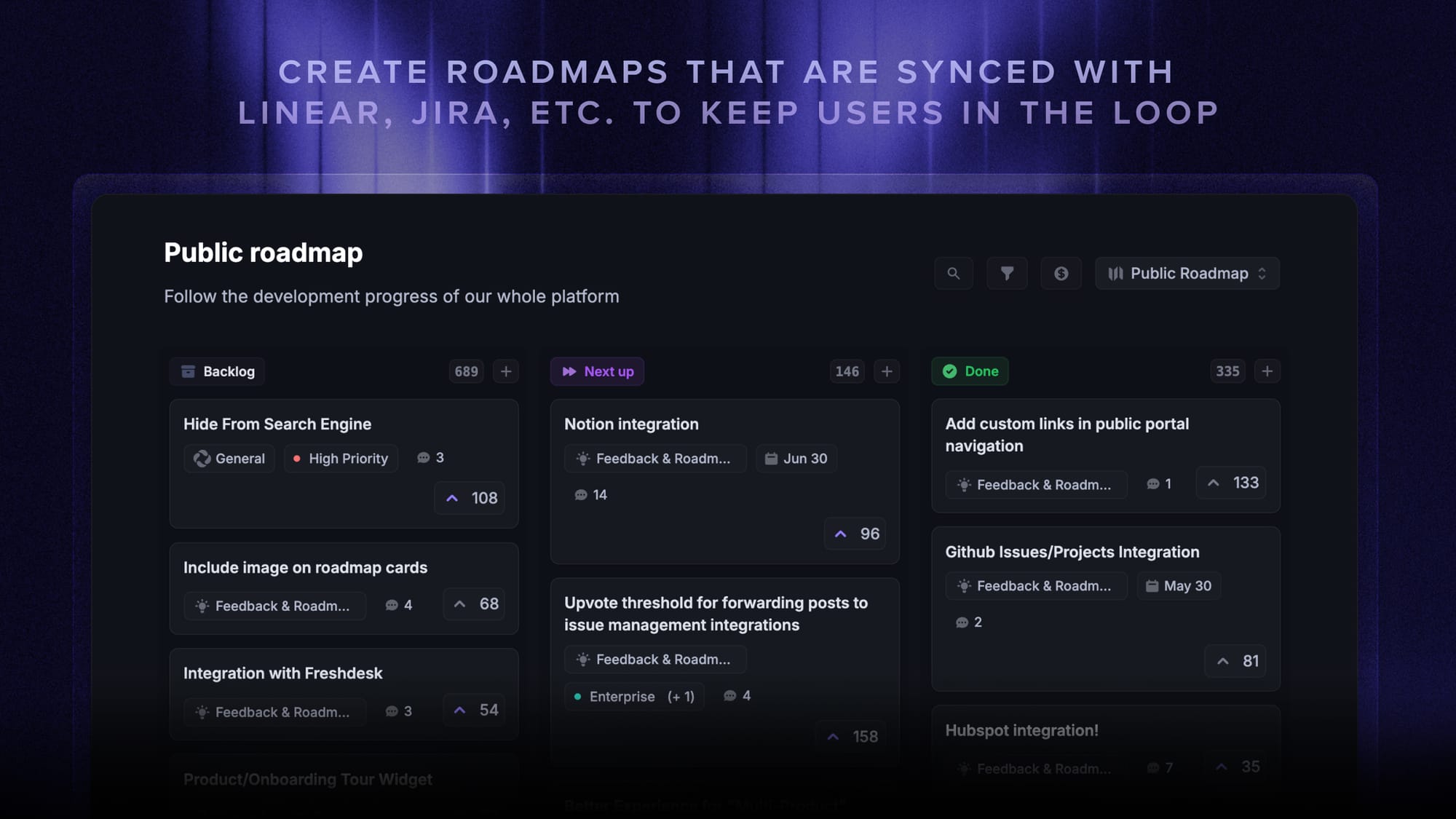
Featurebase Roadmaps help you share planned work and progress with customers. Keep delivery commitments realistic, and check whether the finished improvement actually solves the problem the customer raised.
6. Measure results and improve the process
Track whether interventions produce lasting customer retention. A reply to an email or an accepted discount is an intermediate result.
Review these outcomes together:
- Retention after intervention: Do customers remain active through later billing periods?
- Revenue retained: How much recurring revenue remains after downgrades and discounts?
- Problem resolution: Did the customer regain the ability to complete their task?
- Cost of the intervention: Was the time and incentive justified by the outcome?
Where practical, compare similar eligible customers receiving different treatments, ideally through a controlled test. Otherwise, record other changes that could explain the result, such as seasonality or a different customer mix.
Review open risks regularly and retention outcomes over a period that matches your billing cycle. Keep the playbooks that help, revise the weak ones, and feed recurring causes back into product improvements.
Churn management examples
These hypothetical scenarios show how the same process leads to different actions.
A new customer never reaches first value
A team signs up for reporting software but never connects its data source. Sending reminders about advanced dashboards won't address the obstacle.
Customer success contacts the account and discovers a permissions problem. A guided setup session helps the team generate its first report. Track activation and subsequent retention to evaluate whether the customer onboarding change helps similar accounts.
An established account encounters a product gap
A customer uses your product regularly but needs an approval step your workflow doesn't support. Their activity looks healthy, while support conversations reveal a renewal risk.
The account owner clarifies the requirement and checks for a workable alternative. Product evaluates whether the missing capability fits the roadmap, and the customer receives an honest update before renewal.
An active subscriber's payment fails
A customer continues using your product, but their renewal payment is declined. Billing initiates the appropriate recovery process and gives the customer a clear way to update payment details.
Track recovered payments and whether the subscription remains active. A failed charge is a billing signal, so keep it separate from product dissatisfaction in your analysis.
What to look for in churn management software
Choose software around the problem you're solving. Your existing tools may already cover some of the work.
- Subscription analytics: Consistent customer and revenue churn reporting, with cohorts and segments.
- Product analytics: Visibility into activation, adoption, and changes in core usage.
- Feedback collection: Surveys and customer context that explain why behavior changes.
- Customer success workflows: Clear account ownership, risk tracking, and follow-up tasks.
- Payment recovery: Support for failed-payment handling through your billing system.
Before buying, test a real use case: can the team identify an at-risk account, understand the evidence, assign an action, and measure the outcome?
Check how customer identities connect across systems, too. A dashboard is less useful when billing records and product activity refer to the same account under different names.
How Featurebase supports your churn management strategy
Churn data tells you which customers are leaving. Customer feedback helps you understand what needs to change to give them a reason to stay.
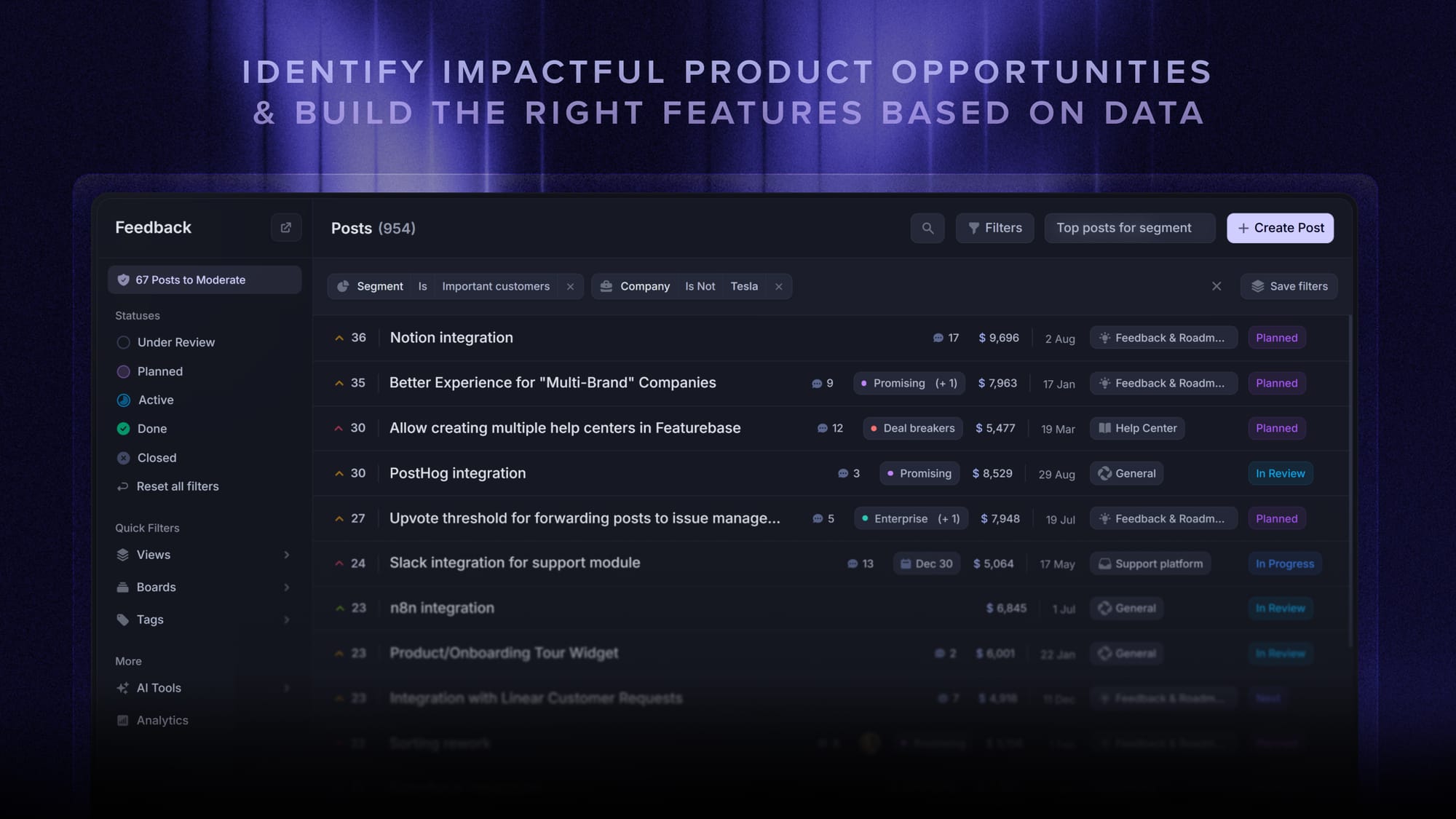
Featurebase is a modern feedback & support platform that helps product teams collect feedback, prioritize features, build roadmaps, and announce product updates, all in one place. It brings the customer insights and follow-through behind your retention work into a shared workflow.
Here's how it fits into your churn management process:
- Collect feedback before cancellation: Use targeted Surveys to ask customers about onboarding friction, missing capabilities, or their experience with a specific workflow. Open-ended answers add context to satisfaction scores.
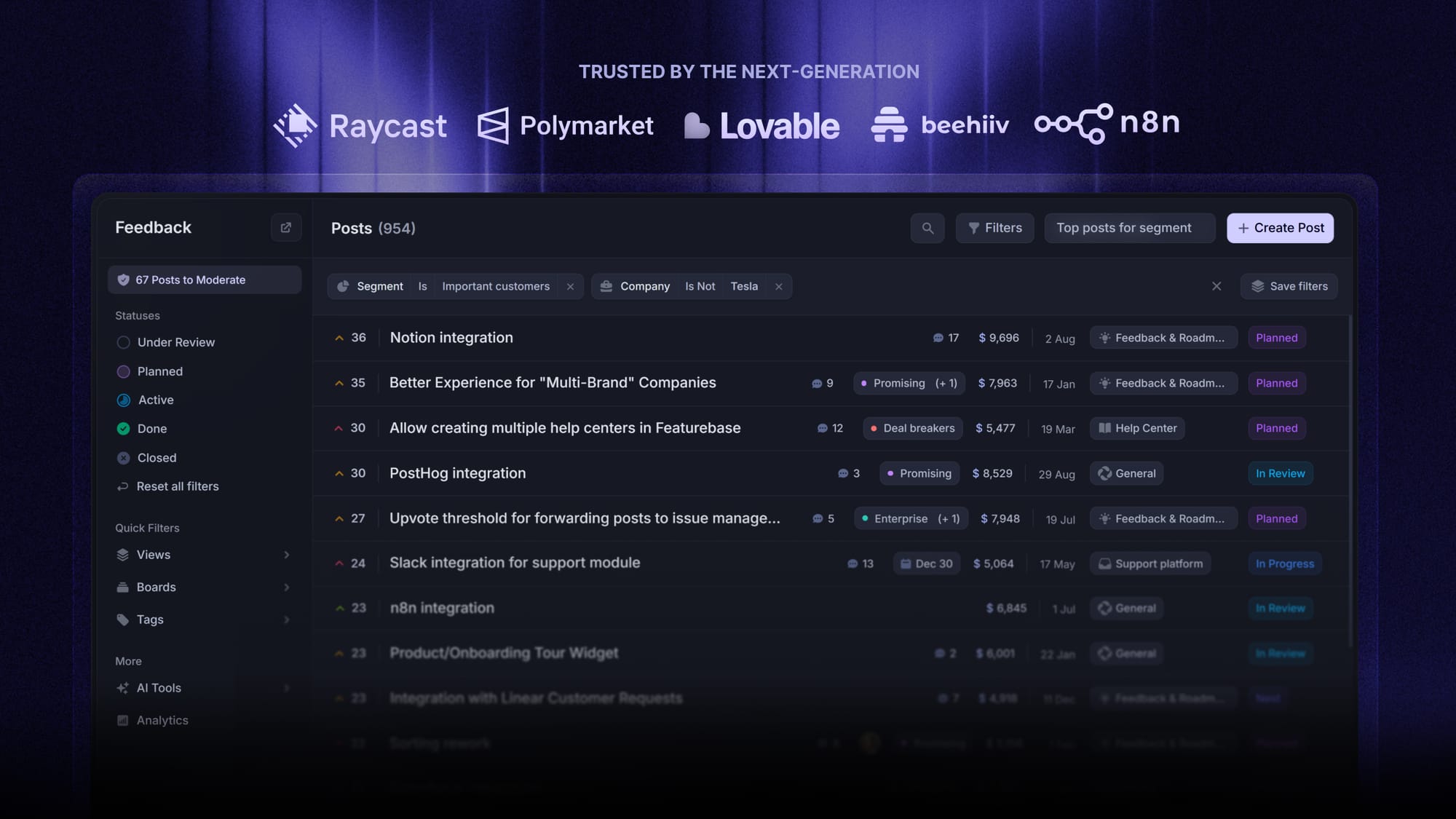
- Understand which product gaps matter: Gather requests through a feedback forum, in-app widgets, and integrations. Connect feedback to customer revenue and segments to understand who is affected and weigh the impact of an improvement.
- Show customers what's progressing: Use Roadmaps to share planned, in-progress, and completed work. Customers can see how their requests relate to your product plans.
- Close the loop when you ship: Notify users when their requested features are implemented and share product updates through changelogs and in-app announcements. Follow up to find out whether the change resolved their problem.
For example, several customers might report that a missing workflow is blocking their team. You can bring that feedback together, assess the affected accounts, communicate the decision, and keep interested users informed as the work progresses.
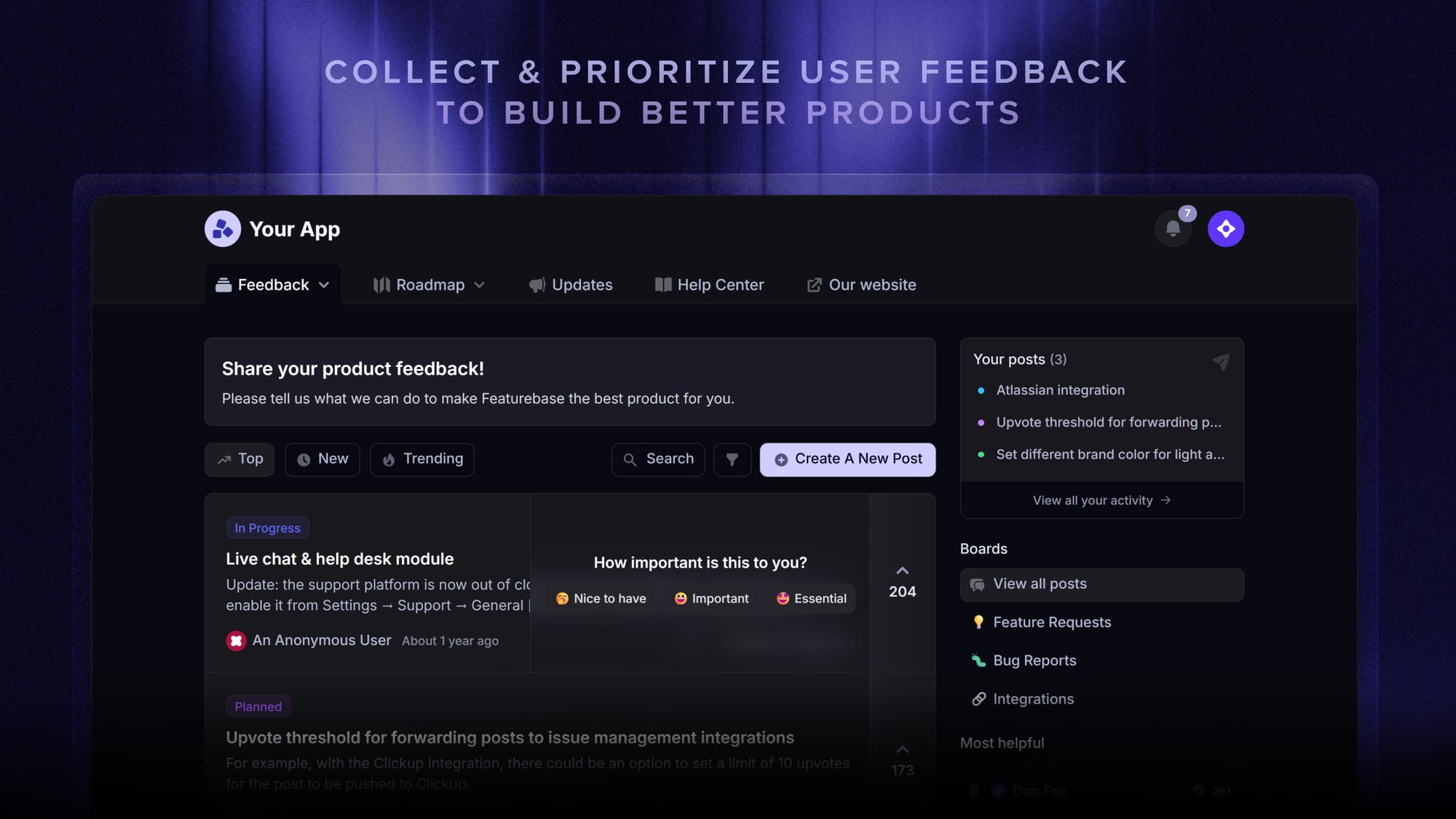
That gives product and customer success teams a practical way to address recurring product-related reasons for churn. Pair those insights with your usage and billing data to measure whether the changes improve retention.

Turn feedback into products your users love
Centralize feedback, identify product opportunities, and build the right features
Conclusion
Effective churn management starts with understanding why customers leave. Measure the losses, find the underlying problems, and give your team specific actions they can follow through on.
Featurebase is a modern feedback tool that helps you collect feedback with a feature voting forum, surveys, embeddable widgets, and integrations. You can connect feedback to customer revenue and data to make better product decisions.
It comes with a Free plan, and you can get started without a credit card. Bring customer feedback into your retention process and start learning what needs attention. 👇
✨ Start collecting & managing feedback with Featurebase for free →
FAQs
What is a good churn rate for a SaaS business?
A useful churn benchmark matches your customer type, account value, contract length, and measurement period. Compare your business with similar companies and track your own cohorts over time. A monthly rate and an annual rate aren't directly comparable.
Can a business have negative churn?
Yes, a business can have negative net revenue churn when expansion from existing customers exceeds revenue lost through cancellations and downgrades. Customer churn itself doesn't become negative. You can grow revenue from your existing base while still losing accounts.
Is every customer worth retaining?
Retention should make sense for both the customer and your business. A poor-fit account that requires unsustainable customization or support may not be worth saving at any cost. Learn from the mismatch and improve how you attract and qualify future customers.
Do you need AI to predict customer churn?
No. Teams can start with simple rules based on meaningful behavior changes and known customer problems. AI-based churn prediction becomes more useful when you have sufficient reliable historical data and a way to test whether its predictions lead to better decisions.
How do subscription management apps reduce churn?
Subscription management apps can help customers update billing details, change plans, or pause subscriptions where supported. Some also provide automated payment retries and recovery messages. These capabilities address billing and subscription friction, while product-value problems still need attention from your team.