Blog The Customer Is Always Right: Is It Really True?
The Customer Is Always Right: Is It Really True?
"The customer is always right" isn't quite true. Here's where the phrase came from, what it really means, and a smarter way to handle customer demands.


"The customer is always right" is one of the most repeated phrases in business. It sounds obvious: keep customers happy and they'll keep coming back.
But taken literally, it's one of the most damaging ideas a team can adopt. It burns out staff, rewards bad behavior, and pushes you to build the wrong things.
Here's where the phrase actually came from, what it really means, and a healthier way to handle customer demands. 👇
Key takeaways
- The phrase started as a 1900s retail slogan from Harry Gordon Selfridge, with Marshall Field and John Wanamaker credited around the same time. It was meant to make shoppers feel valued, not to be obeyed word for word.
- The popular "in matters of taste" full quote is unproven. There's no solid evidence the original phrase was ever that long.
- Taken literally, the rule hurts team morale, rewards abusive customers, and sets unrealistic expectations no team can meet.
- The phrase still holds real value as a reminder to stay customer-centric, as long as you back it with fair policies that protect your team.
- Featurebase✨ helps you collect customer feedback in one place and prioritize it by real impact, so you act on the strongest signal instead of the loudest voice.
- The better question isn't "is the customer right?" but "what is the customer really telling us?" - listen to the signal, not the literal demand.
Where "the customer is always right" comes from
The phrase is about a century old, and it comes from retail.
The most cited originator is Harry Gordon Selfridge, who founded Selfridges in London in the early 1900s and used it as a staff training and advertising slogan. US retailers Marshall Field and John Wanamaker are credited with similar mottos around the same time, so no single person clearly owns it.
The idea was radical back then. This was the era of caveat emptor - "let the buyer beware" - when sellers could misrepresent products and all the risk sat with the shopper. Telling staff to treat customers as always right was a way to signal that shoppers were valued and safe to trust.
Similar mottos popped up worldwide, all built on respect rather than literal infallibility:
- France: Swiss hotelier César Ritz championed "le client n'a jamais tort" - "the customer is never wrong."
- Germany: the saying is "der Kunde ist König" - "the customer is king."
- Japan: the phrase translates closer to "the customer is a god."
What the phrase actually means (and the "matters of taste" myth)
It was never a literal promise that customers are correct about everything.
Selfridge and his peers weren't claiming customers are experts on your business. They were telling staff to take complaints seriously and treat shoppers with dignity at a time when that was rare. The point was loyalty, not obedience.
You've probably seen the claim that the "real" full quote is "the customer is always right in matters of taste." It's a tidy idea, that a retailer should sell you the ugly hat you want without judgment, but there's no solid evidence the original phrase was ever that long. Treat it as a nice reframe, not history.
Henry Ford is often quoted (probably apocryphally) as saying, "If I'd asked my customers what they wanted, they would have said faster horses." Whether or not he said it, the lesson holds: customers are great at describing problems, and far less reliable at prescribing solutions.
Is the customer always right? Why you can't take it literally
Short answer: no. The moment you treat it as an unbreakable rule, 3 problems show up.
It hurts team morale
Telling staff the customer always wins, no matter what, puts them in an impossible spot. Research from Deakin University found that customer failures and unreasonable behavior take a real toll on frontline employees' well-being, especially when managers don't back their team up.
When employees are berated and then told the customer was right anyway, morale drops and turnover climbs. You can't deliver great service with a demoralized team.
It rewards bad behavior
A literal reading hands leverage to your worst customers. People who shout, threaten, or exploit policies learn that pushing harder gets results, while your polite, loyal customers get the same treatment or less.
Policy abuse is common, too. In a 2025 Forter survey, 68% of US and UK consumers said retailers make it easy to abuse flexible return policies, and 58% said it's easy to open multiple accounts to exploit promotions. Bending every rule to keep one angry person happy quietly trains customers to game you.
It sets your team up to fail
Promising that the customer is always right creates expectations you can't meet. The classic example is the shopper who returned snow tires to Nordstrom, a store that never sold tires, and still got a refund. It makes a great story, but imagine honoring that at every location, every day. Some requests simply aren't reasonable, and staff need permission to say so.
The case for still putting customers first
Here's the balance: the phrase is wrong as a literal rule, but the instinct behind it is right.
Customer-centricity pays off. According to Qualtrics' 2024 ROI of Customer Experience study, customers are 2.9 times more likely to trust a retail brand after a 5-star experience. Seeing things from the customer's perspective, even when you can't give them exactly what they ask for, builds the loyalty that keeps a business alive.
So the goal isn't to stop caring about customers. It's to care about the right things: solving real problems, owning genuine mistakes, and protecting both your customers and your team at the same time.
A better question: what is the customer really telling you?
Instead of asking "is the customer right?", ask "what is the customer actually telling us?" A complaint or a feature request is a signal, not a spec.
There's a big gap between what customers say they want and what they actually need. Someone might demand a specific feature when the real problem is that something else is confusing or slow. Your job is to decode the request, not just fulfill it.
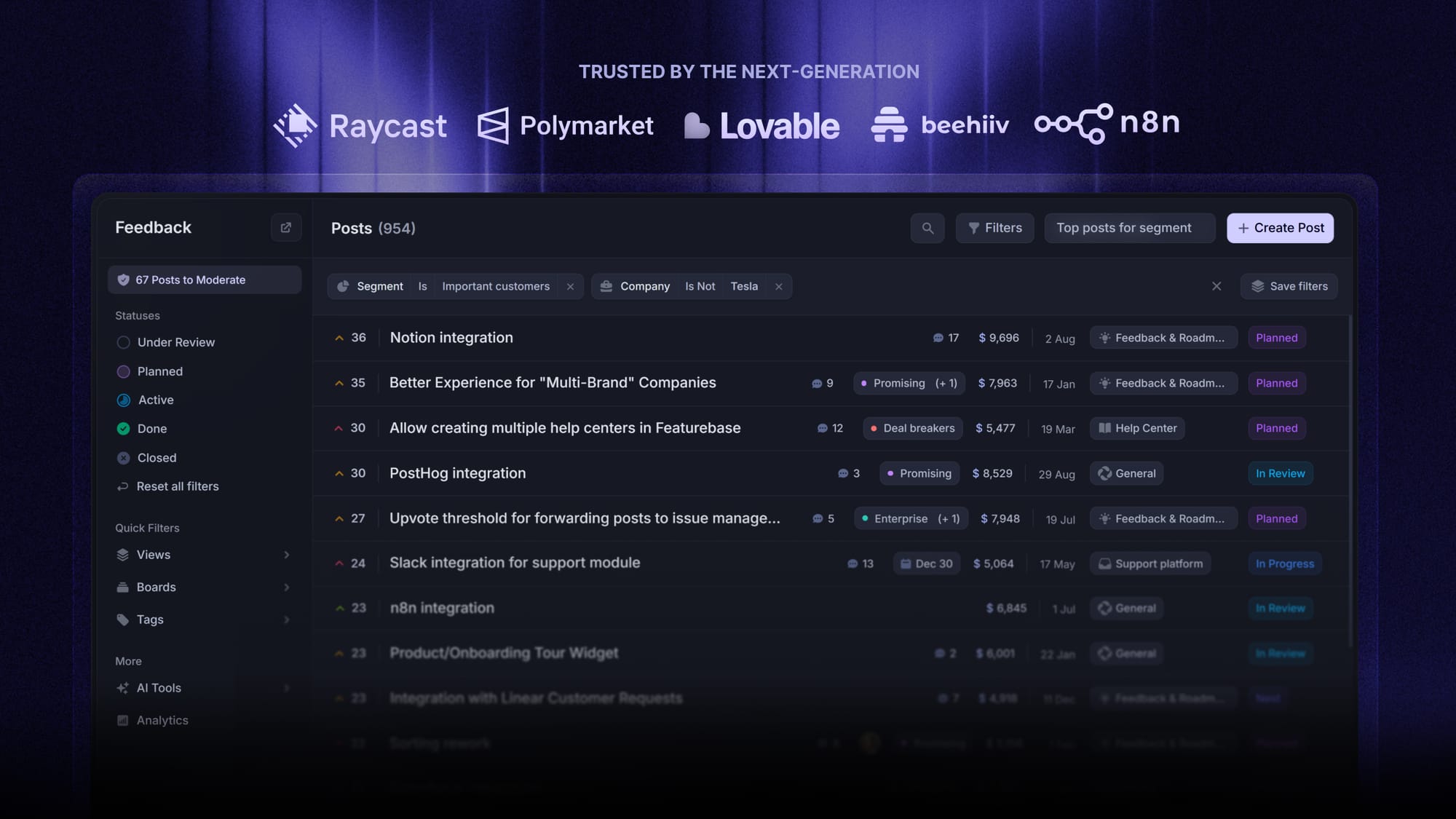
That's much easier when feedback lives in one place instead of scattered across inboxes, calls, and chats. Collecting all your feedback and weighing it by real impact - how many users are affected, and how much revenue sits behind each request - lets you act on the strongest signal instead of the loudest voice. One furious customer is not the same as a pattern across hundreds.
Conclusion
So, is the customer always right? Not literally. The phrase is a useful reminder to respect customers and take their problems seriously, but blind obedience burns out your team, rewards bad actors, and leads to worse products. The smartest teams listen closely and then decide with judgment. The customer is always real, just not always right.
Featurebase is a modern & powerful feedback tool. It helps you collect feedback with a feature voting forum, surveys, embeddable widgets, and integrations. You can then analyze all of that feedback in one place by connecting it to your customers' revenue and data to make better product decisions.
It comes with affordable pricing and a Free plan with unlimited feedback. The onboarding is quick and doesn't require a credit card, so there's no downside to trying it. 👇
✨ Start collecting & managing feedback with Featurebase for free →
FAQs
Who first said "the customer is always right"?
Harry Gordon Selfridge, founder of the Selfridges department store in London, is the most commonly credited source, using it as a slogan in the early 1900s. US retailers Marshall Field and John Wanamaker promoted near-identical mottos around the same period, so the phrase has no single undisputed author.
What is the full "customer is always right" quote?
Many people claim the original was "the customer is always right in matters of taste," but there's no reliable evidence the phrase was ever that long. The "matters of taste" version is a modern reframe, not a documented historical quote.
What does "the customer is always right" actually mean?
Originally it meant "treat customers as valued and take their complaints seriously," not "customers are correct about everything." It was a loyalty philosophy from an era when shoppers had few protections, not a literal instruction to grant every demand.
Is "the customer is always right" a good interview answer?
Usually not on its own. Interviewers asking about it want to see nuance: that you'll treat customers with empathy and take their concerns seriously, while also using judgment, respecting policies, and knowing when to say no. Blind agreement signals you'd struggle with difficult situations.
Why is the customer not always right?
Because customers can be misinformed, unreasonable, or abusive, and treating every demand as valid causes real harm. Taken literally, the rule hurts employee morale, rewards people who exploit policies, and sets unrealistic expectations that no team can meet consistently.
How do you decide which customer feedback to act on?
Prioritize by impact, not volume. Look at how many customers are affected, how much revenue sits behind a request, and whether it fits your product strategy, rather than reacting to whoever complains loudest. Featurebase helps here by centralizing feedback and letting you prioritize it by customer revenue and votes, so the strongest signals rise to the top.