Blog Customer FeedbackCustomer Churn Prediction: A Practical Guide
Customer Churn Prediction: A Practical Guide
Customer churn prediction uses your data to flag the customers most likely to leave, so you can act before they cancel. Here's how it works and how to reduce churn.

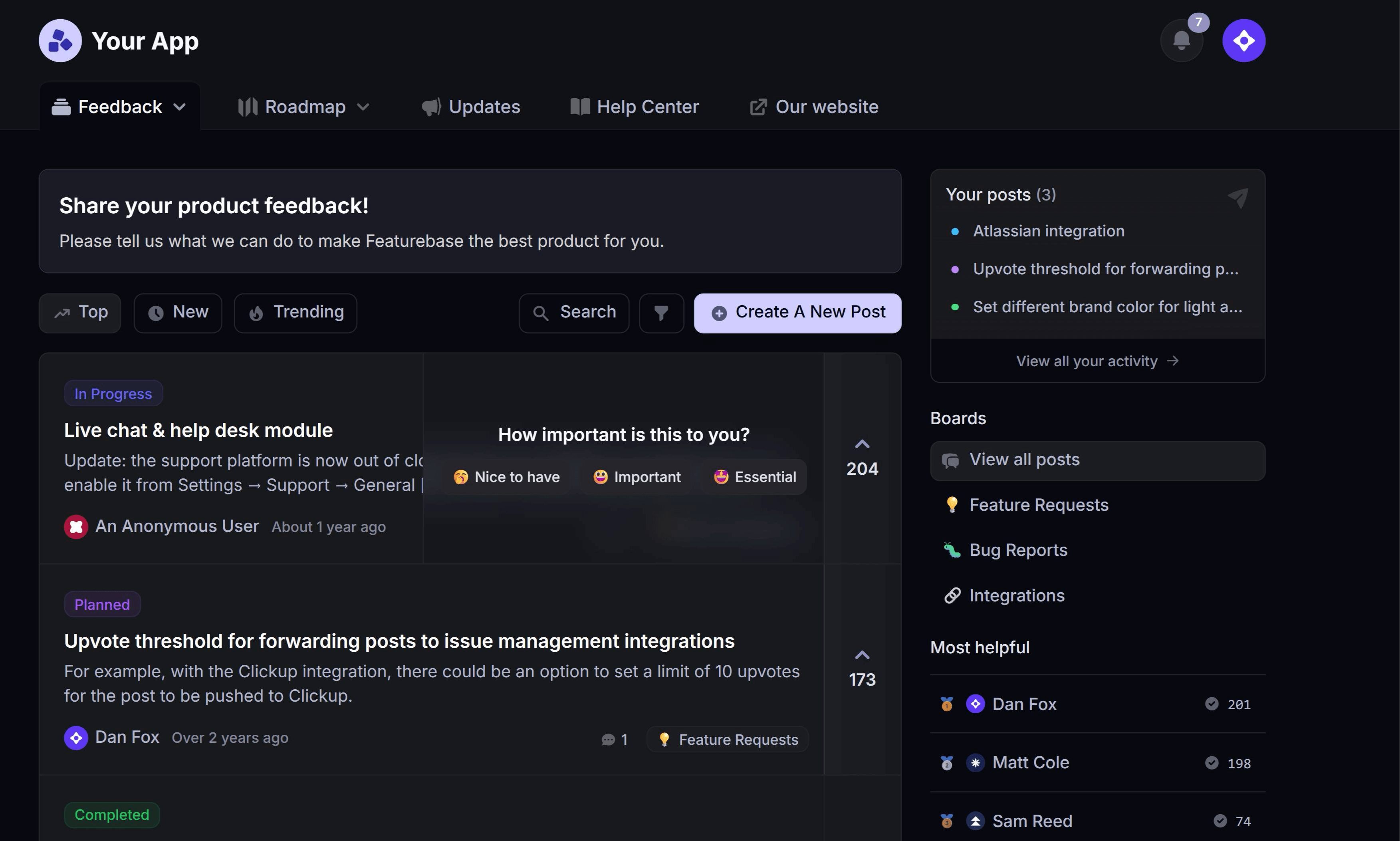

Most customers don't tell you they're leaving. They quietly stop logging in, ignore your emails, and one day the cancellation just lands in your inbox.
By then it's too late to do anything about it.
Customer churn prediction flips that around. It uses the data you already have to flag the accounts most likely to leave while you still have time to win them back. In this guide, I'll cover what churn prediction is, why it matters, the models behind it, and how to actually act on it. 👇
Key takeaways
- Customer churn prediction uses historical and behavioral data to flag the customers most likely to cancel or go inactive, so you can step in before they leave.
- Churn splits into voluntary churn (customers choose to go) and involuntary churn (failed payments and passive drop-off) - and the two need very different fixes.
- The strongest predictive signals are usually behavioral: falling logins, lower feature usage, fewer support interactions, and slipping engagement.
- Most teams start with a simple model like logistic regression or gradient boosting - accuracy you can act on beats a perfect score you can't.
- Prediction only pays off when it triggers action: better onboarding, proactive outreach, and shipping the features customers keep asking for.
- Featurebase✨ helps you capture the why behind churn with surveys and a feedback forum, so you can fix the issues driving customers away.
What is customer churn prediction?
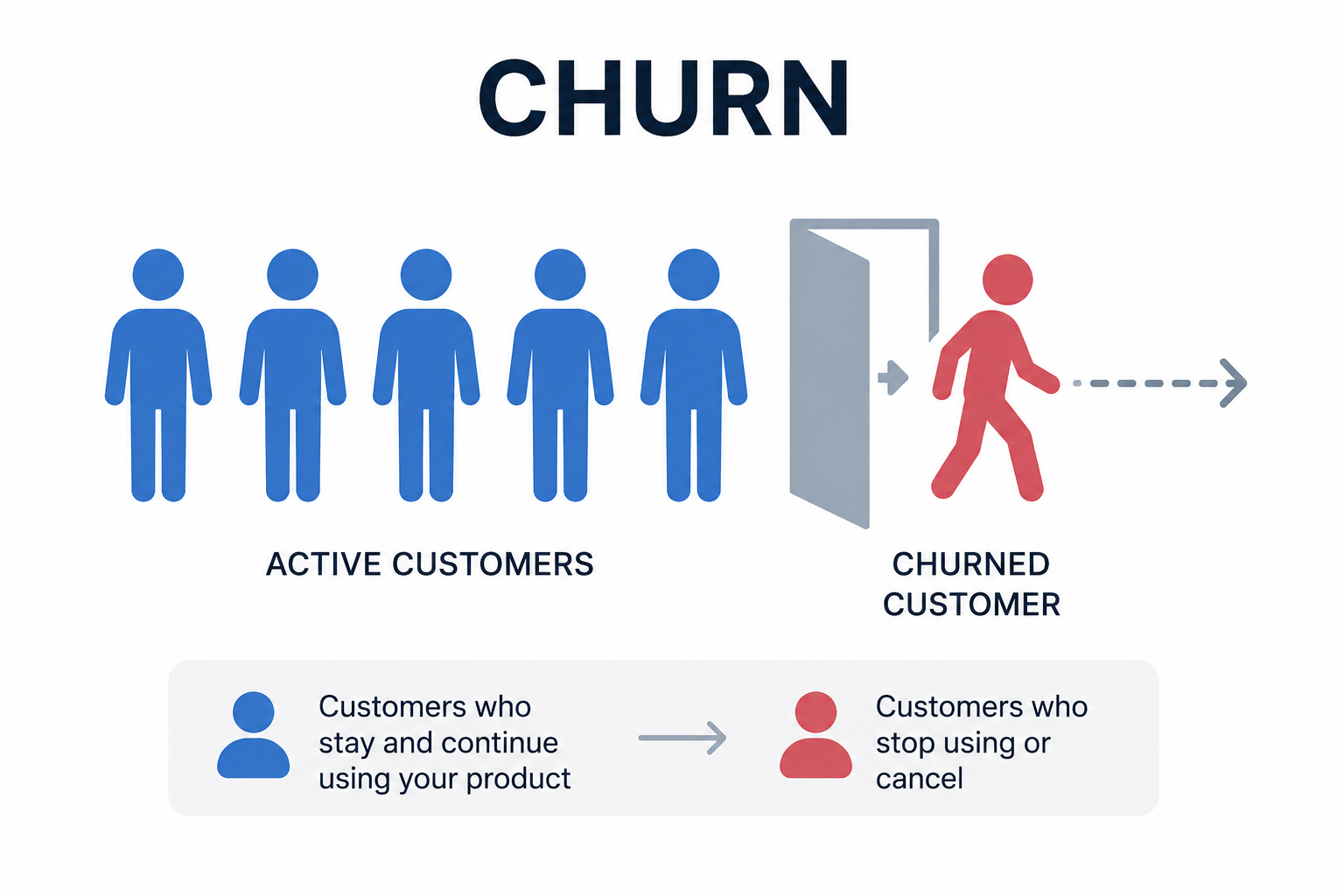
Customer churn prediction is the process of using data to identify which customers are most likely to stop using your product or cancel their subscription - before they actually do it.
A few related terms get mixed up all the time, so let's separate them:
- Customer churn is when a customer stops doing business with you, whether they cancel, downgrade, or simply go inactive.
- Customer churn rate is the percentage of customers who leave over a set period. It tells you how big the problem is, but not who's about to leave.
- Churn prediction is forward-looking. It scores individual customers on how likely they are to churn, so you can act on specific accounts.
Churn rate is the rear-view mirror. Churn prediction is the windshield. It's the difference between knowing you lost 5% of customers last quarter and knowing which customers are at risk this quarter, while you can still do something about it.
Why customer churn prediction matters
The math on retention is brutal, and it's the whole reason churn prediction earns its keep.
Acquiring a new customer is anywhere from five to 25 times more expensive than retaining an existing one, based on research from Bain & Company. And the upside of holding onto customers compounds fast: increasing retention rates by 5% increases profits by 25% to 95%.
In other words, every customer a model helps you save is far cheaper than the one you'd have to acquire to replace them. That makes churn prediction one of the highest-leverage things a customer retention program can do.
There's a timing angle too. Most retention efforts are reactive - you find out a customer left when the cancellation comes through. Prediction lets you be proactive instead, reaching out while the relationship is still salvageable rather than after it's gone.
Picture a high-value account whose logins quietly drop 40% over a month. Without prediction, nobody notices until renewal, when the decision to leave is already made. With it, that account surfaces on a risk list in week one, a CSM reaches out, and you have a real shot at fixing whatever went wrong. That single save can pay for the whole effort.
Types of customer churn
Not all churn looks the same, and lumping it together makes it harder to fix. Most of it falls into three buckets:
- Voluntary churn: The customer makes an active choice to leave - they cancel over price, a missing feature, a bad experience, or a competitor. This is the churn prediction can most directly influence.
- Involuntary churn: Passive churn the customer didn't intend, usually from failed payments, expired cards, or billing errors. It's often recoverable with dunning emails and automatic payment retries.
- Revenue churn: When you lose revenue rather than logos - downgrades and lost expansion. A customer who stays but halves their plan still hurts your bottom line.
Knowing which type dominates changes your response. A high involuntary churn rate is a billing problem, not a product problem, and no amount of proactive outreach will fix it.
The data and signals that predict churn
A churn model is only as good as the signals you feed it. The good news is that most of the useful data already lives in your product and your billing system.
The strongest predictors tend to fall into a few categories:
- Product usage: Login frequency, active days, and feature adoption. A steady decline in usage is the single most reliable signal that a customer is drifting away.
- Engagement: Email opens, in-app responses, and how customers interact with onboarding, updates, and community.
- Support and sentiment: Ticket volume, low satisfaction ratings, and negative feedback. A spike in complaints or a falling NPS or CSAT score often precedes a cancellation.
- Account and billing: Plan type, tenure, payment history, and contract value, which help you weight risk by how much each account is worth.
You don't need every one of these to start. Even a few well-chosen signals wired into a simple customer health score will catch a meaningful share of at-risk customers. Just remember that behavioral data tells you who is slipping, not why - which is a gap we'll come back to.
Common churn prediction models
You don't need to know the math to make good decisions here, but it helps to know what the common options are and when each fits. Most churn prediction models come down to a handful of approaches:
- Logistic regression: The simplest and most interpretable option, and a great baseline. It's a common starting point precisely because you can explain why it flagged an account.
- Decision trees and gradient boosting: Methods like Random Forest and XGBoost handle messy, non-linear patterns well and are the workhorses for most tabular churn data.
- Survival analysis: Predicts not just whether a customer will churn, but when - useful for timing your interventions.
- Neural networks: Powerful for very large, complex datasets, but usually overkill for the average SaaS team.
The practical advice: start simple. A logistic regression or gradient boosting model will get you most of the way, and you can add complexity later only if it earns its place.
How to build a churn prediction model
You don't have to be a data scientist to understand the workflow. Building a churn prediction model is a 6-step loop, and most of the work is in the data, not the algorithm:
- Define what churn means for you: Decide exactly what counts as churn - a cancellation, 30 days of inactivity, a downgrade. A fuzzy definition produces a fuzzy model.
- Gather and clean your data: Pull usage, billing, support, and engagement data into one place, then fix gaps and inconsistencies before anything else.
- Engineer the features: Turn raw data into meaningful signals, like "logins in the last 30 days" or "days since last support ticket."
- Train and test a model: Split your data, train on customers whose outcome you already know, and validate on the rest.
- Evaluate on the metrics that matter: Look at precision and recall on the customers who actually churned, not just overall accuracy. Catching real at-risk accounts is the point.
- Put predictions where people act: A risk score buried in a dashboard changes nothing. Route it to the customer success and product teams who can respond.
The last step is where most churn programs quietly fail. A model that nobody acts on is just an expensive report.
How to act on predictions and reduce churn
A prediction is only useful if it changes what you do next. Once you know which accounts are at risk, the plays are fairly consistent:
- Fix the leaks upstream: If churn clusters around week two, your onboarding is the problem, not your customers.
- Prioritize by value: Focus proactive outreach on the high-value accounts where saving one customer is worth the effort.
- Close the loop: When you fix something a customer flagged, tell them - closing the feedback loop is one of the most underrated retention moves there is.
But there's a limit to what behavioral models can tell you. They're good at flagging who is at risk and when, and pretty poor at explaining why. For that, you have to ask.
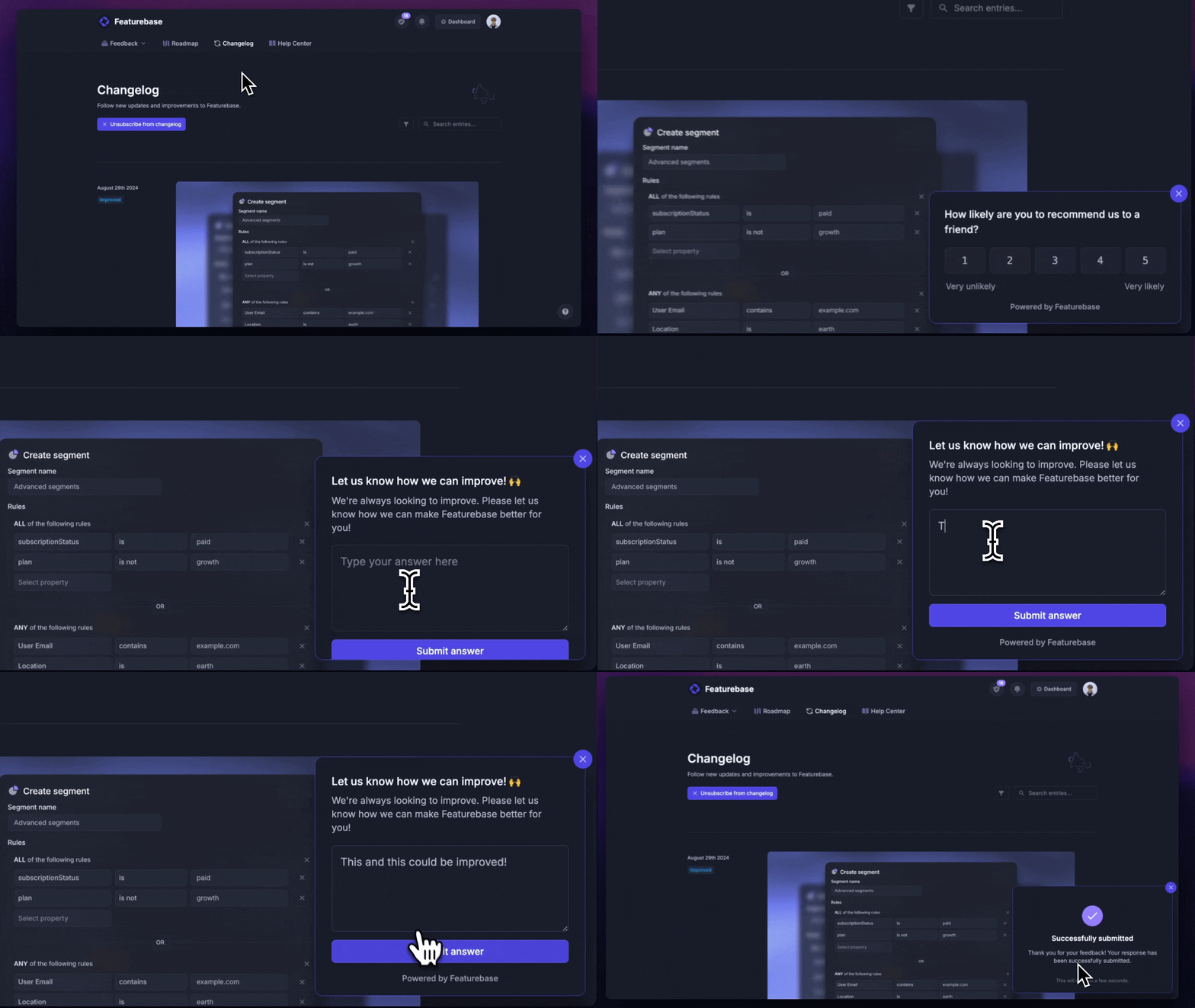
Running targeted NPS and CSAT surveys when an account's usage starts slipping surfaces the frustration behind the numbers, and a central feedback forum shows you which missing features keep coming up in churn conversations. This is the qualitative layer that a usage score can't give you. Featurebase brings that signal together and lets you prioritize fixes by the revenue at risk, so you're not just predicting churn - you're removing the reasons behind it.
Where churn prediction makes the biggest difference
Churn prediction isn't just a customer success tool. Once you have risk scores and the reasons behind them, several teams can put them to work:
- Customer success: Prioritize which accounts to spend time on, so your team focuses its energy on the customers most likely to leave rather than spreading thin across everyone.
- Product: Turn recurring churn reasons into roadmap decisions. If the same missing feature shows up across at-risk accounts, that's a signal about what to build next.
- Marketing: Trigger targeted win-back and re-engagement campaigns for customers whose behavior says they're drifting, before they cancel outright.
- Finance and leadership: Feed churn risk into revenue forecasting for a far more realistic picture of next quarter than a flat renewal assumption gives you.
The common thread is that a prediction is a starting point for a decision, not the end of one. The teams that get value from churn prediction are the ones who wire it into how they already work.
Conclusion
Churn prediction isn't about building the fanciest model. It's about spotting risk early enough to do something, then actually acting on what you find - fixing onboarding, reaching out to at-risk accounts, and shipping what customers ask for.
The predictions tell you who's likely to leave. To fix the reasons behind it, you need their feedback.
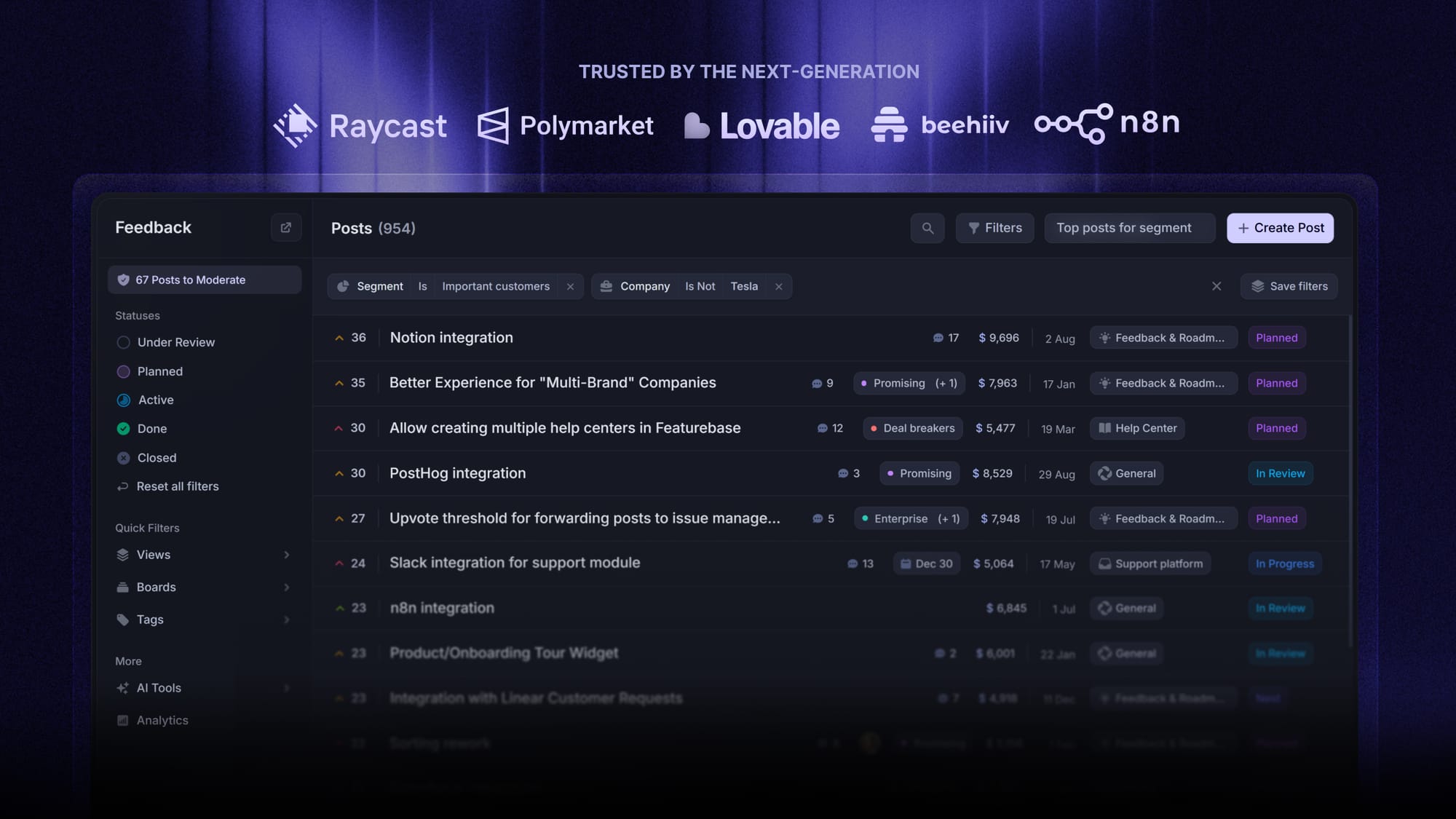
Featurebase is a feedback tool that helps you collect feedback through a public voting forum, in-app surveys, and embeddable widgets - then connect it to customer revenue and data so you can prioritize the fixes that keep your highest-value accounts from leaving.
It comes with a Free plan and quick onboarding that doesn't require a credit card, so there's no downside to trying it. 👇
✨ Start collecting & managing feedback with Featurebase for free →
FAQs
How accurate is customer churn prediction?
Accuracy depends on your data quality and how you measure it, but most business teams land useful models in the 80-90% range on standard metrics. What matters more than raw accuracy is precision and recall on the customers who actually churn - a model that catches most at-risk accounts is worth more than one with a high overall score that misses them. Aim for "accurate enough to prioritize outreach," not perfect.
Which machine learning model is best for churn prediction?
There's no single best model, but most teams start with logistic regression or a gradient boosting method like XGBoost. Logistic regression is simple and easy to explain, while gradient boosting tends to be more accurate on messy, real-world data. Start simple, get a baseline, and only add complexity if it clearly improves results.
What industries use churn prediction the most?
Any business with recurring revenue relies on it, but it's especially common in SaaS, telecom, banking, insurance, and subscription services like streaming. These industries have large customer bases, predictable billing cycles, and enough historical data to train reliable models. The higher your customer lifetime value, the more each prevented cancellation is worth.
Can you predict churn without a data science team?
Yes. You don't always need a custom model to spot at-risk customers - a simple health score built from usage drops, missed logins, and support complaints catches a lot of churn on its own. Pairing those signals with direct customer input closes the gap: Featurebase lets you run in-app NPS and CSAT surveys and collect feature requests, so smaller teams can act on churn risk without building a model from scratch.
What's the difference between churn prediction and churn analysis?
Churn analysis is backward-looking - it studies customers who already left to understand why. Churn prediction is forward-looking - it scores current customers on how likely they are to leave next. You need both: analysis tells you what patterns to watch for, and prediction applies those patterns to the customers you can still save.
How is AI changing churn prediction?
AI is making churn prediction faster and more continuous. Instead of running a model once a quarter, teams can now monitor behavioral signals in real time and flag at-risk accounts the moment engagement drops. It's also lowering the barrier to entry, with more tools handling the modeling automatically so smaller teams can predict churn without deep data science expertise.