Blog Customer Feedback50 Customer Satisfaction Survey Questions to Ask
50 Customer Satisfaction Survey Questions to Ask
50 customer satisfaction survey questions organized by what you're measuring, plus the question formats to use and the phrasing mistakes that quietly ruin your data.


✨ Start running surveys & collecting feedback with Featurebase for free →
Plenty of companies are convinced their customer satisfaction is improving. Their customers often feel the opposite. That gap almost always traces back to one thing: asking the wrong questions, at the wrong time, in the wrong way.
A good customer satisfaction survey turns vague hunches into clear direction, but only if you ask questions people can actually answer honestly.
Below are 50 customer satisfaction survey questions organized by what you're trying to measure, plus the formats to use and the mistakes to avoid. 👇
Key takeaways
- Match the question to the metric: CSAT measures satisfaction with a specific experience, NPS measures loyalty, and CES measures how much effort a task took. Each one answers a different question, so pick the metric before you pick the questions.
- Pair ratings with open-ended follow-ups: a score tells you what is happening, and a simple "What's the main reason for your score?" tells you why. You need both to actually act.
- Keep it short: 5 to 10 focused questions beat a 30-question form. Most people abandon surveys that run longer than a few minutes.
- Ask in context, right after the moment: send a support survey when a ticket closes and a product survey after the feature is used, while the experience is still fresh.
- Avoid leading and double-barreled questions: neutral, one-idea-at-a-time phrasing is what gets you honest, usable data instead of flattering noise.
- Run surveys where your users already are: with Featurebase✨ you can launch in-app NPS and CSAT surveys that target the right users on the right page and branch to follow-up questions based on their answers.
What is a customer satisfaction survey?
A customer satisfaction survey is a short set of questions that measures how happy customers are with your product, service, or a specific interaction. It turns a fuzzy feeling ("customers seem happy") into a number you can track, compare over time, and act on.
Most surveys are built around one of 3 core metrics:
- CSAT (Customer Satisfaction Score): measures how satisfied someone is with a specific experience, usually on a 1-5 scale. It's your go-to for "how did we do?" moments.
- NPS (Net Promoter Score): measures loyalty by asking how likely someone is to recommend you, on a 0-10 scale. It predicts word-of-mouth and long-term retention.
- CES (Customer Effort Score): measures how hard a customer had to work to get something done. Lower effort tends to mean higher loyalty.
You don't need all three in one survey. The right metric depends on what decision you're trying to make, whether that's fixing onboarding, reducing churn, or improving support.
The reason any of this matters is simple. A well-built survey surfaces friction you can't see from the inside, shows you which fixes will move the needle most, and gives you a baseline to measure against as you improve.
Types of customer satisfaction survey questions
Before you write a single question, it helps to know the formats you can choose from. Each one trades off depth against how easy it is for a customer to answer.
Likert scale and rating questions
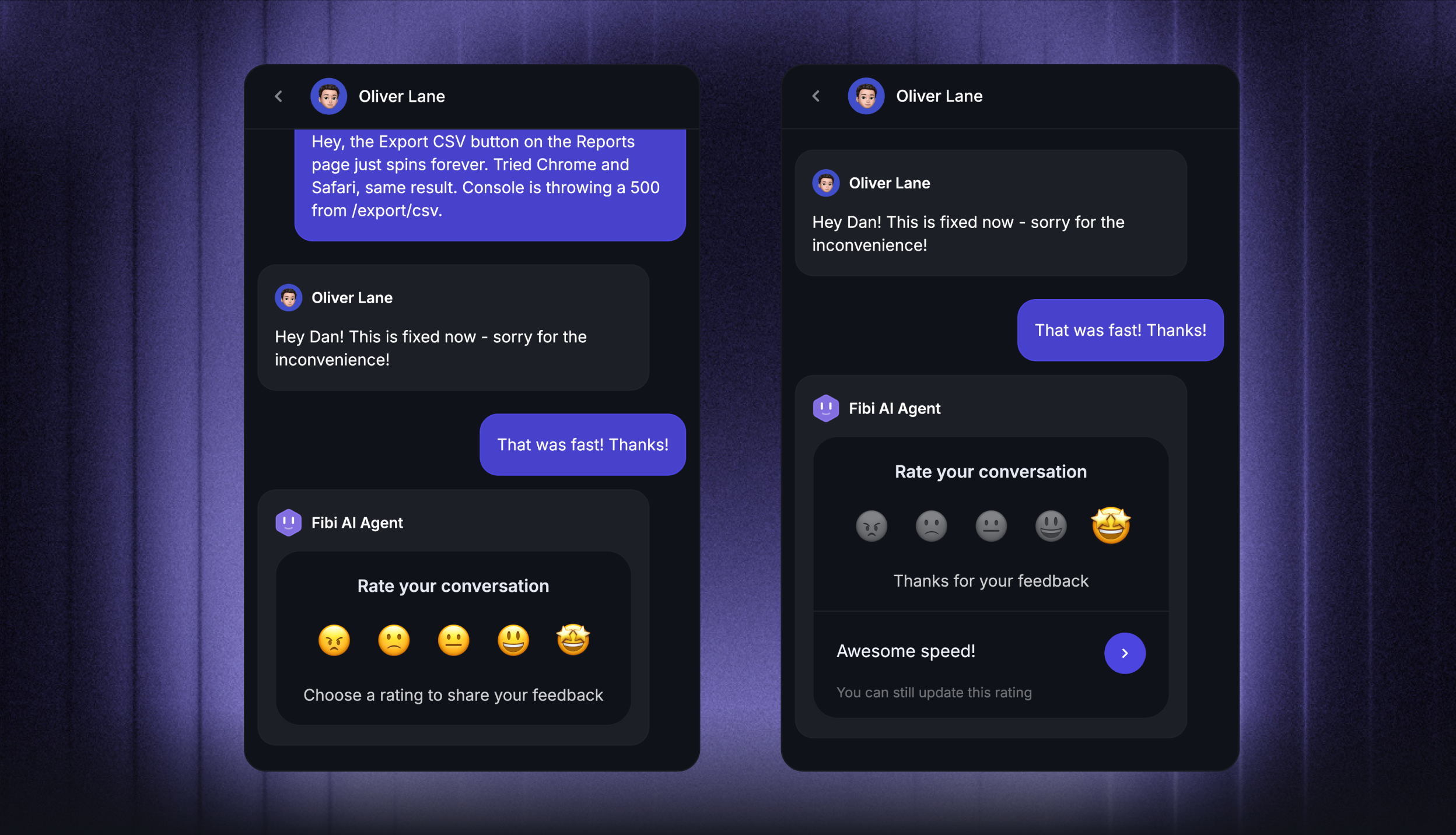
Likert scale questions ask people to rate something on a fixed scale, like "very satisfied" to "very dissatisfied," or a simple 1 to 5. They're quick to answer and give you clean, comparable numbers over time.
The trade-off is that a rating alone doesn't tell you the reason behind it. That's why most surveys pair a rating question with an open-ended follow-up.
Multiple-choice questions
Multiple-choice questions give customers a preset list of answers to pick from. They're low-effort and easy to analyze, which usually means higher completion rates.
The catch is that you only learn what your options allow. Add an "Other" choice with a text box so people aren't forced into an answer that doesn't fit.
Binary questions
Binary questions offer two choices: yes or no, thumbs up or thumbs down. They're the fastest possible question and great for a quick pulse ("Did you find what you were looking for?").
Use them sparingly. A yes/no answer flattens a lot of nuance, so they work best as a first question, not the whole survey.
Open-ended questions
Open-ended questions give customers a text box to answer in their own words. This is where you capture the "why" behind a score and pick up on problems you didn't think to ask about.
They take more effort to answer and more time to analyze, so keep them to 1-3 per survey and place them where they'll be most useful.

Grab and collect feedback easily
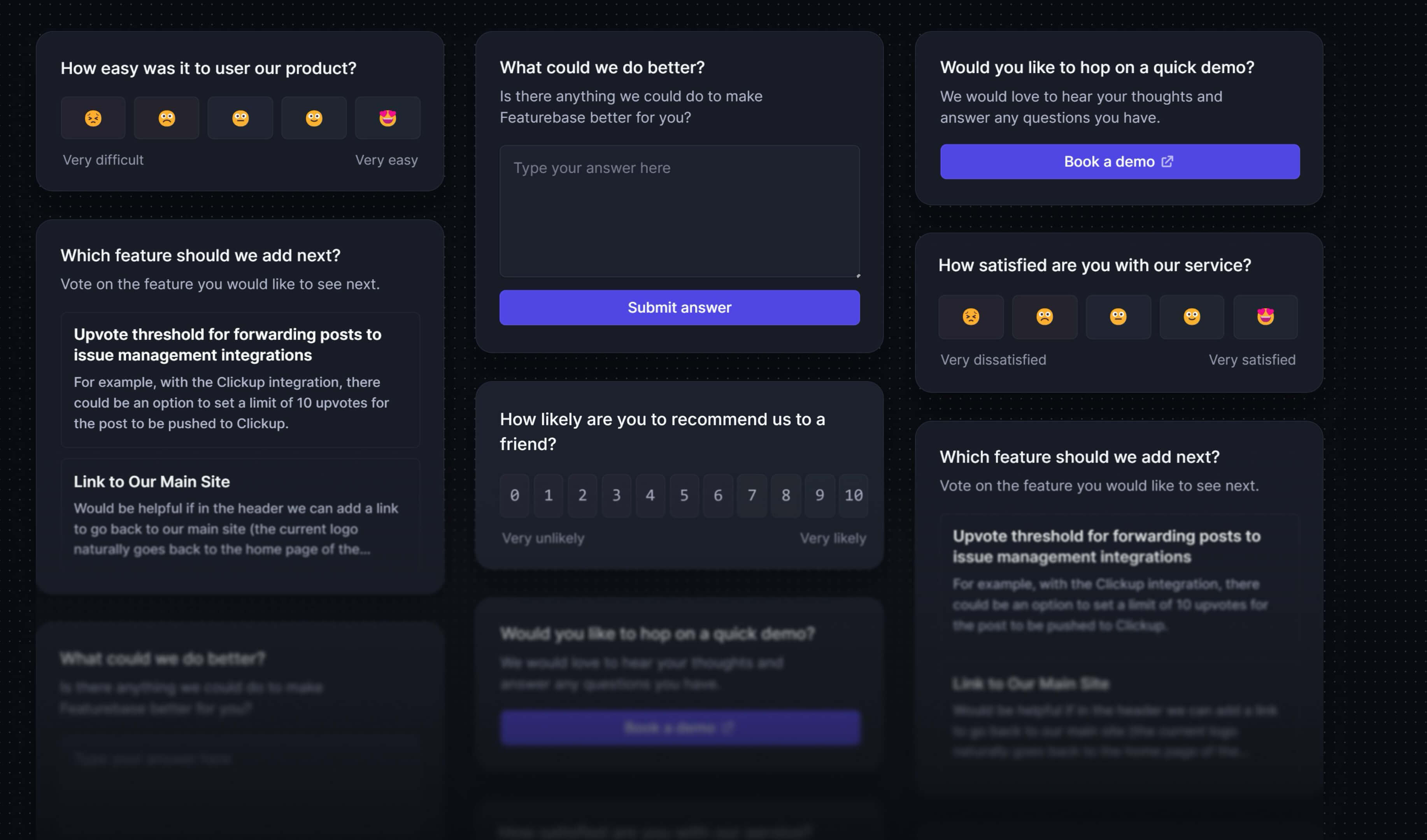
Create targeted NPS, CSAT, multiple-choice, or text response surveys for free
50 customer satisfaction survey questions by category
Here are 50 questions grouped by what you're trying to measure. Don't use all of them at once. Pick the handful that match your goal, and swap the bracketed placeholders for your own product or company name.
General satisfaction (CSAT) questions
These give you a broad read on how customers feel about you overall.
- Overall, how satisfied are you with [company]?
- How well does [product] meet your needs?
- How satisfied are you with the quality of our [product/service]?
- How would you rate your most recent experience with us?
- How does [product] compare to what you expected before buying?
- What could we do to improve your experience?
- What do you like most about [product]?
- Is there anything else you'd like to share about your experience with us?
Loyalty and recommendation (NPS) questions
These predict whether customers will stick around and tell others about you.
- How likely are you to recommend [company] to a friend or colleague?
- What's the main reason for your score?
- How likely are you to keep using [product] over the next year?
- How likely are you to buy from us again?
- What would make you more likely to recommend us?
- Which alternatives did you consider before choosing us?
Customer effort (CES) questions
These reveal friction, which is one of the biggest drivers of churn.
- How easy was it to get your issue resolved today?
- How much effort did you personally have to put in to get what you needed?
- How easy was it to find the information you were looking for?
- How easy was it to reach the right person?
- [Company] made it easy to handle my request.
- What made your experience harder than it should have been?
Customer support questions
Send these right after a support interaction, while it's fresh.
- How satisfied were you with the support you received?
- How would you rate the helpfulness of our support team?
- Was your issue resolved to your satisfaction?
- How satisfied were you with our response time?
- How knowledgeable was the person who helped you?
- How clearly did our team communicate with you?
- How satisfied are you with support availability when you need it?
- What could we do to improve our support?
Product and usability questions
These tell your product team what to fix and what to build next.
- How easy is [product] to use?
- Which feature do you find most valuable?
- Which feature do you use the least?
- Are there any features you wish [product] had?
- How reliably does [product] perform day to day?
- How easy was it to get started with [product]?
- Did you run into any problems while using [product]?
- How does [product] compare to alternatives you've tried?
Pricing and value questions
These help you understand whether customers feel they're getting their money's worth.
- How satisfied are you with the pricing of [product]?
- Do you feel [product] offers good value for the price?
- How does our pricing compare to what you expected?
- How likely would you be to switch for a lower price elsewhere?
- What would make [product] feel more worth the cost?
Journey-stage and follow-up questions
These target specific moments, from first impression to renewal.
- How did you first hear about [company]?
- How easy was it to decide to buy from us?
- How satisfied were you with the checkout or signup process?
- How satisfied were you with your onboarding experience?
- How satisfied were you with delivery or setup?
- How likely are you to renew or continue with us?
- May we follow up with you about your feedback?
- What almost stopped you from choosing us?
- What's one thing we could do to earn a higher score from you?
How to write customer satisfaction survey questions that get honest answers
The best questions in the world won't help if the phrasing skews the answers. A few common mistakes quietly wreck otherwise good surveys:
- Leading questions: wording like "How great was our friendly support team?" tells people what to say. Strip out the superlatives and ask "How would you rate the support you received?" instead.
- Double-barreled questions: "How satisfied are you with our pricing and support?" bundles two topics into one answer, so you never know which one the score reflects. Split it into two questions.
- Too many questions: every extra question costs you completions. Aim for 5 to 10 and cut anything you won't actually act on.
- Forcing an answer to everything: making every question required pushes people to abandon the survey or guess. Let them skip, or add an "I don't know" option.
- Overusing yes/no: "Is our product easy to use?" loses the nuance a rating scale captures. Ask "How easy is our product to use?" with a range of options instead.
- Jargon and internal terms: if a customer has to read a question twice, you'll get worse data. Write the way you'd speak.
One more rule ties them all together: know what decision each answer will inform before you add the question. If you can't say how you'd use a response, cut it.
When and how to run your survey
Timing matters as much as wording. Ask for feedback while the experience is still fresh, and the answers you get will be far more accurate.
A good rule of thumb is to split surveys into 2 types:
- Transactional surveys go out right after a specific moment, like a support ticket closing, a purchase, or finishing onboarding. They tell you how a single interaction went.
- Relational surveys go out on a schedule, like quarterly, to track how loyalty and satisfaction shift over the whole relationship.
Where you ask is just as important as when. Email surveys are easy to send but easy to ignore, while in-app surveys reach customers in the exact moment they're using your product, which usually means higher response rates and more relevant answers.
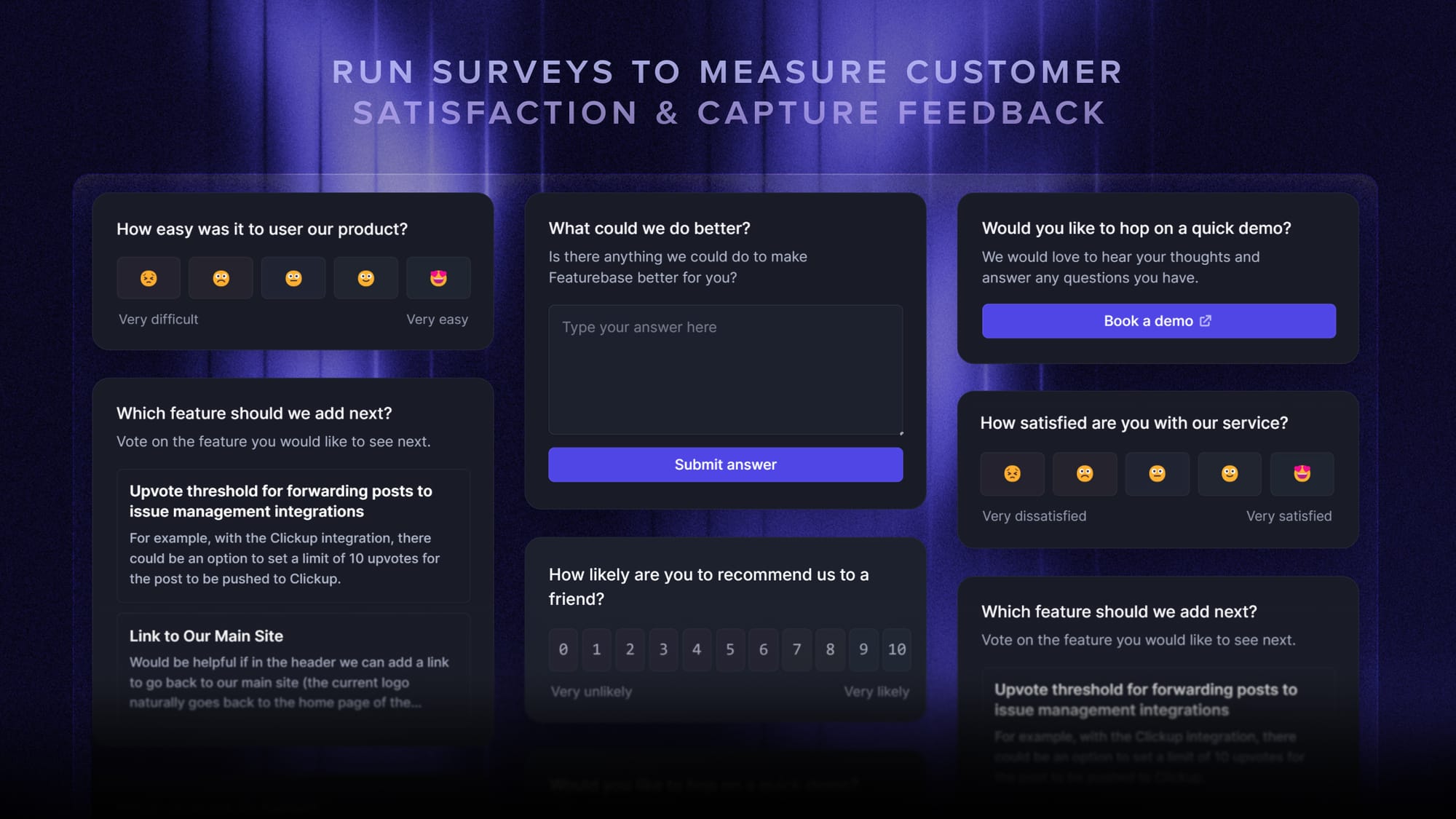
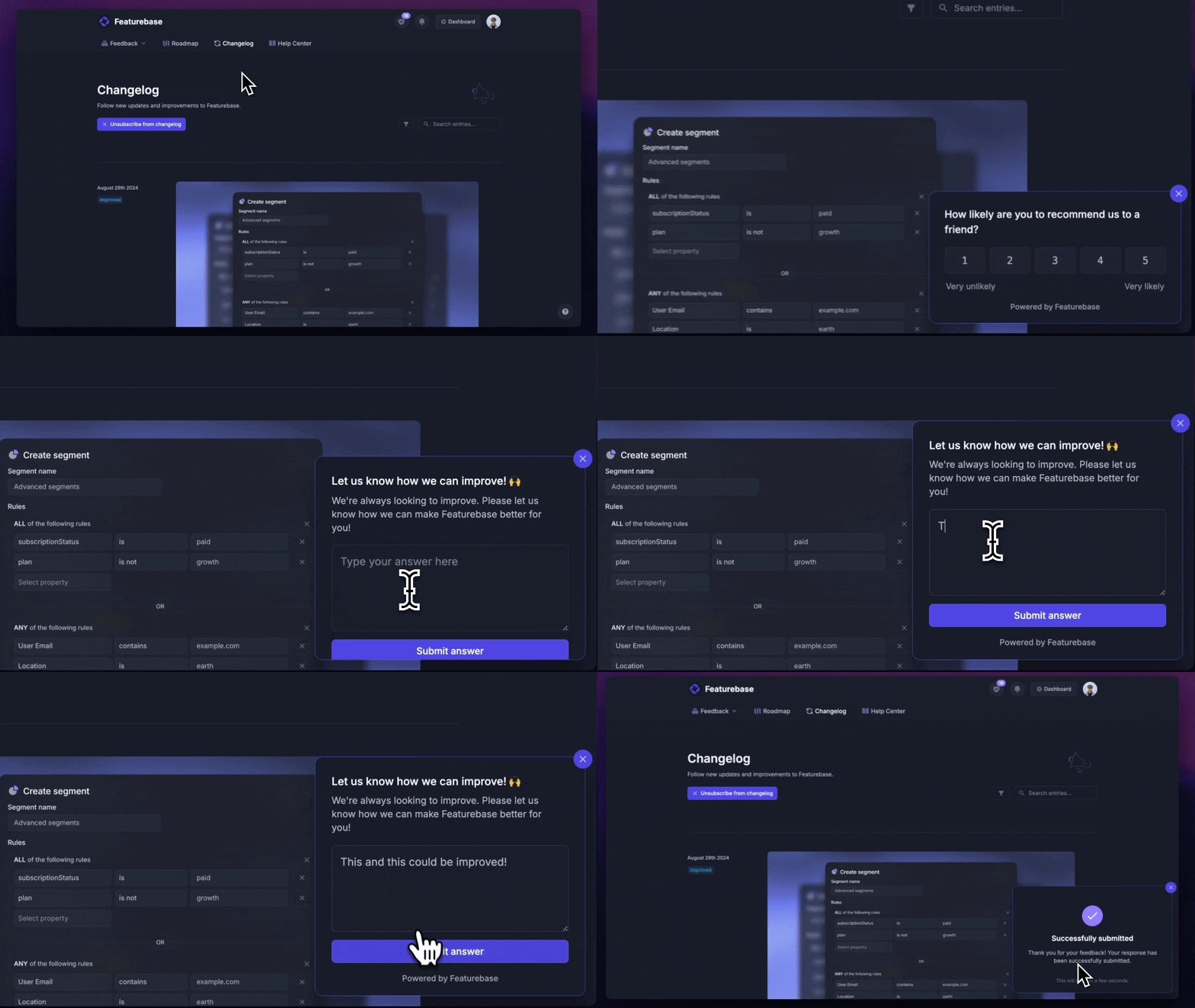
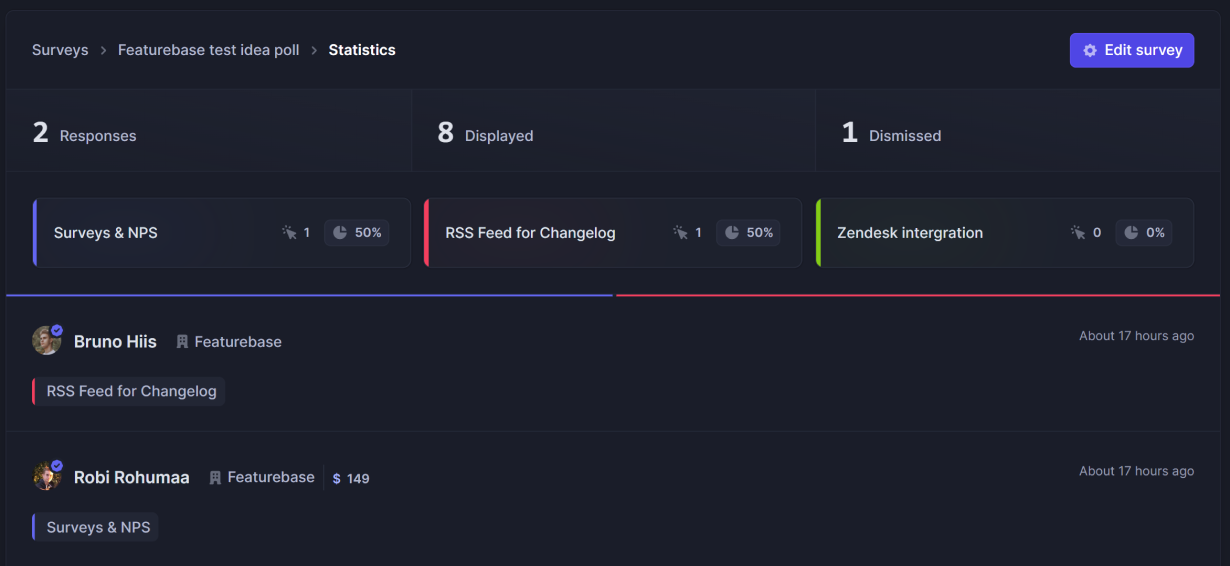
This is where a tool like Featurebase helps. You can run in-app NPS and CSAT surveys that automatically appear for the right user segment on the right page, then use conditional logic to ask a follow-up question based on how someone answered, so a low scorer and a happy customer see different next questions. Each survey gets its own results page, so you can spot dips and act on them without exporting anything.
Conclusion
Customer satisfaction surveys are only as good as the questions you ask. Match each question to the metric you care about, keep the survey short, ask at the right moment, and phrase everything neutrally, and you'll walk away with feedback you can actually act on instead of vanity scores.
Featurebase is a modern feedback and survey platform that lets you collect feedback through no-code, multi-step surveys, in-app widgets, and a public feedback forum, all in one place. You can target specific user segments, ask conditional follow-up questions, and measure NPS and CSAT right inside your product to make better decisions.
It comes with a Free plan that includes unlimited survey responses and feedback, and the onboarding is quick and doesn't require a credit card, so there's no downside to trying it. 👇
✨ Start running surveys & collecting feedback with Featurebase for free →
FAQs
How many questions should a customer satisfaction survey have?
Most customer satisfaction surveys work best with 5 to 10 questions. That's usually enough to measure a score and understand the reason behind it without wearing people out. Response rates drop sharply once a survey takes more than a few minutes, so if you can't act on an answer, leave the question out.
What is a good CSAT score?
A CSAT score between 75% and 85% is generally considered good, though it varies a lot by industry and how you calculate it. For a national reference point, the American Customer Satisfaction Index sat at 76.9 out of 100 in Q4 2025 and has barely moved since 2017. The most useful benchmark is your own trend over time, not a single industry average.
When is the best time to send a customer satisfaction survey?
Send transactional surveys right after the relevant moment, like a support ticket closing, a purchase, or the end of onboarding, while the experience is fresh. Relational surveys that track overall loyalty can go out on a schedule, such as quarterly. Prompt timing gets you more accurate answers and higher response rates.
How do you improve customer satisfaction survey response rates?
Keep the survey short, ask at the right moment, and make it easy to answer on mobile. In-app surveys that appear while someone is using your product tend to outperform email because they catch customers in context. A clear, neutral first question also helps, since a confusing opener is a common reason people drop off.
What's the difference between CSAT, NPS, and CES?
CSAT measures satisfaction with a specific experience, NPS measures how likely someone is to recommend you over the long term, and CES measures how much effort a task took. They answer different questions, so many teams use CSAT for individual touchpoints, NPS for relationship health, and CES for spotting friction. Using them together gives you a fuller picture than any one on its own.
Can you run customer satisfaction surveys inside your product?
Yes, and in-app surveys are often the most effective option because they reach customers in the exact moment they're using your product. Tools like Featurebase let you trigger NPS and CSAT surveys for specific user segments on specific pages, then branch to follow-up questions based on the answers. This context usually produces higher response rates and more relevant feedback than a standalone email.