Blog Customer FeedbackTypes of Customer Satisfaction Surveys & When to Use Them
Types of Customer Satisfaction Surveys & When to Use Them
Not all customer satisfaction surveys measure the same thing. Here are the 6 main types of customer satisfaction surveys and exactly when to use each one.


"Customer satisfaction survey" sounds like one thing. It isn't.
CSAT, NPS, CES, and a handful of others each measure a completely different slice of the customer experience, and picking the wrong one leaves you with a number you can't actually act on. Send an NPS survey when you needed CSAT and you'll learn whether people would recommend you, not whether they liked the thing they just did.
This guide breaks down the 6 main types of customer satisfaction surveys and when to use each. 👇
✨ Start running surveys & collecting feedback with Featurebase for free →
Key takeaways
- There are 6 main types of customer satisfaction surveys: CSAT, NPS, CES, product-market fit, milestone/journey, and in-app/website feedback surveys.
- The big 3 are metric surveys: CSAT measures happiness with a single interaction, NPS measures long-term loyalty, and CES measures how much effort something took.
- The right survey type depends on the moment you're measuring: right after a purchase, right after a support chat, at an onboarding milestone, or as a periodic relationship check-in.
- Short surveys win. A 1 to 3 question survey gets far higher completion rates than a long questionnaire, so match the survey type to a single clear goal.
- You can run targeted in-app NPS and CSAT surveys, then manage the feedback that comes back, with Featurebase✨.
What is a customer satisfaction survey?
A customer satisfaction survey is a short questionnaire that asks customers how they feel about your product, a specific interaction, or their overall relationship with your brand. The goal is to turn a fuzzy feeling ("are people happy?") into a number you can track over time and act on.
That number matters more than it used to. According to Forrester's US Customer Experience Index, customer experience quality in the US dropped for a third year in a row in 2024 and hit its lowest point since the index began. When the baseline is sliding, the companies that actually measure satisfaction (and fix what's broken) are the ones that hold onto customers.
And the cost of not knowing is steep. In a Qualtrics and ServiceNow study, 80% of customers said they had switched brands because of a poor customer experience. A good survey is your early-warning system before that happens.
The catch is that "customer satisfaction" isn't a single thing. Satisfaction with a support reply, willingness to recommend you to a friend, and how easy your checkout felt are three separate questions. That's why there are different survey types, each built to capture a different facet.
The 6 main types of customer satisfaction surveys
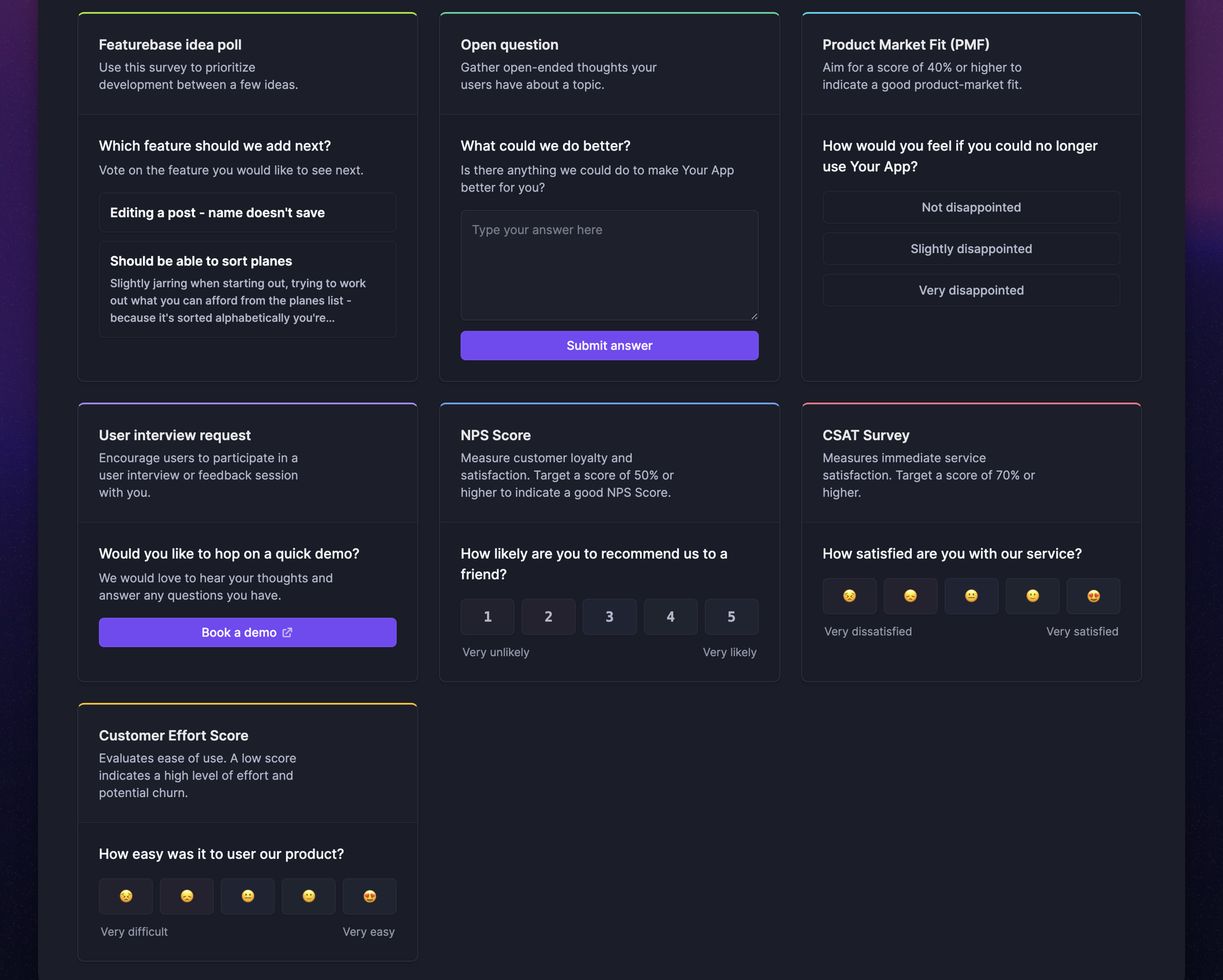
Most satisfaction surveys fall into two buckets: metric surveys that give you a trackable score (CSAT, NPS, CES), and purpose surveys built around a specific moment or question (product-market fit, milestone, in-app feedback). Here's how each one works and when to reach for it.
1. Customer Satisfaction Score (CSAT) surveys
CSAT is the most direct satisfaction survey there is. You ask customers to rate their satisfaction with a specific interaction, usually on a scale of 1 to 5 (from "very unsatisfied" to "very satisfied").
The score is the percentage of positive responses. If 80 out of 100 people pick a 4 or 5, your CSAT is 80%. It's simple, it's fast, and it maps cleanly to a single touchpoint.
CSAT works best right after a defined event: a resolved support ticket, a completed purchase, or a feature someone just used. The classic customer satisfaction survey question is "How satisfied were you with [X]?" Because it's tied to a fresh, specific moment, the feedback tends to be accurate and easy to act on.
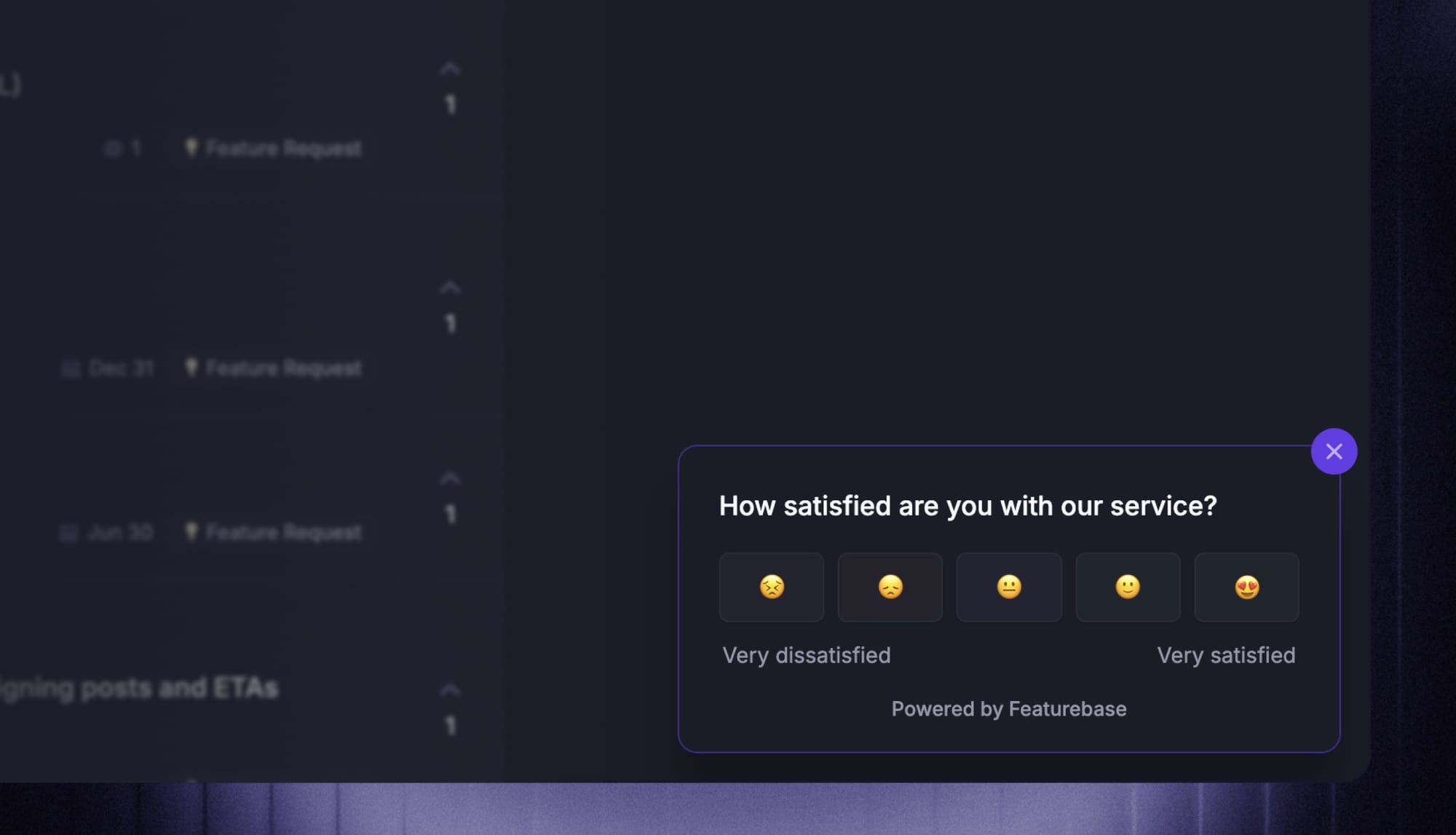
Best for: measuring satisfaction with a single, recent interaction like a support chat or a checkout.
2. Net Promoter Score (NPS) surveys
NPS measures loyalty rather than momentary satisfaction. It asks one question: "How likely are you to recommend us to a friend or colleague?" on a scale of 0 to 10.
Responses split into 3 groups:
- Promoters (9 to 10): loyal fans who'll refer others
- Passives (7 to 8): satisfied but unenthusiastic and easily poached
- Detractors (0 to 6): unhappy customers who can damage your reputation
Your NPS is the percentage of promoters minus the percentage of detractors, giving a score from -100 to +100. Because it's about the overall relationship, NPS is a relational survey - you send it periodically (say, quarterly), not after every interaction. It's a great high-level pulse on loyalty, but on its own it won't tell you why someone is a detractor, so always pair it with an open-ended follow-up question.
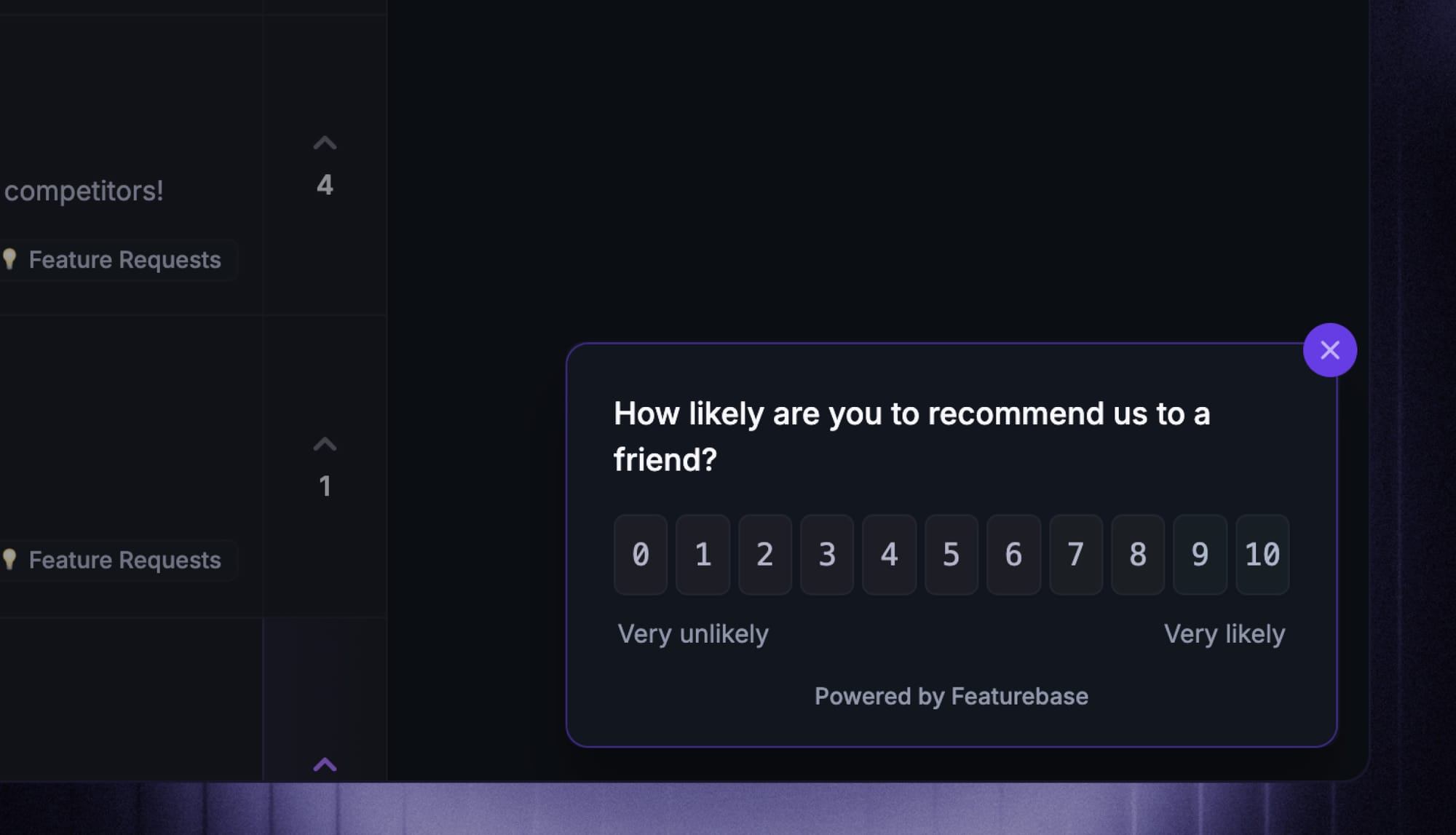
Best for: tracking overall loyalty and word-of-mouth potential over time.
3. Customer Effort Score (CES) surveys
CES flips the question from "how happy are you?" to "how hard was that?" It asks customers how much effort they had to put in to get something done, typically by rating agreement with a statement like "The company made it easy for me to handle my issue."
The logic is well supported: reducing customer effort is one of the strongest predictors of loyalty. People rarely rave about a frictionless experience, but they'll leave over a painful one. A high-effort checkout, a support runaround, or a confusing onboarding flow all show up in CES before they show up in churn.
Send a CES survey right after a task that's supposed to be easy: completing a purchase, resolving a ticket, or finishing setup. It pinpoints friction you can go and remove.
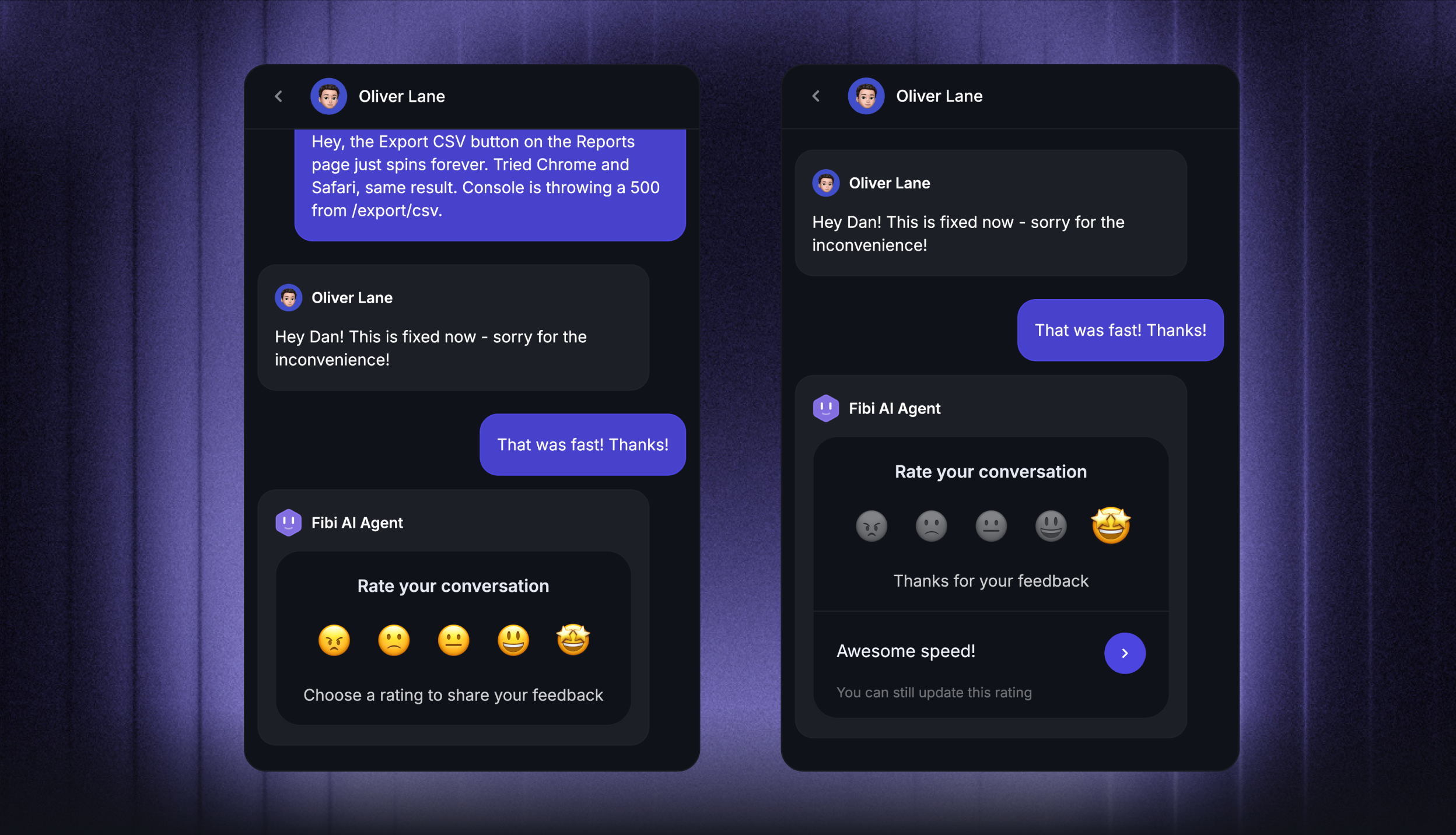
Best for: finding friction in a specific process like support, onboarding, or checkout.
4. Product-market fit (PMF) surveys
A PMF survey measures something deeper than satisfaction: how much your product actually matters to people. The signature question comes from Sean Ellis: "How would you feel if you could no longer use this product?" with options ranging from "very disappointed" to "not disappointed."
The benchmark most teams aim for is 40% or more of users answering "very disappointed." Below that, you probably haven't nailed product-market fit yet. It's less about polishing an interaction and more about understanding whether your core value is landing.
PMF surveys are most useful for early-stage products and new feature launches, where the real question isn't "were you satisfied?" but "would you miss this if it were gone?"
Best for: early-stage products and new features, to gauge whether your value actually resonates.
5. Milestone & customer journey surveys
Milestone surveys are triggered by where a customer is in their journey, not by a fixed calendar date. You send them at meaningful moments: 30 days after signup, after onboarding is complete, on a renewal anniversary, or when someone hits a key usage milestone.
The point is context. A satisfaction question hits differently when it's tied to a real moment the customer just lived through. Asking "how's onboarding going?" the week someone sets up your product gets you specific, fixable answers instead of a vague overall rating.
Mapping surveys to the customer journey also shows you where satisfaction dips - maybe people are happy at signup but frustrated by day 30. That's a pattern you'd never catch with a single annual survey.
Best for: understanding how satisfaction changes at each stage of the customer lifecycle.
6. Website & in-app feedback surveys
These are the short, contextual in-app surveys that appear directly inside your product or on your website - a small pop-up asking about a page, a feature, or a recent action. Because they catch people in the moment, response rates are usually much higher than email surveys.
They're perfect for targeted questions: "Did you find what you were looking for?" on a help article, a quick CSAT after a feature is used, or a micro-NPS for active users. The feedback is immediate and tied to exactly what the user was doing.
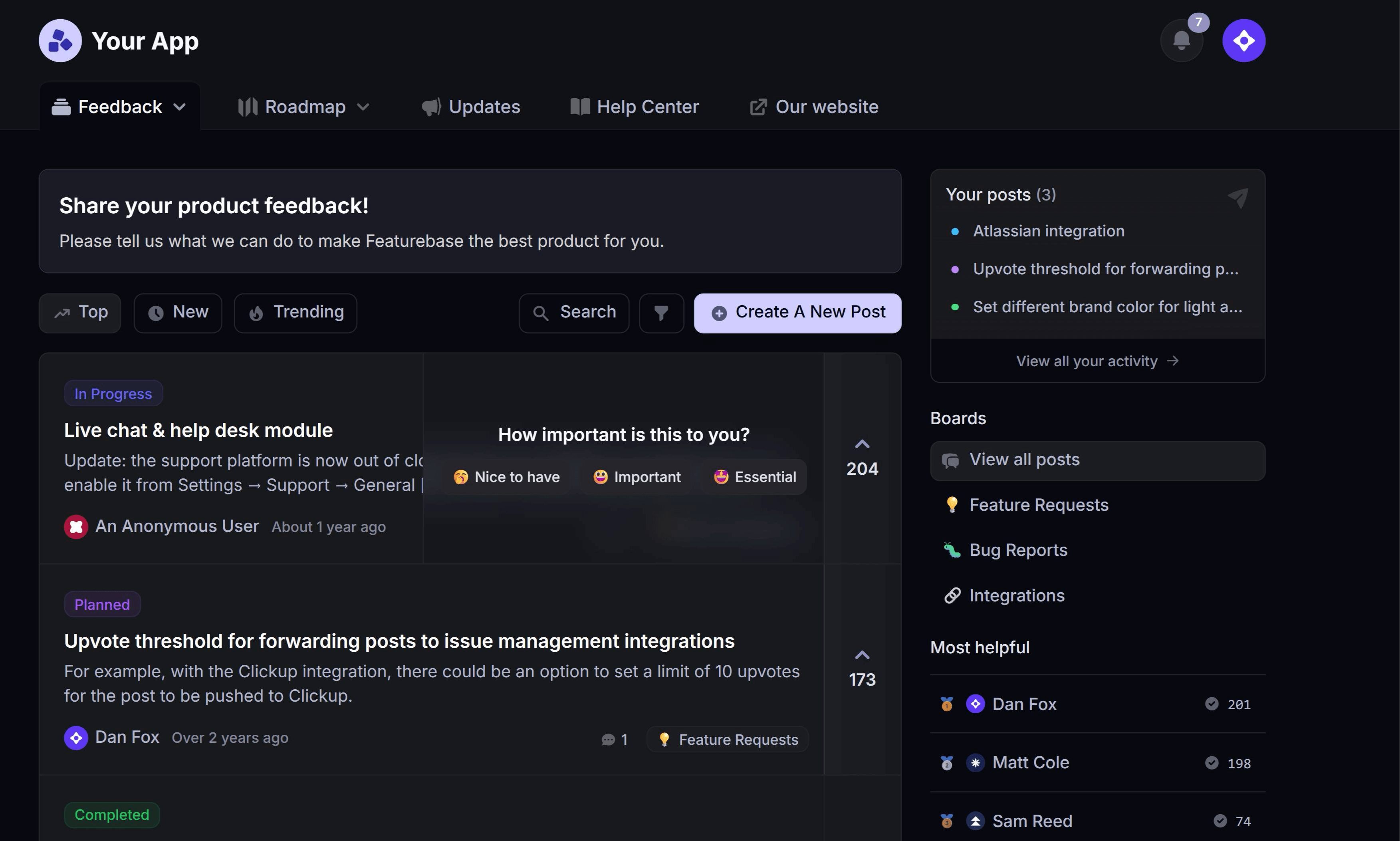
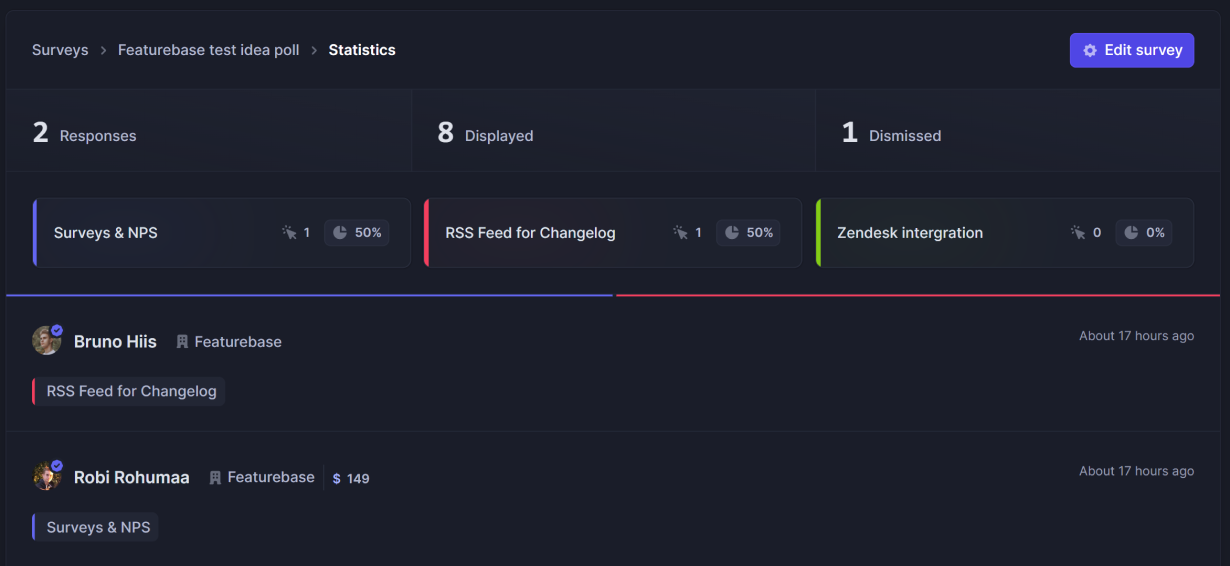
This is also where a dedicated survey tool earns its keep. With Featurebase, you can run targeted in-app NPS and CSAT surveys that fire only for specific user segments, add conditional follow-up questions based on how someone answers, and then triage the responses alongside the rest of your product feedback in one place. That means the survey reaches the right person at the right moment instead of landing in an ignored inbox.
Best for: high-response, in-context feedback tied to a specific page, feature, or action.
CSAT vs NPS vs CES: what each one measures
The 3 metric surveys get mixed up constantly, but they answer different questions:
- CSAT measures how satisfied someone was with a specific interaction. It's short-term and transactional, answering "did we do a good job just now?"
- NPS measures overall loyalty and how likely someone is to recommend you. It's long-term and relational, answering "how do you feel about us as a whole?"
- CES measures how much effort a task took. It's process-focused, answering "how easy did we make this?"
A simple way to remember it: CSAT is about happiness, NPS is about loyalty, and CES is about ease. Most mature teams don't pick just one. They run CSAT and CES on specific touchpoints and layer NPS on top as a periodic loyalty pulse.
How to choose the right survey type
The wrong survey gives you a clean-looking number that answers a question you didn't ask. To pick the right one, work backwards from what you're trying to learn and when.
Start with 3 questions:
- What decision will this inform? If you want to fix a support process, CES beats NPS. If you want to gauge loyalty for the board, NPS is the one.
- What just happened? Tie transactional surveys (CSAT, CES) to a fresh event, and send relational surveys (NPS, PMF) on a periodic cadence.
- Where is the customer in their journey? A day-1 onboarding check and a renewal-time survey should ask very different things.
Then keep it short - one of the most reliable customer satisfaction survey best practices there is. A survey with 1 to 3 questions almost always outperforms a long one on completion rate, and a focused survey gives you cleaner data. If you find yourself cramming CSAT, NPS, and 5 open-ended questions into a single form, that's a sign you're trying to measure too much at once. Split it up and trigger each survey at the moment it actually fits.

Start running surveys & collecting feedback
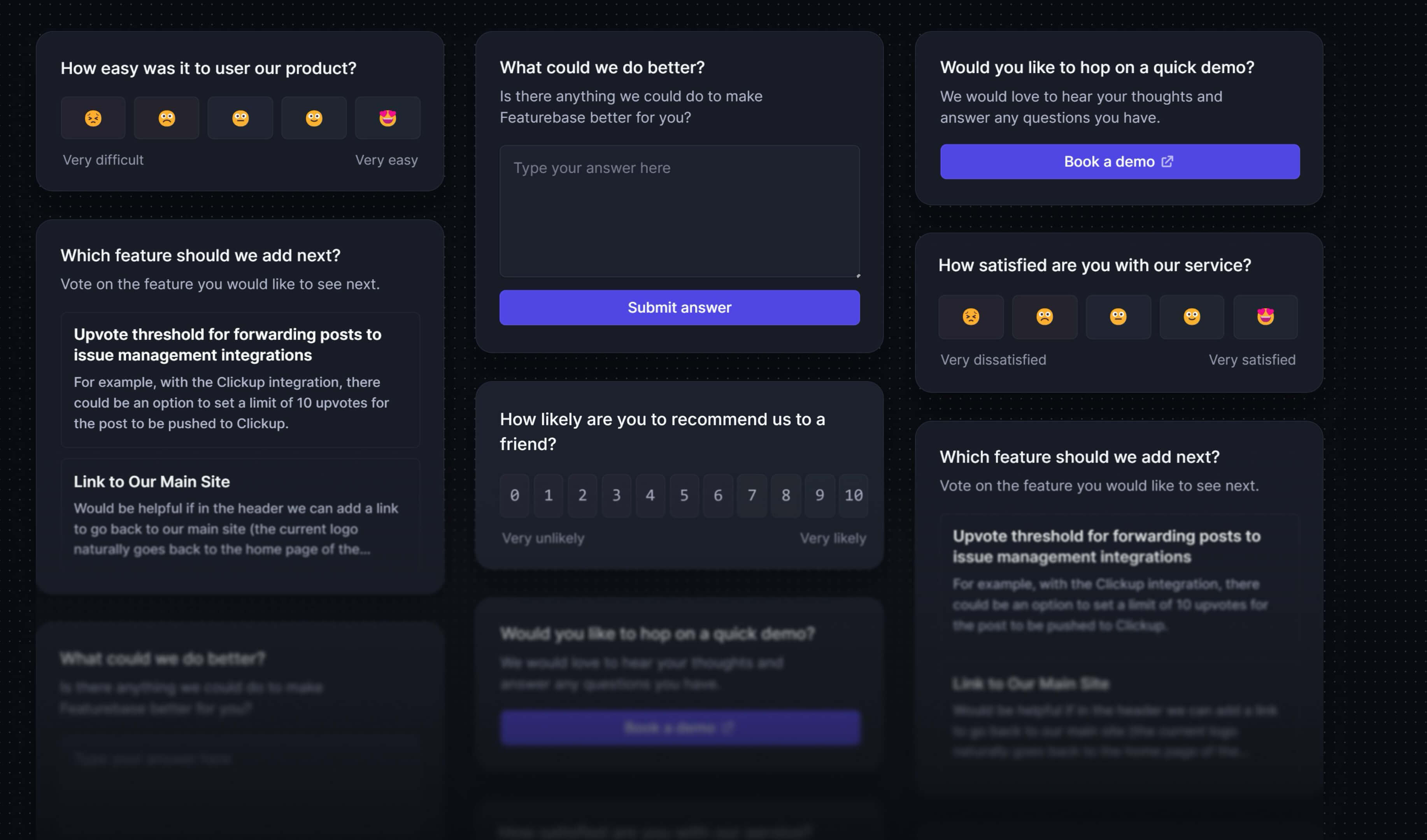
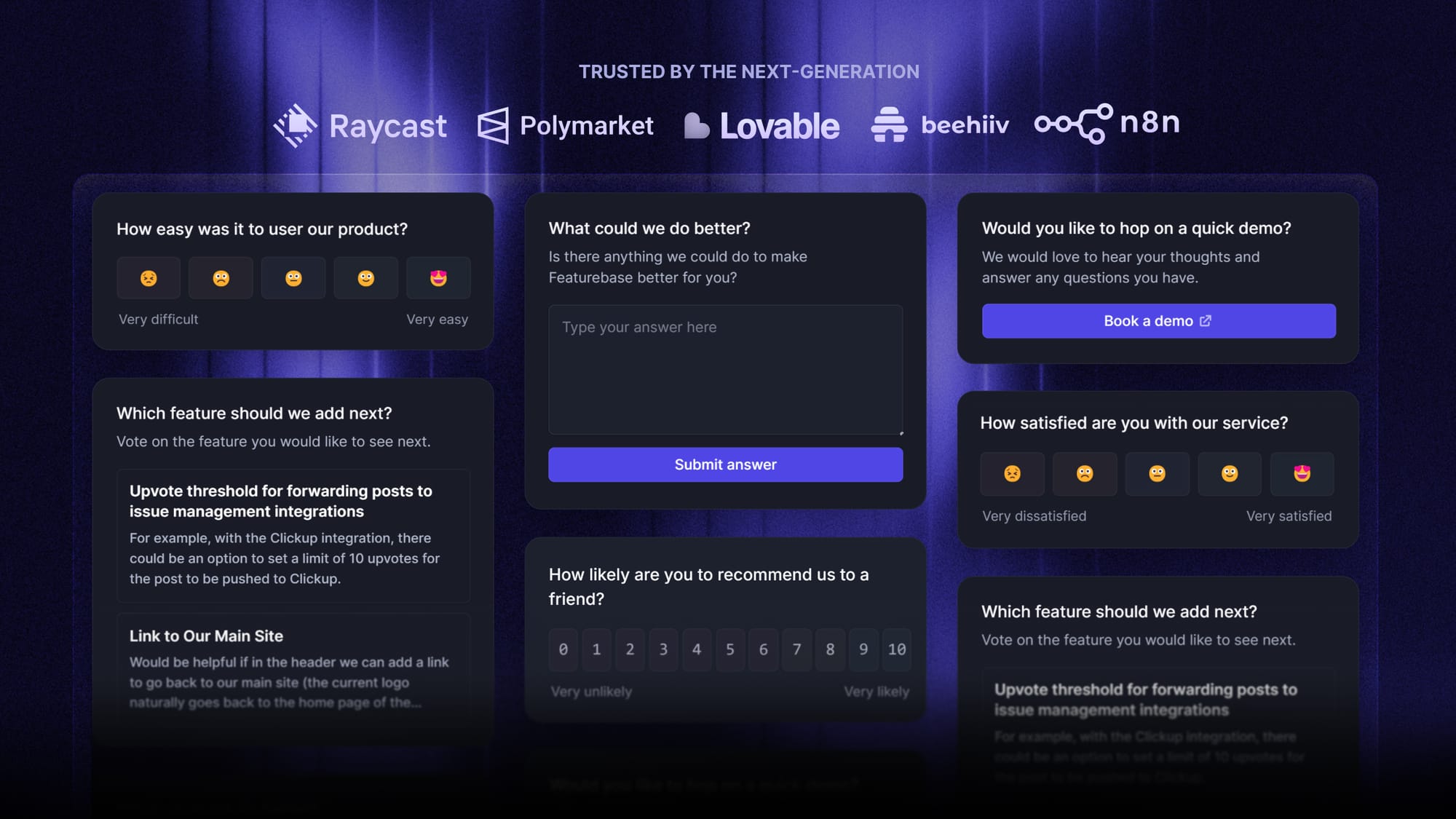
Create targeted NPS, CSAT, multiple-choice, or text response surveys for free
Conclusion
There's no single "best" customer satisfaction survey. CSAT, NPS, CES, and the purpose-built types each capture a different piece of the picture, and the real skill is matching the survey to the moment - measuring effort after a support chat, loyalty on a quarterly cadence, and satisfaction right after a key interaction.
Featurebase is a modern feedback and survey tool that lets you run targeted NPS, CSAT, and custom in-app surveys, add conditional follow-up questions, and target specific user segments so you ask the right people at the right time. All the feedback flows into one place, where you can connect it to customer revenue and data to decide what to act on first.
It comes with a Free plan that includes unlimited survey responses, and onboarding takes minutes with no credit card required, so there's no downside to trying it. 👇
✨ Start running surveys & collecting feedback with Featurebase for free →
FAQs
What are the four types of customer satisfaction surveys?
The four most commonly cited types are Customer Satisfaction Score (CSAT), Net Promoter Score (NPS), Customer Effort Score (CES), and product-market fit (PMF) surveys. CSAT tracks happiness with a specific interaction, NPS tracks loyalty, CES tracks how easy a task was, and PMF gauges how much users would miss your product. In practice there are more than four, including milestone and in-app feedback surveys, so treat the "four" as the core set rather than a hard limit.
When is the best time to send a customer satisfaction survey?
For transactional surveys like CSAT and CES, send them immediately after the relevant event while it's fresh, such as right after a resolved support ticket or a completed purchase. Relational surveys like NPS work better on a periodic cadence, often quarterly, so you can track loyalty trends without survey fatigue. Milestone surveys should be triggered by where the customer is in their journey, like 30 days after signup or at renewal.
What is a good CSAT or NPS score?
A CSAT score of 75 to 85% is generally considered good, though it varies by industry. For NPS, anything above 0 means you have more promoters than detractors, a score above 30 is solid, and above 50 is excellent. Benchmarks shift a lot by sector, so the more useful comparison is your own score over time rather than an absolute number.
How can you measure customer satisfaction without surveys?
You can infer satisfaction from behavioral and operational signals: churn and retention rates, product usage and feature adoption, support ticket volume and resolution times, and public reviews or social mentions. These don't replace direct feedback, but they flag problems surveys might miss. Tools like Featurebase help here by centralizing in-product feedback, feature requests, and survey responses together, so behavioral signals and stated feedback sit side by side.
What are the 5 key CX metrics?
The 5 most tracked customer experience metrics are CSAT, NPS, CES, customer churn rate, and customer retention (or customer lifetime value). The first 3 are survey-based and capture how customers feel, while churn and retention are behavioral and show what customers actually do. Watching them together gives you both the sentiment and the outcome.
How many questions should a customer satisfaction survey include?
Keep it short: 1 to 3 questions is the sweet spot for most satisfaction surveys. A single metric question (like CSAT or NPS) plus one open-ended follow-up ("what's the main reason for your score?") captures both the number and the why without hurting completion rates. The longer the survey, the more people abandon it, so only add a question if you'll actually act on the answer.