Blog Customer ServiceCustomer Service Bots: A Complete Guide for 2026
Customer Service Bots: A Complete Guide for 2026
A customer service bot answers repetitive questions instantly, around the clock. Here's how they work, where they help most, and how to choose the right one.


Most of your support tickets are the same handful of questions asked thousands of times: where's my order, how do I reset my password, what's your refund policy. Your customers want those answers instantly, at 2am on a Sunday if that's when they ask.
A customer service bot handles that first line of questions so your team can spend its time on the problems that actually need a human. This guide covers what a customer service bot is, how the technology has changed, where bots help most, and how to choose and build one that customers don't hate. 👇
✨ Automate your support with the fastest AI-enhanced Inbox today →
Key takeaways:
- A customer service bot is software that automates customer conversations, answering common questions and completing simple tasks without a human agent.
- There are 3 broad types: rule-based bots that follow scripts, AI bots that understand natural language, and AI agents that can take action across your systems.
- The biggest wins are 24/7 availability, instant responses, lower cost per contact, and the freeing up of human agents for complex work.
- A good bot always offers a clean path to a human and passes along full context when it hands off.
- Featurebase✨ bundles an AI support agent, omnichannel inbox, and help center in one platform, with a free plan to start.
What is a customer service bot?
A customer service bot is an automated software application that simulates conversation to help customers with their questions. It works through a chat window, a messaging app, or a voice interface, and its job is to resolve common requests without pulling in a human agent.
The term covers a wide range of sophistication. Some bots follow a rigid script. Others use large language models to understand a messy, real-world question and answer it in context. The gap between those two experiences is enormous, which is why it helps to break the category into 3 types.
Rule-based bots vs AI bots vs AI agents
These 3 labels get used interchangeably, but they describe very different tools:
- Rule-based bots: These follow pre-written scripts and decision trees. They match keywords or menu choices to canned responses. They're cheap and predictable, but they break the moment a customer phrases something outside the script.
- AI bots: These use natural language processing and large language models to understand what a customer actually means, then generate an answer grounded in your help center or knowledge base. They handle varied phrasing and hold context across a conversation.
- AI agents: These go a step further and take action. Instead of only answering, an agent can look up an order, process a refund, update account details, or reschedule an appointment by connecting to your other systems, then hand off to a human with full context when it hits its limit.
Most modern "customer service bots" people mean today sit in the AI bot or AI agent category. Rule-based bots still have a place for simple, high-volume routing, but they're rarely the whole answer anymore.
Why customer service bots matter now
Customer expectations have moved faster than most support teams can hire. People compare your response time to the best experience they've had anywhere, not to your last quarter.
The technology has also crossed a real threshold. Gartner predicts that by 2029, agentic AI will autonomously resolve 80% of common customer service issues without human intervention, leading to a 30% reduction in operational costs. That's a shift from bots that deflect questions to bots that actually close them out.
Now, bots handle the routine questions, which makes the human customer service skills - judgment, empathy, knowing when to step in - matter even more on the tickets that reach a person.
Benefits of customer service bots
The case for a customer service bot comes down to a few concrete advantages for both your customers and your team:
- 24/7 availability: Bots answer at any hour, across time zones, without a night shift. This matters because 74% of consumers expect customer service to be available 24/7, a bar no human-only team can clear affordably.
- Instant responses: A bot replies the moment a customer asks, eliminating the queue for simple questions like order status or business hours.
- Lower cost per contact: Automating routine inquiries means your team handles far more volume without proportional hiring, which lowers the cost of each resolved conversation.
- Scalability under spikes: A product launch or a holiday rush that would swamp a human team is just more traffic to a bot, which handles thousands of chats at once.
- Freeing up human agents: When automation takes the repetitive work, your agents spend their time on the nuanced, high-value issues that actually need empathy and judgment.
- Data-driven insights: Every conversation is logged, so you can see the questions customers ask most and spot gaps in your product, docs, or onboarding.
The highest-value customer service bot use cases
Bots earn their keep on repetitive, well-defined tasks. These are the use cases where they consistently deliver:
- Answering FAQs: The classic use case. The bot pulls from your knowledge base to instantly answer questions about shipping, returns, pricing, and hours, cutting the ticket volume that never needed a human.
- Order tracking and status updates: Connected to your commerce or logistics systems, a bot lets customers check where their order is and when it will arrive, conversationally.
- Account self-service: Customers can update their details, reset passwords, or manage a subscription on their own, which is faster for them and lighter for your team.
- Technical troubleshooting: The bot walks a user through common fixes step by step, and gathers the relevant details before escalating anything it can't solve.
- Lead capture and qualification: On your marketing site, a bot can greet visitors, answer pre-sales questions, and route qualified leads to your sales team.
- Delegating routine tasks to AI: This aligns with where customers already are. 67% of consumers say they are ready to delegate tasks like tracking orders and getting personalized recommendations to AI.
What to look for in a customer service bot
Not every bot is built the same, and there's a wide range of customer service chatbot software on the market. When you're evaluating one, weigh these features:
- Natural language understanding: The bot should understand real, varied phrasing rather than forcing customers to guess the magic keyword. This is the difference between an AI bot and a glorified FAQ menu.
- Knowledge base grounding: It should answer from your actual help articles and docs, so responses stay accurate and update automatically when you update your content.
- Easy human handoff: Look for a clean, obvious path to a human, with the full conversation context passed along so the customer never repeats themselves.
- Omnichannel reach: A good bot works across your website, in-app messenger, email, and messaging platforms, giving customers a consistent experience wherever they reach you.
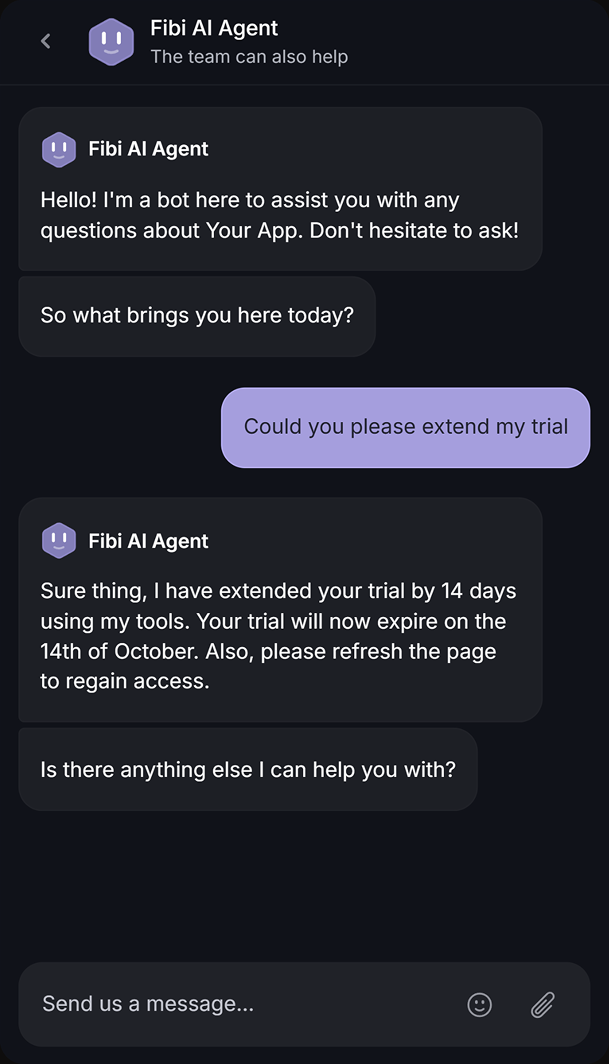
- Actions and integrations: The strongest bots connect to your other systems to actually do things like issue a refund or extend a trial, not just talk about them.
- Analytics and reporting: You need visibility into resolution rate, common questions, and where the bot struggles, so you can keep improving it.
How to build a customer service bot (and keep it good)
Deploying a bot is less about the launch and more about the ongoing loop, and it works best as one piece of your broader customer support operations. A practical approach looks like this:
- Start with your most common questions: Pull your top support tickets and map the 10 to 20 questions that make up most of your volume. Those are your bot's first job.
- Ground it in a real knowledge base: Feed the bot accurate, well-structured help content so its answers are correct from day one and improve as you expand your docs.
- Design an obvious escape hatch: Make it effortless to reach a human, and transfer the full conversation so the customer doesn't start over.
- Match your brand voice: The bot should sound like your company across every channel, not like a generic script.
- Review conversations and iterate: Read real transcripts, find the questions the bot fumbles, and refine its knowledge and behavior on a regular cadence.
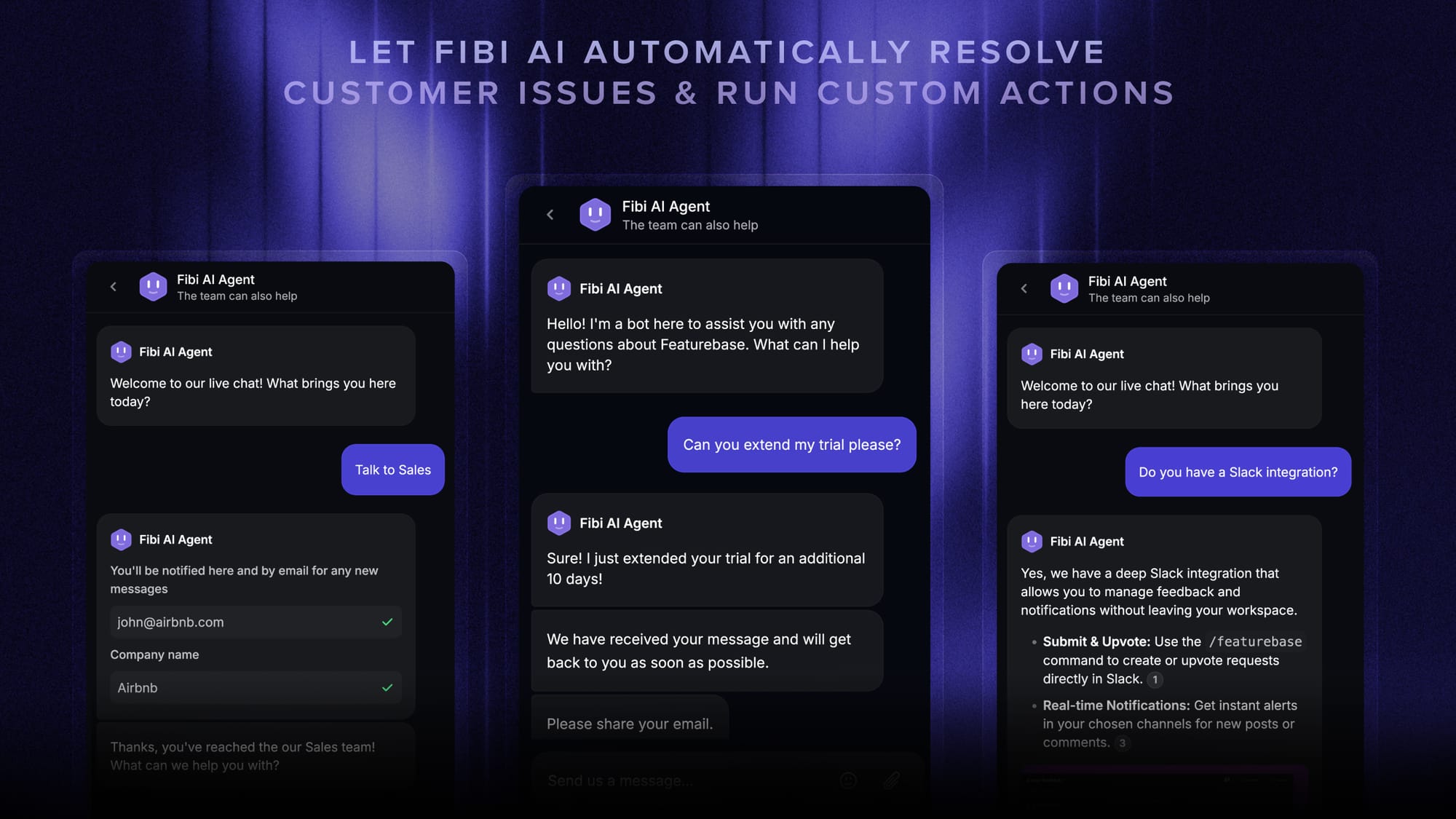
This is where a modern platform saves a lot of setup. With Featurebase, the Fibi AI Agent resolves common questions on autopilot using your help center content, and can run real actions like extending a trial or processing a refund before handing off to a human agent with full context when a conversation needs one.
The modern option: Featurebase
Featurebase is a modern AI customer support platform for product-led SaaS. It combines AI-powered support, help center, and feedback management into a single platform for startups that want all their customer-facing tools in one place. Featurebase is loved by thousands of support teams from companies like Lovable, Raycast, and n8n. 💫
Top features:
- Omnichannel inbox – Manage live chat, email, and Slack conversations from one AI-powered view
- Fibi AI Agent - Resolve customer issues on autopilot & run custom actions like trial extensions and refunds
- Help center with AI search – Provide instant, multilingual self-serve answers
- Workflows & automations – Auto-assign tickets, route conversations, collect customer data, and more
- AI Copilot – Help your agents answer customers faster with AI Copilot that uses your internal knowledge
- Multi-brand support – Manage multiple Help Centers and Live chats from a single workspace
- Automatic AI translations – Automatically translate all messages and help articles to your customers native language
- Service Level Agreements – Track SLAs to make sure your team responds to customers on time, every time
- Mobile app – Respond to customers, receive notifications, and unblock users on the go
- Feedback & roadmap tools – Collect feature requests and close the loop with updates
- Product updates – Publish release notes with a changelog page, in-app widget, and emails
- Integrations – Connects with Slack, Linear, Jira, HubSpot, and more
Pricing: Free plan available with unlimited conversations. Paid plans start at $29/seat/month with $0.29 per AI resolution.
Featurebase covers all the basic support features that legacy platforms do, but with a much more modern approach. It comes with AI automations, a mobile app, and multiple channels (email, live chat, Slack, etc.).

Get the best customer service bot
Automatically resolve 70% of customer requests & cut down manual support loads
Conclusion
A customer service bot is one of the highest-leverage tools a support team can add. It answers the repetitive questions instantly and around the clock, it scales through spikes without new hires, and it hands the hard problems to your team with context attached. The teams that win with bots are the ones that ground them in real knowledge, keep a clean path to a human, and treat the bot as something to improve every week rather than set and forget.
If you want a modern customer service bot without stitching together 5 separate tools, Featurebase brings AI-powered support, a help center, and feedback collection into one platform. The Fibi AI Agent resolves common issues on autopilot and escalates cleanly when a human is needed.
There's a free plan with unlimited conversations, and onboarding is fast, so there's no downside to trying it. 👇
✨ Automate your support with the fastest AI-enhanced Inbox today →
FAQs
What's the difference between a rule-based bot and an AI customer service bot?
A rule-based bot follows fixed scripts and keywords, so it only responds to phrasing it was explicitly programmed for. An AI customer service bot uses natural language processing and large language models to understand what a customer means and generate a contextual answer. In practice, the AI bot handles far more of your real conversations without breaking.
How much does a customer service bot cost?
Cost ranges widely depending on how capable the bot is. Simple rule-based tools can be free or a few dollars a month, while AI platforms often charge per seat plus a fee for each AI resolution, and enterprise contact-center suites run into custom enterprise pricing. Featurebase, for example, has a free plan with unlimited conversations and paid plans from $29 per seat per month with $0.29 per AI resolution, so cost scales with usage rather than a large upfront commitment.
Can customer service bots handle complex queries?
Modern AI bots and AI agents handle far more than simple FAQs, including multi-step requests like processing a return or updating an account. They still have limits, though, and the best setups detect when a conversation is beyond the bot and route it to a human. The goal is not to automate everything, but to automate the repetitive majority well.
When should a customer service bot hand off to a human agent?
A bot should escalate when it detects frustration, when a request falls outside its knowledge, or when the issue is high-value or sensitive, such as a billing dispute or a churn risk. The handoff should be effortless for the customer and carry the full conversation history so they never have to repeat themselves. A clear escape hatch is one of the biggest factors in whether customers trust your bot at all.
Can a customer service bot support multiple languages?
Yes. Many AI bots use natural language processing and automatic translation to understand and reply in a customer's own language, which lets a small team support a global audience. This means the same knowledge base can serve customers across dozens of languages without maintaining a separate bot for each one.
How do you measure the ROI of a customer service bot?
Track a few core metrics: resolution or deflection rate (how many conversations the bot closes without a human), customer satisfaction on bot conversations, average handle time, and cost per contact. Compare those against your pre-bot baseline to see the real impact. A bot that deflects a large share of tickets while keeping satisfaction steady is delivering clear, measurable return.