Blog Customer ServiceCustomer Service Standards: A Complete Guide for Support Teams
Customer Service Standards: A Complete Guide for Support Teams
Most customer service standards read like slogans. Here's how to define the 7 that matter, pair each with a metric, and keep them sticking as you scale.


✨ Automate your support with the fastest AI-enhanced Inbox today →
Most teams say they have customer service standards. In practice, those "standards" are either fuzzy value statements like "be empathetic" or a scattered set of KPIs that nobody owns.
This guide shows how to define standards that are concrete, measurable, and survive as your team grows. 👇
Key takeaways:
- Customer service standards are the agreed-upon rules for how your team responds to customers - covering speed, accuracy, tone, and outcomes.
- Vague standards (like "be friendly") don't scale. Every standard needs at least one metric tied to it so you can measure whether you're meeting it.
- The 7 standards that show up across the best support teams: responsiveness, accountability, empathy, resolution quality, availability, transparency, and consistency.
- Setting standards is a 5-step process: baseline current performance, set stretch targets, translate each standard into a playbook, train and empower your team, and run a QA loop.
- Featurebase✨ is a modern AI-powered support platform that helps you track SLAs, automate routine work with Fibi AI Agent, and keep the response quality consistent across every channel.
What are customer service standards?
Customer service standards are the agreed-upon rules that define how your team responds to customers. They cover 4 things: how fast you reply, how accurate your answers are, the tone you use, and whether the issue actually gets resolved.
The point of a standard is to make service predictable. Those rules flow from a deeper customer service philosophy that shapes how your team treats customers.
Standards matter more than ever because expectations keep rising. 65% of customers expect companies to adapt to their changing needs and preferences, according to Salesforce. Without standards, that adaptation happens by accident, when it happens at all.
Why customer service standards matter
A standard does 3 things at once.
It sets clear expectations for your team. New agents stop guessing how to greet a customer, how fast to reply, or when to escalate. A documented standard is faster to onboard against than a senior agent's intuition.
It gives customers a consistent experience. When the standard is "first response within 4 business hours," every customer gets that response - not just the ones who happen to reach your best agents on a good day.
It makes performance measurable. You can't improve what you can't measure, and standards turn abstract goals like "great service" into numbers you can track on a dashboard.
Standards only hold up when someone owns them, which is why growing teams build a support operations function to keep workflows, SLAs, and training consistent as headcount grows.
The stakes are high. 88% of customers say the experience a company provides is as important as its products and services, per Salesforce's State of the Connected Customer research. When experience is on equal footing with the product itself, the rules that govern it stop being a nice-to-have and start being a competitive moat.
The 7 customer service standards that actually matter
Different blogs list 5, 8, or 12 standards. The consensus set that shows up across every credible source is these 7. Each one needs to be paired with a measurable target, not left as a slogan.
Responsiveness
Responsiveness is the speed at which you acknowledge and reply to customer inquiries. It's the most universally expected standard - 90% of customers rate an "immediate" response as important or very important when they have a customer service question, according to HubSpot.
A real standard has channel-specific targets. Live chat pickup in under 20 seconds. Email first response within 4 business hours. Social media reply in under 30 minutes. Without channel-specific numbers, "be responsive" means nothing.
Accountability
Accountability is owning the resolution end-to-end, not passing the customer between agents or hiding behind policy language. The customer needs one person responsible for getting their issue fixed.
In practice this looks like clear escalation rules, named ticket owners, and the authority to make decisions without a manager's approval. If an agent has to ask permission to issue a $25 refund, the standard is broken.
Empathy
Empathy is recognising the customer's emotional state and responding to it before jumping into a process. It's the difference between "Per our policy, returns must be initiated within 30 days" and "I can see how frustrating it is to be stuck with this. Here's what I'll do to fix it."
The standard isn't "be empathetic" - it's "acknowledge emotion before process in every reply where the customer signals frustration." That's auditable in a QA review. The slogan version isn't.
Resolution quality
Resolution quality measures whether the issue actually got solved, not just whether you replied. The headline metric is First Contact Resolution (FCR) - the percentage of issues closed on the first interaction without a follow-up needed.
Top support teams target 70-80% FCR for non-technical issues. Anything lower and customers are bouncing between channels repeating themselves, which kills satisfaction faster than slow response times do.
Availability
Availability is the standard for when customers can reach you and what happens when they can't. Customers don't expect 24/7 staffing from every business, but they do expect predictable hours and a clear path for after-hours requests.
The standard has 2 parts: stated hours of human support, plus an automated acknowledgement (chatbot, auto-reply, status page) for inquiries that arrive outside those hours. The worst version is implied always-on availability that quietly disappears at 5pm.
Transparency
Transparency means being honest about what you know, what you don't, and how long things will take. When an agent doesn't have the answer, the standard is "I'm not sure, but I'll find out and follow up by end of day" - not a guess dressed up as fact.
This also covers wait time communication. If a customer is waiting on a fix, they get a status update every 24-48 hours, not silence. Silence is what makes customers escalate to public channels.
Consistency
Consistency is the standard that ties all the others together. A customer who emails should get the same brand voice as one who calls. A new hire should resolve issues using the same playbook as a senior agent.
Without consistency, your other standards are aspirational. The path to consistency runs through documented playbooks, a searchable knowledge base, and AI-assisted reply suggestions that surface the right answer regardless of which agent is at the keyboard.
Metrics that turn standards into measurable goals
Every standard above maps to one or two metrics. If a standard doesn't have a metric, it isn't a standard - it's a value.
The core measurement set:
- First Response Time (FRT): How quickly the team acknowledges a new inquiry, measured per channel. Tracks responsiveness directly. Top performers hit under 4 hours on email and under 60 seconds on chat.
- First Contact Resolution (FCR): The percentage of issues resolved in the first interaction with no follow-up. Tracks resolution quality. Strong teams target 70%+ on non-technical issues, 50%+ on complex ones.
- Customer Satisfaction (CSAT): A post-interaction rating, usually on a 1-5 or 1-10 scale. Tracks the customer's perception of the whole interaction - tone, speed, outcome. Benchmark for SaaS support is roughly 4.3 out of 5.
- Customer Effort Score (CES): How hard the customer had to work to resolve their issue. Tracks the friction in your process, not just the speed. CES is often a better predictor of churn than CSAT.
- Net Promoter Score (NPS): Whether customers would recommend you. Tracks long-term loyalty, less useful for individual interactions but useful at the team level.
- QA score: An internal review of a sample of tickets against your standards. Tracks adherence to tone, accuracy, and process. The only metric that catches "fast and friendly but wrong" replies.
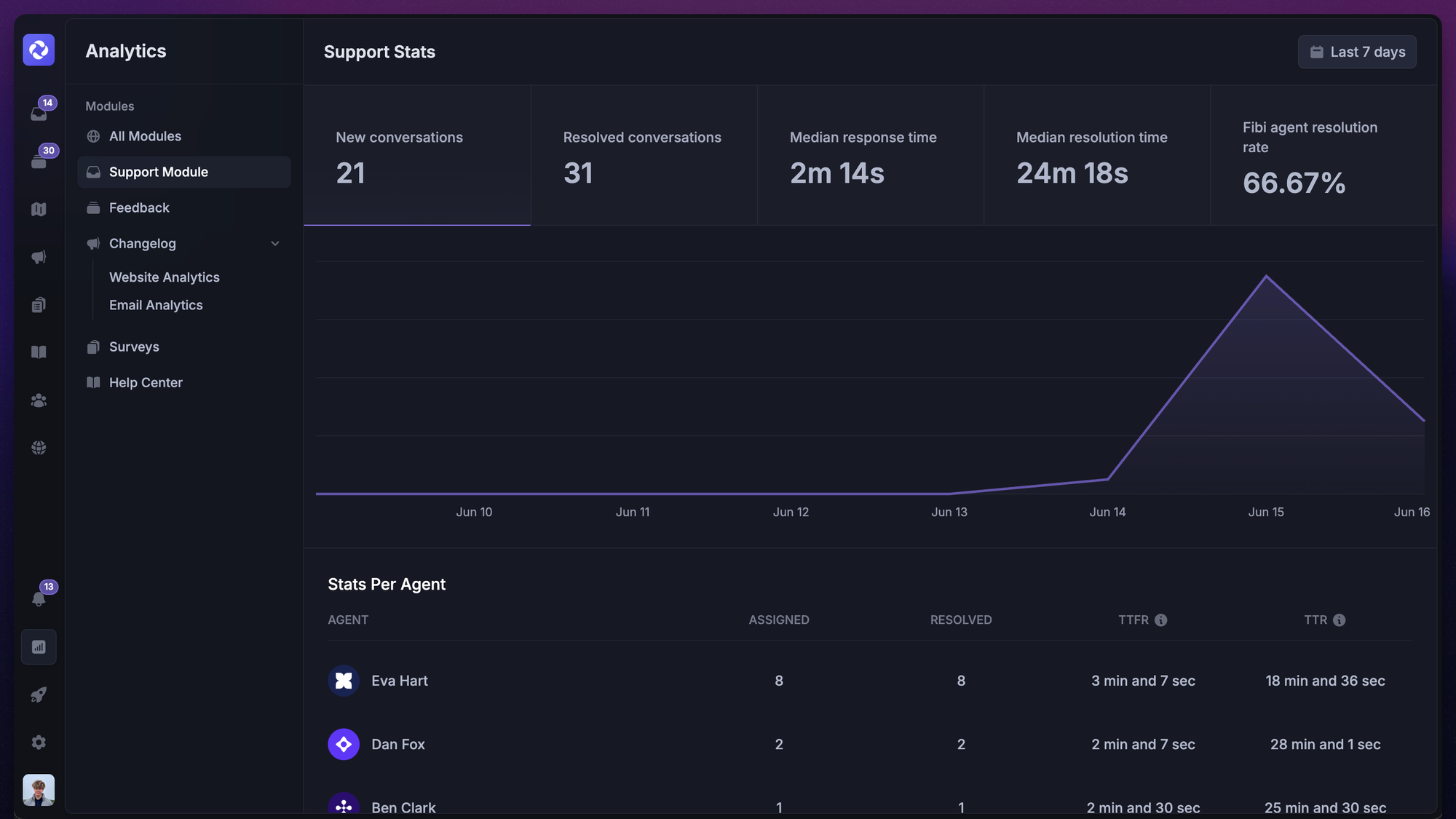
Pair each standard with at least one of these and read the numbers by channel, region, and team. Reading them in aggregate hides the places where standards are quietly slipping.
How to set customer service standards (a 5-step process)
Most teams skip step 1 and go straight to copying a competitor's response time targets. That's how you end up with standards nobody can hit.
- Baseline what you do today: Pull the last 90 days of FRT, FCR, CSAT, and QA data by channel. To sanity-check the basics of your setup, work through this customer service checklist.
- Set stretch targets, not fantasy ones: A support goal should beat your baseline by 20-40%, not by 4x. If email FRT is 12 hours today, target 4-6 hours, not 1 hour. Unreachable standards train your team to ignore them.
- Translate each standard into a playbook: Abstract standards don't change behaviour. "Be responsive" becomes "Acknowledge every email within 4 business hours and provide either a resolution or a next-step ETA in that first reply." That's something an agent can actually execute.
- Train, then empower: Run scenario-based training on the playbooks - real tickets, role-played in pairs - to sharpen the customer service skills the standards depend on. Then give agents the authority to act. If your standard is "resolve in one interaction whenever possible," agents need refund authority, expedited shipping authority, and account credit authority within clear caps.
- Run a weekly QA loop: Sample 5-10 random tickets per agent per week. Score them against your standards on responsiveness, accuracy, empathy, and resolution quality. Use the gaps to update playbooks and target coaching - not to punish individual reps.
The thing every step has in common: standards live in operational reality, not in a deck. If they aren't in the playbook, in the QA rubric, and on the agent dashboard, they aren't real.
✨ Automate your support with the fastest AI-enhanced Inbox today →
How to maintain standards as you scale
Standards that work for a team of 5 collapse when you hit 50 agents handling 5,000 conversations across 6 channels. The failure points are predictable:
- Inconsistent training: New hires shadow whoever's free that week. Without codified playbooks, each cohort picks up slightly different habits.
- Ad-hoc decisions: Policies that live in senior heads, not in a documented knowledge base, get applied differently by different agents.
- Lost context across channels: A customer who emails Monday, chats Wednesday, and calls Friday gets asked to repeat themselves 3 times because no system stitches the threads together.
3 things keep standards intact at scale.
Centralise communication into one omnichannel support platform. Email, chat, social, phone, and in-app messaging should land in a single inbox where the full customer history is visible without context-switching. This is the single biggest fix for the lost-context problem.
Codify standards into measurable Service Level Agreements (SLAs). An SLA turns a soft standard ("respond within 4 hours") into a tracked commitment with breach alerts, so the standard self-enforces instead of relying on agent memory.
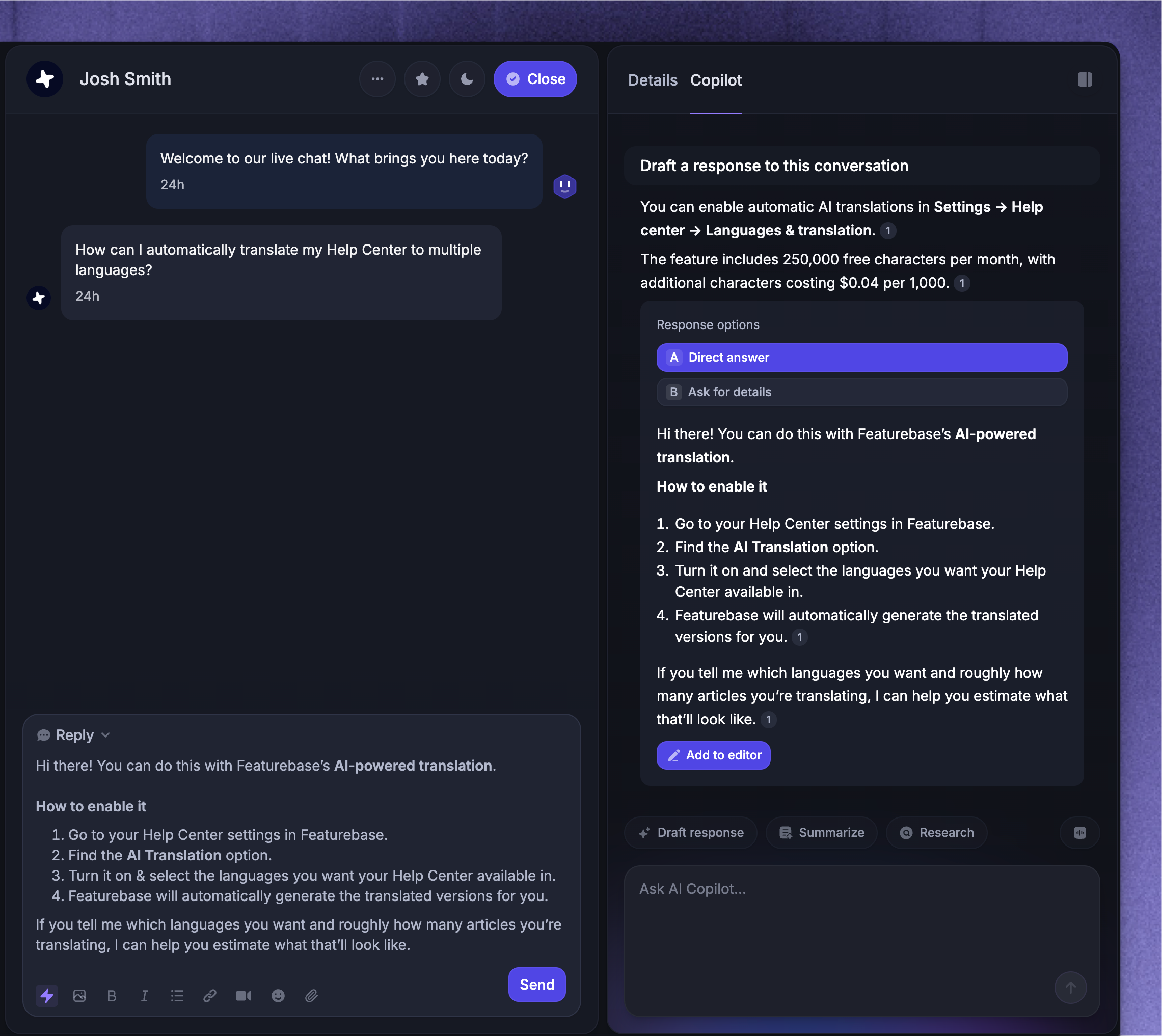
Use AI to enforce consistency. AI Copilot tools surface the right knowledge base answer to whichever agent is at the keyboard, which is how you keep the senior-agent quality bar across a fast-growing team.
Supporting customer service standards at scale
Customer service standards are easy to write down but harder to maintain in daily support work.
A team might agree on a 4-hour email response target, a specific tone of voice, or a rule for when to escalate a ticket. But once conversations start coming from live chat, email, Slack, and in-app messages, those standards can slip unless the workflow supports them.
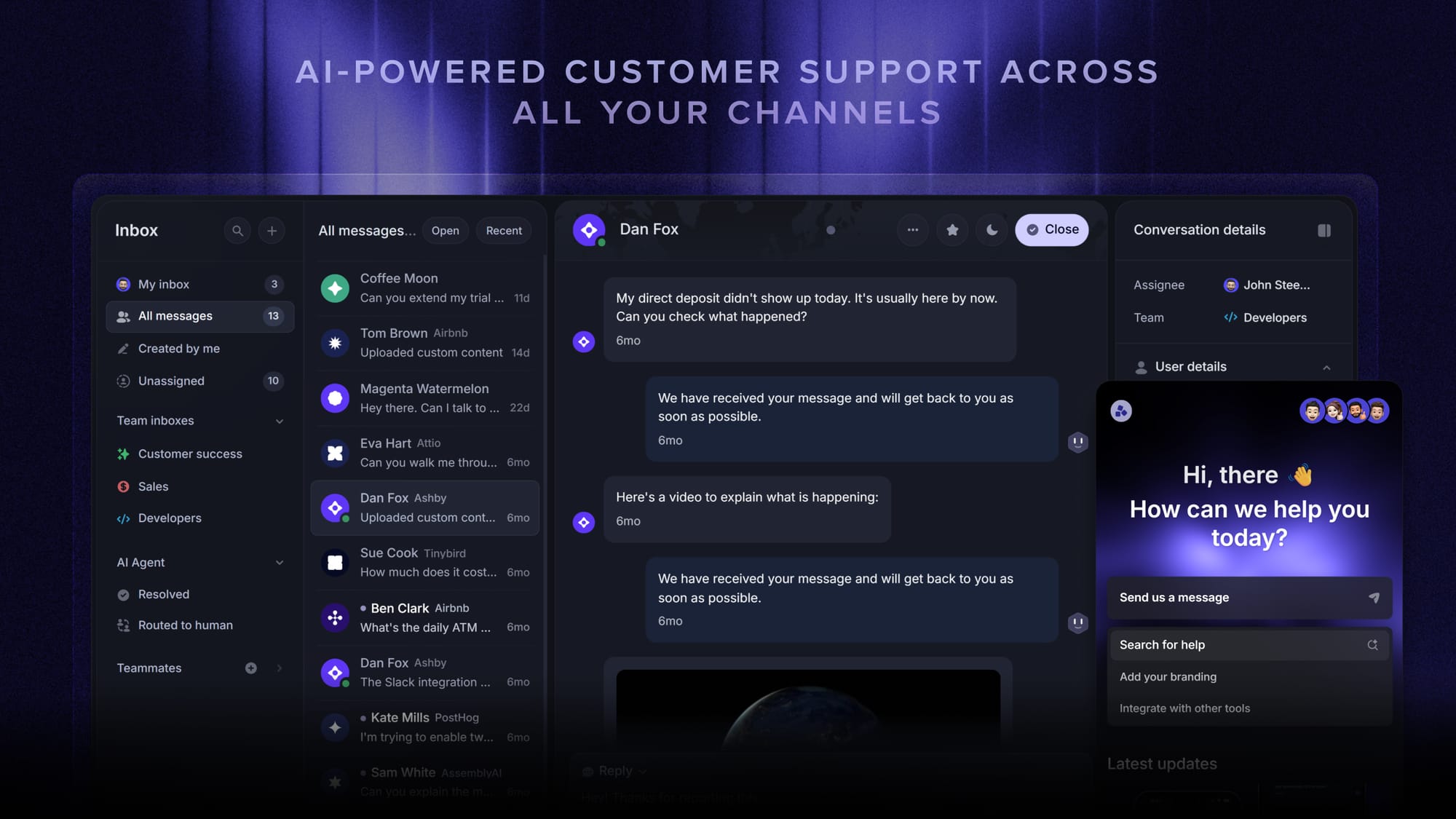
Featurebase helps support teams turn standards into something easier to follow:
- Omnichannel inbox keeps conversations in one place, so agents can see the full customer context before replying.
- Service Level Agreements (SLAs) help teams track response-time targets and catch conversations before they fall behind.
- AI Copilot helps agents draft replies using the right context, which makes accuracy and tone easier to keep consistent.
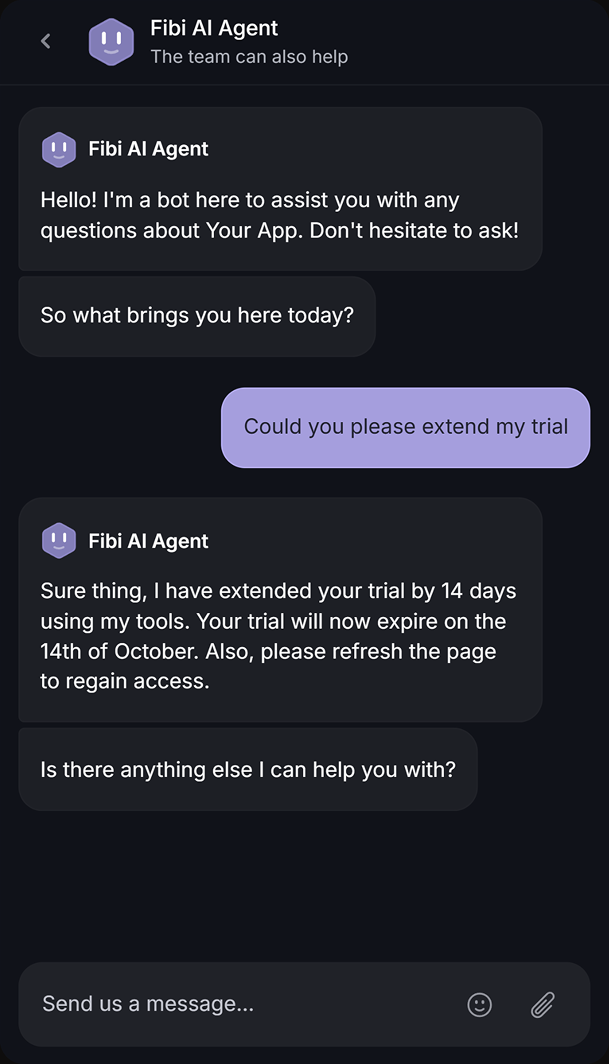
- Fibi AI Agent can answer common questions automatically, reducing repetitive tickets and helping customers get faster responses.
- Help center with AI search gives customers a self-serve option that supports availability and resolution quality.
- Workflows and automations help standardize routing, assignments, and follow-ups.
- Translations make it easier to offer a consistent support experience across languages.
- Feedback, roadmap, and changelog tools help teams spot recurring issues and close the loop when improvements ship.
The point is not that software creates good customer service standards for you. You still need clear targets, playbooks, training, and QA. But the right support system makes those standards easier to apply across every conversation, especially as your team and ticket volume grow.

Get the best customer service tool
Automatically resolve 70% of customer requests & cut down manual support loads
Conclusion
Customer service standards only work when they are clear, measurable, and easy for your team to follow every day. Once you define what good support means across speed, quality, tone, and ownership, the next step is putting systems in place that help your team maintain those standards as support volume grows.
Featurebase is a modern AI customer support platform that helps SaaS teams manage conversations, track SLAs, keep answers consistent, and automate repetitive support work. It comes with an omnichannel inbox, Fibi AI Agent, AI Copilot, AI-powered help center, workflows, translations, and feedback tools to help you deliver a more consistent customer experience across every channel.
It comes with a Free plan, and paid plans start at $29/seat/month with $0.29 per AI resolution. The onboarding is quick and doesn’t require a credit card, so you can try it without a big setup process. 👇
✨ Automate your support with the fastest AI-enhanced Inbox today →
FAQs
What are some examples of customer service standards?
Concrete examples include: first response within 4 business hours on email, live chat pickup in under 60 seconds, a First Contact Resolution rate of 70% or higher on non-technical issues, CSAT of 4.3 out of 5 or better, and 95% QA adherence to tone and accuracy guidelines. The pattern is that every standard names a specific behaviour and pairs it with a measurable target.
How do you set customer service standards?
Start by baselining your current performance on FRT, FCR, CSAT, and QA scores by channel. Then set stretch targets that beat the baseline by 20-40%, not impossible 4x jumps. Translate each target into a playbook your agents can execute, train against real scenarios, and run a weekly QA loop to catch drift early.
How are customer service standards measured?
Each standard pairs with one or two metrics. Responsiveness maps to First Response Time. Resolution quality maps to First Contact Resolution. Overall experience maps to CSAT or NPS. Friction maps to Customer Effort Score. Internal adherence to tone and process maps to QA scores. Read all of them by channel and team, not just in aggregate.
Why are customer service standards important?
Standards give your team clear expectations, give customers a consistent experience regardless of which agent they reach, and turn abstract goals like "great service" into numbers you can actually track and improve. Without them, service quality fragments as you grow - new hires guess at the bar, senior agents make one-off decisions that become accidental policy, and customers get different answers to the same question.
How do you improve customer service standards?
Improvement is a cycle: baseline current performance, identify the biggest gap, raise the target on that specific standard, update the playbook and training to match, then measure again the next quarter. Avoid trying to raise every standard at once. Pick the one with the worst customer impact and focus there until the metric moves.
What are the 5 most important customer service standards?
The 5 that consistently rank highest in consumer surveys are responsiveness, accountability, empathy, availability, and friendliness. Of those, responsiveness is the most universally expected and the most directly measurable. The other 2 from the consensus 7 - resolution quality and transparency - are slightly less front-of-mind for customers but show up strongly in retention data.