Blog Comparisons11 Best Fin AI Alternatives in 2026 (Cheaper Resolution Pricing & Better Coverage)
11 Best Fin AI Alternatives in 2026 (Cheaper Resolution Pricing & Better Coverage)
Fin AI charges $0.99 per resolution. These 9 alternatives deliver the same outcomes at a fraction of the cost - here's what to pick when.


Intercom's Fin AI is one of the most capable outcome-based AI agents on the market, but $0.99 per support outcome adds up fast.
A team running 10,000 monthly conversations with a 50% resolution rate is looking at roughly $5,000/month on Fin alone, before you've paid for a single Intercom seat. 💀
In this guide, I'll break down the 9 genuine Fin AI alternatives into the three categories that matter for your decision, with current 2026 pricing and the trade-offs each one hides. 👇
Overview
The best Fin AI alternatives for AI-powered customer support:
| Tool | Pricing model | Starting cost | Best for | Main trade-off |
|---|---|---|---|---|
| Featurebase | Per-resolution + seat | $29/seat + $0.29/resolution | Product-led SaaS replacing Intercom + Fin | Newer brand on the enterprise AI agent scene |
| Decagon | Custom annual | $95K–$590K/year | Enterprise with deep AI budgets | Agent Assist locked to Zendesk only |
| Sierra AI | Custom annual | ~$150K/year + setup | Brand-sensitive enterprise | Multi-month deployment, vendor-driven changes |
| Ada | Base + per-resolution | ~$30K base + $1.00–$3.50/resolution | Mature Zendesk/Salesforce orgs | 8–16 week real deployment, fuzzy resolution definition |
| Forethought | Opaque enterprise | Custom (20K+ historical ticket minimum) | Established mid-market support orgs | Weak reporting, high ticket-volume floor |
| My AskAI | Flat-rate sidecar | $199/month + Intercom seat | Intercom users cutting Fin cost | Double-platform cost, thin enterprise track record |
| eesel AI | Pay-per-task | $0.40/ticket + helpdesk seat | Teams needing prompt-level control | Thin G2 sample, double-platform cost |
| Zendesk Advanced AI | Per-seat add-on | $50/agent + $115/agent Suite | Teams already deep in Zendesk | Billing surprises, weak autonomous resolution |
| Chatbase | Tiered SaaS | $32/month entry, $400/month Pro | Budget-conscious DIY chatbot | Hallucination and support quality concerns |
| Lyro | Per conversation | $32.50/month entry | SMBs and e-commerce on the Tidio platform, or teams adding AI to their existing helpdesk | Quota counts conversations, not just resolutions (pay-per-resolution only on Premium) |
| Quiq | Usage based annual | custom pricing | Enterprise CX teams needing agentic resolution across AI and humans | Custom pricing, enterprise deployment |
What is Fin AI?
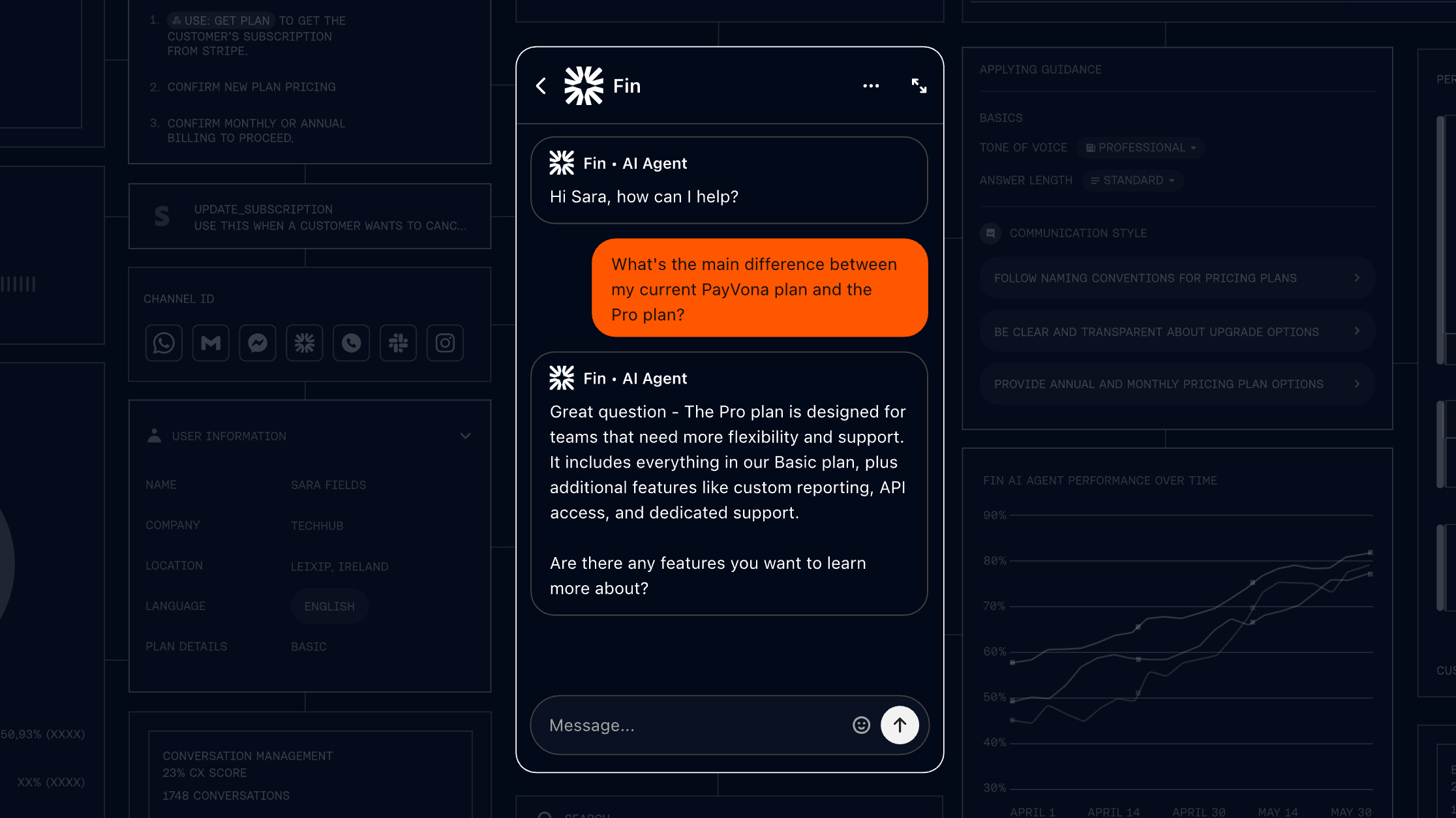
Fin AI is Intercom's AI customer service agent. It uses LLMs trained on your help center articles, past support conversations, and any other content sources you connect to resolve customer questions end-to-end, across chat, email, and messaging channels.
The defining feature is its pricing model. Fin charges $0.99 per support outcome, covering resolutions and configured procedure handoffs. Resolutions include confirmed answers and cases where the customer leaves without asking for more help. This outcome-based model is genuinely innovative, but it scales linearly with your support volume, which is where most teams start looking for alternatives.
Fin is the AI layer. It does not replace your helpdesk, your knowledge base infrastructure, or your feedback collection. If you use Intercom underneath it, seats start at $19/seat/month billed annually ($29 monthly). With another supported helpdesk, standalone Fin requires no Intercom seats and has a 50-outcome monthly minimum ($49.50 at $0.99 each), plus your existing helpdesk bill.
Why teams look for Fin AI alternatives
Three reasons come up over and over in real customer reviews:
- The per-resolution bill compounds faster than expected
At $0.99/resolution, a team handling 5,000 successful AI resolutions a month pays $4,950 for Fin on top of their Intercom seats. Many teams discover their actual resolution count is higher than forecasted, and the invoice arrives bigger than the plan said it would. - The scope is narrow
Fin is an AI agent layered on Intercom. It does not replace your feedback portal, your roadmap, your product changelog, or your standalone help center if you're hosting one elsewhere. Teams running a multi-tool stack often want to consolidate, not add another bill. - The resolution definition is fuzzy
Fin counts an "assumed resolution" when a customer exits the conversation without asking for more help. In practice, that includes customers who gave up and emailed someone instead. Teams reviewing their Fin transcripts often find they're paying for outcomes that did not actually resolve the underlying issue.
If any of those three sound familiar, an alternative is worth a serious look.
How to evaluate Fin AI alternatives
Before comparing tools, pick a stance on these three questions. The answers narrow the field by at least half.
1. Resolution definition (the contract trap)
Every AI agent vendor defines "resolution" differently, and the definition is buried in the contract. Ada, Decagon, Sierra, and Forethought all use custom definitions in their enterprise contracts.
The same 10,000-conversation month can produce a 45% resolution rate on one vendor's definition and 75% on another's, with identical underlying behavior.
Before signing anything, get the exact definition in writing and run it past your CX team.
2. Scope: chat AI vs full platform replacement
Fin alternatives fall into 3 buckets:
- Full-platform replacements (Featurebase, Zendesk, etc.) replace Intercom entirely - the AI agent, the inbox, the help center, sometimes the feedback portal too.
- Intercom sidecars (My AskAI, eesel AI) plug into your existing Intercom seats and replace just the Fin AI layer with cheaper flat-rate pricing. You're still paying for Intercom underneath.
- Enterprise AI agents (Decagon, Sierra, Ada, Forethought) are standalone AI platforms that sit on top of your helpdesk of choice. Annual contracts typically run $50K-$500K.
Pick the bucket first, then compare within it.
3. Pricing model: per-resolution vs per-conversation vs flat-rate
Resolution-based pricing (Ada, Featurebase's Fibi) charges for resolutions as defined by each vendor. Fin uses broader outcome-based pricing, including $0.99 for resolutions and configured procedure handoffs. Per-conversation pricing charges for every chat the bot touches, resolved or not. Flat-rate pricing (My AskAI, eesel AI's Enterprise tier) gives you a predictable monthly invoice but no built-in alignment with actual outcomes.
For volume-heavy teams with strong resolution rates, a flat rate is usually cheapest. For lower-volume teams that want pricing tied to outcomes, resolution-based is the safer bet, provided the resolution definition is honest.
The 9 best Fin AI alternatives in 2026
1. Featurebase's Fibi AI ✨
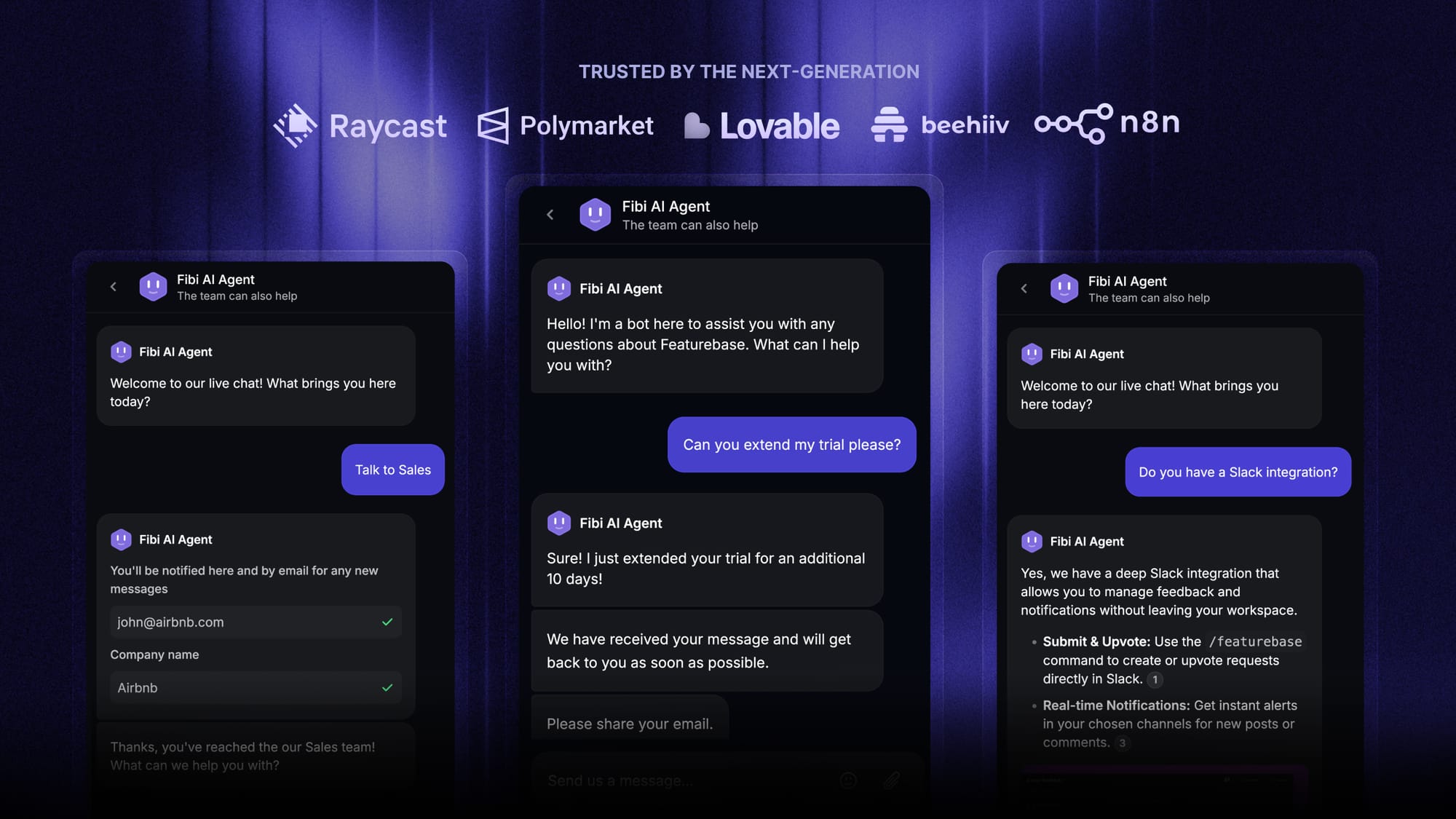
This is as close as it can get to Intercom's Fin without the high pricetag.
Featurebase is a modern AI customer support platform for product-led SaaS. It combines AI-powered support, help center, and feedback management into a single platform for startups that want all their customer-facing tools in one place. Featurebase is loved by thousands of support teams from companies like Lovable, Raycast, and n8n. 💫
Top features:
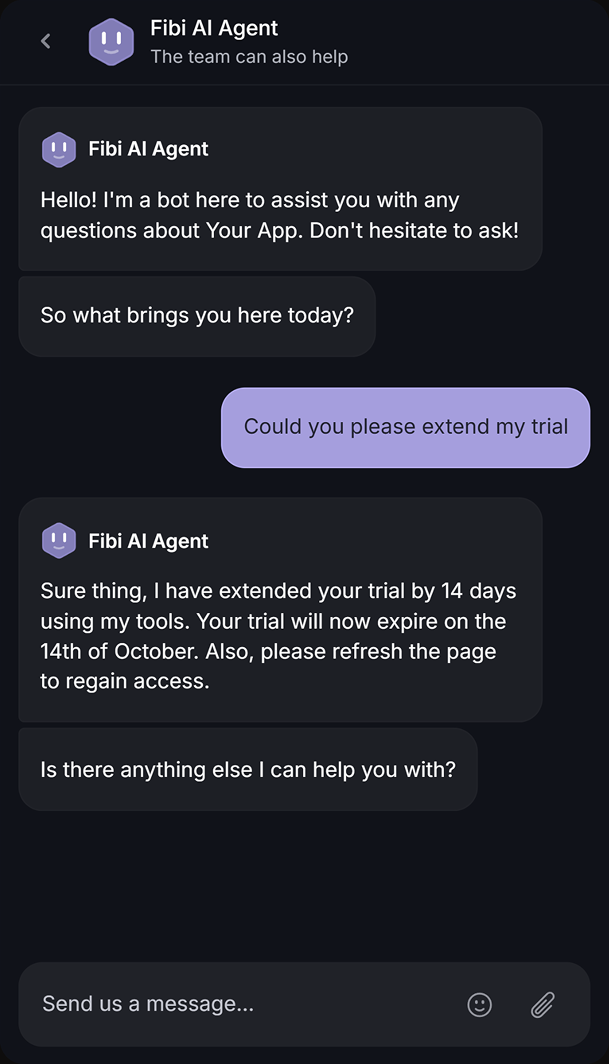
- Fibi AI Agent - Resolve customer issues on autopilot & run custom actions like trial extensions and refunds
- Workflows & automations – Auto-assign tickets, route conversations, collect customer data, and more
- Omnichannel inbox – Manage live chat, email, and Slack conversations from one AI-powered view
- AI Copilot – Help your agents answer customers faster with AI Copilot that uses your internal knowledge
- Help center with AI search – Provide instant, multilingual self-serve answers
- Multi-brand support – Manage multiple Help Centers and Live chats from a single workspace
- Automatic AI translations – Automatically translate all messages and help articles to your customers native language
- Service Level Agreements – Track SLAs to make sure your team responds to customers on time, every time
- Mobile app – Respond to customers, receive notifications, and unblock users on the go
- Integrations – Connects with Slack, Linear, Jira, HubSpot, and more
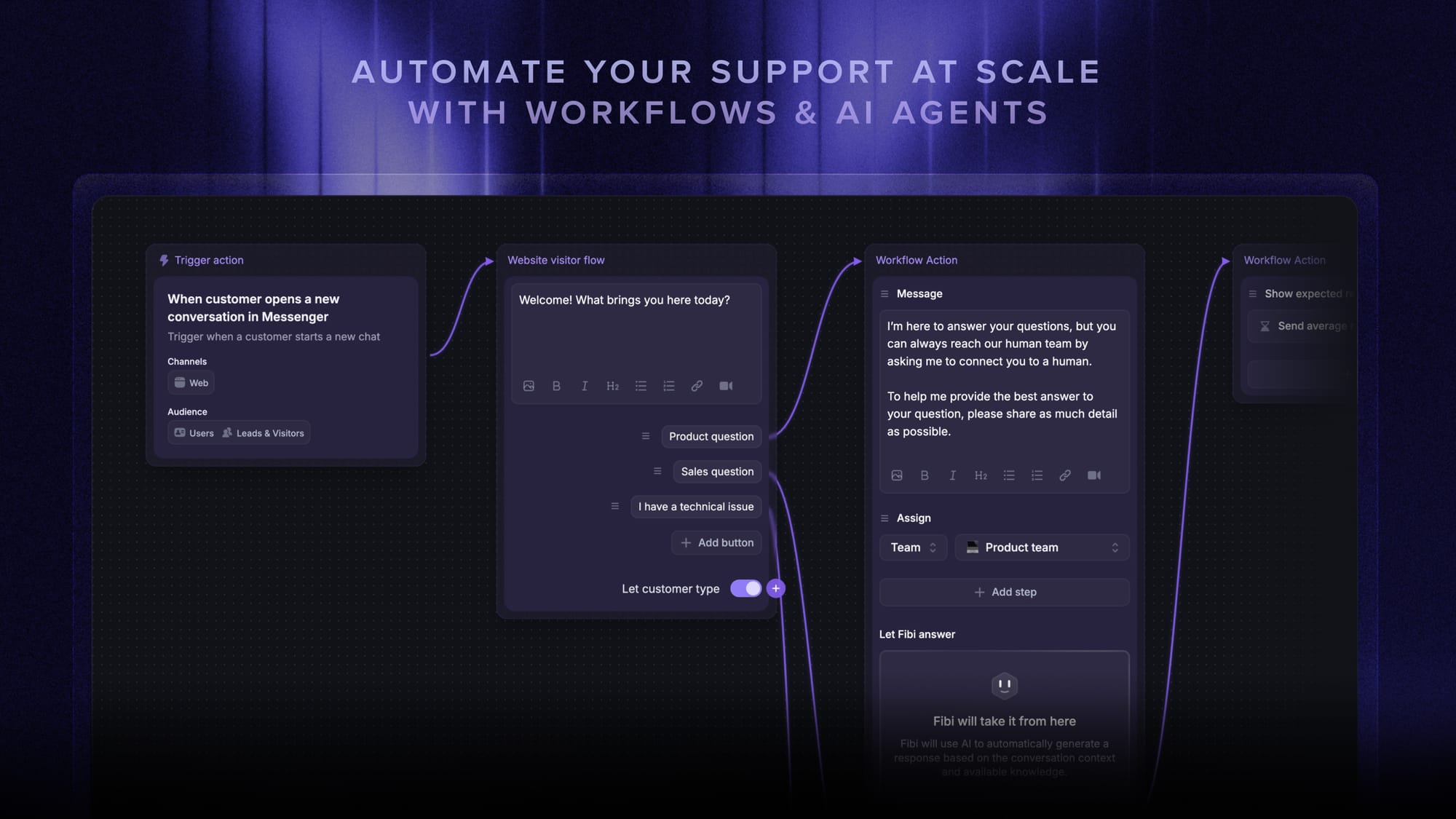
Pricing: Free plan available with unlimited conversations. Paid plans start at $29/seat/month with $0.29 per AI resolution - about 70% cheaper per resolution than Intercom + Fin pricing.
Featurebase covers all the basic support features that legacy platforms do, but with a much more modern approach. It comes with AI automations, a mobile app, and multiple channels (email, live chat, Slack, etc.).

Resolve 70% of customer requests with AI
Automatically resolve customer issues & cut down support loads for your team
2. Decagon
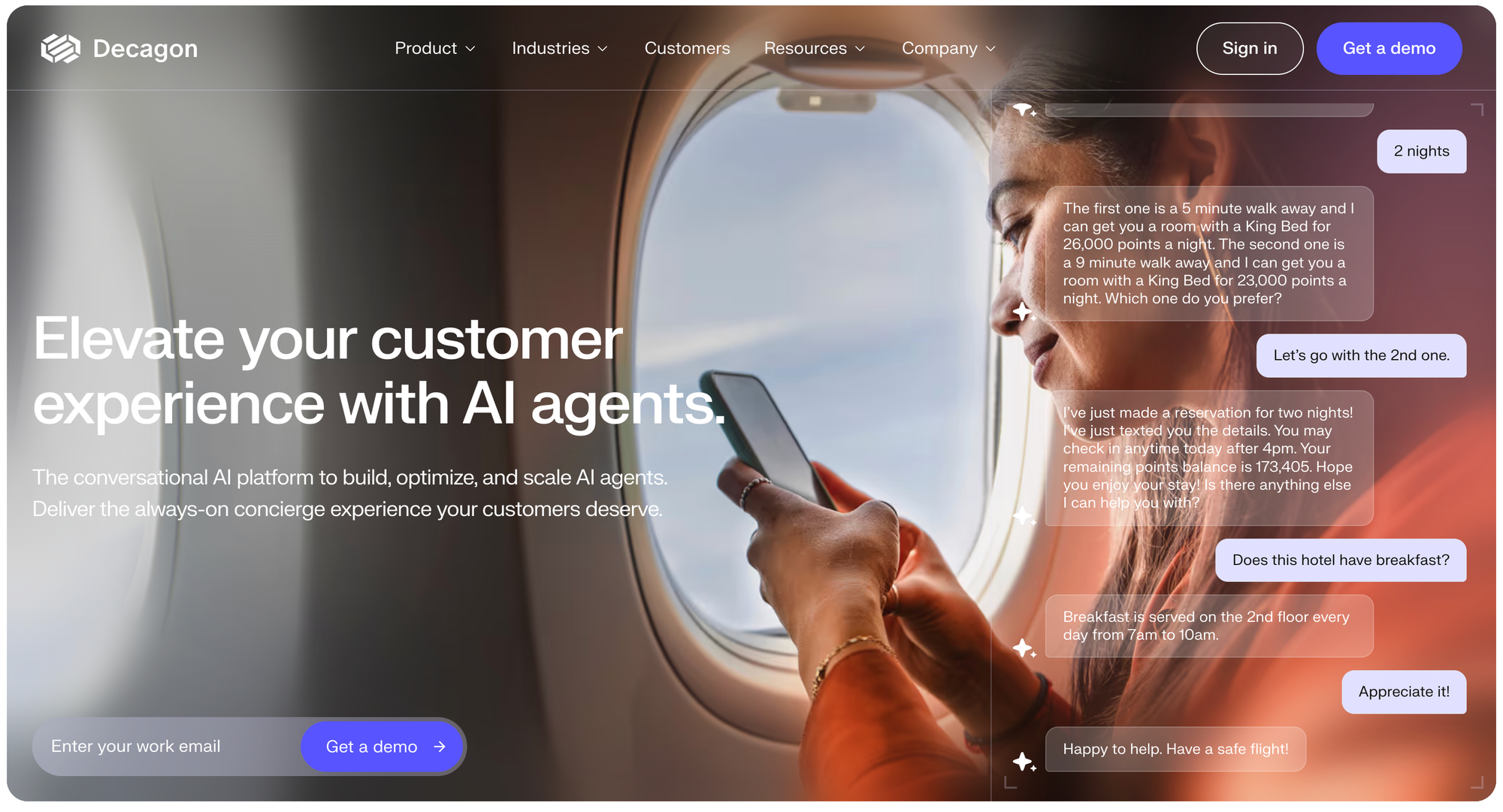
Decagon is a high-end enterprise AI agent platform built for support orgs that want deterministic workflows and tight brand control. Real G2 reviewers consistently highlight quick implementation (some teams live in under a week) and the platform's ability to scale conversation volume without adding human headcount.
Top features
- AI agent that learns from past support conversations
- Deterministic workflow builder for high-risk scenarios
- Agent Assist for human reps (Zendesk integration only)
- Enterprise-grade audit and compliance controls
- Dedicated implementation team during onboarding
Pricing: Custom enterprise contracts only. Real customer data points place annual costs between $95,000 and $590,000+, with most mid-market deals landing in the $100K-$200K range.
Best for: Large support orgs with enterprise budgets and an in-house team that can run the implementation.
Main trade-off: Reviewers consistently flag that Agent Assist (the AI copilot for human reps) only works inside Zendesk. If your humans handle escalations in Salesforce, Intercom, or any other helpdesk, those teammates do not get Decagon's copilot at all. Implementation also typically needs dedicated Agent Engineers, which prices SMBs out entirely.
3. Sierra AI
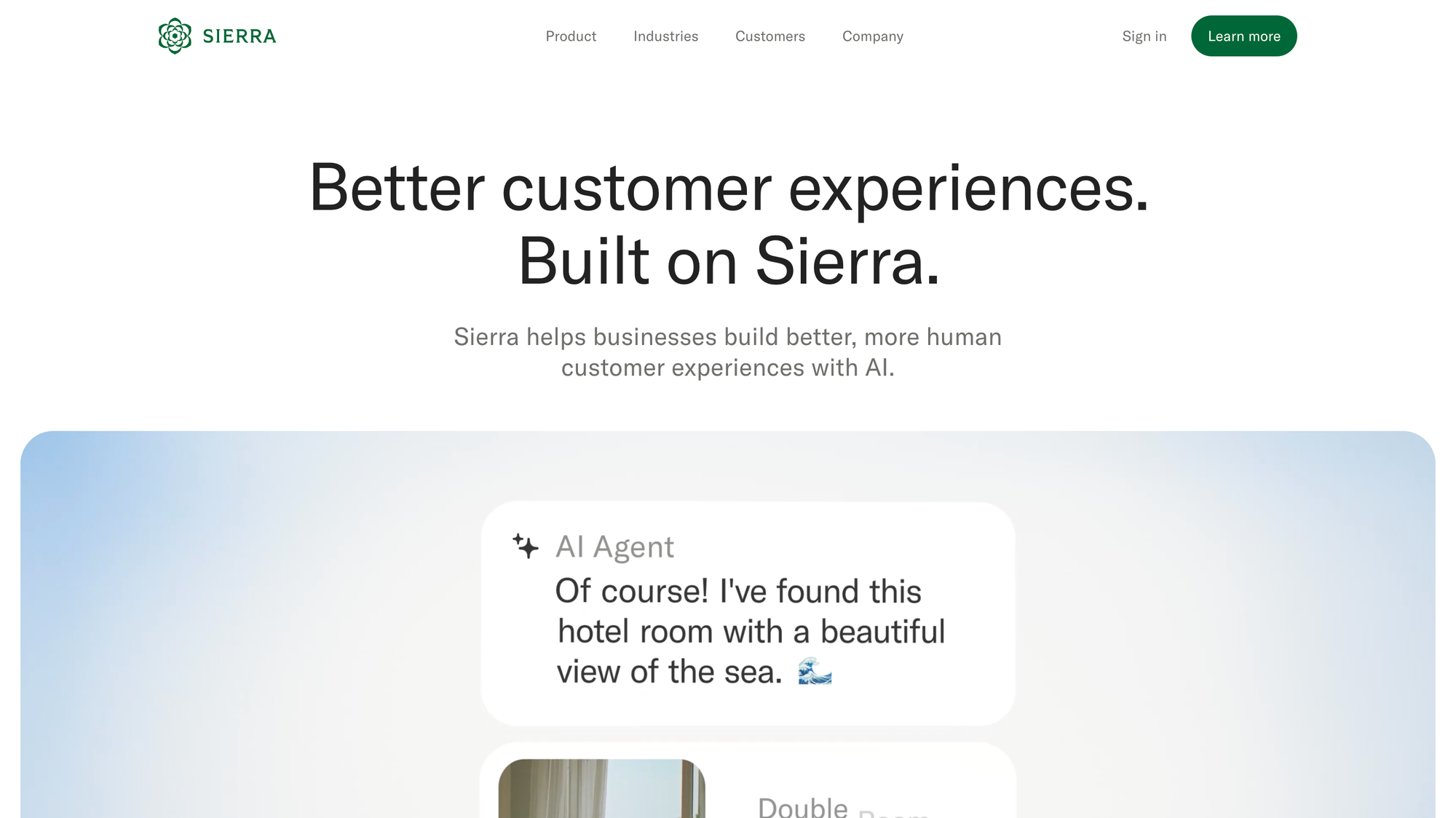
Sierra, Bret Taylor's AI customer service company, focuses on supervised AI agents that can take real business actions while protecting brand integrity. G2 reviewers praise the clean interface and the platform's ability to manage high-traffic chat without dropping context.
Top features
- Supervised AI agents with brand-safety guardrails
- Real-action capability across CRMs, order systems, and helpdesks
- Constellation architecture (checks multiple models before responding)
- Voice and chat support from the same platform
- Dedicated 90-day onboarding with personalized training
Pricing: Custom enterprise pricing. Real customer-reported figures put Sierra around $150,000/year, with implementation fees ranging from $50,000 to $200,000 depending on complexity.
Best for: Large enterprises that want supervised AI taking real actions and have the budget plus IT resources to support a multi-month implementation.
Main trade-off: A recurring theme in G2 feedback is the long deployment timeline. Sierra's internal team configures the agent rather than letting customers self-serve, so changes that should take an afternoon end up taking weeks. The constellation architecture also introduces latency that can feel unnatural in real-time voice interactions.
4. Ada
Ada is one of the most established enterprise AI customer service platforms, with mature integrations into Zendesk, Salesforce, and Contentful. G2 ratings average 4.6/5, with users praising natural-language quality and reported automation rates of 70-83% on routine inquiries.
Top features
- Mature AI agent for chat, email, and voice
- No-code conversation builder (with some real-code escape hatches)
- Deep integrations with Zendesk, Salesforce, and major CRMs
- Multilingual support across 50+ languages
- Analytics dashboard for conversation outcomes
Pricing: Custom enterprise contracts. Ada CX pricing typically combines a ~$30,000/year base platform fee with $1.00-$3.50 per resolution. Median enterprise deals run around $70,000/year, with high-volume contracts exceeding $200,000.
Best for: Mature enterprise support orgs running Zendesk or Salesforce that want a battle-tested AI agent.
Main trade-off: G2 reviewers report a clear gap between the marketing pitch ("no-code, live in days") and reality. Full enterprise deployment takes 8-16 weeks. End-customer reviews on Trustpilot tell a harsher story (2.0/5 average), with frequent complaints about chatbot loops and context loss. The resolution definition in Ada's contracts is also notoriously vendor-friendly, so push back hard on the language before signing.
5. Forethought
Forethought is an AI support platform combining ticket triage, agent assist, and autonomous resolution. Reviewers praise the intuitive interface and the way it reduces manual work on repetitive inquiries.
Top features
- AI triage that routes tickets based on intent
- Agent assist with suggested replies
- Autonomous resolution for simple FAQs
- Custom workflow actions for repetitive tasks
- Integrations with major helpdesks
Pricing: Opaque. No published prices at any tier, annual-only contracts, and minimums of 20,000+ historical tickets and 2,000+ monthly tickets to even qualify.
Best for: Mid-market and enterprise teams already past the ticket-volume floor who want AI layered on a legacy helpdesk.
Main trade-off: The biggest theme in G2 reviews is reporting weakness. Users say datasets are ambiguous, exports are manual, and getting deep workflow insights requires off-platform analysis. The high ticket minimums also shut out smaller teams completely. End-customers on Trustpilot complain about conversational loops with the AI, which is a recurring pattern in enterprise resolution-rate tools.
6. My AskAI
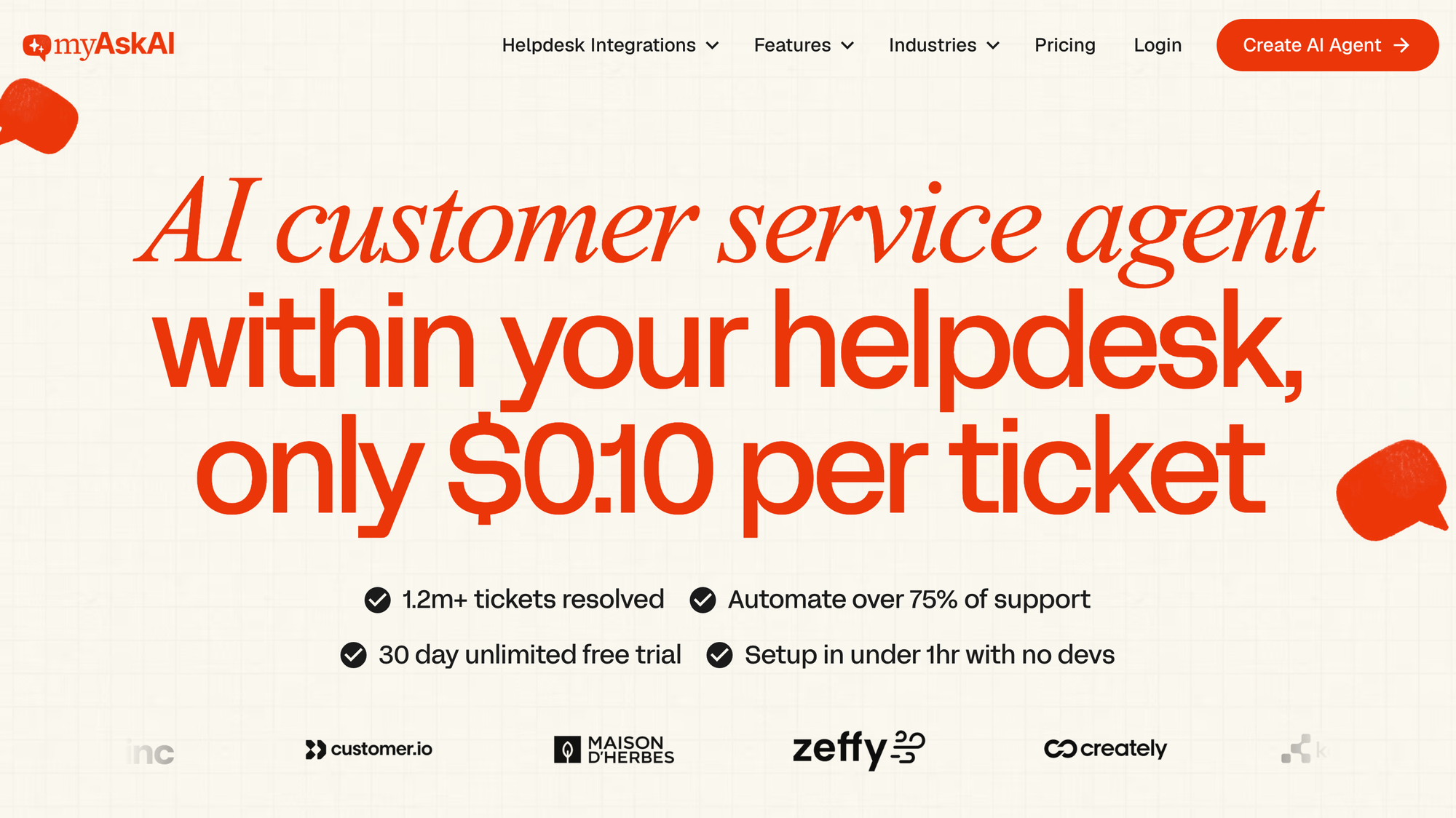
My AskAI is the most popular Intercom-sidecar AI agent for teams that want to keep Intercom but ditch Fin's per-resolution pricing. It plugs into the Intercom marketplace and replaces the AI layer with a flat monthly fee.
Top features
- Approved Intercom marketplace app
- No-code setup in under 10 minutes
- Internal-notes testing mode (test the agent before going live)
- Flat-rate pricing with no per-resolution charges
- Trains on help center, internal docs, and past conversations
Pricing: Starts at $199/month flat for the basic plan. Higher tiers add more knowledge sources and team seats but stay flat-rate rather than per-resolution.
Best for: Teams staying on Intercom who want the AI layer at 5-8x cheaper than Fin and don't need a full platform replacement.
Main trade-off: Voice-of-customer feedback flags two things. First, the G2 review sample is smaller than enterprise tools (the platform is newer), which makes peer comparison harder. Second, you're paying twice: an Intercom seat ($19-$132/month billed annually, or $29-$139 monthly) plus My AskAI ($199/month and up). For high-volume teams the math still beats Fin, but for low-volume teams the double-platform cost can wash out the savings.
7. eesel AI
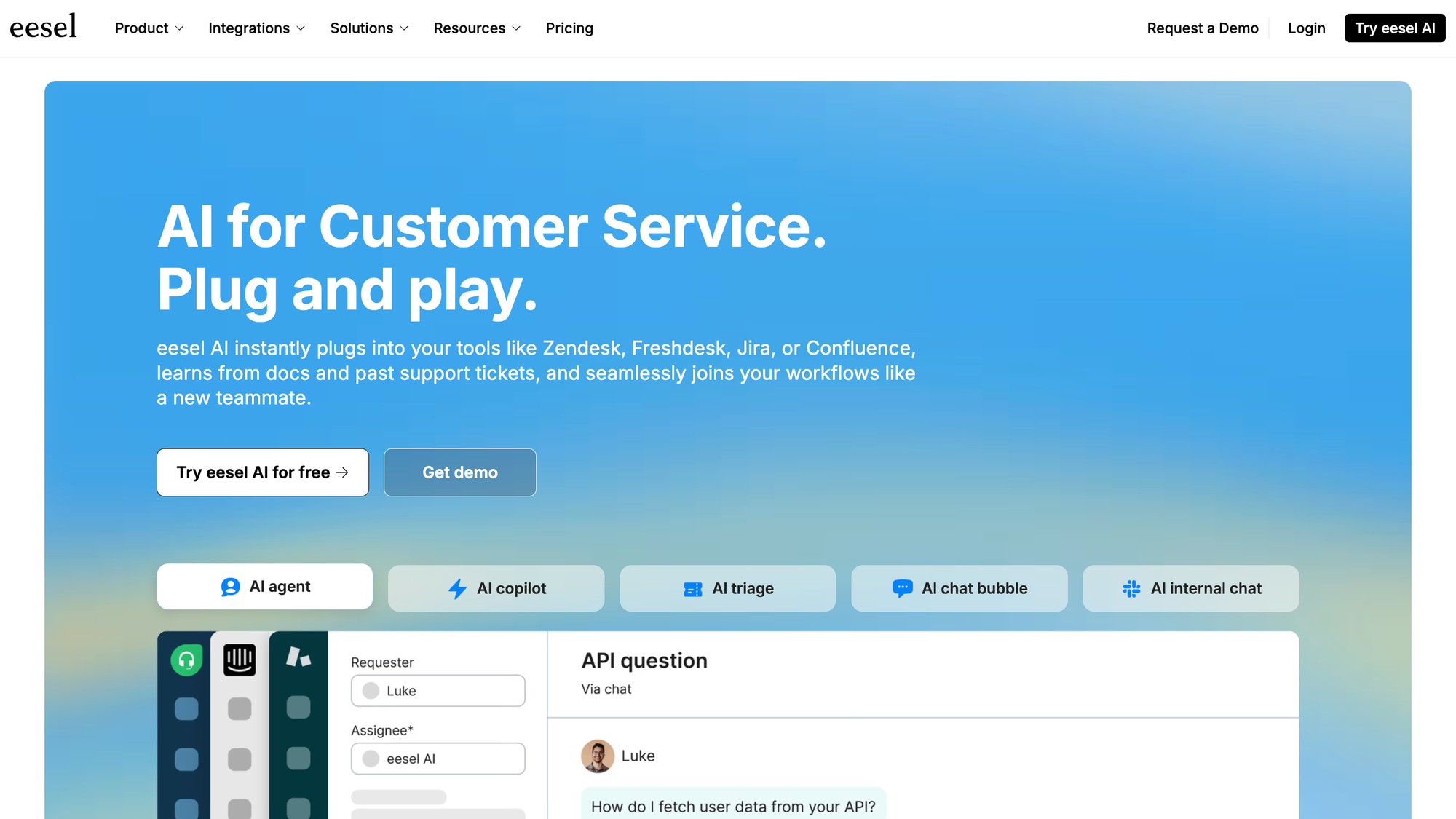
eesel AI is a customizable AI sidecar that works with Intercom, Zendesk, and several other helpdesks. G2 reviewers single out the prompt customization as the standout feature, often citing it as the reason they switched from Fin.
Top features
- Full prompt customization (not just persona-level tweaks)
- Multiple AI agents per workspace for different use cases
- Works with Intercom, Zendesk, Freshdesk, and other helpdesks
- Internal-knowledge integrations (Confluence, Notion, Slack)
- Pay-per-task pricing model
Pricing: As of Q1 2026, eesel pricing moved to a pay-per-task model: $0.40 per support ticket, with light tasks free. Enterprise plans start at $2,100/month for higher-volume teams.
Best for: Teams that want hands-on control over how the AI agent responds and need it deployed across multiple knowledge sources.
Main trade-off: G2 has 15 reviews against eesel's 2,000+ claimed customer count, which means independent peer validation is thin. Reviewers also note occasional slow customer support and, like My AskAI, the double-platform cost (you're still paying your Intercom or Zendesk bill underneath).
8. Zendesk Advanced AI
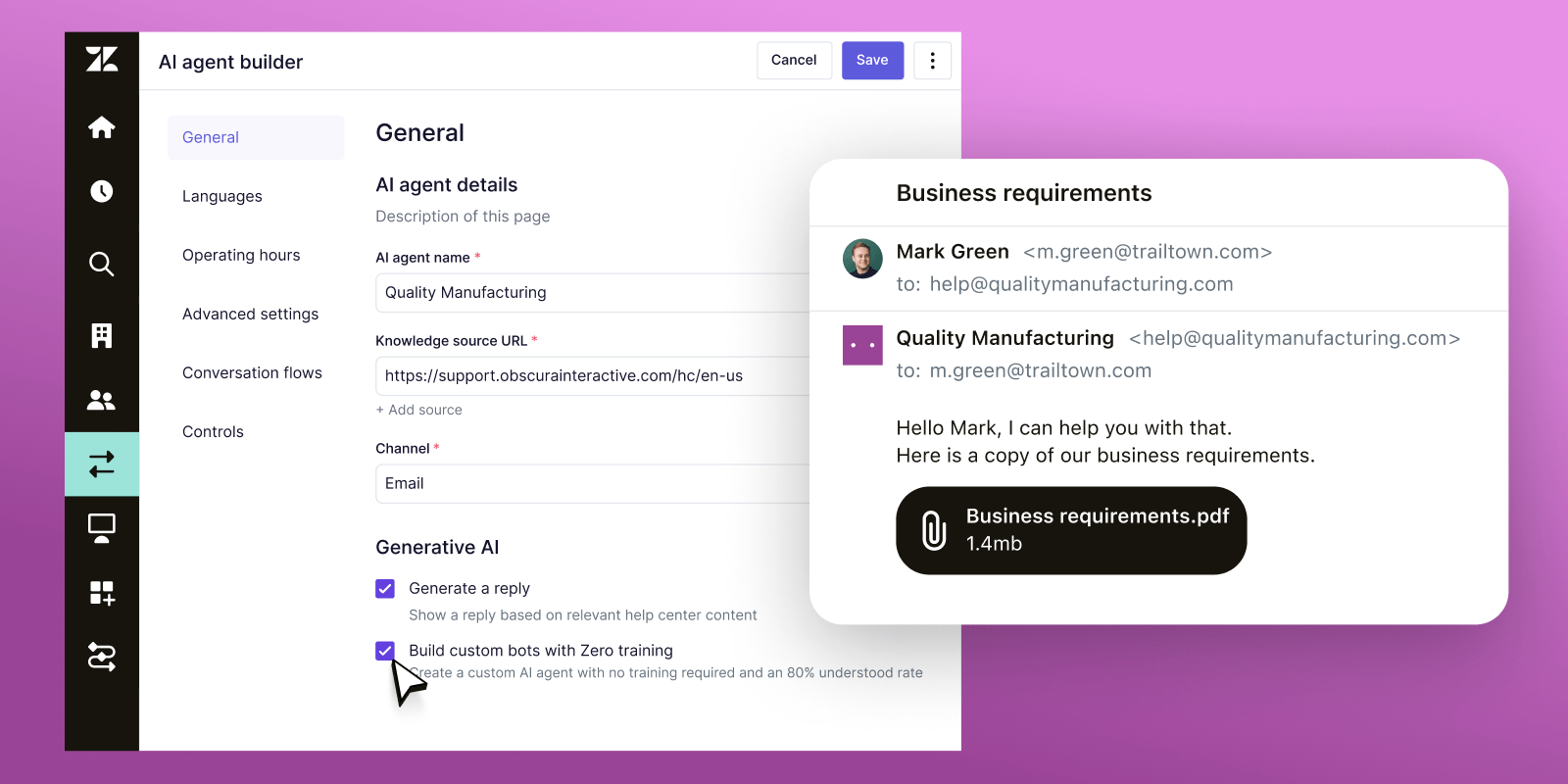
Zendesk Advanced AI is the native AI add-on for teams already on Zendesk Suite Professional or higher. It's not really a Fin alternative in the strict sense, but it's the most common destination when teams leave Intercom entirely for a different helpdesk.
Top features
- AI ticket summarization for long threads
- Suggested replies for human agents
- AI bot with tone and personality controls
- Native integration with Zendesk Suite features
- Structured onboarding training included
Pricing: Zendesk pricing for Advanced AI is $50 per agent/month on top of Suite Professional ($115/agent/month), so the all-in cost is $165/agent/month minimum. Advanced AI is not available standalone.
Best for: Teams already invested in the Zendesk ecosystem who want AI features baked in rather than a separate vendor.
Main trade-off: The most consistent G2 complaint is billing unpredictability - users report that conversations get tagged as "resolved" their team would not have counted, and invoices arrive higher than expected. The dialogue builder is also frequently called out as one of the most frustrating interfaces in the category. For autonomous resolution specifically, most reviewers still recommend pairing Zendesk Advanced AI with a dedicated AI agent like Fin, Ada, or Featurebase.
9. Chatbase
Chatbase is a budget-friendly no-code AI chatbot builder that's often pitched as a Fin alternative for small teams. It trains on your knowledge base and embeds as a chat widget on your site.
Top features
- No-code chatbot builder
- Multiple AI model choices (economy through premium)
- Integrations with Shopify, Slack, WhatsApp, and Zapier
- Custom branding on higher tiers
- Lead qualification flows
Pricing: Chatbase pricing starts free, then Hobby at $32/month, Standard at $120/month, and Pro at $400/month. Each tier has message-credit limits that get expensive when you hit them, and add-ons (custom domain, removing branding) add another $39-59/month each.
Best for: Budget-conscious teams that just need a knowledge-base chatbot and don't need full helpdesk AI integration.
Main trade-off: Voice-of-customer reviews flag two recurring issues. The bigger one is hallucination - users on G2, Capterra, and Trustpilot consistently report the bot generating confident, wrong answers. The second is customer support and billing: Trustpilot scores Chatbase 2.1/5, with frequent complaints about unauthorized charges and unresponsive support. For mission-critical customer-facing AI, both are real concerns to weigh.
10. Lyro
Lyro AI Agent by Tidio is an AI customer service agent that fits both buckets in this list: it comes built into Tidio's full support platform (live chat, help desk, ticketing, and Flows automation), or plugs into your existing Zendesk, Intercom, Salesforce, or Gorgias setup via Lyro Connect - so you can cut the Fin bill without migrating anything.
Top features
- AI agent that answers from your support content without hallucinating
- Lyro AI Actions for handling actions beyond Q&A
- Native support for 45+ languages
- Full platform underneath: live chat, help desk, ticketing, and Flows automation builder
- Works across chat, email, Messenger, Instagram, and WhatsApp
- Integrations with Shopify, WooCommerce, WordPress, Wix, HubSpot, Salesforce, Zapier, and more
Pricing: Every account starts with 50 free Lyro conversations and a 7-day free trial. The Core plan starts at $32.50/month (billed anually). Plus and Premium are custom-priced, adding higher limits, real-time knowledge refresh, MCP and API access, the 50% resolution rate guarantee, pay-per-resolution billing, and Lyro as a managed service.
Best for: Teams that want one AI agent across both paths - SMBs and e-commerce stores using the full Tidio platform, and teams that keep their current helpdesk and just swap the AI layer.
Main trade-off: Lyro counts conversations rather than resolutions, so the quota includes chats the AI engages in but doesn't fully close - though a single conversation covers unlimited AI replies, even if the customer leaves and comes back.
11. Quiq
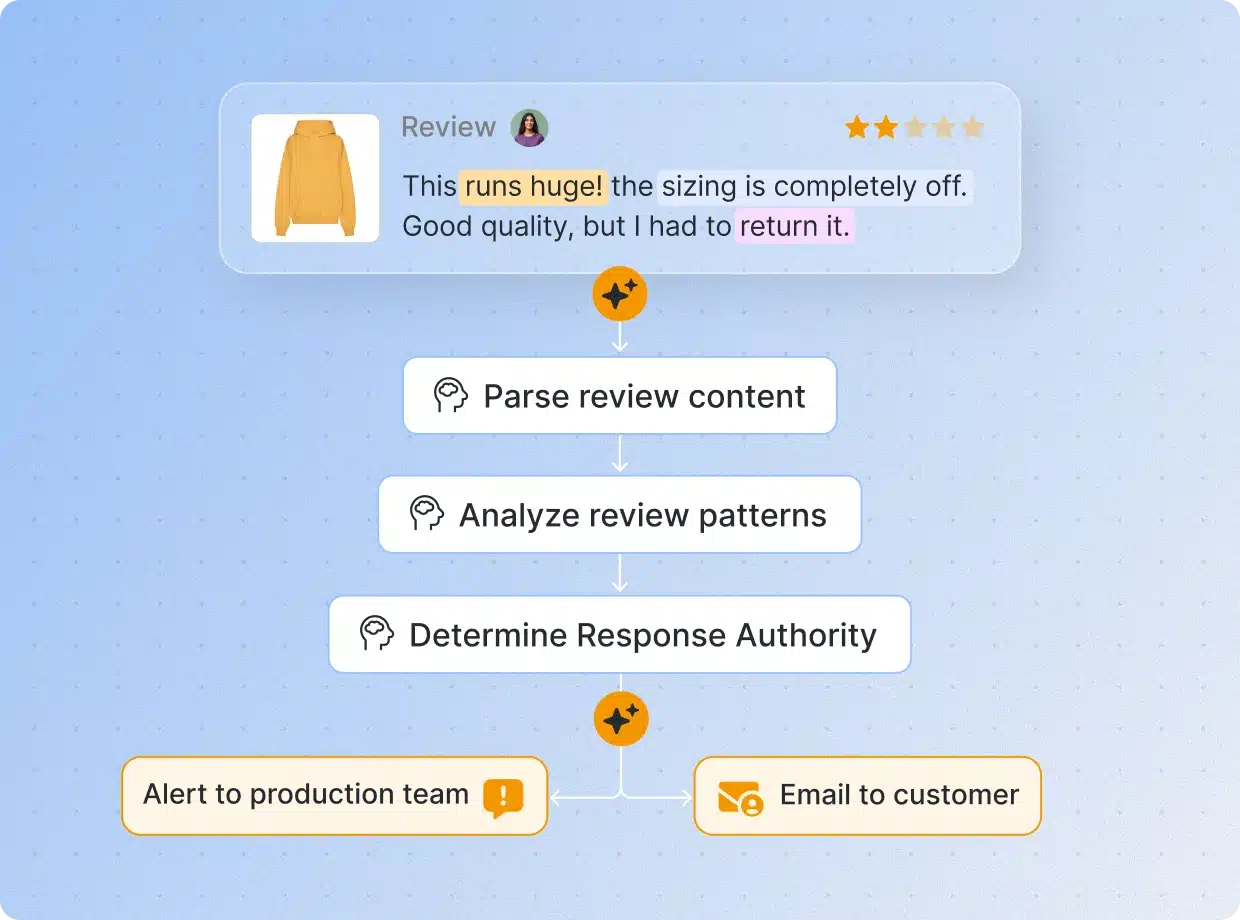
Quiq is an enterprise agentic customer journey platform focused on resolving customer issues rather than simply answering questions. Its AI Agents can use customer data and take actions such as processing returns, updating accounts, or rebooking flights. When a human agent needs to step in, Quiq carries the conversation context with them, even when the customer switches channels.
Top features
- AI Agents across voice, SMS, chat, WhatsApp, and other digital channels
- AI Assistants that give human agents contextual guidance and execute actions
- Process Guides for teaching AI your workflows and brand rules
- Guardrails and claim verification with step by step observability
- AI Conversation Analysts that score interactions across AI and human agents
- Digital Engagement Center that can embed inside major CRM platforms or run independently
Pricing: Custom annual contracts. Quiq uses usage-based pricing tied primarily to conversation volume, with additional charges for automated resolutions and premium capabilities. Contact sales for a quote.
Best for: Large CX teams that want AI to handle customer issues across voice and digital channels while preserving context when humans need to take over.
Main tradeoff: Pricing is not public, and deployment is closer to an enterprise implementation than a lightweight Fin replacement. Quiq's own materials put proof of concept deployments at around 6 to 8 weeks, with full adoption taking around 3 to 4 months depending on complexity. Advanced reporting can also take some time to learn.
Which Fin AI alternative should you choose?
The honest answer depends on what you're trying to replace. If you only want to swap Fin's per-resolution bill and keep Intercom underneath, My AskAI or eesel AI are the cheapest, fastest path. If you're a large enterprise with a six-figure AI budget, Decagon, Sierra, or Ada are the canonical choices, each with their own deployment and pricing trade-offs.
But if what you actually want is something that feels like Intercom - same omnichannel inbox, same AI agent layered on top, same modern help center, same in-app messenger - just without the high price, look at Featurebase. It's the closest like-for-like swap on this list. You get the same support shape Intercom users are used to, with Fibi handling AI resolutions at $0.29 each (about 70% cheaper than Fin's $0.99) and seats at $29/month.
Featurebase comes with a Free plan with unlimited conversations, and the onboarding is fast, so there's no downside to trying it before you commit. 👇
✨ Switch from Intercom + Fin to save thousands per month with the fastest AI-enhanced support platform →
Frequently asked questions
What is better than Intercom's Fin?
It depends on your scope. For teams replacing the full Intercom stack (AI + inbox + help center + feedback), Featurebase offers the same outcome-based AI model at $0.29 per resolution instead of $0.99, plus the surrounding product surface in one platform.
For teams staying on Intercom but cutting just the Fin bill, My AskAI or eesel AI are the cheapest sidecars. For enterprise budgets, Decagon and Sierra both match Fin's depth and add custom workflow capabilities Fin lacks.
How much does Fin AI cost compared to alternatives?
Fin AI charges $0.99 per support outcome, including resolutions and configured procedure handoffs. Inside Intercom, you also need at least one paid seat, starting at $19/month billed annually ($29 monthly). Standalone Fin with another helpdesk has a 50-outcome monthly minimum. For 5,000 support outcomes, Fin usage costs $4,950. Sales qualifications cost $9.99 each, while disqualifications and self-serve routing cost $0.99 each.
By comparison: Featurebase's Fibi runs $1,450/month at the same volume, My AskAI is a flat $199/month, eesel AI is $2,000/month at 5,000 tickets, and Decagon or Sierra are custom enterprise contracts that typically work out to $8,000-$15,000/month at that volume.
Do Fin alternatives replace a helpdesk?
Some do, some don't. Intercom-sidecar tools (My AskAI, eesel AI) only replace the AI layer - you still need Intercom or another helpdesk underneath them. Enterprise AI agents (Decagon, Sierra, Ada, Forethought) sit on top of your helpdesk of choice, but don't replace it. Full-platform alternatives like Featurebase and Zendesk Advanced AI replace the helpdesk entirely, including the inbox, ticketing, and (for Featurebase) the help center and feedback portal.
Why do resolution rates vary so widely between Fin alternatives?
Two reasons.
- The first is vendor-defined resolution counting - what counts as a "successful resolution" varies dramatically between contracts, with Ada, Decagon, and Sierra each using different definitions. The same conversation can be a resolution at one vendor and an unresolved ticket at another.
- The second is conversation routing maturity. Established platforms like Ada and Fin have spent years tuning intent recognition on real support data, so they handle edge cases more gracefully than newer tools. Always ask for the exact resolution definition in writing before signing.
What's the cheapest alternative to Intercom Fin
Featurebase's is one of the cheapest and closest modern alternatives to Intercom. Paid plans start at just $29/seat/month plus $0.29/AI resolution, which beats Fin on per-resolution cost by about 70%.