Qualtrics pricing 2026: How much does Qualtrics cost?
Explore Qualtrics pricing, its $420/month annual plan, free account limits, enterprise quotes, and the costs to check before buying.


On this page
Psst... Looking for a Qualtrics alternative with transparent pricing? Check out Featurebase
Qualtrics is survey software built for research and insights leaders, if you ask Qualtrics themselves.
But how much does it actually cost? Qualtrics has a Free plan and a self-service Strategic Research plan at $420/month, billed annually at $5,040. Its broader experience management products require a custom quote.
The distinction matters because that public price includes a specific response allowance, not unlimited usage.
Below, we'll break down Qualtrics pricing, what's included, and what to check before you commit. 👇
Key takeaways
- Qualtrics has public entry-level pricing: a Free account and a self-service Strategic Research plan.
- The paid self-service plan costs $5,040 per year, advertised as $420/month but billed annually.
- The Free account includes 500 total responses, 3 active surveys, and 30 questions per survey.
- Strategic Research includes 1,000 responses shared across unlimited users. Contact sales if you need a larger allowance.
- Customer Experience, Employee Experience, and larger research packages require quotes. There isn't a published universal enterprise price.
- Featurebase is a simpler alternative for product feedback, with a Free plan for feedback collection and surveys available from the Growth plan.
Qualtrics pricing at a glance
| Plan or product | Public price | Main allowance or pricing basis | Best fit |
|---|---|---|---|
| Free account | $0 | 500 total responses, 3 active surveys, 30 questions per survey | Trying basic surveys |
| Strategic Research, self-service | $420/month, billed annually at $5,040 | 1,000 responses shared across unlimited users | Teams running research within the included allowance |
| Strategic Research, higher volume | Custom quote | Higher response volumes, with a 5,000+ response option advertised | Larger research programs |
| Customer Experience | Custom quote | Interactions and selected products | Customer experience teams |
| Employee Experience | Custom quote | Scope and terms agreed with sales | Employee feedback programs |
| Other Market Research products | Custom quote | Product-specific usage, such as responses, video minutes, or social mentions | Specialized research and brand pro |
The $420 figure is a monthly equivalent, not a monthly payment option. Compare the annual commitment and response allowance with your expected usage before choosing a plan.
Why most Qualtrics pricing requires a quote
Qualtrics does not publish full pricing because it does not sell a fixed, one-size-fits-all product.
Its broader suites use a custom sales model where the package is tailored to the company buying it.
Pricing depends on several variables, including:
- Survey responses or interactions, depending on the product
- Selected modules, such as customer or employee experience
- Enterprise requirements, including security, integrations, and support
As a result, two companies can end up paying very different amounts for what looks like the same platform on the surface.
This approach tells you all about Qualtrics' target market. It is not positioning itself as a simple survey tool but as a full experience management platform used by large organizations.
The structure of the product itself also makes public pricing difficult. Qualtrics combines surveys, analytics, and experience management tools, with different usage measures across products.
However, that doesn't mean every buyer needs an enterprise contract. The public Strategic Research plan already includes advanced research tools. Whether it works for you depends on its response allowance and included capabilities.
How Qualtrics pricing works
Qualtrics combines a fixed-price self-service research subscription with custom pricing for its broader suites.
For Customer Experience, its usage-based structure is built around "interactions," which can include data collected across surveys, calls, chats, and other feedback channels.
At a high level, pricing is shaped by how much data you collect, how many products you use, and how complex your setup is.
Pricing model
Qualtrics pricing is primarily based on:
- Usage volume, such as survey responses, interactions, or video minutes
- Product suite selection, such as Customer Experience, Employee Experience, or Market Research
- Enterprise requirements, like integrations, security, and support
The exact usage unit depends on the product. A response allowance for Strategic Research should not be treated as the pricing model for every Qualtrics suite.
The self-service plan includes unlimited users, so adding a researcher does not give you another 1,000 responses. Your team shares the allowance.
If you mainly want to collect feedback, compare the capabilities you'll actually use with that annual commitment.
What affects pricing
Several variables influence what you'll actually pay:
- Number of interactions or responses collected
- Number of programs or use cases running in parallel
- Chosen suite, such as Customer Experience, Employee Experience, or Market Research
- Advanced features like AI analytics, sentiment analysis, or omnichannel tracking
- Implementation and onboarding requirements
This structure makes it possible to scale, but also harder to predict total cost upfront. Ask sales to separate included capabilities from optional products or services.
Public price and annual commitment
The self-service Strategic Research plan costs $5,040 per year, paid annually upfront. Its advertised $420/month price spreads that annual amount over 12 months for comparison.
It includes 1,000 responses and unlimited users. It also includes advanced analysis tools, so describing it as only a basic survey plan would be misleading.
For more than 1,000 responses, Qualtrics directs buyers to sales. There is no public flat overage rate you can use to calculate a larger package yourself.
Enterprise pricing remains quote-based. Without a quote for your specific products and usage, a broad annual cost range is not a reliable budget.
Switch from Qualtrics to get transparent pricing and faster feedback collection
Qualtrics plans and products
Qualtrics organizes its broader offering around three main suites. It also offers a Free account and an online Strategic Research subscription.
Free account
The Free account supports 3 active surveys, 30 questions per survey, and 500 total responses. That response limit is not a monthly allowance.
You get 8 question types, more than 50 survey templates, basic skip, display, and branch logic, and one survey language.
It's useful for testing the survey builder or a small project. Check the total response limit before sharing a survey with a large audience.
Strategic Research self-service
The $420/month annual plan adds unlimited surveys and questions, 23 question types, and 1,000 responses shared across unlimited users.
It includes video and audio feedback, advanced statistical analysis, and more than 20 guided research solutions. These cover methods such as conjoint analysis, MaxDiff, concept testing, and Video Diaries.
This is the first paid option to evaluate if you need survey research. You do not automatically need the Customer Experience suite just to create surveys.
Customer Experience
The Customer Experience suite focuses on collecting and analyzing feedback across multiple touchpoints like surveys, support interactions, and digital behavior.
It supports omnichannel data collection and real-time insights across customer journeys.
Pricing here is based on interactions and the products you select. The suite extends beyond surveys into areas such as digital experience analytics, contact center insights, and reputation management.
Employee Experience
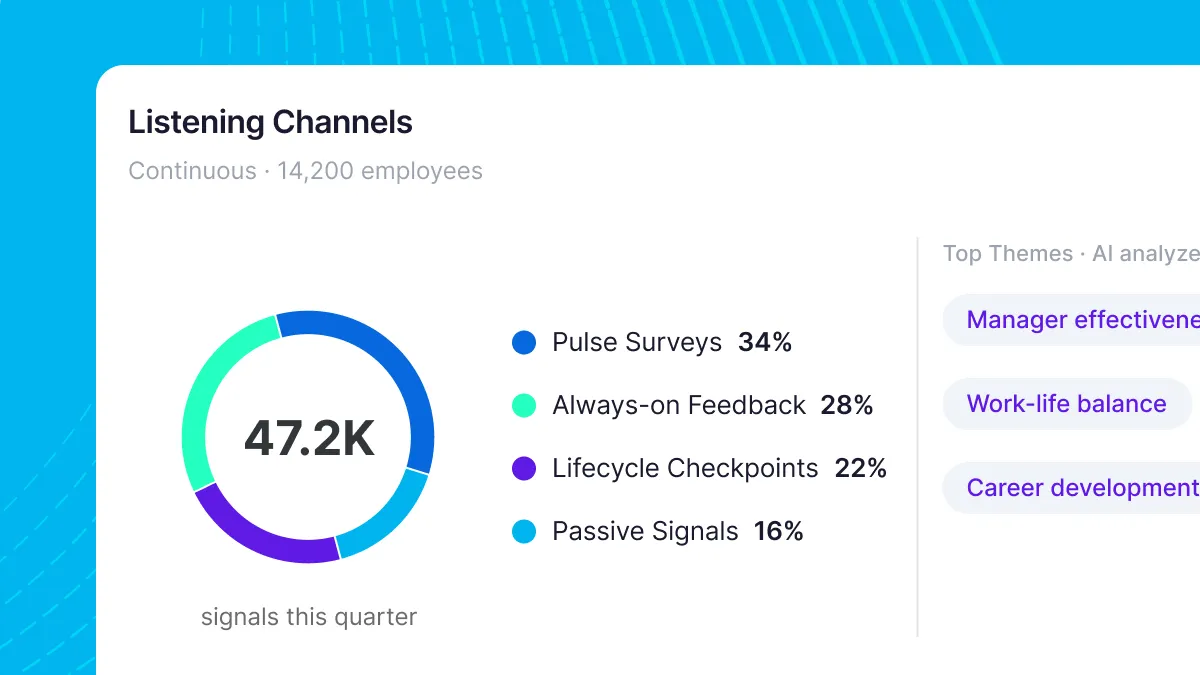
The Employee Experience suite is built for internal feedback programs such as employee engagement surveys, lifecycle tracking, and 360-degree development.
It helps companies monitor retention, satisfaction, and workplace sentiment. You can then analyze data to get deeper insights on what to improve in the workplace.
Pricing requires a quote. Ask sales which employees, programs, and capabilities the proposal covers rather than assuming it follows the research plan's response allowance.
This module is best for HR teams and employee experience leaders running structured internal feedback programs at scale.
Market Research
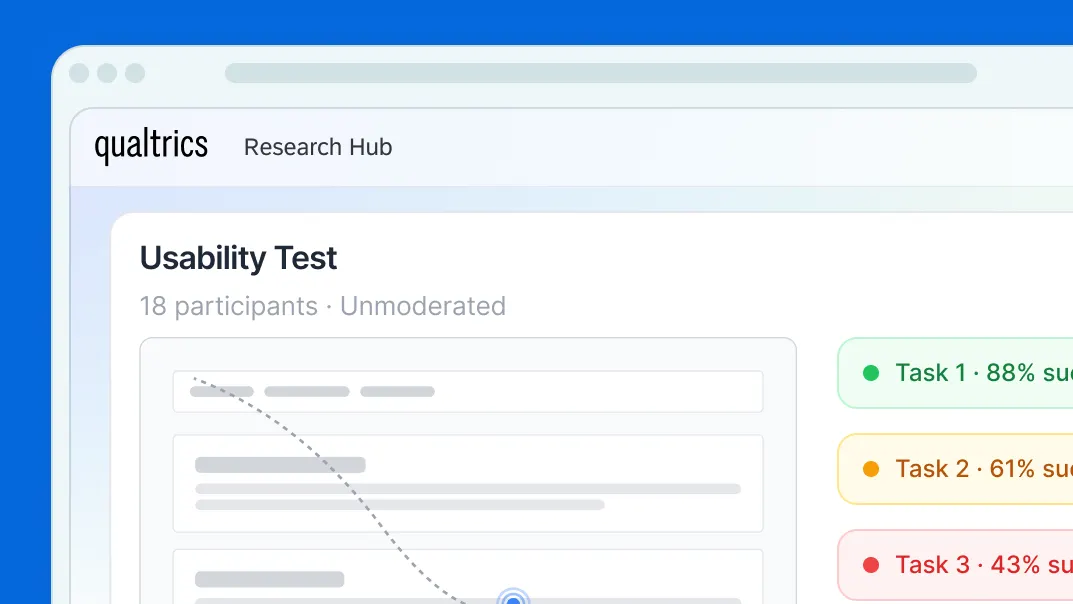
This suite covers market research, product feedback, and advanced survey capabilities.
It includes tools for concept testing, video feedback, and statistical analysis.
Strategic Research sits within this broader offering. Higher-volume research packages and specialized products, such as brand tracking, require sales discussions. Their usage measures can differ, so confirm whether your quote is based on responses, video minutes, social mentions, or another unit.
What’s included in Qualtrics pricing plans
What you get with Qualtrics depends heavily on the plan and configuration. Separate the Free account, self-service subscription, and custom suites when comparing features.
The Free account includes:
- Basic survey creation with 8 question types
- More than 50 templates
- Skip, display, and branch logic
- A single user and one survey language
- The survey and response limits listed above
The paid Strategic Research plan adds:
- Unlimited users, surveys, and questions
- 23 question types, including video and audio
- Advanced statistical tools and crosstabs
- Guided solutions for methods such as conjoint and MaxDiff
- Generative AI summaries for video feedback
- Dashboards and video highlight reels
Custom suites depend on your agreement. Confirm access to the integrations, workflows, security controls, support, and analytics tools you need.
Unlimited surveys does not mean unlimited responses. A team can create many research projects while still sharing the same response allowance.
The main budgeting risk is buying a package without understanding its limits.
First, interaction-based pricing can change your budget as feedback volume grows. Ask how additional usage is purchased and what happens when you reach your allowance.
Second, confirm whether the quote includes:
- Onboarding or implementation services
- The integrations you need
- Advanced analytics or additional products
- Extra responses, interactions, or other usage
- The level of support your team expects
These are questions to check in your quote, not charges that every Qualtrics customer necessarily pays.
For self-service buyers, the annual payment is an important commitment. The subscription renews automatically, and cancellation stops the next renewal rather than ending access immediately.
Tip: Before signing a Qualtrics contract, ask what happens if your response volume grows, which features are add-ons, and whether implementation costs are included in the quote.
Read the agreement as well as the quote. If your team uses AI-assisted contract analysis, focus the review on usage commitments, renewal terms, and any additional-service charges.
Pros and cons of Qualtrics pricing
Qualtrics can be great for advanced analysis and quantitative research at scale, especially when you need to understand customer behavior and gather data across many touchpoints.
But do you really need all of that if you have a SaaS business and want quick feedback collection?
Here are the main pros and cons of how Qualtrics is priced compared to other survey platforms.
Pros
- Public self-service pricing makes the starting annual cost clear
- Unlimited users in the paid self-service plan
- Advanced research methods included in the online subscription
- Supports complex, multi-program deployments through custom suites
- Strong fit for enterprise research, CX, and EX teams
Cons
- No public pricing for most enterprise products
- Annual upfront payment for the self-service subscription
- The 1,000-response allowance is shared across users
- Larger response packages require sales involvement
- Often too complex for smaller product teams
Is Qualtrics worth it?
Qualtrics can be worth it if you're a large enterprise with dedicated research, CX, EX, or insights teams.
It makes sense when you need advanced survey logic, large-scale research programs, custom analytics, and enterprise-level workflows.
But if you're a SaaS team that mainly wants to collect product feedback, run targeted surveys, prioritize ideas, and close the loop with users, Qualtrics is probably too heavy.
For that use case, you'll likely get more value from a simpler tool that is easier to set up, easier to understand, and more transparent about pricing.
Why you should get Featurebase instead
If your main goal is collecting product feedback through in-app surveys, Featurebase gives you a more focused option.
Featurebase is a modern feedback & support platform that helps product teams collect feedback through multi-step surveys, integrations, and a feedback portal, all in one place, to make better product decisions. It's loved by thousands of product teams from companies like Lovable, Raycast, and n8n. 💫
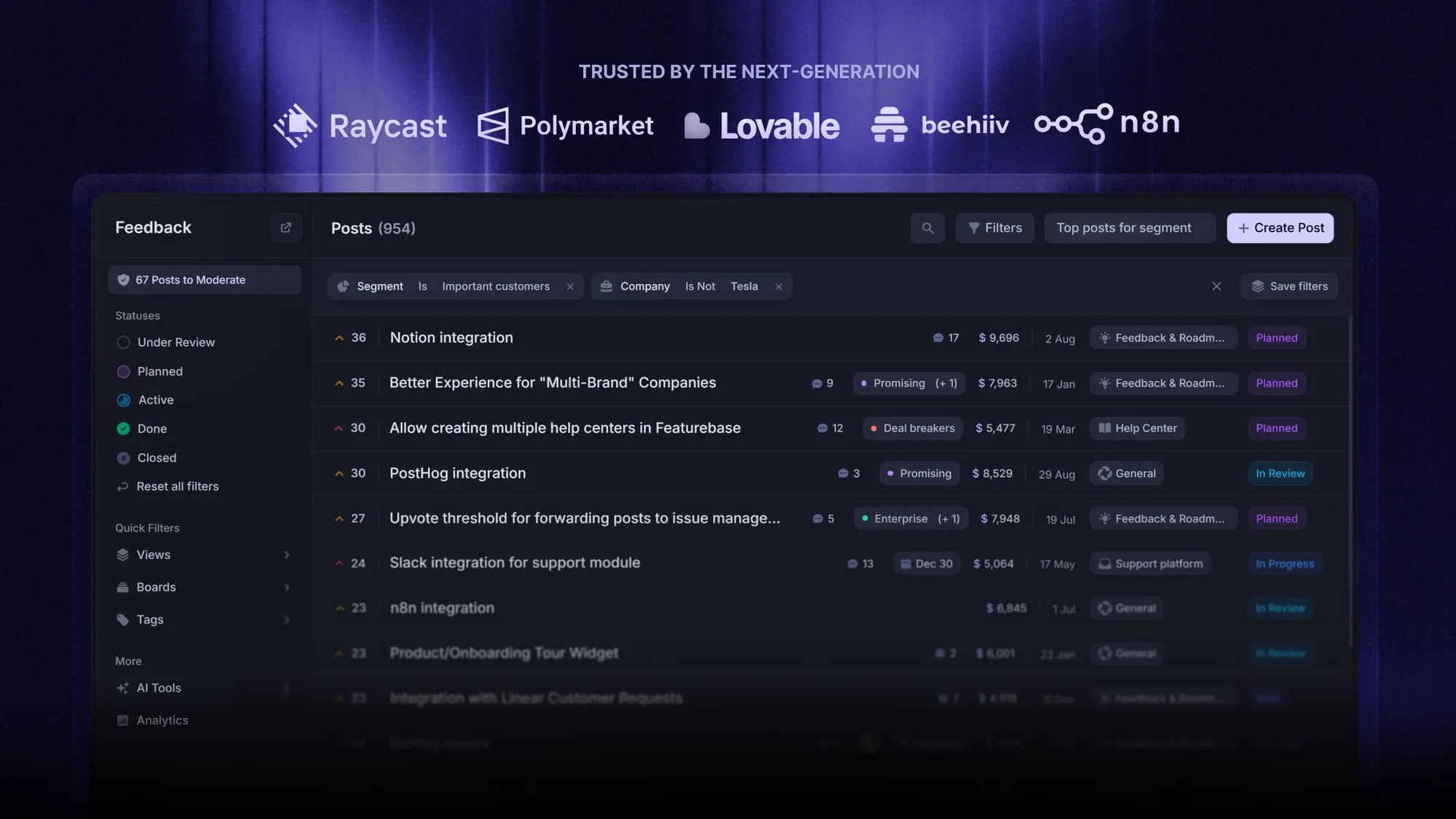
Top features:
- Surveys (NPS, CSAT, etc) – Create targeted no-code surveys to ask users anything and measure customer satisfaction.
- User targeting – Target specific user segments based on properties like plan, role, location, etc.
- Conditional multi-step surveys – Ask follow-up questions based on conditional logic and users' answers
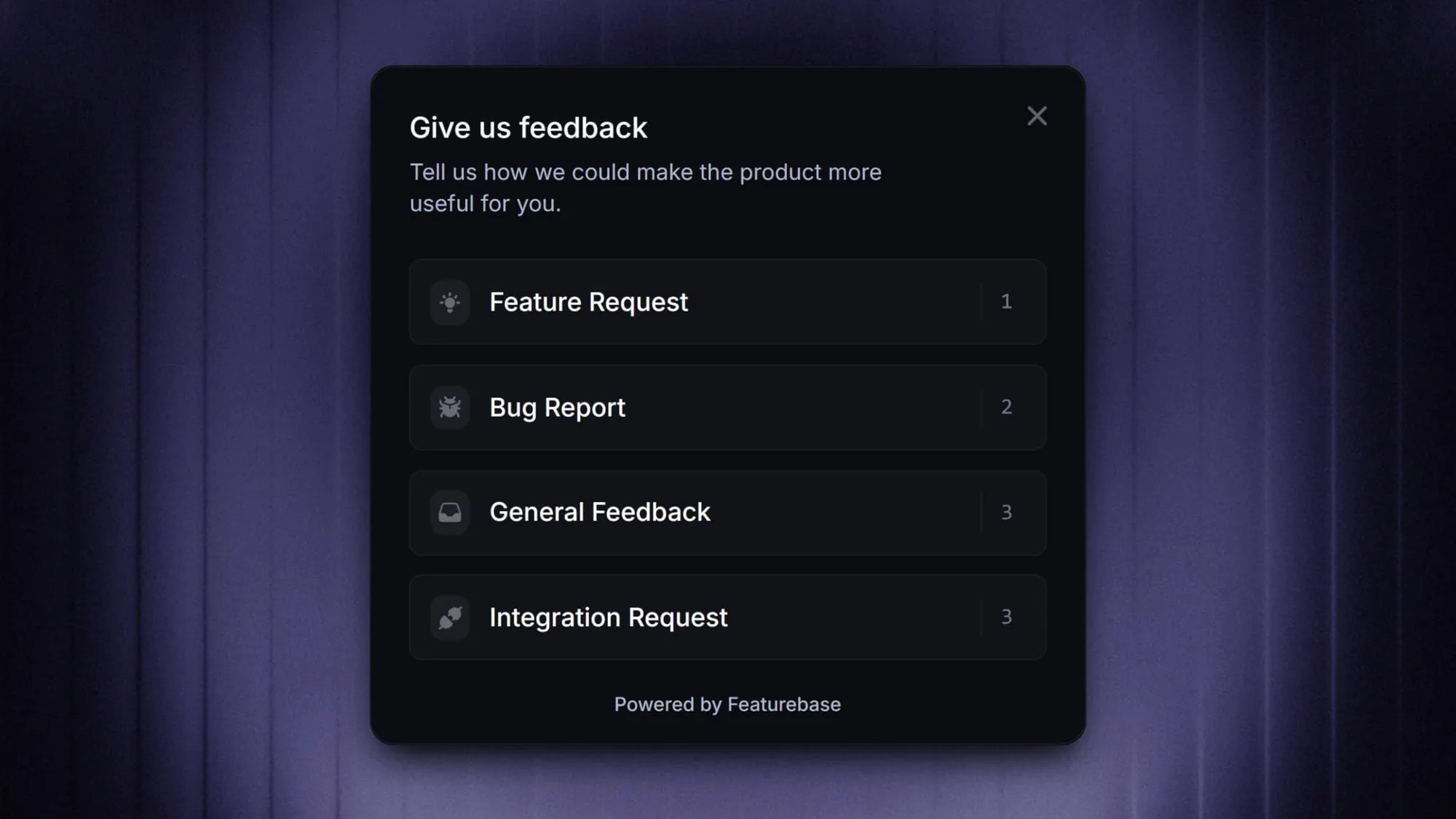
- In-app widgets – Collect ideas, bug reports, and suggestions directly from your website or webapp with interactive widgets
- Feedback forum – Public feedback forum where users can submit ideas and vote on features helping you know what customers want
- Prioritize by revenue – Link feedback with customer revenue, company size, and much more to better understand the impact of ideas
- Integrations – Connects with Slack, Linear, Jira, HubSpot, and more
- Plus, help center, product roadmaps, release notes, and customer surveys – all in one place
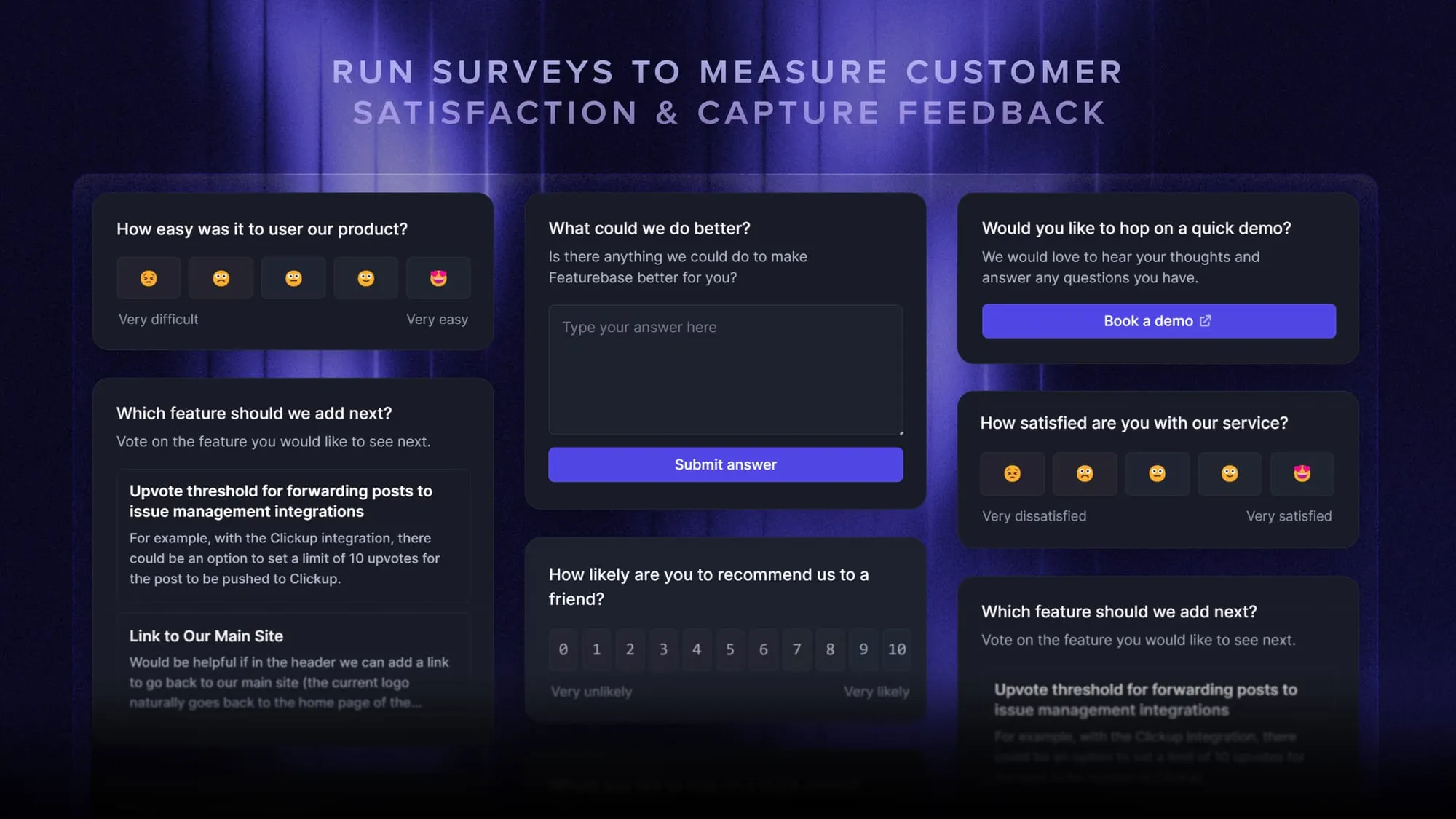
Pricing: Free plan available for feedback collection. Surveys are included from the Growth plan at $29/seat/month, billed yearly.
Instead of having 4+ different tools, Featurebase enables you to replace all your customer-facing tools by bringing your feedback collection, product updates, support, and help center together in one place, helping you build products your users love.
Explore Featurebase's surveys and feedback tools as a Qualtrics alternative
FAQs about Qualtrics pricing
Qualtrics offers both free and paid options. The Free account has 500 total responses, 3 active surveys, and 30 questions per survey, while paid plans unlock additional research capabilities. A free account is different from the temporary trial of premium features.
The online Strategic Research plan is advertised at $420/month, but you pay $5,040 annually upfront. It is not a month-to-month subscription. Payment terms for custom contracts need to be confirmed with sales.
The trial lasts 30 days. If you don't upgrade, your account automatically moves to the Free plan, and you lose access to premium features. You retain access to your surveys and responses.
Qualtrics directs self-service buyers who need more than 1,000 responses to its sales team. It advertises a higher-volume Strategic Research option with 5,000+ responses, but does not publish a flat price for it. Confirm your allowance and how extra usage is handled before launching a larger study.
Some universities provide Qualtrics access through an institutional license. Check with your university before buying a personal subscription, because access and available features depend on its agreement. An institutional account is separate from assuming every student gets premium access for free.
It can be if you need research methods such as conjoint or MaxDiff and the included response allowance suits your studies. For simpler surveys, compare the annual commitment with the features you'll use, and consider our SurveyMonkey vs Qualtrics comparison. For ongoing SaaS feedback, Featurebase combines surveys on paid plans with feedback boards, roadmaps, and product updates.


