Blog Customer ServiceRetail Chatbots: Benefits, Use Cases, and Examples
Retail Chatbots: Benefits, Use Cases, and Examples
A practical guide to retail chatbots: what they are, the main types, the highest-value use cases, real brand examples, and how to roll one out.


Shoppers expect instant help, day or night, and most won't wait around for a reply. A retail chatbot meets that demand by answering questions, recommending products, and tracking orders in real time, across your website, app, and messaging channels.
Done well, it lifts sales and cuts support costs at the same time. In this guide, I'll break down what retail chatbots are, the types available, the use cases that actually move the needle, real brand examples, and how to choose one. 👇
Key takeaways:
- A retail chatbot is an automated assistant that talks with shoppers in real time to answer questions, recommend products, and help complete purchases.
- The 4 main types are rule-based, AI-powered, hybrid, and AI agents, ranging from fixed scripts to systems that take action on their own.
- The highest-value use cases span the whole journey: product discovery, recommendations, order tracking, returns, FAQs, and in-store support.
- The payoff is real: lower support costs, faster responses, 24/7 availability, and higher conversion from guided shopping.
- Success comes down to clear goals, smooth human handoff, deep integrations, and regular training, not just switching a bot on.
- Featurebase✨ brings AI-powered support, a help center, and feedback tools together so retail teams can automate customer conversations without juggling 5 separate tools.
What is a retail chatbot?
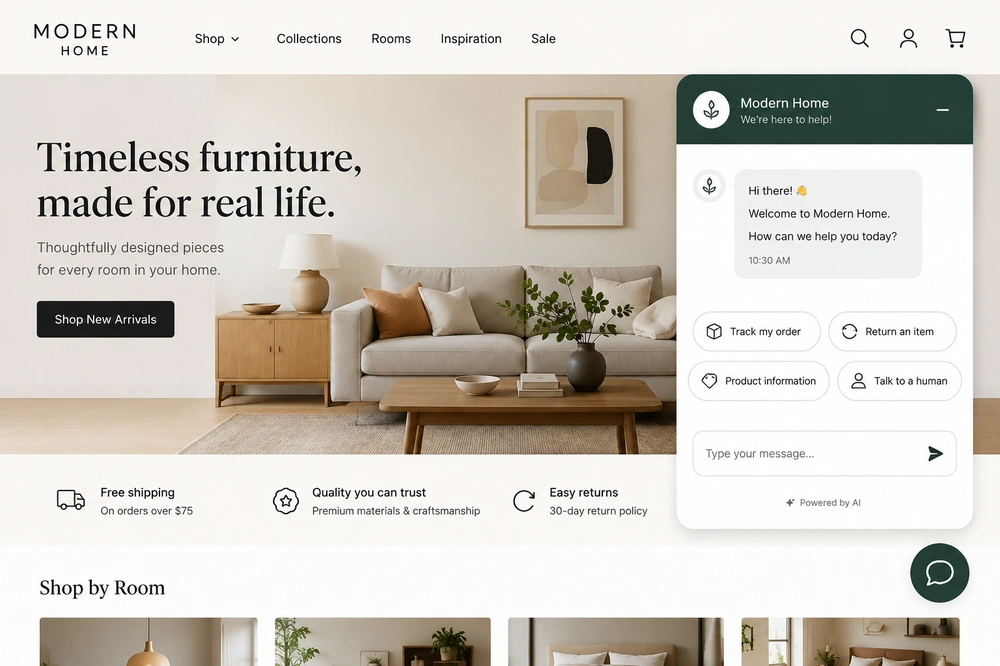
A retail chatbot is software that talks with shoppers through text or voice to help them along the buying journey. It lives on your website, mobile app, or messaging platforms like WhatsApp and Messenger, and handles everything from "Where's my order?" to "Do you have this in medium?"
The appeal is simple. Instead of digging through an FAQ page or waiting on hold, a customer types a question and gets an instant, accurate answer. That convenience is something shoppers actively want: in a global Statista survey, 44% of consumers said they appreciate chatbots' help finding product information before they buy.
Modern bots go well beyond scripted replies. The best customer-service chatbot software can recommend products from browsing history, guide a shopper through checkout, and resolve returns without a human agent ever stepping in.
Types of retail chatbots
Not every retail chatbot works the same way. Picking the right one starts with understanding the 4 main types and what each is good at:
- Rule-based chatbots: These follow predefined scripts and decision trees, so they shine at predictable tasks like sharing store hours, return policies, or order status. They're quick to deploy and reliable, but they can't handle questions outside their rules.
- AI-powered chatbots: These use natural language processing and machine learning to understand intent, tone, and context. They answer free-form questions, personalize recommendations, and improve over time, which makes them ideal for self-service support and nuanced conversations.
- Hybrid chatbots: These blend rule-based structure with AI flexibility, handling routine flows with scripts while leaning on AI for the messier questions. Most retailers end up here because it balances control with scale.
- AI agents: The newest category, these act on their own initiative, completing tasks like placing orders, processing returns, or updating accounts across systems rather than just answering. They guide shoppers toward a decision instead of waiting to be asked.
In practice, the strongest setups mix a few of these so the bot can deflect simple queries and still handle complex ones gracefully.
8 retail chatbot use cases across the shopping journey
A retail chatbot earns its keep when it shows up at the right moments, from first browse to post-purchase. Here are the 8 use cases that deliver the most value:
- Product discovery: The bot asks a few questions ("What's your skin type?") and narrows a huge catalog down to a handful of relevant options, acting like a digital personal shopper.
- Personalized recommendations: By drawing on browsing and purchase history, the chatbot surfaces "you may also like" items and bundles in the moment, which lifts average order value.
- Order tracking: Shoppers drop an order number and get carrier status, predicted arrival, and delay alerts instantly, removing one of the most common reasons people contact support.
- Returns and exchanges: The bot verifies order details, generates a return label, and processes refunds or store credit, turning a painful task into a quick chat.
- FAQs around the clock: A FAQ chatbot answers repetitive questions about shipping, sizing, and warranties 24/7, so your team isn't buried in the same tickets every day.
- Lead capture and notifications: Chatbots can qualify leads, collect emails for back-in-stock alerts, and send personalized offers right inside the conversation.
- In-store and omnichannel support: SMS bots and in-app chat help shoppers locate items, check stock at a nearby store, or start a buy-online-pickup-in-store flow, bridging digital and physical.
- Feedback collection: After a chat or purchase, the bot can run a quick CSAT survey or collect customer feedback, giving you a steady read on what's working and what isn't.
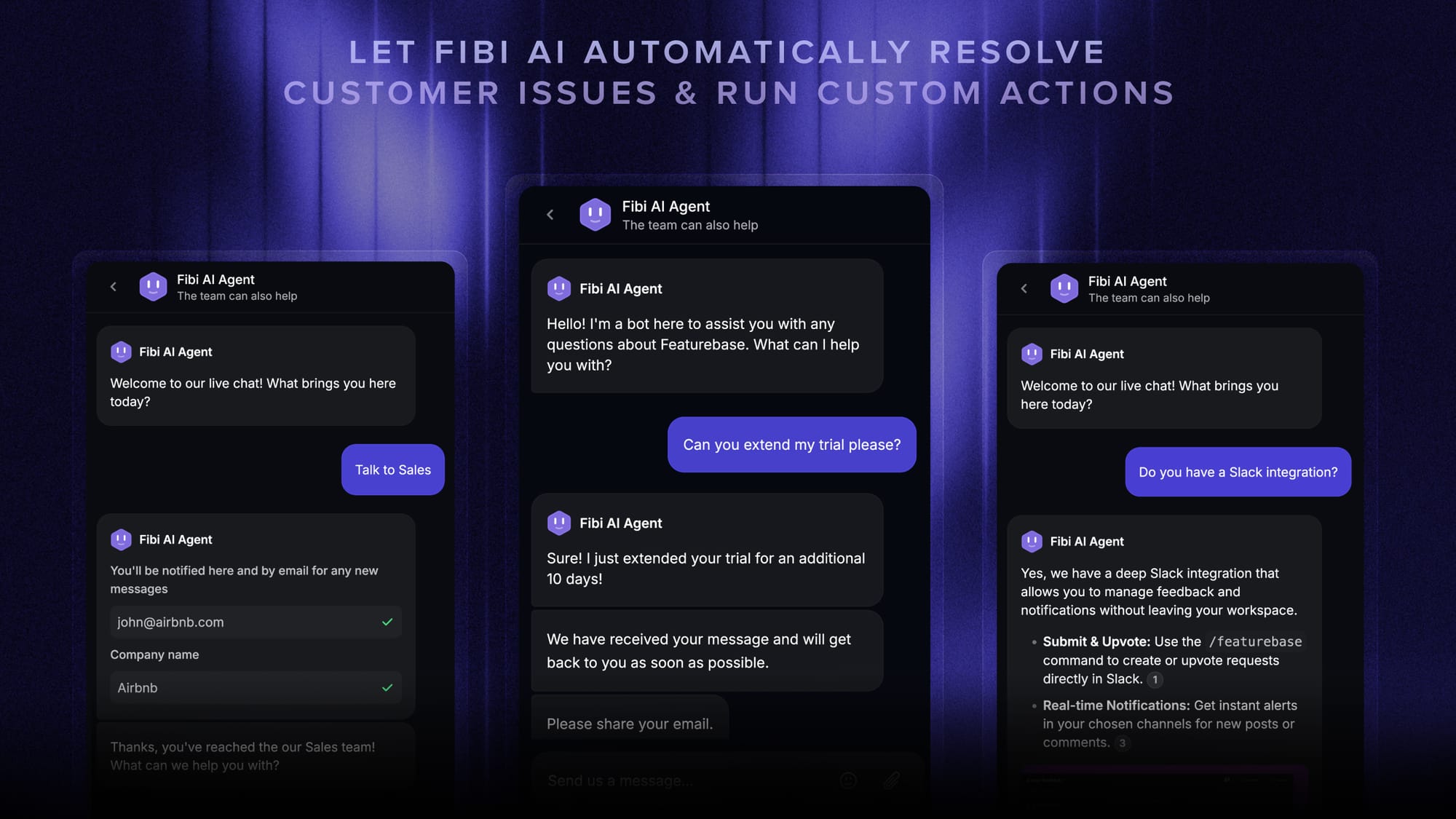
This is also where an AI support layer pays off. With Featurebase, the Fibi AI Agent and omnichannel inbox resolve common retail questions like order status and returns across live chat, email, and Slack, then hand off to a human agent with full context when a conversation needs a personal touch.
The benefits of retail chatbots
The use cases are nice, but the business case is what gets a chatbot approved. Here's what retailers actually gain:
- Lower support costs: Bots handle thousands of routine queries at once, so you scale service without scaling headcount. IBM found that conversational AI cuts cost-per-contact by 23.5% while lifting revenue around 4%.
- 24/7 availability: Whether it's midnight or a holiday weekend, customers get help immediately, which keeps shoppers engaged long after your team logs off.
- Faster responses: Instant answers reduce bounce rates on product pages and shorten time to resolution, both of which protect sales you'd otherwise lose to friction.
- Higher conversion: By answering objections and recommending products in real time, chatbots reduce cart abandonment and nudge shoppers toward checkout.
- Consistent, accurate information: Bots don't misremember a return window or forget a policy, so customers get the same trustworthy answer on every channel.
The upside is only growing. McKinsey estimates that generative AI could add up to $310 billion in value for the retail industry, much of it through customer-service automation and personalized selling.
Retail chatbot examples from real brands
Plenty of well-known retailers already lean on chatbots, and their setups are a useful blueprint:
- Sephora: Uses conversational bots to book in-store appointments and serve personalized beauty advice and product recommendations.
- Starbucks: Pairs its chatbot with mobile ordering so customers can place and customize orders by voice or text, cutting wait times.
- Walmart: Runs AI assistants that handle customer inquiries, track orders, and guide shoppers through support, including its agentic assistant that can build out a cart for a task.
- Nike: Uses chatbots to power loyalty and marketing, offering exclusive product drops and personalized promotions through messaging.
- H&M: Built a style-advice bot that asks about preferences and recommends outfits, mimicking the help of an in-store associate.
The common thread is that each bot is tied to real data, whether that's inventory, loyalty status, or order history, which is what makes the conversations feel useful instead of generic.
How to choose and roll out a retail chatbot
A chatbot only delivers if it's deployed with a plan. These are the practices that separate a helpful bot from a frustrating one:
- Start with clear goals: Decide what the bot should achieve first, whether that's deflecting tickets, recovering carts, or driving recommendations, and design around those outcomes.
- Integrate across your systems: Connect the bot to your CRM, inventory, and ecommerce platform so it can pull real-time data and give accurate, personalized answers.
- Make human handoff easy: Always offer a clear path to a live agent, and pass the full conversation context so customers never repeat themselves.
- Train it on real data: Use past tickets, chat logs, and current product info to shape responses, and refresh that knowledge as policies and promotions change.
- Go omnichannel: Keep the experience consistent across web, app, SMS, and social so conversations and data flow into one customer profile.
- Monitor and optimize: Track deflection rate, resolution time, conversion, and CSAT, then use well-designed chatbot scripts and ongoing tweaks to improve weak spots.
Get these right and the bot keeps getting better instead of quietly frustrating customers.
Run retail support, feedback, and updates in one place with Featurebase
Featurebase is a modern AI customer support platform for product-led retail and SaaS teams. It combines AI-powered support, a help center, and feedback management into a single platform for teams that want all their customer-facing tools in one place. Featurebase is loved by thousands of support teams from companies like Lovable, Raycast, and n8n. 💫
Top features:
- Omnichannel inbox – Manage live chat, email, and Slack conversations from one AI-powered view
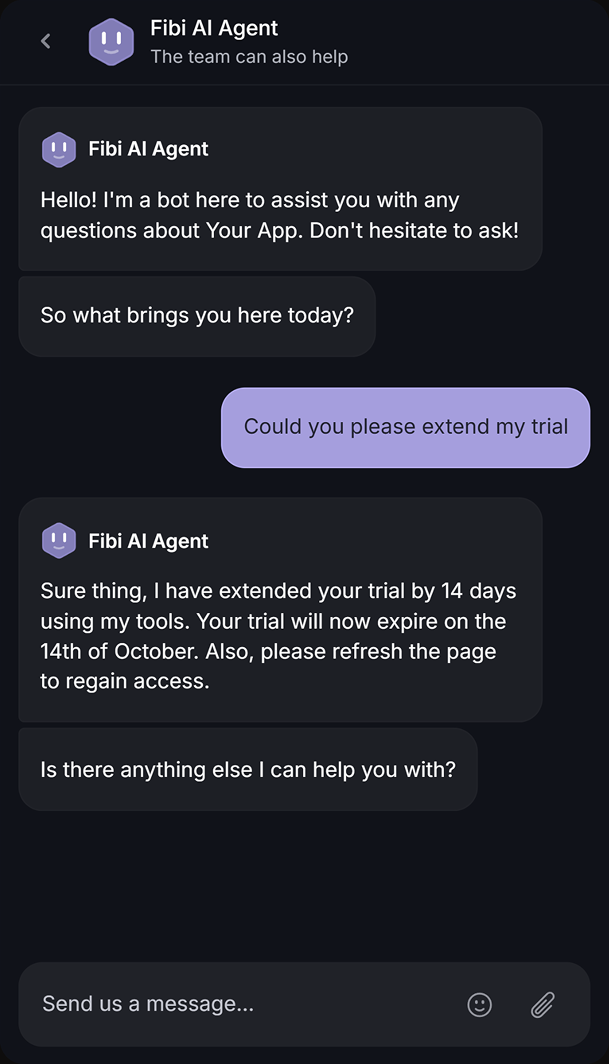
- Fibi AI Agent - Resolve customer issues on autopilot & run custom actions like trial extensions and refunds
- Help center with AI search – Provide instant, multilingual self-serve answers
- Workflows & automations – Auto-assign tickets, route conversations, collect customer data, and more
- AI Copilot – Help your agents answer customers faster with AI Copilot that uses your internal knowledge
- Multi-brand support – Manage multiple Help Centers and Live chats from a single workspace
- Automatic AI translations – Automatically translate all messages and help articles to your customers native language
- Service Level Agreements – Track SLAs to make sure your team responds to customers on time, every time
- Mobile app – Respond to customers, receive notifications, and unblock users on the go
- Feedback & roadmap tools – Collect feature requests and close the loop with updates
- Product updates – Publish release notes with a changelog page, in-app widget, and emails
- Integrations – Connects with Slack, Linear, Jira, HubSpot, and more
Pricing: Free plan available with unlimited conversations. Paid plans start at $29/seat/month with $0.29 per AI resolution.
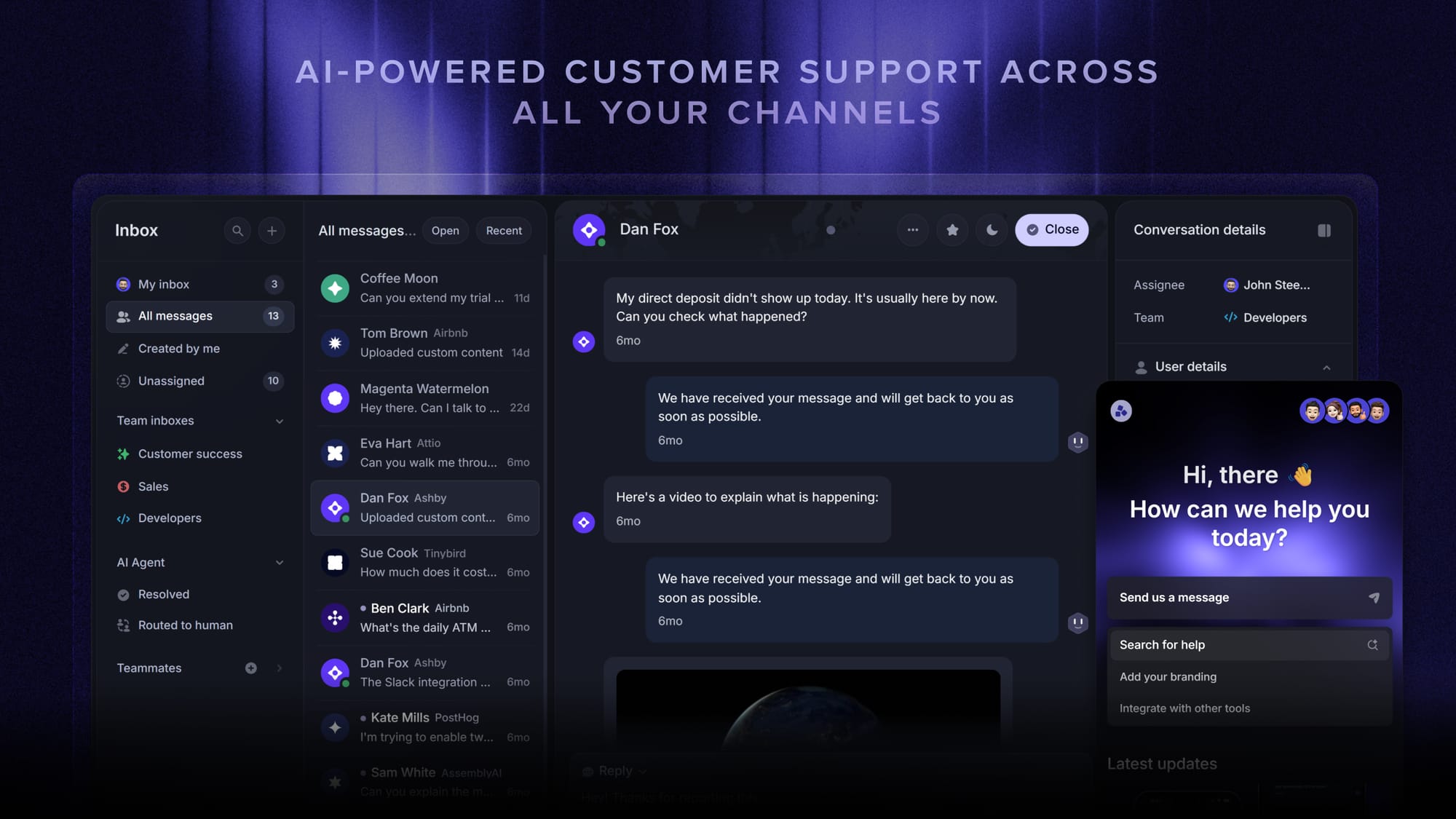
Featurebase covers all the basic support features that legacy platforms do, but with a much more modern approach. It comes with AI automations, a mobile app, and multiple channels (email, live chat, Slack, etc.).
Conclusion
Retail chatbots have moved from novelty to necessity. They meet shoppers instantly, guide them to the right products, and take the repetitive load off your team, all while feeding you the data to keep improving.
Featurebase is a modern AI support platform that brings your live chat, AI agent, help center, and feedback tools together in one place so you can automate retail conversations and still close the loop with customers when it matters. You can pair self-serve answers with a powerful AI agent and an AI-powered knowledge base without stitching together separate tools.
It comes with a Free plan, and the onboarding is quick with no credit card required, so there's no downside to trying it. 👇
✨ Automate your support with the fastest AI-enhanced Inbox today →
FAQs
What is the best chatbot software for retail?
There's no single best option, since the right fit depends on whether you care most about product discovery, support automation, or completing orders in chat. For support-led retail, Featurebase pairs an omnichannel inbox with the Fibi AI Agent and a free plan, while discovery-first teams often look at tools built around catalog search. Match the tool to the job you most need done.
How much does a retail chatbot cost?
Most retail chatbots are sold as SaaS subscriptions, with entry plans ranging from free to roughly $20 to $50 per seat or month, plus usage-based fees like a charge per AI resolution. Custom-built bots cost more upfront because of development, integrations, and ongoing maintenance. Your real cost depends on volume, the number of integrations, and how much AI automation you need.
Can retail chatbots integrate with ecommerce platforms like Shopify?
Yes. Most modern chatbots connect with ecommerce platforms, CRMs, and inventory systems so they can pull live data on products, orders, and stock. Those integrations are what let a bot give accurate order updates, check availability, and complete purchases inside the chat. Always confirm a tool supports your specific stack before committing.
How do you measure the success of a retail chatbot?
Track a mix of service and revenue metrics: customer satisfaction (CSAT), resolution and containment rate, average response time, conversion rate, and average order value. Together these show how many questions the bot handles on its own and whether it actually drives sales. Watching them over time tells you where the bot adds value and where it needs tuning.
Are retail chatbots secure enough to handle payments and customer data?
When built with proper encryption, authentication, and compliance measures like GDPR and CCPA, retail chatbots can securely process payments and protect customer data. The key is choosing a provider with strong security practices and clear data handling policies. Reputable platforms treat security and privacy as core requirements, not afterthoughts.
Do retail chatbots replace human support agents?
No. Chatbots handle routine, high-volume queries and early-stage guidance, which frees your team to focus on complex, sensitive, or high-value conversations. The best setups route those harder cases to a human agent with full context, so nothing falls through the cracks. Think of a chatbot as a force multiplier for your team, not a replacement.