Blog Customer ServiceTidio vs Crisp: Which Live Chat Tool Wins?
Tidio vs Crisp: Which Live Chat Tool Wins?
Tidio vs Crisp comes down to one question: do you want powerful conversational AI, or a flat-priced omnichannel inbox? Here's the honest, category-by-category verdict.


✨Psst... want a modern all-in-one alternative that bundles support, help center, and feedback? Check out Featurebase →
Picking the wrong live chat tool is an expensive mistake. You migrate your team, train your agents, wire up your integrations, and three months later you're hitting a limit or paying for features you'll never use.
Tidio and Crisp both promise to fix your customer conversations, but they solve different problems. One bets everything on AI automation, the other on a unified inbox at a predictable price.
Below I break down how they compare on AI, channels, ease of use, and real cost, so you can pick right the first time. 👇
Key takeaways:
- Tidio is the better pick if you run an e-commerce store and want AI that resolves support and drives sales. Its Lyro AI Agent handles a large share of conversations on its own.
- Crisp is the better pick for small teams that want a simple omnichannel inbox (chat, email, social, WhatsApp) at a flat, predictable price.
- AI: Tidio's Lyro is a true conversational AI agent that resolves questions on its own. Crisp's Hugo has caught up fast - as of July 2026 it takes real actions like applying discounts and updating Shopify addresses, and assists agents on complex cases, though it leans more on setup than Lyro.
- Pricing: Tidio bills by conversation volume, so costs scale with traffic. Crisp charges a flat fee per workspace with seats and AI credits included, which is easy to predict but jumps sharply between tiers.
- Free plan: Tidio's free tier is far more generous than Crisp's 2-seat free plan.
- If you're a product-led SaaS team that wants support, a help center, and feedback collection in one tool instead of two, Featurebase✨ is worth a look.Tidio vs Crisp at a glance
| Tidio | Crisp | |
|---|---|---|
| Best for | E-commerce stores wanting AI-driven support & sales | Small teams wanting a simple omnichannel inbox |
| AI | Lyro AI Agent (conversational, resolves up to ~67% of queries) | Hugo AI agent (action-taking, Copilot for complex cases) + no-code bot builder |
| Channels | Live chat, email, Instagram, Messenger, WhatsApp | Live chat, email, WhatsApp, Instagram, Messenger, Line, Telegram |
| Pricing model | Per billable conversation | Flat per workspace (seats + AI credits included) |
| Free plan | 50 conversations, limited Lyro, multiple seats | 2 seats, basic live chat |
| Starting paid price | $24.17/mo (billed annually) | $45/mo per workspace |
AI & automation
If automation is your priority, this is where the two tools split the most, and it's increasingly what buyers judge AI customer support software on.
Tidio
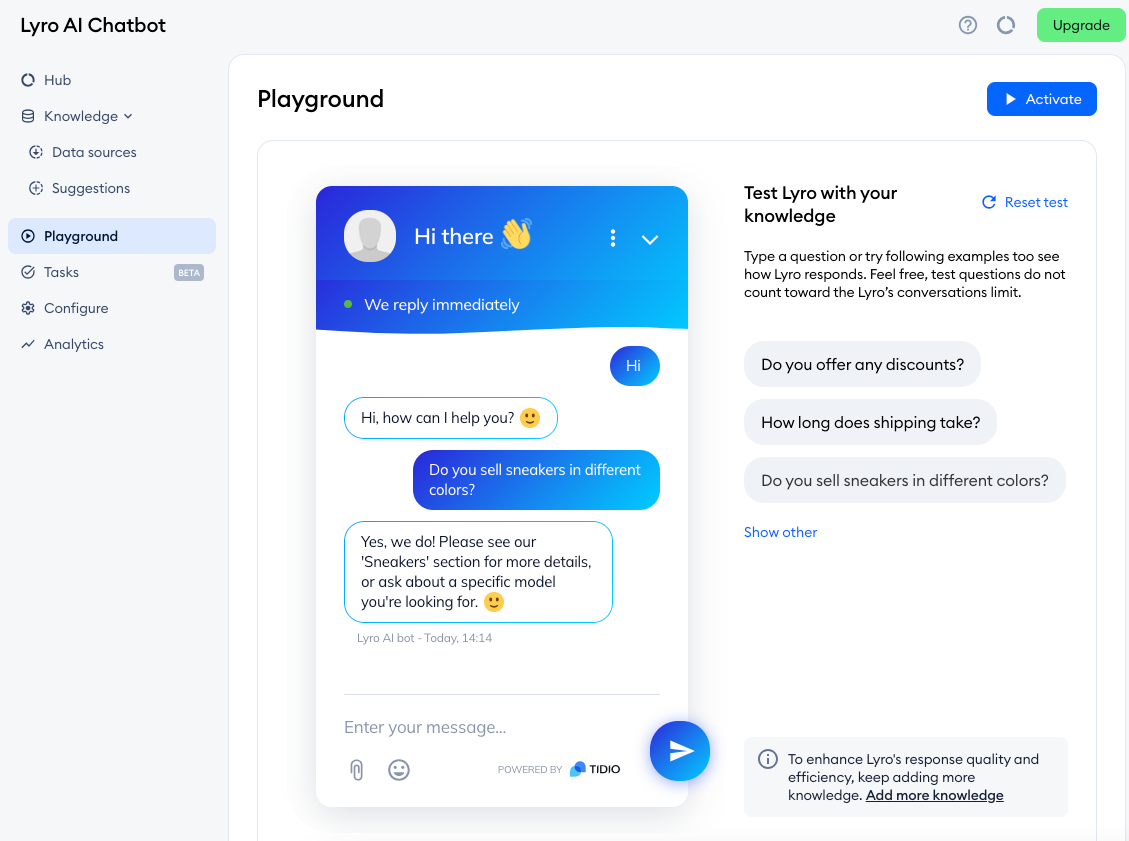
Tidio's headline feature is its Lyro AI Agent, a conversational AI that learns from your website content, FAQs, and uploaded docs to hold natural, human-like conversations. Tidio says it resolves up to 67% of inquiries without a human. On top of Lyro, a visual flow builder lets you design rule-based bots for tasks like recovering abandoned carts, and an AI Copilot suggests replies to live agents.
The catch shows up in real use. On G2, reviewers note that you have to choose either Lyro AI or custom flows for a given conversation, not both at once, and Lyro stops responding once its daily cap is hit. So the automation is powerful, but it's metered.
Crisp
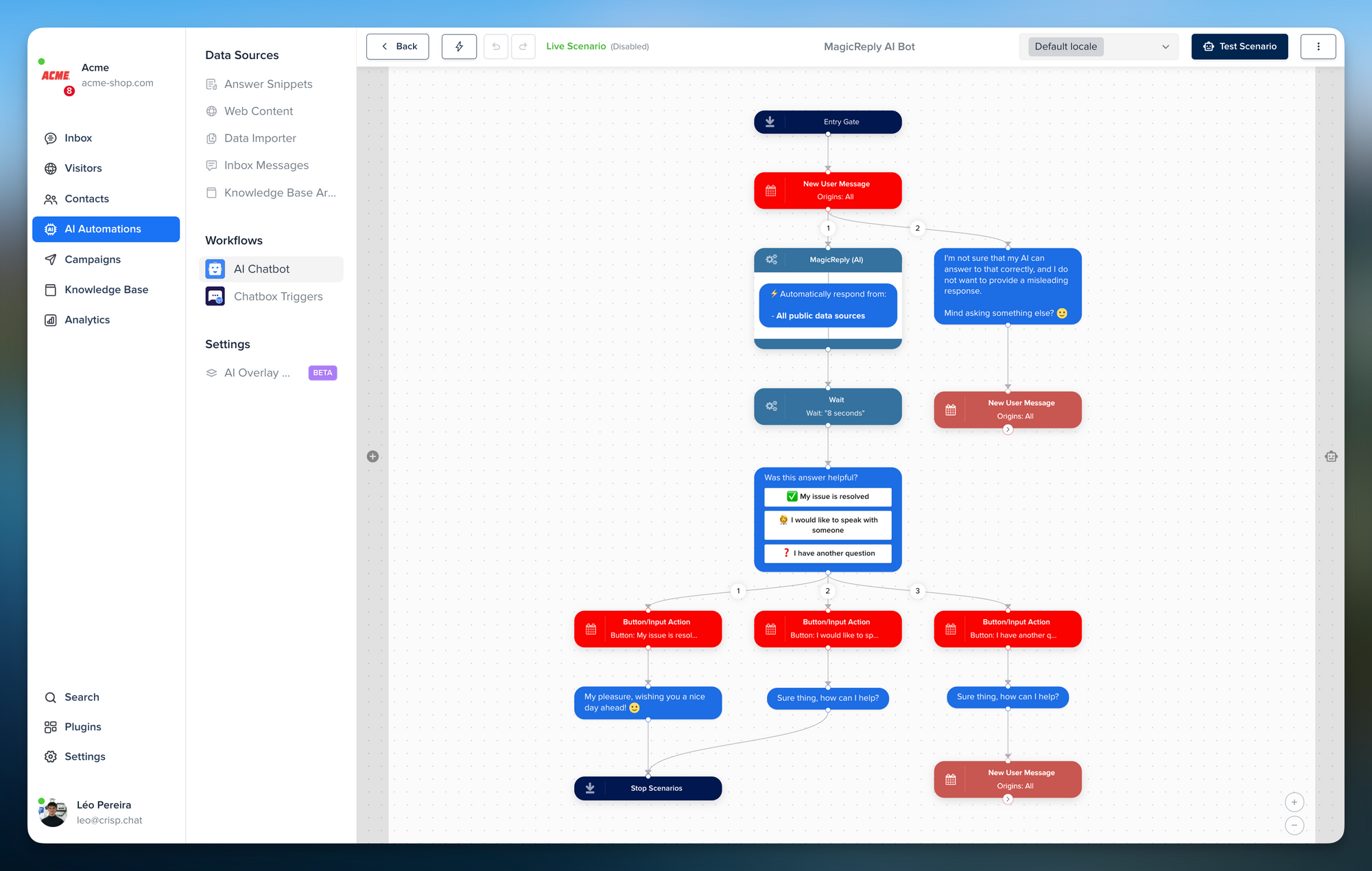
Crisp has moved fast on AI. Its agent, Hugo, is now the centre of the product, and as of July 2026 it does far more than answer FAQs. Hugo Copilot works alongside your team on complex conversations, so from inside the inbox an agent can investigate a request, summarise the thread, draft a reply, review the underlying sources, and prepare a clean handover.
More importantly, Hugo can now take actions, not just talk. With Widget Tools it can trigger things directly on your site, like applying a discount, guiding a user to the right page, or pulling live account data mid-conversation. On Shopify it can even read and update a customer's shipping address without sending them elsewhere.
You also get real control over the automation. You choose which tools Hugo can use, route conversations to specific operators (even offline ones), and send out-of-credit conversations to a workflow instead of dumping them straight on an agent. Crisp still offers its no-code bot builder for structured flows like booking meetings or qualifying leads, plus MagicReply and real-time translation to help agents move faster.
The one catch: G2 reviewers still describe Crisp's AI as more setup-heavy than a plug-and-play agent, and review sentiment lags the recent releases. But the gap in raw capability has narrowed sharply. If you're weighing Crisp against pricier incumbents, our Crisp vs Intercom comparison goes deeper.
Winner: Tidio, but barely Lyro is still the most hands-off option for autonomous resolution out of the box. But Crisp has closed the gap fast - Hugo now takes real actions and handles complex cases, so if action-taking AI with tight human control matters more to you than plug-and-play setup, Crisp is very much in the race.
For context on where this whole category is heading, our guide to conversational customer service covers how AI agents are reshaping support.
Channels & integrations
A live chat tool is only useful if it plugs into the rest of your stack and the channels your customers actually use.
Tidio
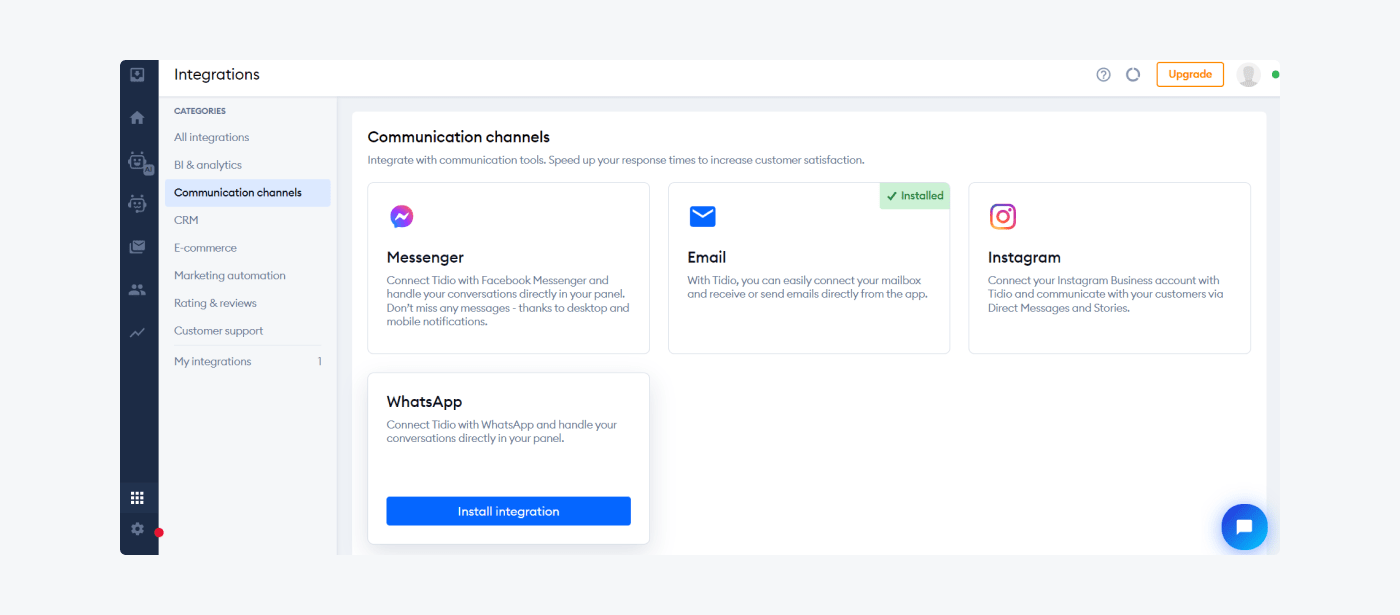
Tidio consistently scores well for setup simplicity. G2 reviewers say it takes minutes to get running, and teams can start handling chat, email, and social from a shared inbox quickly. Automatic chat assignment, internal @mentions, and real-time notifications keep agents in sync.
The friction point reviewers mention is that you can't view all projects or conversations in one unified dashboard, which gets annoying once you manage multiple sites.
Crisp
Crisp gives agents a robust day-to-day environment: automatic routing to departments, private notes for collaboration, and a widget that converts into a lead form when the team is offline. Reviewers praise the chat interface as intuitive and responsive.
But G2 feedback flags two recurring issues: a learning curve on the broader feature set, and unreliable notifications that can cause missed conversations. Some users also find the mobile app thinner than the web version.
Winner: Tidio (slightly) Both are pleasant to use. Tidio edges ahead on first-run simplicity, while Crisp packs more features behind a steeper learning curve.
Pricing & value
This is where most decisions are actually made, and the two tools use completely different models.
Tidio
Tidio bills by billable conversations, not by seat. That makes the free plan generous and the entry price low, but your cost grows with your traffic.
| Plan | Price | What you get |
|---|---|---|
| Free | $0 | 50 live chat conversations, 50 one-off Lyro chats |
| Starter | $24.17/mo* | 100 billable conversations, live chat & ticketing |
| Growth | From $49.17/mo* | From 250 conversations, automation, advanced analytics |
| Plus | From $300/mo + usage | Custom volume, departments, multi-project, CSM |
| Premium | Custom | High-volume Lyro, guaranteed resolution rate, SSO |
*Billed annually, as of July 2026. Lyro AI conversations are priced separately on top of the plan.
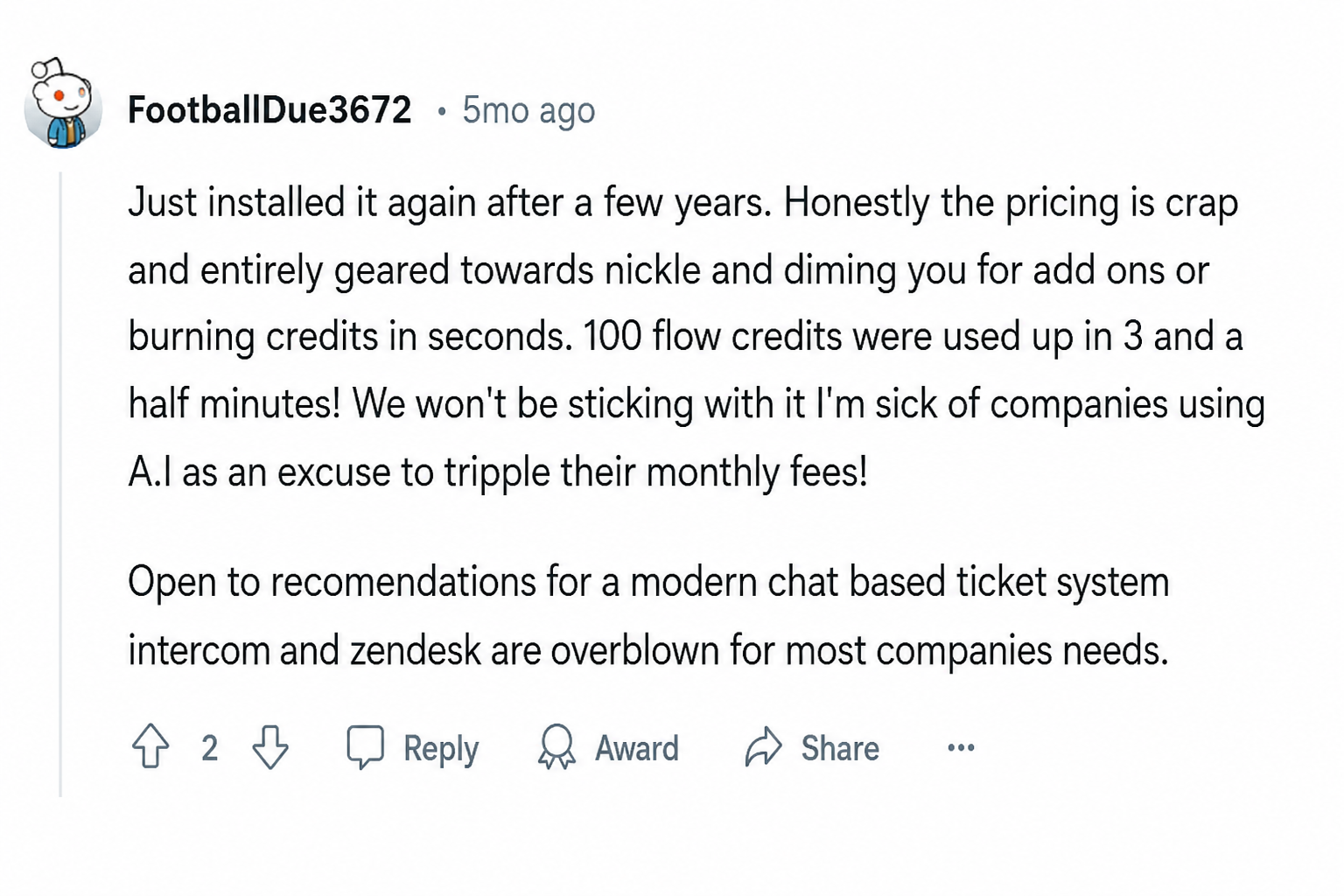
The most common Tidio complaint, by far, is hitting conversation limits sooner than expected and being pushed to upgrade. For a high-traffic site, the per-conversation model can get expensive fast.
Crisp
Crisp uses a flat per-workspace model. As of July 2026, you pay one price per workspace with a set number of seats and AI credits included, rather than paying per seat or per conversation. That makes budgeting predictable, but the jumps between tiers are steep and AI usage is capped by the credits in your plan.
| Plan | Price | What you get |
|---|---|---|
| Free | $0 | 2 seats, basic live chat, shared inbox |
| Mini | $45/mo per workspace | 4 seats, shared email inbox, shortcuts, ~90 AI-automated conversations |
| Essentials | $95/mo per workspace | 10 seats, omnichannel inbox, AI chatbot, workflow builder, knowledge base, ~450 AI conversations |
| Plus | $295/mo per workspace | 20+ seats, full AI-first suite, ticketing, 100+ integrations, white-label, ~1,350 AI conversations |
Extra seats on Plus are $10/mo each. Crisp bundles AI usage as credits rather than billing per conversation, and conversations themselves are unlimited.
The recurring G2 gripe is cost confusion and steep jumps between tiers, plus no multi-site discount on lower plans, which makes Crisp pricey for agencies managing several workspaces.
Winner: Depends on your traffic Low volume or a tiny team? Tidio's free and Starter plans win. Steady volume on one workspace with a growing team? Crisp's flat per-workspace pricing gets more predictable as you add agents.
What users complain about
No tool is perfect. Here's what real reviewers flag most often, so you go in with clear eyes.
Tidio
- Conversation limits: The per-conversation billing means you can hit your cap mid-month and get pushed to upgrade sooner than planned.
- No unified dashboard: You can't see all projects or conversations in a single view, which hurts multi-site teams.
- Limited CRM depth: Native CRM and marketing integrations are thin, so you lean on Zapier.
- AI is metered: You pick Lyro or custom flows per conversation, and Lyro pauses once its daily cap is reached.
Crisp
- AI takes setup: Reviewers find Crisp's automation more setup-heavy than a plug-and-play agent, though the July 2026 Hugo release (action-taking Copilot, autonomous agent) has narrowed that gap and sentiment is catching up.
- Pricing confusion: Steep jumps between tiers and no multi-site discount on lower plans draw repeated complaints.
- Notification reliability: Some users report missed conversations from unreliable alerts.
- Scales poorly past mid-size: Satisfaction tends to dip as teams grow past 50 to 150 people.
Looking beyond Tidio and Crisp: Try Featurebase
Here's the thing both tools have in common: they're live chat first, everything else second. If you're a product-led SaaS team, support is only half the job. You also need a help center, a way to collect and act on feedback, and a place to announce what you shipped. Stitching that together across Tidio or Crisp plus a few other tools is exactly the sprawl you're trying to avoid. 🤔
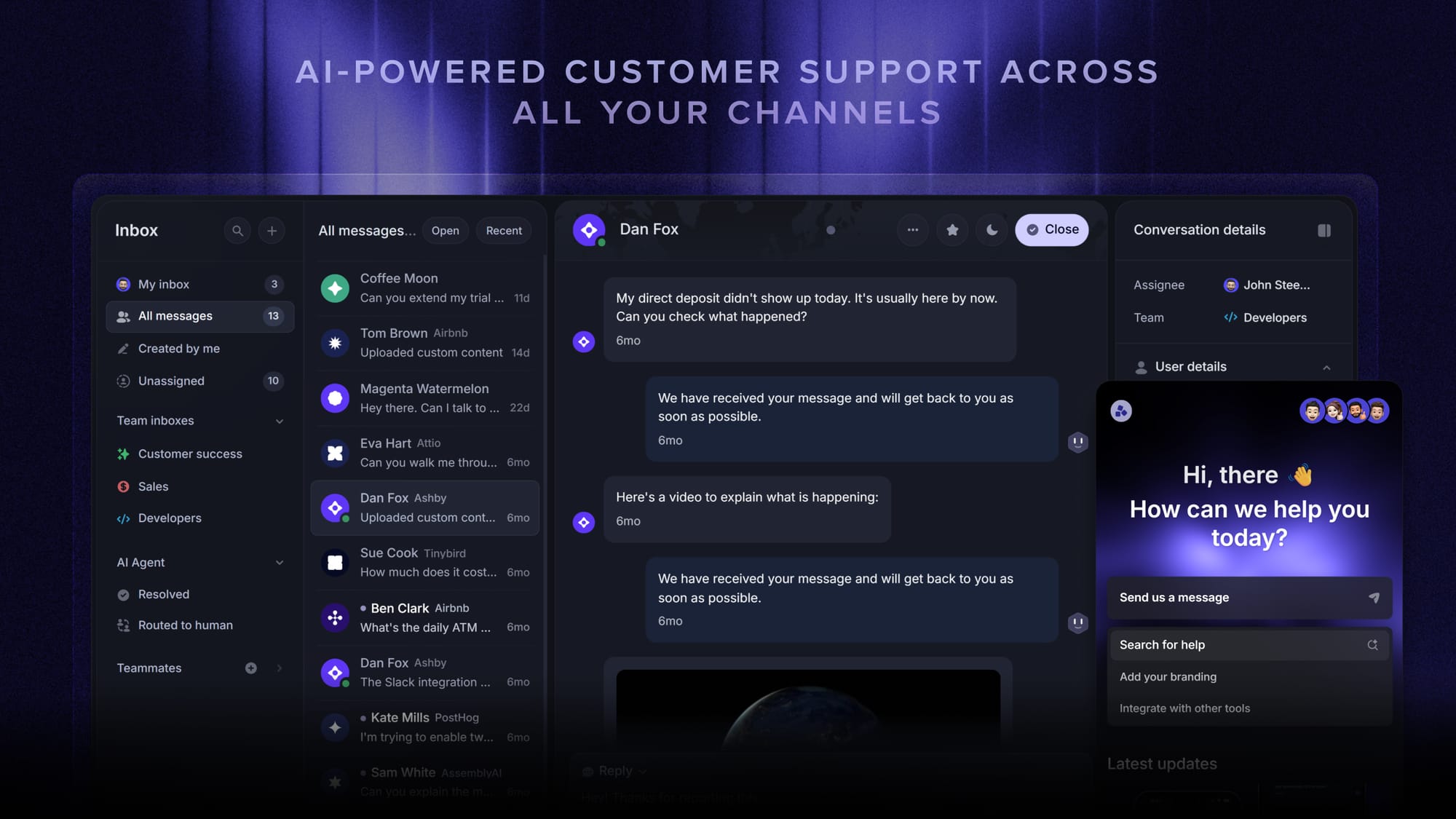
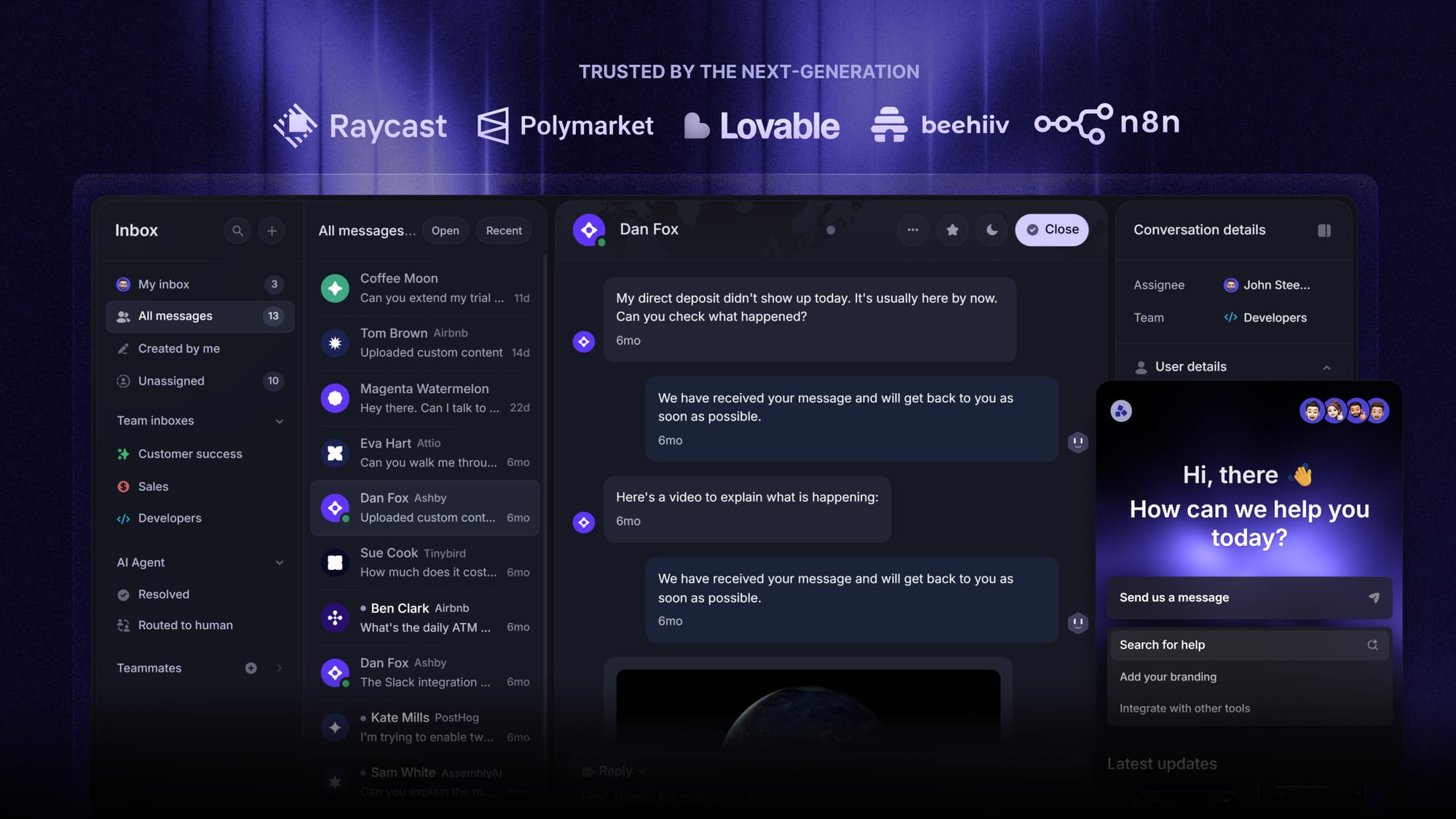
Featurebase is a modern AI customer support platform for product-led SaaS. It combines AI-powered support, help center, and feedback management into a single platform for startups that want all their customer-facing tools in one place. Featurebase is loved by thousands of support teams from companies like Lovable, Raycast, and n8n. 💫
Top features:
- Omnichannel inbox – Manage live chat, email, and Slack conversations from one AI-powered view
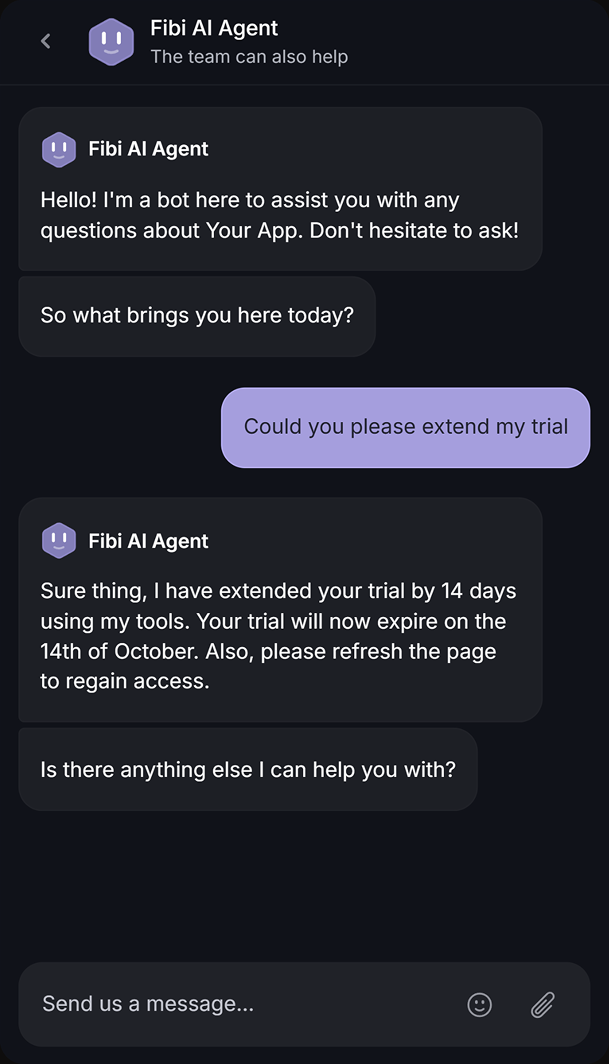
- Fibi AI Agent - Resolve customer issues on autopilot & run custom actions like trial extensions and refunds
- Help center with AI search – Provide instant, multilingual self-serve answers
- Workflows & automations – Auto-assign tickets, route conversations, collect customer data, and more
- AI Copilot – Help your agents answer customers faster with AI Copilot that uses your internal knowledge
- Multi-brand support – Manage multiple Help Centers and Live chats from a single workspace
- Automatic AI translations – Automatically translate all messages and help articles to your customers native language
- Service Level Agreements – Track SLAs to make sure your team responds to customers on time, every time
- Mobile app – Respond to customers, receive notifications, and unblock users on the go
- Feedback & roadmap tools – Collect feature requests and close the loop with updates
- Product updates – Publish release notes with a changelog page, in-app widget, and emails
- Integrations – Connects with Slack, Linear, Jira, HubSpot, and more
Pricing: Free plan available with unlimited conversations. Paid plans start at $29/seat/month with $0.29 per AI resolution.
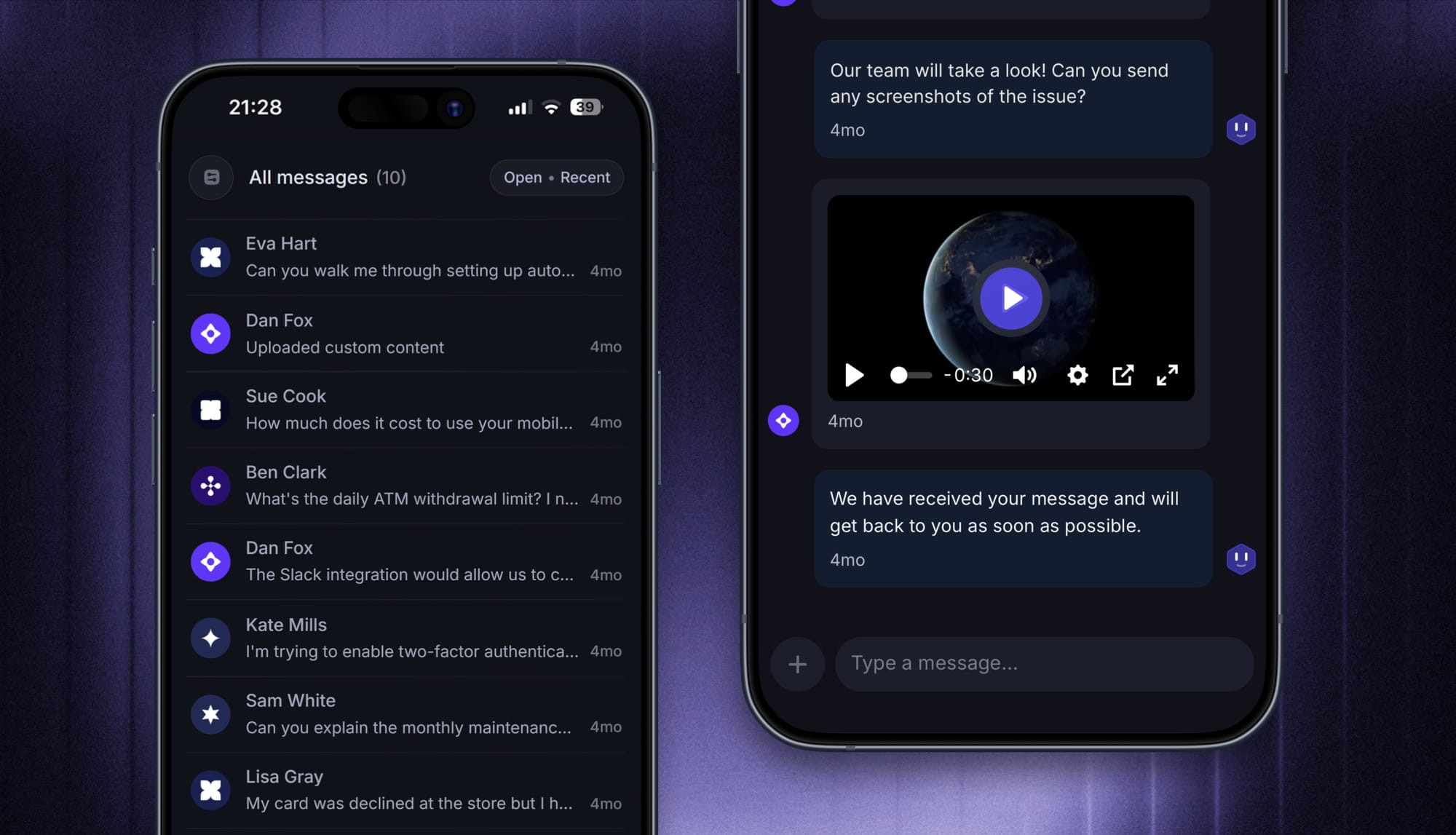
Featurebase covers all the basic support features that legacy platforms do, but with a much more modern approach. It comes with AI automations, a mobile app, and multiple channels (email, live chat, Slack, etc.).
Conclusion
Tidio vs Crisp really comes down to one trade-off: Tidio for advanced conversational AI and e-commerce depth, Crisp for a broad omnichannel inbox at a flat, predictable price. Run a Shopify store and want AI to carry the load? Go Tidio. Small team juggling chats across six messaging apps on a tight budget? Go Crisp. Either way, test both before you commit.
But if you're a SaaS team, the better question might be whether a chat widget alone is enough. Featurebase brings AI-powered support, a help center, feedback collection, and product updates into one platform, so you can replace the chat tool and the other tools bolted around it.
It comes with a Free plan and onboarding takes minutes, so there's no downside to trying it. 👇
✨Automate your support with the fastest AI-enhanced Inbox today → Try Featurebase free
FAQs
Is Tidio or Crisp better for AI chatbots?
Both are strong now. Tidio's Lyro AI Agent still leads for hands-off conversational resolution, holding natural multi-turn chats and closing a high share of inquiries on its own. Crisp's Hugo has caught up quickly, and as of July 2026 it can take real actions like applying discounts or updating a Shopify address, while its Copilot helps agents handle complex cases. If you want the most autonomous AI out of the box, Tidio still edges it. If you want action-taking AI with tighter human control, Crisp is now a real contender.
Which is cheaper, Tidio or Crisp?
It depends on your size and traffic. Tidio bills by conversation volume, so it's cheaper for low-traffic sites and small teams but climbs with usage. Crisp charges a flat fee per workspace with seats and AI credits included, which is more predictable but can cost more for agencies running several sites.
Does Tidio or Crisp have a better free plan?
Tidio's free plan is more generous. It includes 50 live chat conversations, a taste of Lyro AI, and multiple agent seats. Crisp's free plan is limited to 2 seats and basic live chat, which suits solo founders more than growing teams.
Is Tidio or Crisp better for Shopify and e-commerce?
Tidio is the stronger e-commerce choice. It offers deep, native integrations with Shopify, WooCommerce, and Wix that enable store-specific automation like cart recovery and order lookups. Crisp connects to e-commerce platforms too, and its Hugo agent can now read and update Shopify shipping addresses, but it lacks Tidio's native depth.
What's the main difference between Tidio and Crisp?
Tidio is an AI-first tool built for e-commerce support and sales automation, billed by conversation. Crisp is an omnichannel inbox built to consolidate chat, email, and social messaging at a flat per-workspace price. One optimizes for automation, the other for channel breadth.
Is there a better alternative to Tidio and Crisp?
It depends on what you need beyond live chat. Product-led SaaS teams often want support, a help center, and feedback collection in one place rather than a standalone chat widget. Featurebase combines an AI-powered support inbox, knowledge base, feedback forum, and product updates in a single platform, which removes the need to bolt several tools together.