Blog Customer FeedbackGood Survey Questions: Examples, Types, and Expert Tips
Good Survey Questions: Examples, Types, and Expert Tips
Good survey questions are clear, unbiased, and built around a decision you need to make. Here are the types, 45+ examples by goal, and the mistakes to avoid.


✨ Start running surveys & collecting feedback with Featurebase for free →
Most surveys don't fail because too few people answer. They fail because the questions were never going to produce a usable answer in the first place.
A good survey question is clear, neutral, asks one thing at a time, and ties back to a decision you actually need to make. Get that right and even a short survey gives you something to act on.
In this guide, I'll cover what makes a question good, the main question types, 45+ ready-to-use examples grouped by goal, the mistakes that quietly wreck your data, and how to get more people to finish. 👇
Key takeaways
- A good survey question is clear, neutral, and focused on one thing, and every question should map back to a decision you need to make.
- The main question types are open-ended, closed-ended, multiple choice, Likert scale, rating scale (including NPS), and yes/no. Most good surveys mix a few.
- Start with your goal, then write questions backward from it. If you won't act on an answer, cut the question.
- The most common data-killers are leading questions, double-barreled questions, loaded wording, and unbalanced scales.
- Shorter surveys finish better. Completion drops fast once you push past 10 to 15 questions.
- Featurebase✨ lets you run targeted in-app NPS and CSAT surveys with conditional follow-ups, then turn the answers into a real feedback loop.
What makes a good survey question?
A good survey question does one job well: it gives you an answer you can trust and use. That comes down to a few traits that show up in almost every survey-design guide worth reading.
- Clear: The respondent understands exactly what you're asking on the first read, with no jargon and no room for interpretation. "How easy was it to use our product?" beats "How would you rate the UX?"
- Neutral: The wording doesn't nudge people toward a particular answer. "How satisfied are you with our product?" is neutral. "How much do you love our product?" is not.
- Focused: Each question asks about one thing only. The moment you ask about two things at once, you can't tell which one the answer refers to.
- Purposeful: Every question maps back to a decision you need to make. If you don't know what you'd do differently based on the answer, the question doesn't belong in the survey.
That last point is the one most people skip. Before you write a single question, write your goal in one sentence: learn why customers aren't activating a feature, measure satisfaction after a key workflow, or find out which product area to build next. Then only ask questions that serve that goal.
The main types of survey questions (with examples)
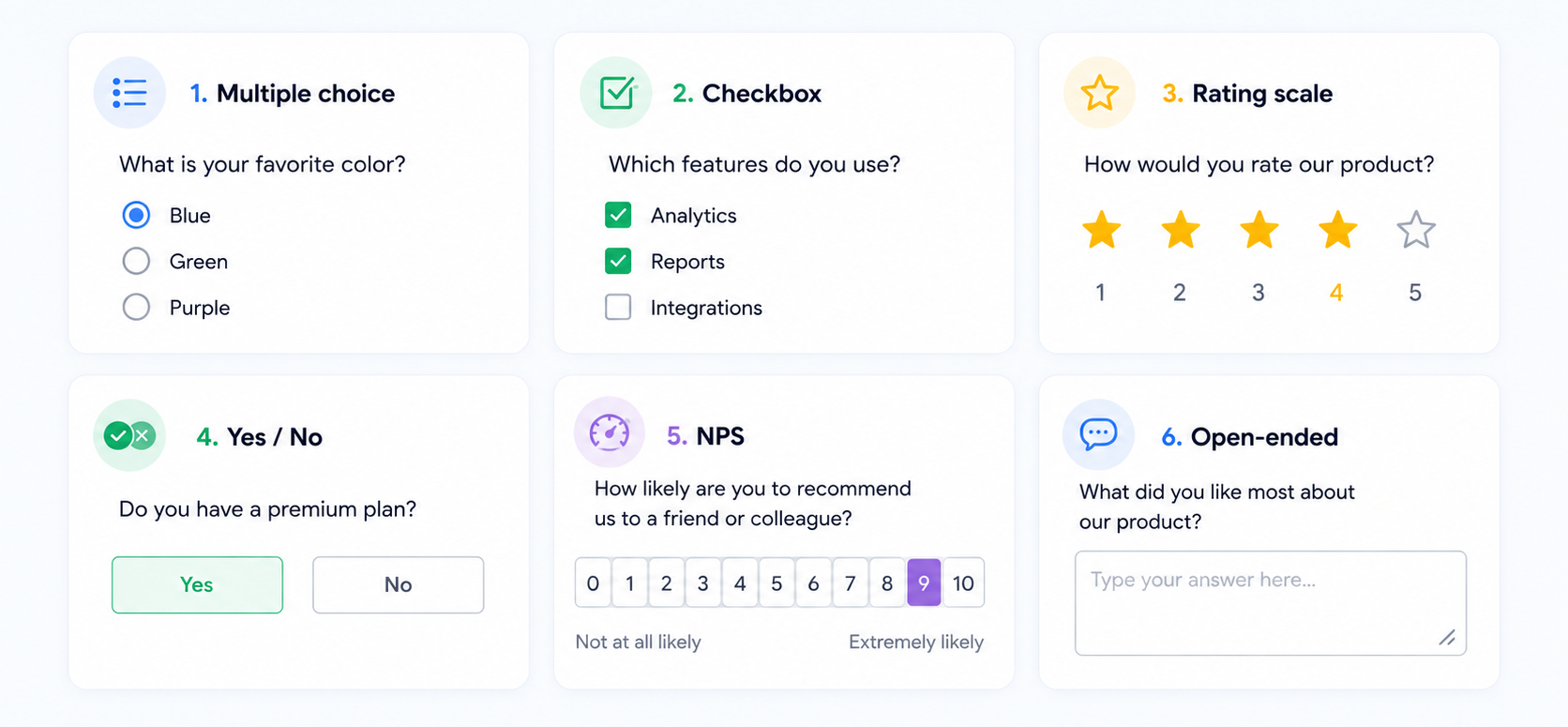
There are 6 question types you'll reach for again and again. Each one is suited to a different kind of answer, and most good surveys use a mix of them.
Open-ended questions
Open-ended questions let people answer in their own words instead of picking from a list. They're the best way to surface things you didn't think to ask about, which makes them ideal early in your research when you're still learning what matters.
- What could we have done better?
- What almost stopped you from signing up?
- What other product or feature would you like us to offer?
The trade-off is that they take more effort to answer and more effort to analyze, so use them sparingly and often as a follow-up to a closed question.
Closed-ended questions
Closed-ended questions limit answers to a set of pre-defined options. They're quick to answer, easy to quantify, and perfect for tracking a number over time. This broad category includes the next four types.
Multiple choice (nominal) questions
Multiple choice questions offer a set of non-numeric options and let people pick one or several. They're great for demographics and market research where you want to segment respondents later.
- Where did you first hear about us?
- What are you primarily using our product for?
- Which of these features matters most to you?
Likert scale questions
A Likert scale measures how strongly someone agrees with a statement, usually on a balanced 5- or 7-point scale from "strongly disagree" to "strongly agree." It's the standard way to turn an attitude into a number you can compare.
- Our product makes my job easier. (Strongly disagree to strongly agree)
- The onboarding process was smooth. (Strongly disagree to strongly agree)
- I'd be disappointed if I could no longer use this product. (Strongly disagree to strongly agree)
Rating scale questions (including NPS)
Rating scale questions map answers onto a number, like 1 to 5 or 0 to 10. Net Promoter Score (NPS) is the best-known example, asking how likely someone is to recommend you on a 0 to 10 scale. Always make the scale direction clear and follow up with an open-ended "why."
- How likely are you to recommend us to a friend or colleague? (0 to 10)
- How would you rate your overall experience today? (1 to 5)
- How easy was it to get your issue resolved? (1 to 5)
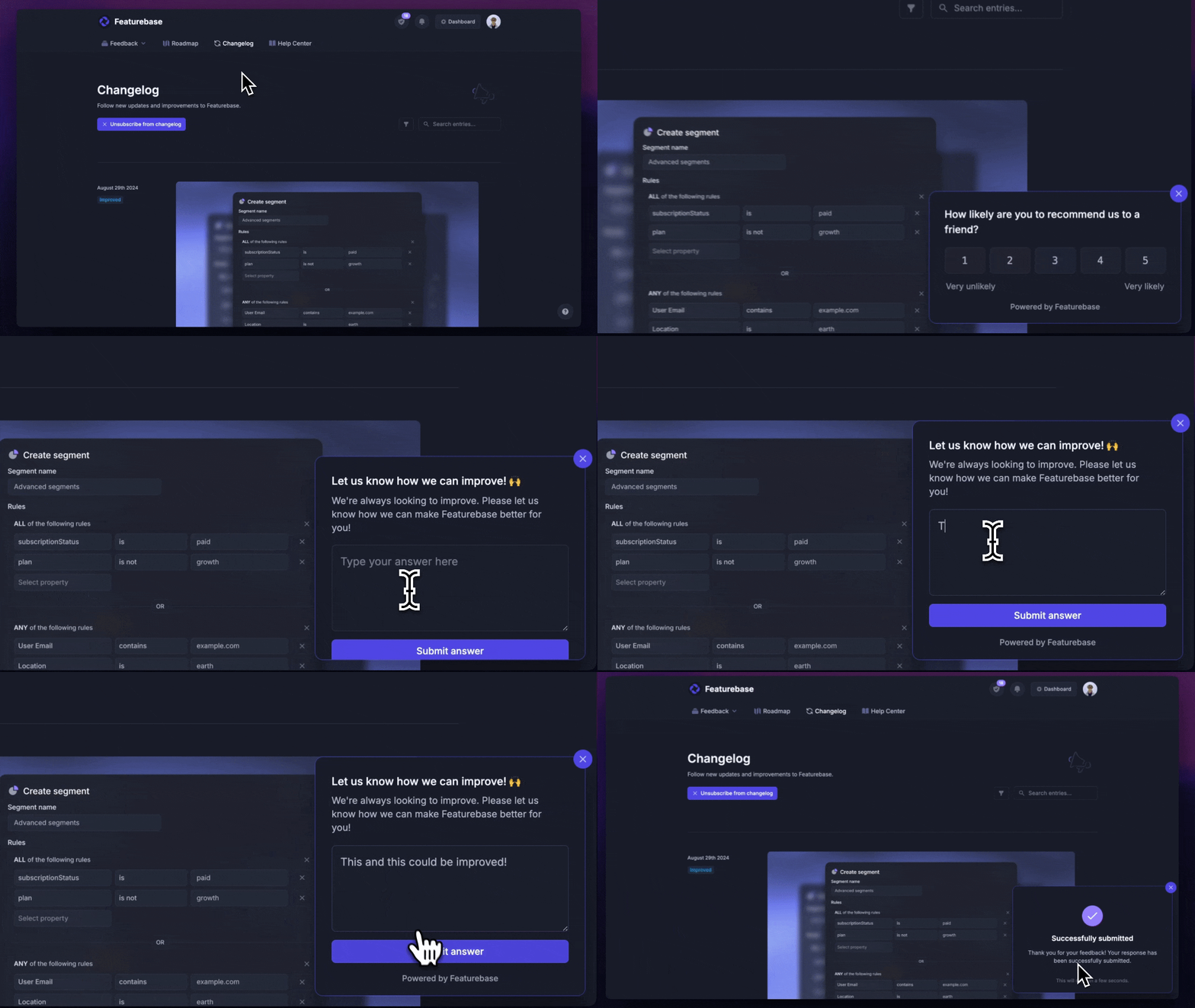
NPS and CSAT measure different things, so it's worth knowing when to use each. If you're deciding between them, our breakdown of NPS vs CSAT walks through where each one fits.
Yes/no questions
Yes/no questions are the simplest possible format and take almost no effort to answer, which makes them a great opener or a quick way to segment respondents before a follow-up.
- Did you find what you were looking for today?
- Was this article helpful?
- Did anything stop you from completing your purchase?
45 good survey question examples by goal
The right question depends entirely on what you're trying to learn. Here are ready-to-use examples grouped by the goal behind them. For more inspiration on what strong feedback looks like in practice, see these customer feedback examples.
Customer satisfaction and NPS
- How likely are you to recommend us to a friend or colleague? (0 to 10)
- Overall, how satisfied are you with our product?
- How well does our product meet your needs?
- How would you rate the value for money you get?
- What's the one thing we could do to make you happier?
- How likely are you to keep using our product over the next year?
Product and feature feedback
- What made you decide to start using our product?
- How would your workflow change if this product disappeared tomorrow?
- Which feature do you rely on the most?
- What's the next feature or improvement we should build?
- Have you used [feature] since we launched it? If not, why?
- What's the most frustrating part of using our product?
- How well does [feature] solve the problem you hoped it would?
- What would make you upgrade to a paid plan?
Onboarding and profile
- What's your role?
- How large is your team or organization?
- What led you to look for a solution like ours?
- What would a successful outcome with our product look like for you?
- How would you rate the setup process so far? (1 to 5)
- Was anything confusing during onboarding?
- What almost stopped you from getting started?
Employee and team
- I have the tools and resources I need to do my job well. (Strongly disagree to strongly agree)
- I feel my opinions are valued at work. (Strongly disagree to strongly agree)
- How well does your manager support your growth?
- How likely are you to recommend this company as a place to work? (0 to 10)
- What's one thing that would make your day-to-day easier?
- Do you feel you get enough recognition for your work?
- How clear are your goals and priorities right now?
Post-event and post-purchase
- Overall, how would you rate the event? (1 to 5)
- How well did the event meet your expectations?
- What was the most valuable part of the event?
- How likely are you to attend again? (0 to 10)
- Was the checkout process easy to complete?
- How satisfied are you with your purchase so far?
- Did the product match what you expected when you bought it?
- Is there anything that would have made your experience better?
Common survey question mistakes to avoid
Even a well-intentioned survey can produce garbage data if the questions carry hidden flaws. These are the ones that show up most often.
- Leading questions: Wording that pushes people toward an answer, like "How great was our friendly support team?" It bakes your assumption into the response. Ask "How would you rate our support team?" instead.
- Double-barreled questions: Asking two things in one, like "How easy and intuitive was the product?" Easy and intuitive aren't the same, so the answer is meaningless. Split it into two questions.
- Loaded questions: Wording that assumes something about the respondent, like "What do you enjoy most about our app?" when they may not enjoy any of it. Don't assume the answer inside the question.
- Unbalanced scales: Offering more positive options than negative ones (excellent, very good, good, poor) tilts your results upward. Keep an equal number of positive and negative options around a neutral middle.
- No opt-out: Forcing an answer when "not applicable" or "prefer not to answer" is the honest response. Missing opt-outs create random noise in your data.
- Asking what you can't act on: If no decision changes based on the answer, the question is just adding length and lowering your completion rate.
How to get more (and better) survey responses
Writing good questions is half the battle. The other half is designing the survey so people actually finish it.
The single biggest lever is length. Study after study finds the same pattern: completion rates stay high for short surveys and drop steadily as you add questions, with a clear fall-off once you push past roughly 10 to 15 questions. Shorter almost always wins, so cut every question you won't act on.
A few more tactics that reliably lift response quality:
- Ask in context: Trigger the survey close to the moment it's about, like showing a feature-feedback question on that feature's page rather than in a generic email blast.
- Lead with an easy question: A quick yes/no or rating question gets people committed before you ask anything harder. Once they start, they're more likely to finish.
- Tell people how long it takes: A simple "2 minutes, 5 questions" sets expectations and reduces drop-off.
- Keep the scale consistent: Switching from a 1 to 5 scale to a 0 to 10 scale mid-survey confuses respondents and skews answers.
- Always leave room for one open comment: A final "anything else you'd like to share?" catches the feedback your structured questions missed.

Get the best survey tool
Centralize feedback, identify product opportunities, and build the right features
Turn survey answers into action with Featurebase
Writing the questions is only useful if the answers go somewhere. This is where an in-app survey tool earns its place, by putting the question in front of the right user at the right moment and feeding the response straight into your feedback workflow.
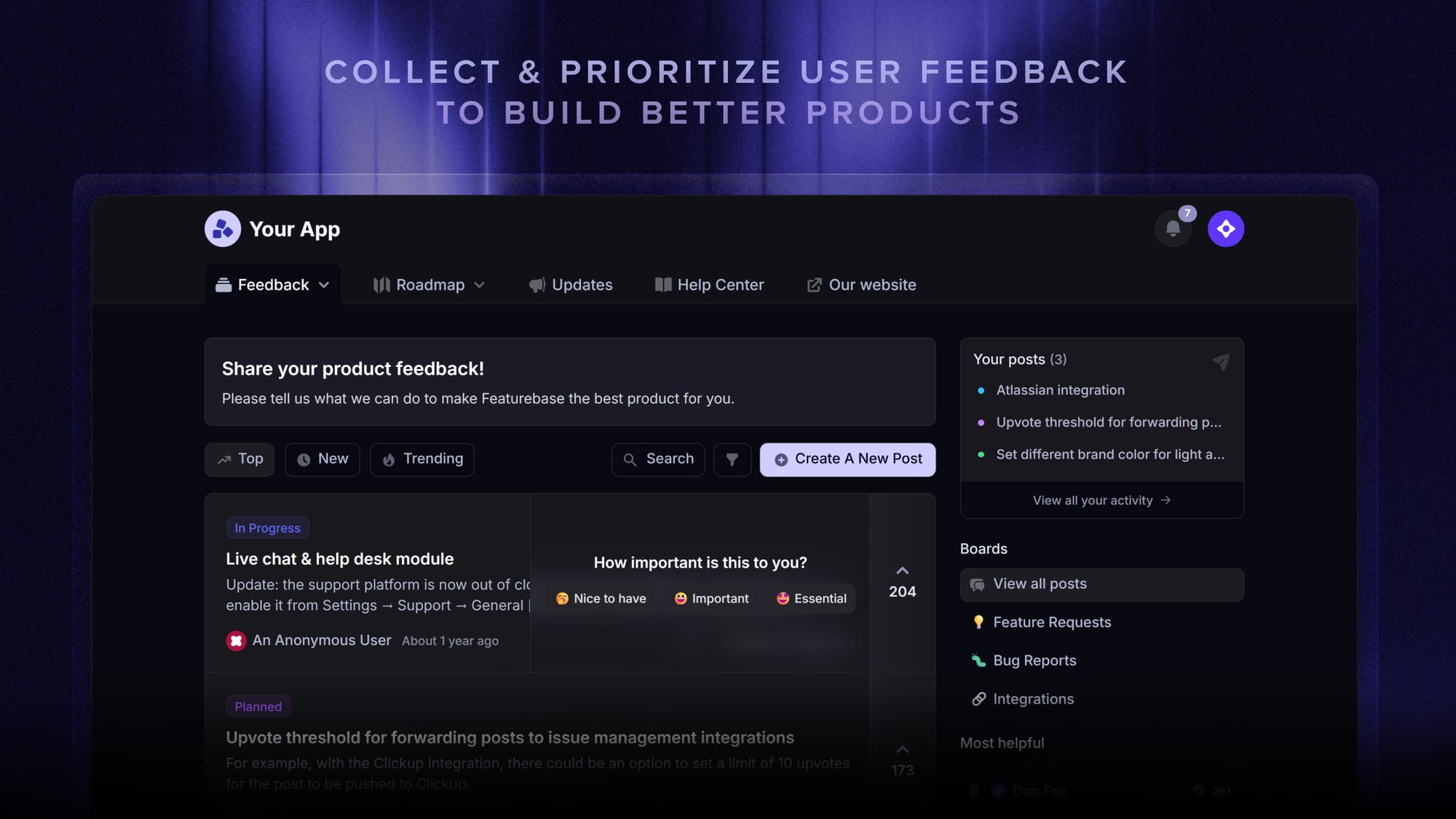
Featurebase is a modern feedback & support platform that helps product teams collect feedback through multi-step surveys, integrations, and a feedback portal, all in one place, to make better product decisions. It's loved by thousands of product teams from companies like Lovable, Raycast, and n8n. 💫
Top features:
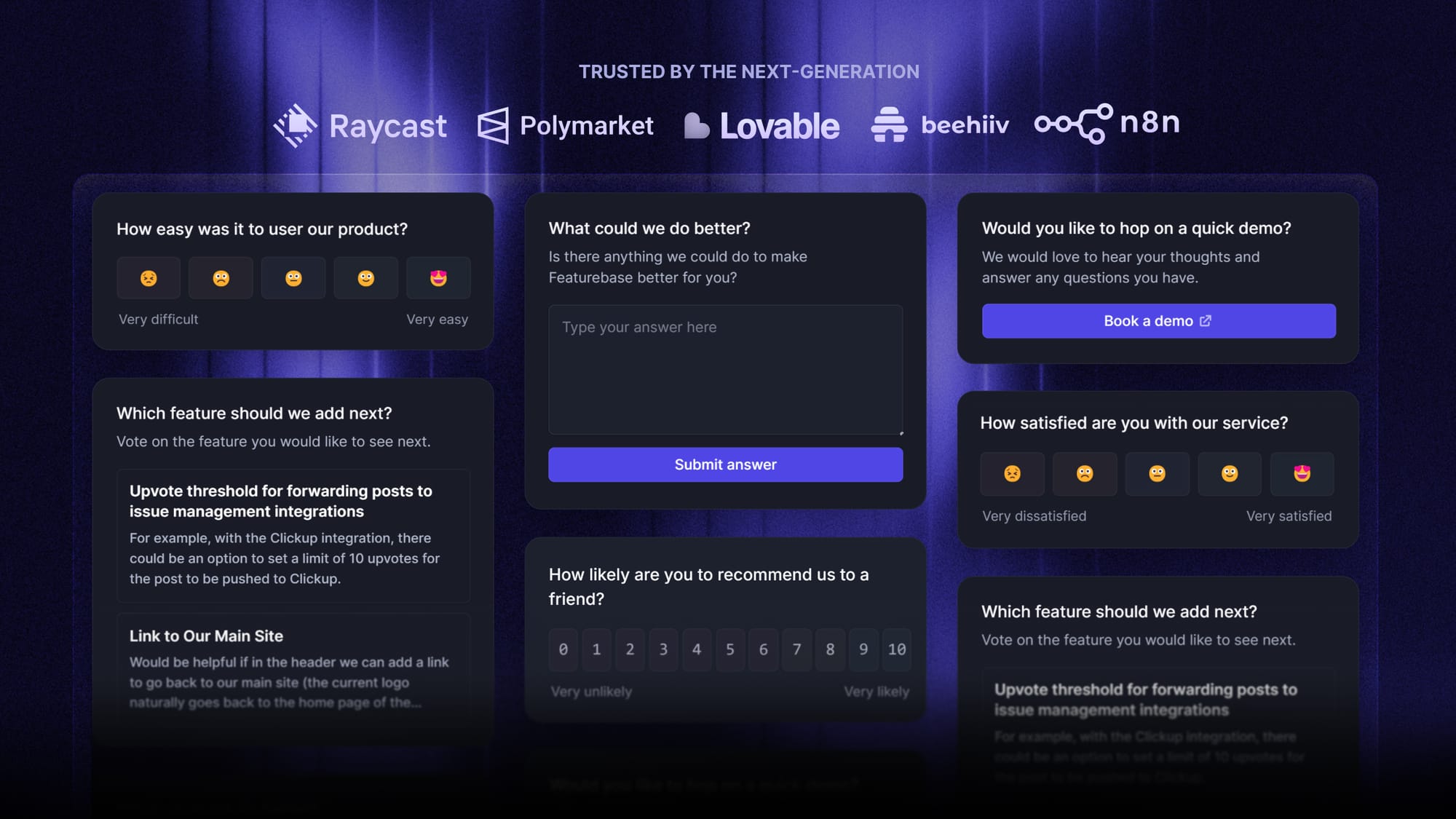
- Surveys (NPS, CSAT, etc) – Create targeted no-code surveys to ask users anything and measure customer satisfaction
- User targeting – Target specific user segments based on properties like plan, role, location, etc.
- Conditional multi-step surveys – Ask follow-up questions based on conditional logic and users' answers
- In-app widgets – Collect ideas, bug reports, and suggestions directly from your website or web app with interactive widgets
- Feedback forum – Public feedback forum where users can submit ideas and vote on features, helping you know what customers want
- Prioritize by revenue – Link feedback with customer revenue, company size, and more to understand the real impact of ideas
- Integrations – Connects with Slack, Linear, Jira, HubSpot, and more
- Plus, help center, product roadmaps, and release notes, all in one place
Pricing: Free plan available with unlimited survey responses and feedback. Paid plans start at $29/seat/mo.
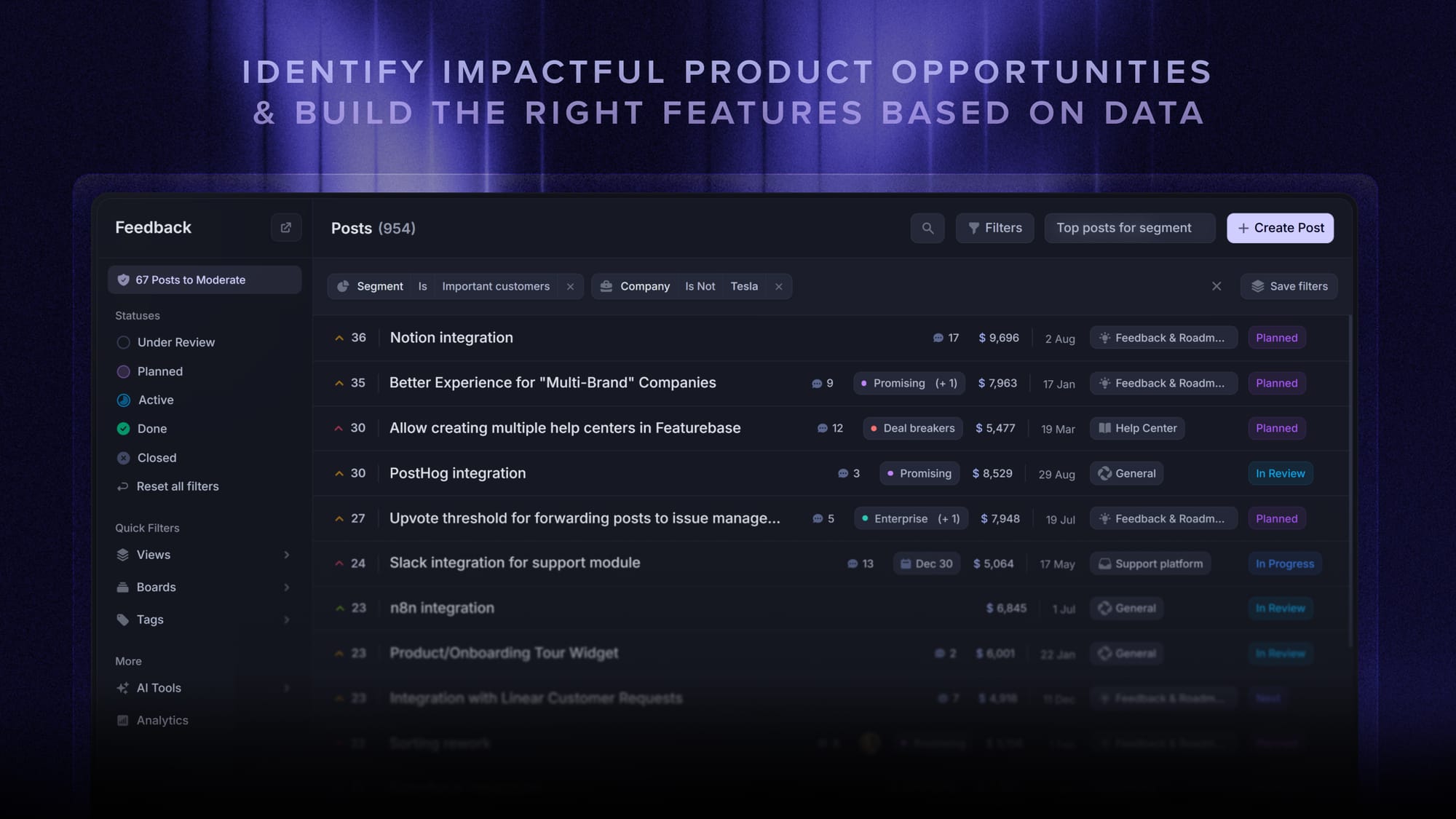
Instead of having 4+ different tools, Featurebase enables you to replace all your customer-facing tools by bringing your feedback collection, product updates, support, and help center together in one place, helping you build products your users love.
Conclusion
Good survey questions come down to a simple discipline: be clear, stay neutral, ask one thing at a time, and only ask what you'll act on. Pick the question type that fits the answer you need, keep the survey short, and always leave room for one open comment.
Featurebase makes the whole loop easy, from writing targeted in-app surveys to collecting the responses and turning them into a public roadmap your users can follow. It's the fastest way to go from a good question to a decision you can defend.
There's a Free plan with unlimited survey responses, so there's no downside to trying it. 👇
✨ Start running surveys & collecting feedback with Featurebase for free →
FAQs
How many questions should a good survey have?
Aim for 10 or fewer whenever you can. Completion rates stay high for short surveys and drop steadily as you add questions, with a noticeable fall-off once you pass about 15. If you have more to ask, split it into shorter surveys triggered at different moments rather than one long questionnaire.
What are 5 good survey questions to start with?
A solid all-purpose starter set: "How likely are you to recommend us to a friend or colleague?" (0 to 10), "How satisfied are you with our product?", "What's the main reason for your score?", "What could we do better?", and "What almost stopped you from signing up?" Those five give you a loyalty number, a satisfaction read, and the open context to explain both.
What are good demographic survey questions?
The most useful demographic questions are role, team or company size, industry, and location, since they let you segment responses later. Keep them optional, avoid anything that could identify an individual, and only ask for details you'll actually use in your analysis.
What's the difference between qualitative and quantitative survey questions?
Quantitative questions produce numbers you can measure and track, like rating scales, NPS, and multiple choice. Qualitative questions produce words and context, like open-ended text responses. The strongest surveys pair them, using a quantitative question to spot a trend and an open-ended follow-up to explain why it's happening.
What is a good survey response rate?
It varies a lot by channel and audience. Email surveys often land in the low double digits, while in-app and post-interaction surveys tend to do much better because you're asking people while they're already engaged. Rather than chasing a universal benchmark, track your own response rate over time and aim to beat your last survey.
What's the best tool for creating and sending surveys?
There are plenty of good options depending on your use case, from standalone survey builders to in-app feedback platforms. If you want targeted in-app NPS and CSAT surveys that feed straight into a feedback loop, Featurebase covers it with a free plan, conditional multi-step logic, and user targeting so the right people see the right question.