Blog 11 Types of Survey Questions (With Examples)
11 Types of Survey Questions (With Examples)
A plain-English guide to the 11 types of survey questions, with an example of each, when to use it, and the mistake to avoid.

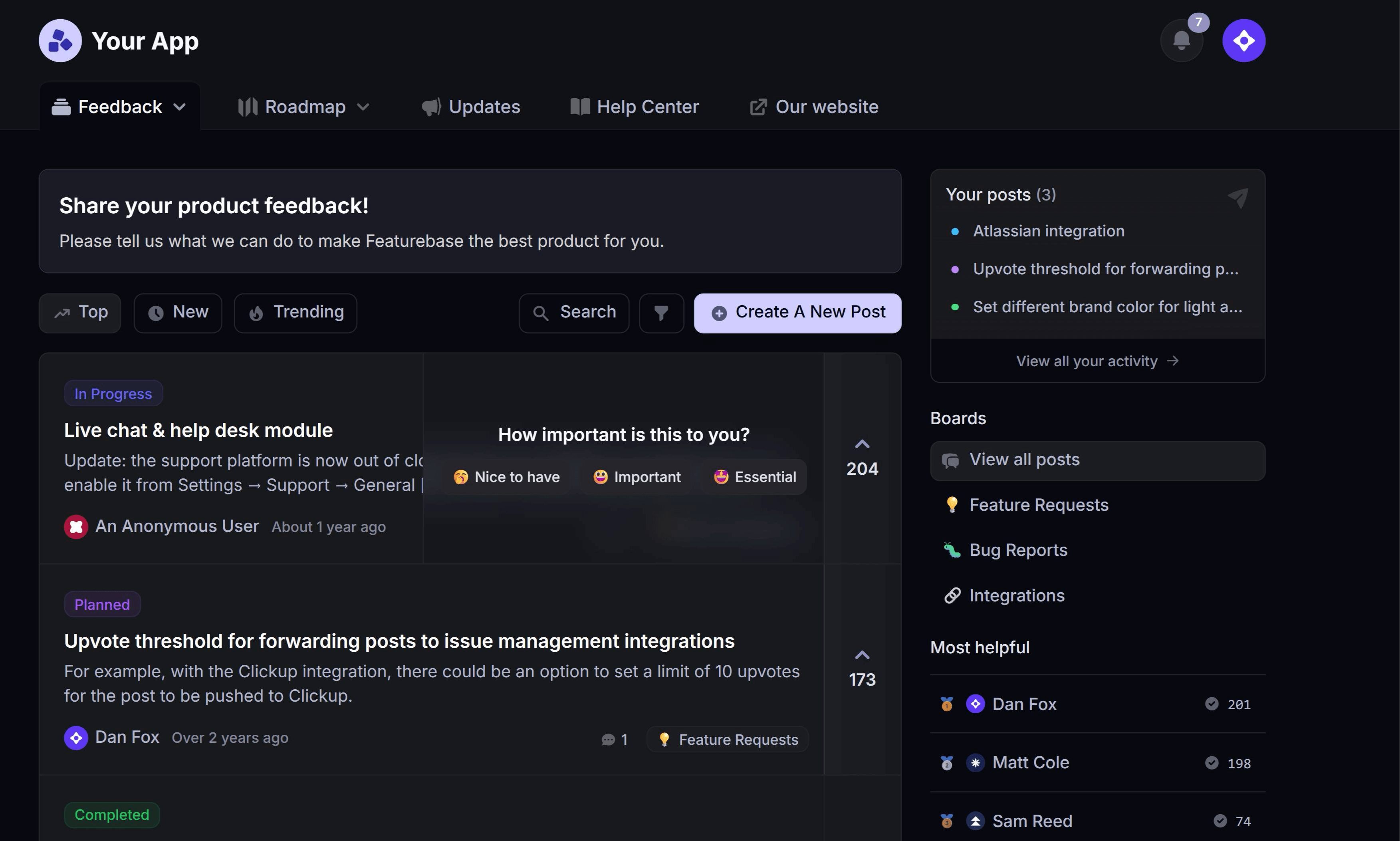

✨ Start collecting & managing feedback with Featurebase for free →
The wrong question format quietly wrecks your survey data. Ask a yes/no when you needed nuance, or drop in an open text box nobody fills, and you end up with answers you can't actually use.
Picking the right question type is half of good survey design. This guide covers the 11 types of survey questions, with an example of each, when to use it, and the trap to avoid. 👇
Key takeaways
- Closed-ended questions give you structured, quantifiable data: multiple choice, rating scales, Likert, matrix, ranking, dropdown, slider, image choice, demographic, and yes/no.
- Open-ended questions capture the "why" in respondents' own words, but they take more effort to answer and to analyze.
- Most strong surveys mix both: a closed-ended question for the score, an open-ended follow-up for the reason behind it.
- Match the question type to the decision you're trying to make and the data you need, not the format you happen to like.
- Featurebase✨ lets you run in-app NPS, CSAT, and multi-step surveys and keep every response in one place next to your feedback and roadmap.
What are survey questions?
Survey questions are the individual prompts you use to collect data from respondents. Each one is built around an answer format, and that format decides what kind of data you get back.
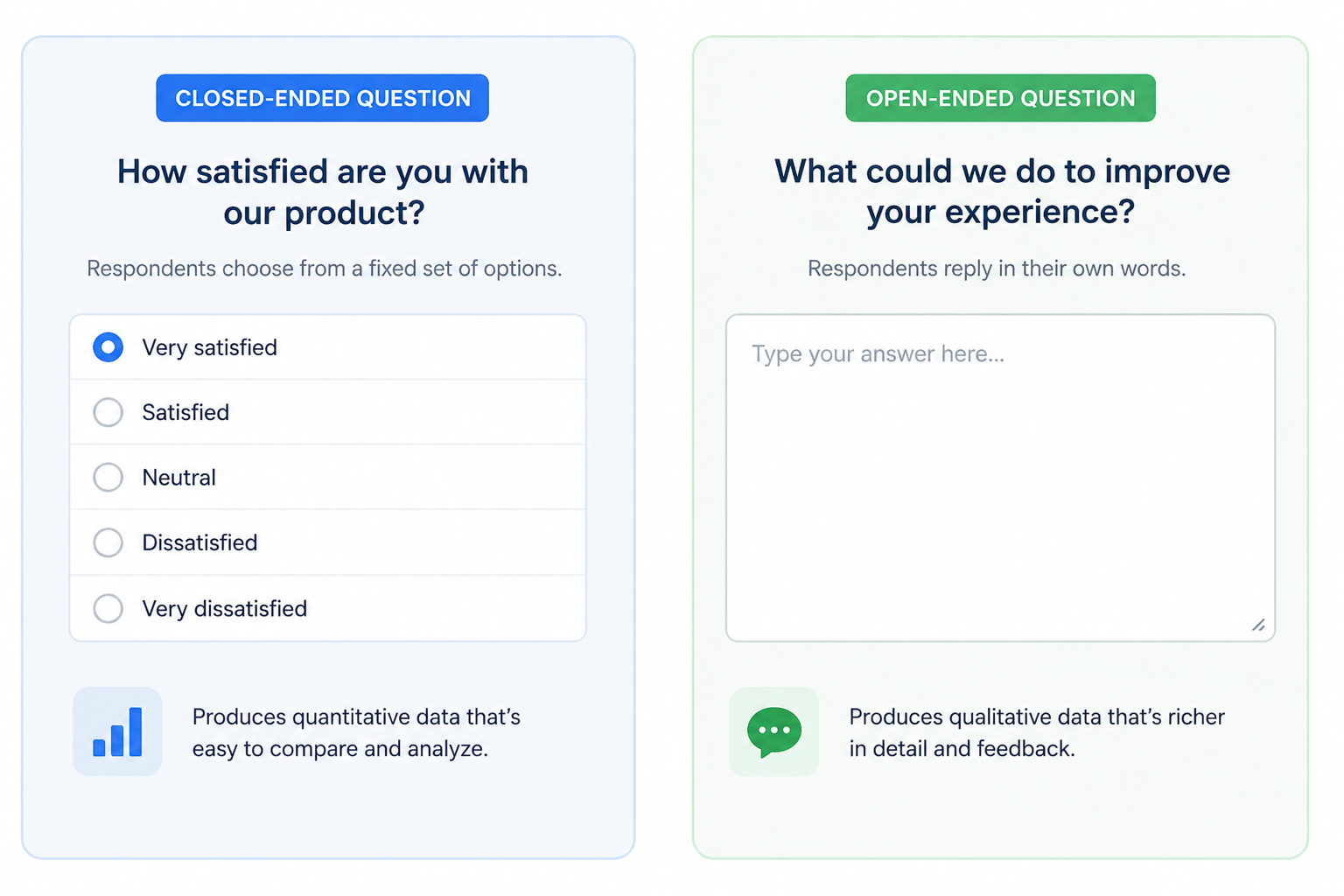
There are two broad families, and almost every survey uses a mix of the two:
- Closed-ended questions give respondents a fixed set of options to choose from. They produce structured, quantitative data that's fast to answer and easy to compare across people.
- Open-ended questions let respondents reply in their own words. They produce qualitative data that's richer and more surprising, but slower to fill in and harder to analyze at scale.
The rest of this guide walks through the 11 most useful types, starting with the closed-ended formats.
Closed-ended survey question types
Closed-ended questions do the heavy lifting in most surveys. They're quick for respondents, they scale cleanly, and the results drop straight into charts. Here are the 10 you'll reach for most.
Multiple choice questions
Multiple choice questions ask respondents to pick one or more answers from a preset list. They're the workhorse of survey design because they're quick to answer and easy to analyze.
Use them when you want clean, countable data on preferences, behaviors, or categories. A single-answer version works for "pick one" cases, while a multi-select version lets people choose everything that applies.
Example: "Which channel did you use to contact us most recently?" (Email / Live chat / Phone / Other)
The main pitfall is incomplete options. If your answers overlap or leave out a common case, add an "Other (please specify)" choice so people don't drop off or pick something inaccurate.
Dichotomous (yes/no) questions
Dichotomous questions offer exactly two options, usually yes/no or true/false. They're the fastest question a respondent can answer, which makes them ideal for screening and simple facts.
Reach for them when a binary answer is all you need, such as confirming eligibility or a past action.
Example: "Have you purchased from us in the last 3 months?" (Yes / No)
Watch out for oversimplifying. If the honest answer is "it depends," a yes/no forces a false choice. Pair it with a rating scale or an open-ended follow-up when you need the nuance.
Rating scale questions
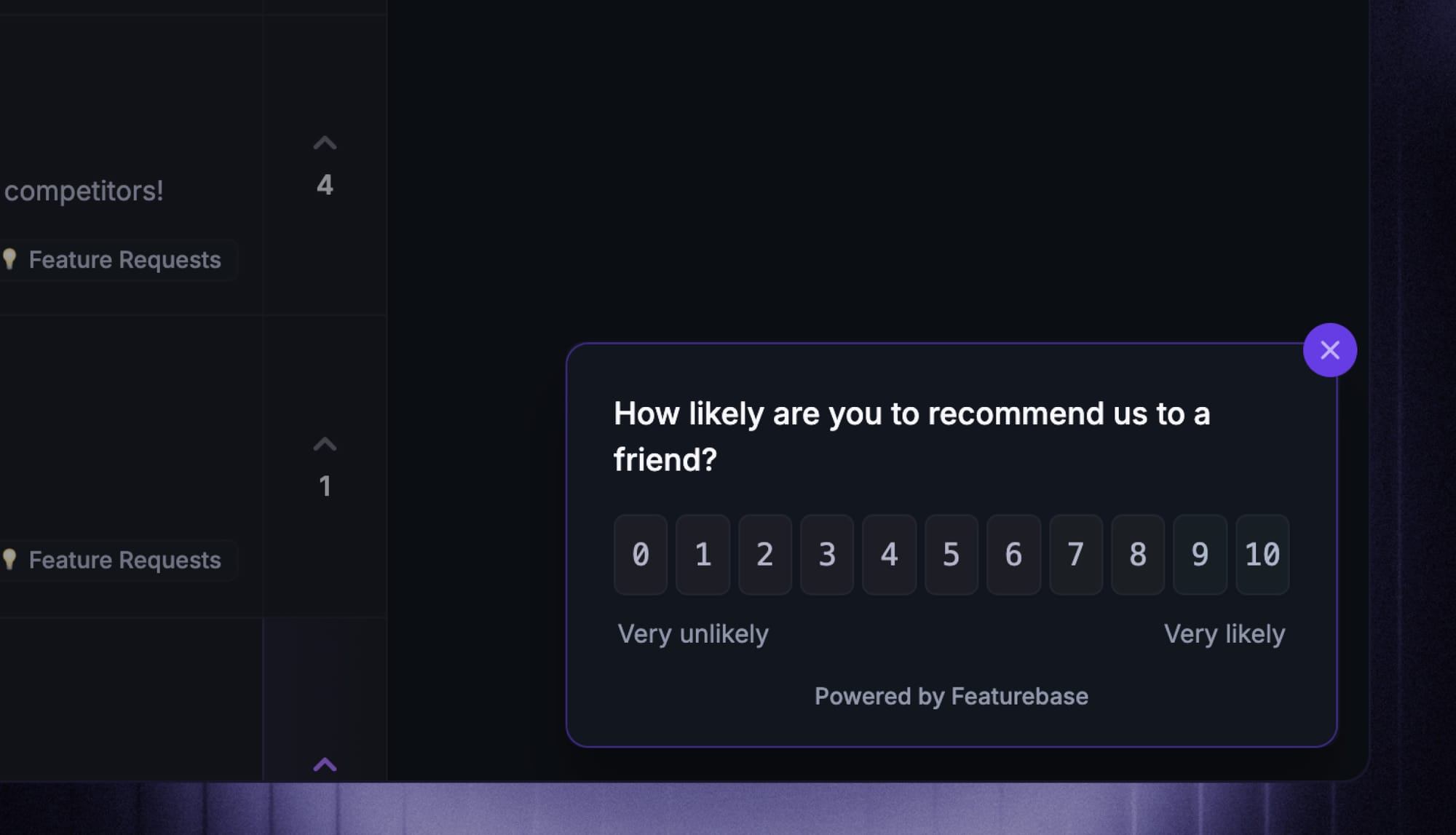
Rating scale questions ask respondents to score something on a numeric range, like 1 to 5 or 0 to 10. They quantify intensity, which makes them perfect for tracking satisfaction over time.
Use them for CSAT, likelihood to recommend, or any sentiment you want to compare month over month.
Example: "How satisfied were you with your experience?" (1 = Very dissatisfied, 5 = Very satisfied)
Always label your endpoints. An unlabelled scale invites midpoint confusion, where respondents default to the middle because they aren't sure what the numbers mean.
Likert scale questions
Likert scale questions measure agreement or attitude across a labelled, evenly spaced set of options, usually running from "strongly disagree" to "strongly agree." They're a close cousin of the rating scale, but they use words instead of raw numbers to capture how strongly someone feels.
Use them to gauge opinions and perceptions, like brand attitudes or how employees feel about their workplace.
Example: "I feel valued as a customer." (Strongly disagree / Disagree / Neutral / Agree / Strongly agree)
Avoid double-barrelled statements like "my manager is clear and supportive." That's two questions in one, and a single answer can't cover both.
Matrix questions
Matrix questions group several related items into a grid so respondents can rate each one against the same scale. They save space and make it easy to compare attitudes across a set of items.
Use them when you're evaluating multiple attributes at once, like rating several product features on the same satisfaction scale.
Example: "Rate each feature." (Ease of use / Speed / Reliability, each scored Poor to Excellent)
Keep grids small and mobile-friendly. Long matrices are hard to read on a phone and push people toward straight-lining, where they pick the same column for every row just to get through it.
Ranking questions
Ranking questions ask respondents to order a set of items by preference or importance. They reveal relative priority, which a rating scale can miss when everything scores highly.
Use them when you need to know what matters most, like prioritizing features or messages.
Example: "Rank these features from most to least important." (Price / Quality / Customer support)
The trade-off is effort. Ranking more than 5 or 6 items creates cognitive overload, and tired respondents start ranking without really reading.
Dropdown questions
Dropdown questions present a long list of answers in a compact, collapsible menu. They keep the survey tidy when a question has many possible answers.
Use them for long, mutually exclusive lists where people already know their answer, like country or job title.
Example: "Select your country." (dropdown menu)
They work poorly when people need to weigh options against each other, since the choices stay hidden until clicked. For anything comparative, a visible multiple choice list is easier.
Slider questions
Slider questions let respondents drag a marker along a continuous scale, often 0 to 100. They capture more granular intensity than a fixed 1 to 5 scale.
Use them when precise degree matters, like price sensitivity or strength of preference.
Example: "How likely are you to try this feature again?" (drag from 0 = Not at all likely to 100 = Extremely likely)
Sliders can be fiddly on small screens, so label both ends clearly and consider snap points if you need clean comparisons across responses.
Image choice questions
Image choice questions use pictures as the answer options instead of text. They're built for visual decisions where a description wouldn't do the choice justice.
Use them for design, packaging, or logo testing, where the look is the whole point.
Example: "Which logo feels most modern?" (Image A / Image B / Image C)
Keep the images consistent in quality and lighting. If one option is sharper or brighter, people pick it for reasons that have nothing to do with the design itself.
Demographic questions
Demographic questions collect background details like age, location, or job role. They don't measure opinions themselves, but they let you segment everyone else's answers.
Use them when you need to compare responses across groups, like satisfaction by age or by plan.
Example: "Which age range best describes you?" (Under 18 / 18-24 / 25-34 / 35-44 / 45+)
Only ask what you'll actually analyze, keep the options inclusive with a "prefer not to say," and place these near the end so they don't cause drop-off before the questions that matter.
Open-ended survey question types
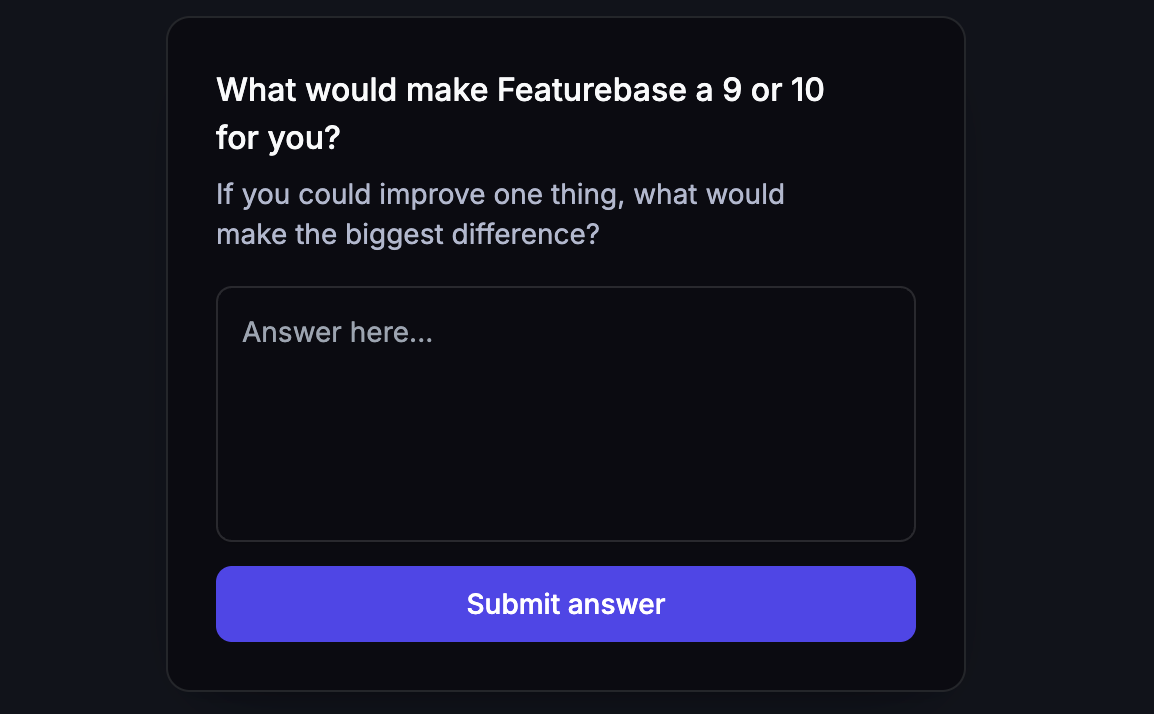
Closed-ended questions tell you what. Open-ended questions tell you why. This is the one format that lets respondents surprise you.
Open-ended (text) questions
Open-ended questions ask respondents to answer in their own words in a free text box. They surface motivations, unexpected pain points, and the exact language your customers use, none of which a fixed list can capture.
Use them to add context to a score, or to discover issues you didn't think to ask about.
Example: "What's the main reason for your score?"
The catch is effort and analysis. Open text takes longer to answer, so overusing it causes drop-off, and the responses take real work to read and theme. Use them sparingly, and lean on AI or text analysis tools when volume gets high.
Qualitative vs. quantitative survey questions
You'll see these two labels a lot, and the difference between qualitative and quantitative data maps neatly onto the closed vs open split above.
Quantitative questions produce numbers. Multiple choice, rating scales, and yes/no questions all fall here, and they're what you use to measure, benchmark, and track trends over time. The strength is comparability. The weakness is that a number tells you the score but not the story.
Qualitative questions produce words. Open-ended prompts are the main example, and they're how you understand motivations and context. The strength is depth. The weakness is that the data is unstructured and slower to analyze.
The best surveys combine them. A rating question captures how people feel, and a focused open-ended follow-up explains why they feel that way.
How to choose the right survey question type
The mistake most people make is starting from the format. They decide they want a Likert scale, then reverse-engineer a question to fit it. Flip that around and start from what you need to learn, then let that decide the questions you ask.
A few rules make the choice fast:
- Start with the decision: write down what you'll do with the answer. If you can't name a decision the response feeds, cut the question.
- Pick your data type: if you need to measure or track something, use a quantitative format. If you need to understand or explore, use an open-ended one.
- Keep effort low: default to quick closed-ended formats, and spend your respondents' patience on the one or two open questions that genuinely need it.
- Mix formats on purpose: pair a score with a reason. A rating question plus an open-ended "why" gives you both the number and the context in one flow.
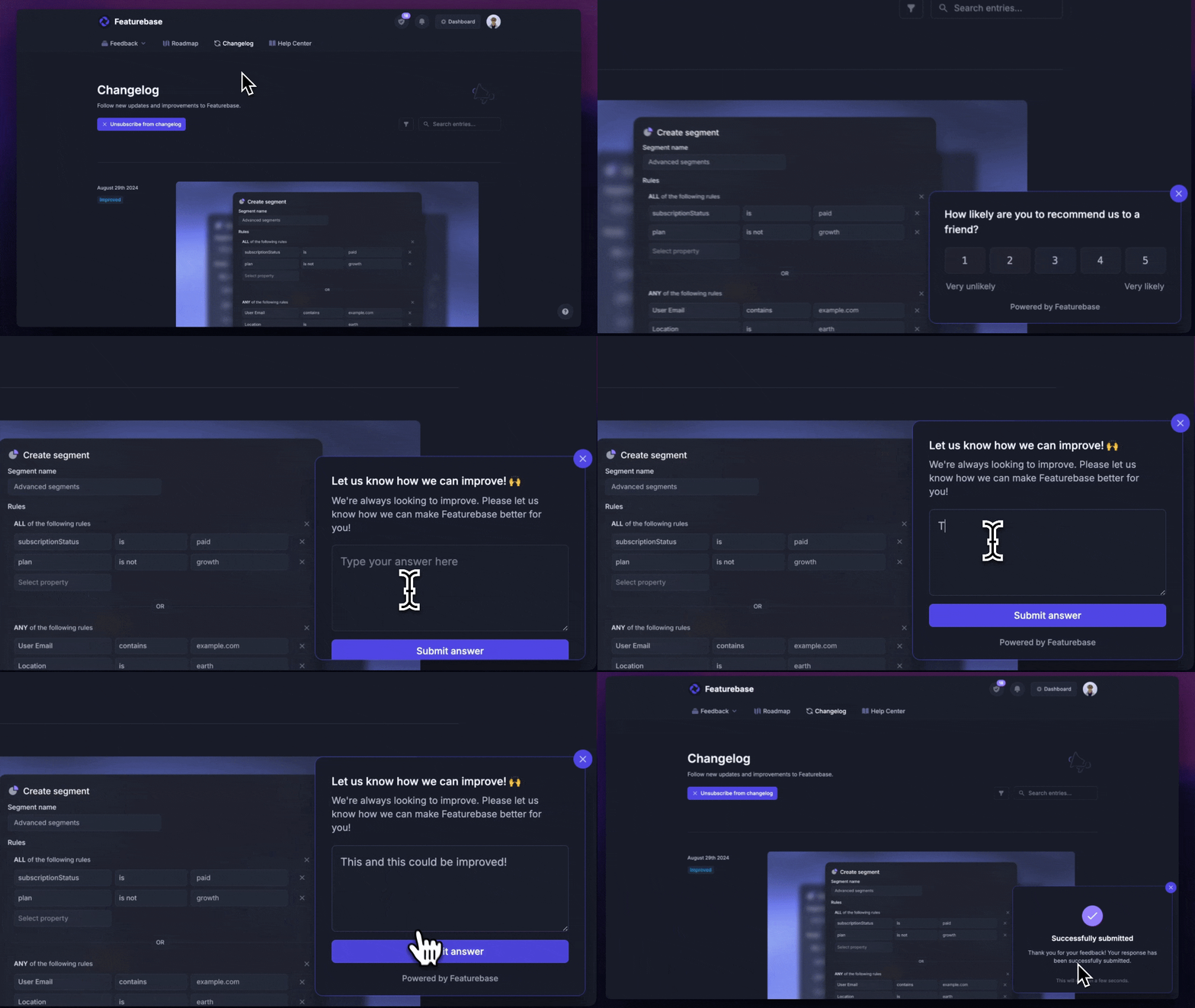
This is also where a dedicated survey tool earns its keep. With Featurebase you can run NPS, CSAT, rating, multiple choice, and open-text questions from an in-app widget, then chain them into a multi-step survey with conditional logic. A low NPS score can automatically trigger a follow-up asking what went wrong, so you pair a quantitative score with a qualitative reason without sending two separate surveys. You can also target the survey to specific user segments, so the right people see it at the right moment.
Conclusion
There's no single best survey question. The right type depends on what you're trying to learn and how you'll use the answer. Get the format right and everything downstream, from response rates to analysis, gets easier, and it becomes far simpler to collect customer feedback you can actually act on.
Featurebase is a modern feedback and survey platform that lets you run targeted NPS, CSAT, and custom surveys right inside your product. You can build multi-step surveys with conditional logic, target specific user segments, and pull every response into one place next to your feature requests, roadmap, and product updates, so survey data actually feeds your product decisions.
It comes with a Free plan that includes unlimited survey responses, and onboarding takes minutes, so there's no downside to trying it. 👇
✨ Start running surveys & collecting feedback with Featurebase for free →
FAQs
What are the 5 main types of survey questions?
The five most commonly cited types are multiple choice, rating scale, Likert scale, dichotomous (yes/no), and matrix questions. These are all closed-ended formats that produce structured, quantifiable data. Most guides then add open-ended (text) questions as the key qualitative counterpart.
What's the difference between open-ended and closed-ended survey questions?
Closed-ended questions give respondents a fixed set of answers to choose from, which produces clean, quantifiable data that's easy to compare. Open-ended questions let people reply in their own words, which produces richer qualitative insight but takes more effort to answer and analyze. Strong surveys use closed-ended questions for the bulk of the data and a few open-ended ones for context.
What's the difference between a Likert scale and a rating scale?
A rating scale uses numbers to measure intensity, such as scoring satisfaction from 1 to 10. A Likert scale uses labelled categories to measure agreement, such as "strongly disagree" to "strongly agree." Both sit on a spectrum, but the Likert version leans on words rather than raw numbers.
How do I choose the right survey question type?
Start from the decision you want to make and the kind of data you need, not the format. If you need to measure or track something, use a quantitative format like multiple choice or a rating scale. If you need to understand why, use an open-ended question, and default to quick closed-ended formats everywhere else to keep the survey short.
How many questions should a survey have?
As few as you can get away with. Every extra question raises the risk of survey fatigue, where people rush or abandon the survey partway through. A focused survey of 5 to 10 questions built around one clear goal will almost always outperform a long one that tries to cover everything.
What makes a good survey question?
A good survey question is clear, neutral, and focused on one idea at a time. Avoid leading phrasing that nudges people toward an answer, and avoid double-barrelled questions that ask about two things at once. It should also be easy to answer on a phone, since most respondents are on mobile.