Blog Customer ServiceAI for Customer Success: Use Cases and Benefits
AI for Customer Success: Use Cases and Benefits
Learn what AI actually does for customer success, the main use cases, benefits, and how to adopt it without losing the human touch.


✨ Automate your support with the fastest AI-enhanced Inbox today →
Most customer success teams spend their days reacting. A customer churns, and only then does anyone realize the warning signs were there for weeks. The problem is not effort, it's that the signals are buried in usage data, support tickets, and emails no one has time to read.
AI changes the math. It reads those signals for you, flags the accounts that need attention, and hands back the hours you used to lose to admin.
This guide covers what AI actually does for customer success, the main use cases, and how to roll it out without losing the human touch. 👇
Key takeaways:
- AI shifts customer success from reactive to proactive: it surfaces churn risk and health signals weeks before a cancellation, so you can act while the account is still saveable.
- The biggest early wins are administrative: meeting summaries, follow-up drafts, and sentiment tagging save hours with very little risk.
- AI predicts, humans decide: the strongest CS teams keep a person in the loop for every judgment call and customer relationship.
- Feedback analysis is an underused CS use case: AI can group thousands of pieces of feedback into themes so you can fix what is actually driving churn.
- Featurebase✨ combines an AI-powered support inbox, help center, and feedback tools so customer success teams can automate routine work and keep every conversation in one place - free to start.
- You don't need a data scientist: modern tools embed AI into existing workflows, so small teams benefit as much as enterprises.
What is AI for customer success?
AI for customer success is the use of machine learning and generative AI to analyze customer data, predict what accounts will do next, and automate routine relationship management tasks. In practice, it means you stop waiting for customers to complain and start spotting problems before they do.
Traditional customer success treats symptoms as they appear. An AI-enabled approach works to prevent the problem in the first place. Instead of noticing a quiet account at the next quarterly review, you get an alert the moment engagement drops.
Underneath, AI does 3 core things for a CS team:
- Data aggregation: it pulls customer information from your product analytics, support tickets, emails, and billing into one view instead of leaving it scattered across systems, creating valuable Data for AI that can help train and improve machine learning models.
- Pattern recognition: it catches combinations you would miss, like declining logins paired with a spike in support tickets that often precede a cancellation.
- Automated action: it triggers the next step - a re-engagement email, a health-score update, or an alert to the CSM - based on what the customer just did.
Put together, those 3 functions turn a pile of scattered data into a real-time picture of every account.
Why customer success teams are turning to AI
This is not a fringe experiment anymore. In Gainsight's State of AI in Customer Success 2024 report, 52% of customer success organizations said they were already using AI in some form.
The pressure behind that number is simple. CS teams are asked to retain and expand more accounts every year without a matching increase in headcount. AI is the most direct way to scale coverage: it handles routine touchpoints for healthy accounts and flags the ones that need a human.
Customer expectations have also shifted. People now expect proactive, personalized service regardless of how big the vendor is, and there is finally enough usage data in most SaaS products to make AI predictions reliable.
6 ways to use AI in customer success
Most teams start with 2 or 3 of these and expand once they trust the results. You don't need to run all 6 at once.
Predict and prevent churn
Churn prediction is the use case that pays for itself. AI studies the accounts that have already left, learns the warning signs, and then watches your current base for the same pattern - dropping usage, slower email replies, fewer active seats.
The advantage is timing. A model can flag an at-risk account weeks or months before a renewal, while there is still time to intervene. Better tools also estimate when an account is likely to churn and suggest the actions that saved similar customers.
Automate customer health scoring
A health score is only useful if it reflects reality. Manual scores built on a few static rules go stale fast. AI health scoring weighs dozens of signals at once - product usage, support history, payment record, stakeholder engagement - and refreshes as new data arrives.
It also benchmarks each account against similar customers that expanded or churned, so a score means something instead of being a gut feeling dressed up as a number.
Personalize onboarding and proactive education
Every new customer needs a different amount of hand-holding, and most of them will not tell you which kind they are. AI helps by reading onboarding survey answers and early usage to gauge how much support an account needs, then tailoring the path accordingly.
It can also power proactive education: spotting when a customer has not adopted a key feature and nudging them with the right guide or tip before they get stuck. Value delivered before it is requested builds trust and cuts early churn.
Analyze feedback and customer sentiment at scale
Customer success teams sit on a mountain of feedback - survey responses, support tickets, feature requests, sales call notes - and almost no time to read it. AI is very good at this. It can classify feedback as positive, negative, or neutral, and group it by theme so you see what is actually driving frustration.
This is where feedback analysis earns its place. AI can automatically sort large volumes of feedback into product areas and themes, so CS teams spot the recurring issues that quietly push customers toward the exit and take them to the product team with evidence instead of a hunch.
Speed up meeting prep and follow-ups
Meeting prep and follow-up are non-negotiable for good relationships, and they eat hours. AI handles the heavy lifting on both ends. Before a call, it can pull account history and recent tickets into a short brief so you walk in with full context.
After the call, it transcribes the conversation, pulls out action items, and drafts the follow-up email for you to review. You stay present in the meeting instead of scribbling notes, and nothing gets forgotten afterward.
Scale personalized outreach and check-ins
Personalization breaks down when one CSM manages hundreds of accounts. AI closes that gap by drafting tailored check-ins, upsell notes, and re-engagement emails based on each customer's situation, then sending them at the times each person is most likely to open.
The point is not to automate the relationship. It is to make one-to-many outreach feel one-to-one, so healthy accounts still hear from you without stealing time from the accounts that need a real conversation.
Benefits of AI for customer success
The use cases above stack into a handful of clear business outcomes:
- Higher retention: catching risk early and acting on it is the most direct lever AI pulls on churn and net revenue retention.
- Scale without new headcount: AI covers routine touchpoints and prioritizes the queue, so a small team can manage far more accounts.
- More productive CSMs: with admin work automated, CSMs spend their time on strategy and relationships instead of data entry.
- Better decisions: AI answers the "which account should I work on today?" question with data rather than instinct.
Common barriers to AI adoption (and how to handle them)
Bringing AI into customer success is rarely a clean switch-flip. Three barriers come up again and again:
- Skills and integration gaps: most CS teams don't have AI experts on staff, and connecting new tools to a legacy CRM takes planning. Starting with AI features already built into tools you use avoids most of this.
- Reliability worries and team resistance: people fear the output is wrong, or that the tool is after their job. The fix is to frame AI as an assistant that removes grunt work, and to prove it on low-stakes tasks first.
- Data privacy: feeding customer data into AI raises real concerns. Choose reputable platforms with clear security practices and set internal rules for how customer data is used before you roll anything out.
Best practices for using AI in customer success
A few principles separate teams that get value from AI from teams that get burned:
- Keep a human in the loop: let AI analyze, draft, and surface insights, but keep a person in charge of judgment calls and customer conversations. AI is the co-pilot, not the pilot.
- Be transparent with customers: if a chatbot handles first-line questions or an algorithm personalizes outreach, say so. Honesty protects the trust you have built.
- Treat it as continuous improvement: AI is not set-and-forget. Review its output, gather feedback from your team, and refine as your product and customers change.
Will AI replace customer success managers?
No. AI is very good at processing data and handling repetitive work, but customer success runs on trust, and trust is built between people. A model can find the pattern, but it takes a person to understand the story behind it and turn that into a decision the customer cares about.
What AI does change is where CSMs spend their time. As the routine work gets automated, the role shifts from task-juggler to strategic advisor. The CSMs who lean into that shift will outperform the ones who don't - not because AI replaced anyone, but because it freed them to do the part of the job only a human can.
Get more from customer success with Featurebase
AI pays off most in customer success when it takes the repetitive work off your plate so you can focus on the relationship. A modern support platform is where a lot of that automation lives - resolving routine questions, surfacing answers, and keeping every customer conversation in one place.
Featurebase is a modern AI customer support platform for product-led SaaS. It combines AI-powered support, help center, and feedback management into a single platform for startups that want all their customer-facing tools in one place. Featurebase is loved by thousands of support teams from companies like Lovable, Raycast, and n8n. 💫
Top features:
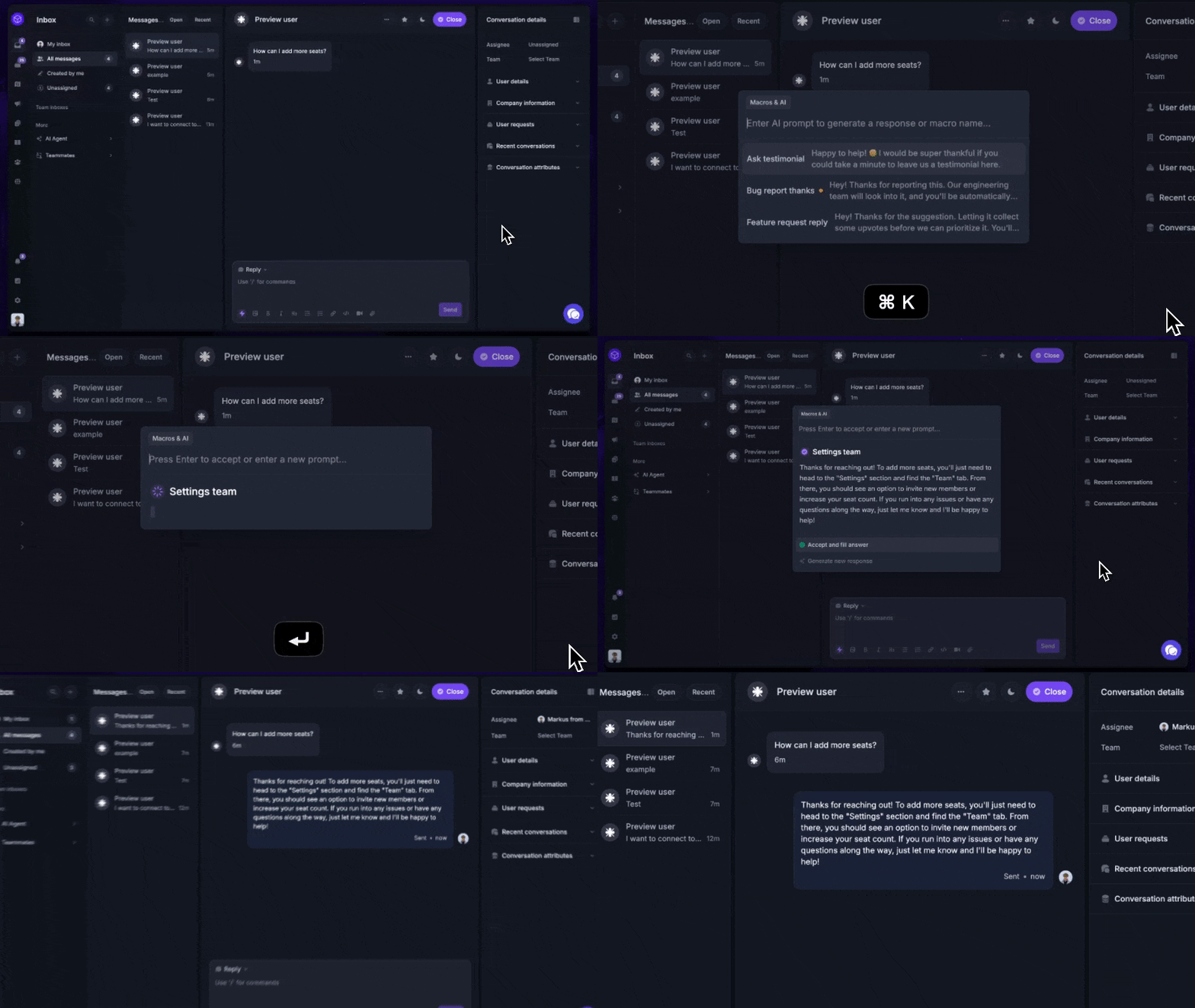
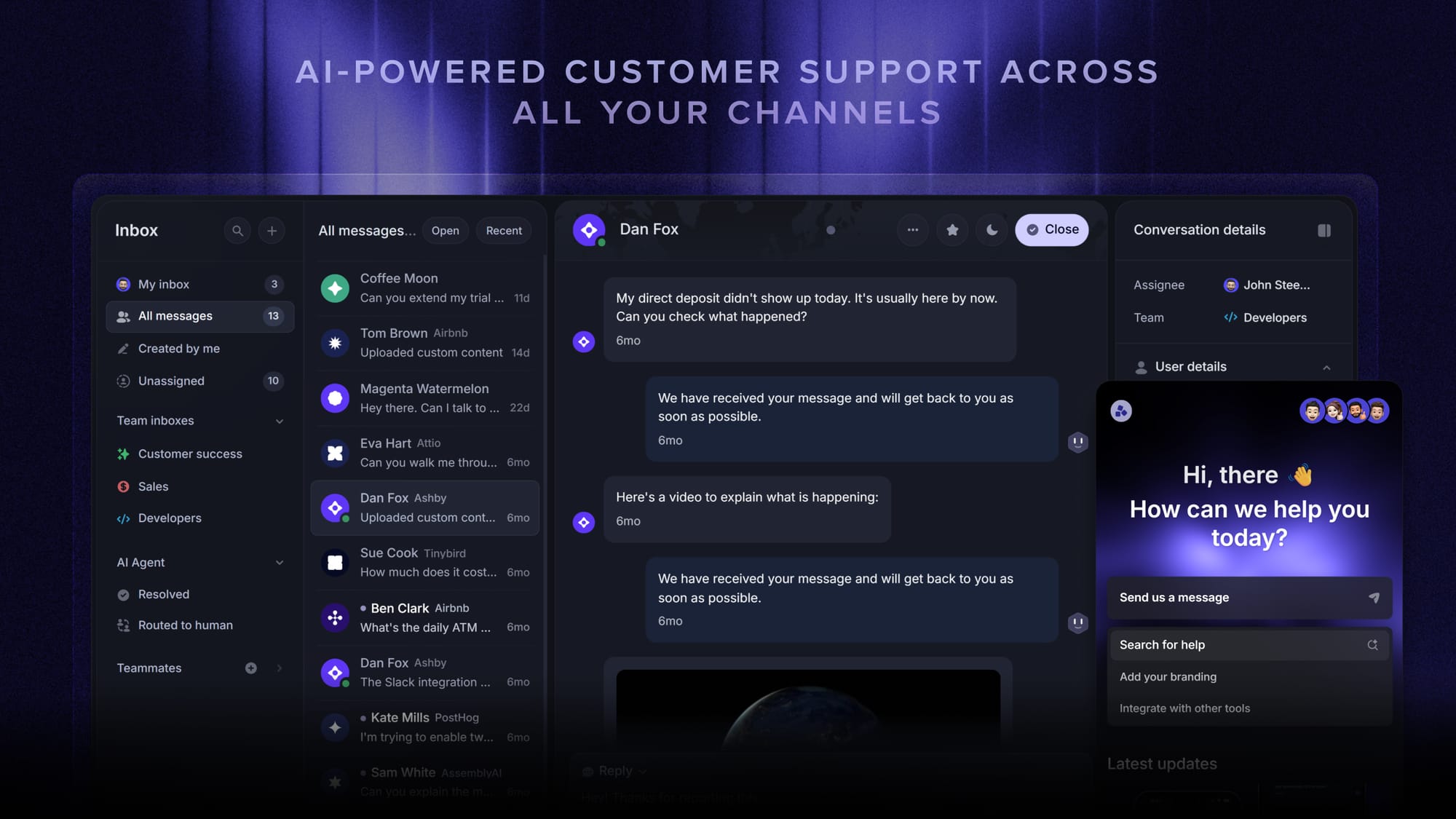
- Omnichannel inbox – Manage live chat, email, and Slack conversations from one AI-powered view
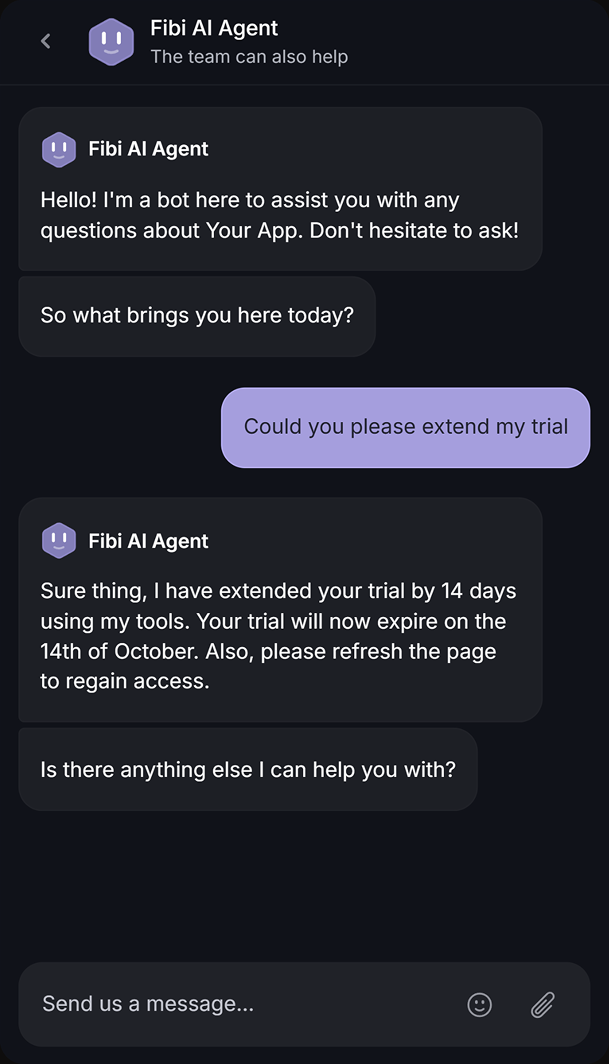
- Fibi AI Agent - Resolve customer issues on autopilot & run custom actions like trial extensions and refunds
- Help center with AI search – Provide instant, multilingual self-serve answers
- Workflows & automations – Auto-assign tickets, route conversations, collect customer data, and more
- AI Copilot – Help your agents answer customers faster with AI Copilot that uses your internal knowledge
- Multi-brand support – Manage multiple Help Centers and Live chats from a single workspace
- Automatic AI translations – Automatically translate all messages and help articles to your customers native language
- Service Level Agreements – Track SLAs to make sure your team responds to customers on time, every time
- Mobile app – Respond to customers, receive notifications, and unblock users on the go
- Feedback & roadmap tools – Collect feature requests and close the loop with updates
- Product updates – Publish release notes with a changelog page, in-app widget, and emails
- Integrations – Connects with Slack, Linear, Jira, HubSpot, and more
Featurebase covers all the basic support features that legacy platforms do, but with a much more modern approach. It comes with AI automations, a mobile app, and multiple channels (email, live chat, Slack, etc.).
Featurebase has a Free plan with unlimited conversations, and paid plans start at $29/seat/month plus $0.49 per AI resolution. Onboarding is fast, so there's no downside to trying it. 👇
✨ Automate your support with the fastest AI-enhanced Inbox today →
FAQs
Will AI replace customer success managers?
No. AI automates repetitive work like summarizing calls, analyzing usage, and drafting routine emails, but it can't build the human trust that customer success depends on. In practice it removes the grunt work so CSMs can focus on strategy and relationships, shifting the role toward that of a trusted advisor rather than eliminating it.
What's the difference between AI for customer success and AI for customer support?
AI for customer support is mostly reactive: it resolves individual tickets and answers questions as they come in. AI for customer success is proactive: it manages the whole post-sale relationship, predicting churn, scoring account health, and spotting expansion opportunities. Support AI handles single interactions, while success AI manages ongoing outcomes across an account's lifetime.
Which customer success tasks should you automate with AI first?
Start with high-volume, low-risk work: meeting summaries, follow-up drafts, sentiment tagging, and record updates. These deliver quick wins and build your team's confidence without much downside if the output needs an edit. Once you trust the basics, expand into triggered workflows like re-engagement emails, then move to predictive models such as churn scoring.
Can small customer success teams benefit from AI?
Yes, and often more than large ones. Small teams face the steepest ratio of accounts to CSMs, which is exactly the strain AI relieves by automating routine touchpoints and prioritizing the queue. The key is to start with AI features already built into your existing tools rather than standing up a complex standalone system.
How do you use AI in customer success without losing the human touch?
Keep a human in the loop for anything the customer sees or feels. Use AI to draft, summarize, and surface insights, but let a person add the final judgment and personal touch before it goes out. Being transparent about where you use AI also matters, since it reassures customers you are using technology to serve them better, not to replace real connection.
What should you look for in an AI tool for customer success?
Look for a tool that fits your existing workflow, integrates with your CRM and product data, and turns raw signals into action rather than just dashboards. AI-powered support automation, sentiment analysis, health scoring, and churn prediction are the highest-value capabilities for CS. For the customer-facing side, Featurebase pairs an AI-powered support inbox with feedback collection and NPS and CSAT surveys, so you can resolve issues and capture what customers want in one place.