Canny vs UserVoice: The 2026 Comparison
Canny and UserVoice are two of the biggest names in the feedback tool game, but which one is better and actually delivers the most bang for your buck? In this post, we’ll break down the features, pricing, and user experience of both tools. Let's get into it!


On this page
✨ Looking for an affordable, modern alternative to Canny and UserVoice? Check out Featurebase →
Choosing between Canny and UserVoice gets tricky once you look beyond feedback boards. Both collect feature requests and connect them to customer context, but their pricing and buying processes work differently.
Canny offers self-service plans with tracked-user limits. UserVoice sells a tailored feedback platform through its sales team. AI capabilities, integrations, and the way your team handles feedback matter just as much as the starting price.
We've compared their features, pricing, and user experience to help you decide which fits your business. 👇
Key takeaways
| Comparison | Canny | UserVoice |
|---|---|---|
| Best fit | Product teams wanting self-service feedback management | Organizations building a shared customer-intelligence program |
| Free access | Free plan with 25 tracked users | 30-day trial arranged through sales |
| Paid pricing | Pro from $79/month billed yearly or $99 monthly | Custom quote |
| What affects the bill | Plan and tracked-user tier | Feedback volume, tools, and integrations |
| AI capabilities | Autopilot capture, deduplication, triage, and theme analysis | Automatic sentiment analysis, themes, and feedback grouping |
| Integrations | PM integrations on Pro, CRM and identity-provider integrations on Business | Integrations included in the agreed package |
| Buying process | Self-service Free and Pro plans, sales-led Business | Demo, tailored quote, and guided onboarding |
Our take: Start with Canny if you want to evaluate a feedback workflow independently. Include UserVoice if cross-team adoption, account-level analysis, and guided rollout are central to the purchase.
Canny vs. UserVoice: the basics
In the battle of Canny vs UserVoice, the two companies have completely different target audiences.
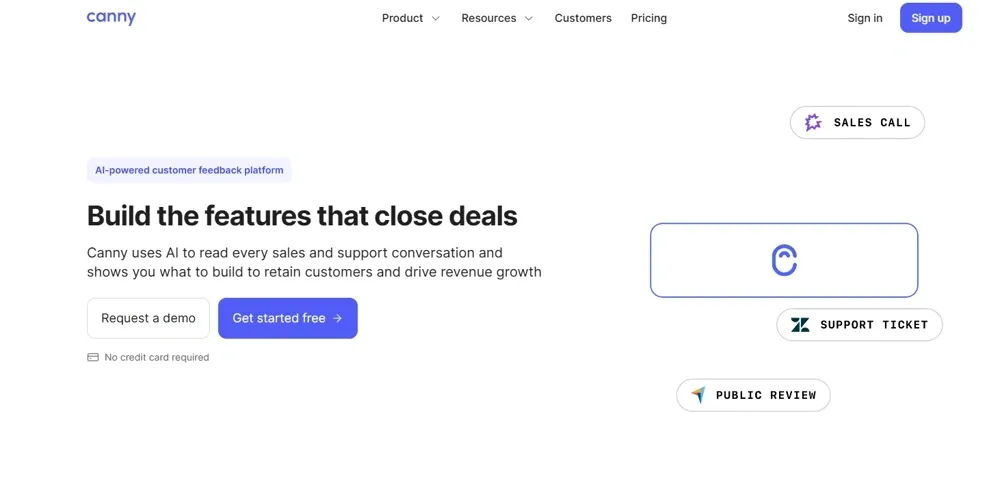
Canny is a relatively new feedback management tool primarily used by growing SaaS startups.
Launched in 2017, Canny was created to help businesses centralize their product feedback and give them an overview of the most important feedback items from their user base.
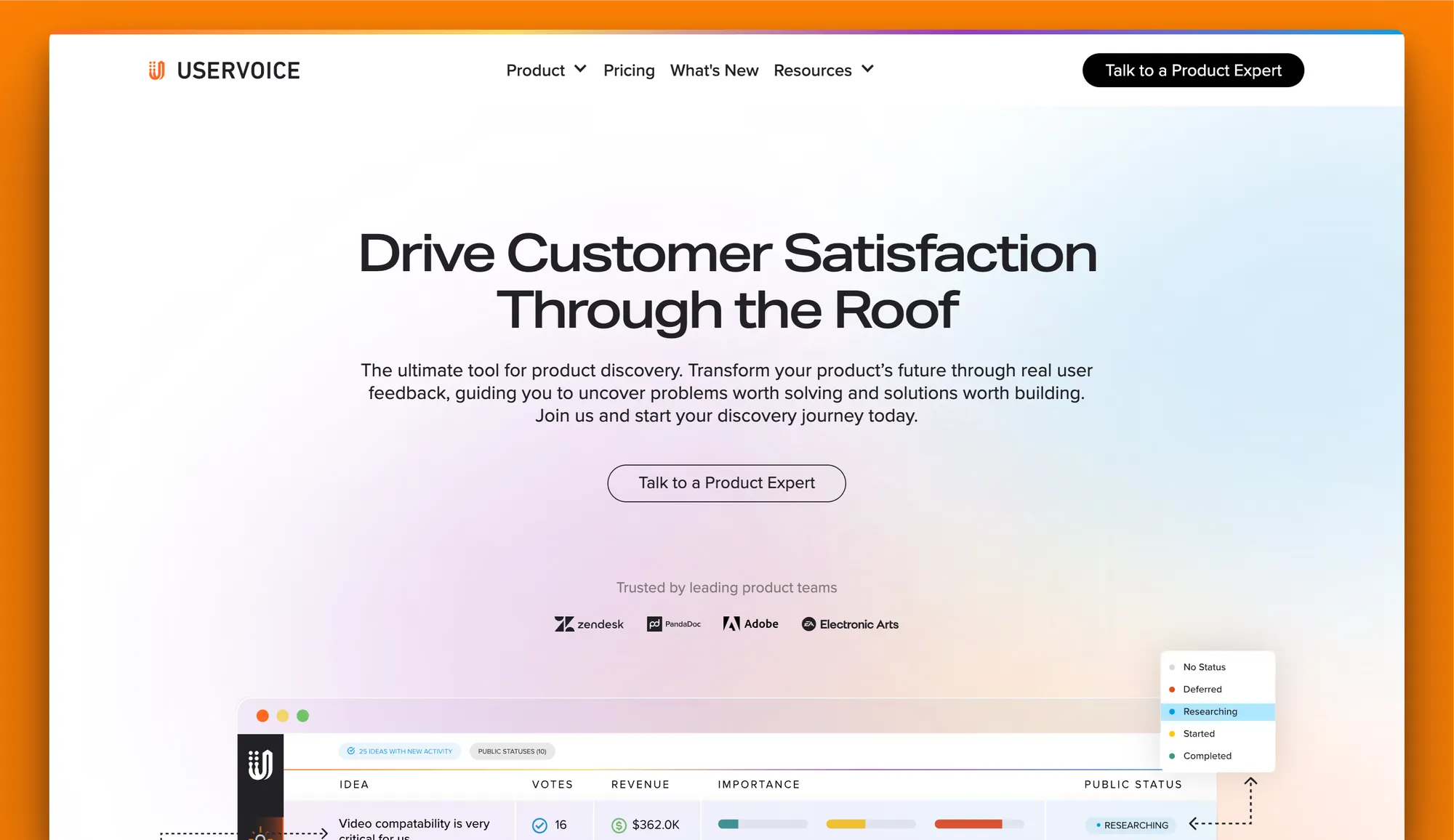
UserVoice is one of the best-known feedback management tools that was launched in 2008.
It lets businesses (primarily software companies) collect and prioritize feedback, round up bug reports and feature requests, and prioritize all of that for maximum impact. Their target audience is enterprise companies.
Canny vs. UserVoice: features
Canny features
Canny combines customer-facing feedback collection with an internal workspace for organizing requests. Its current offering goes beyond a voting board, especially if feedback arrives through support conversations and sales calls.
Top features
- Feedback portals with voting, comments, and status updates
- Public and private product roadmaps, plus a product changelog
- Autopilot feedback capture from sources such as Intercom, Zendesk, Gong, and Slack
- AI deduplication and triage into product areas
- Smart Replies for follow-up questions and Comment Summaries for long discussions
- Revenue analysis using customer and CRM data
- Theme tracking and custom prioritization formulas
- MCP access for working with feedback through compatible AI tools
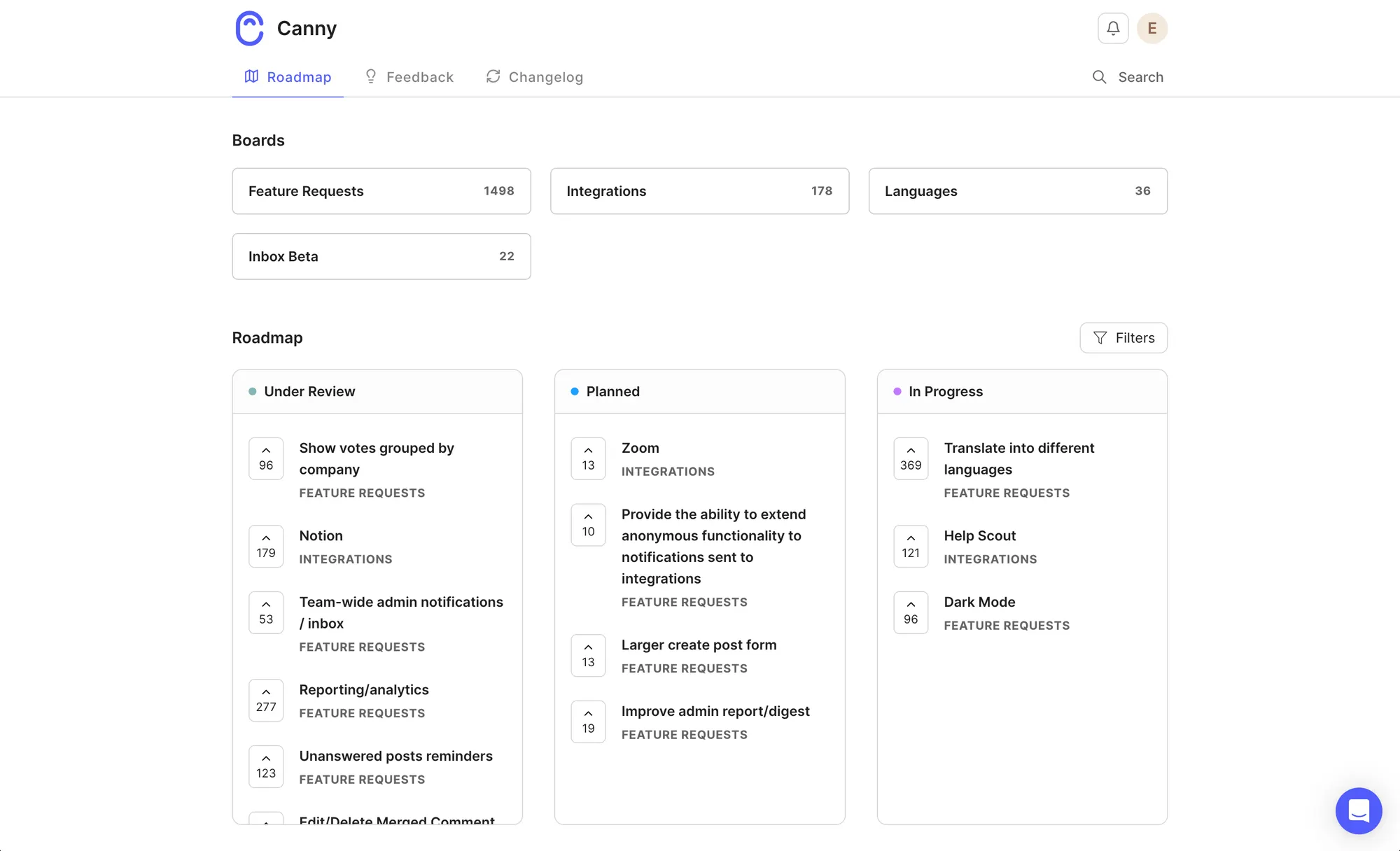
Autopilot helps organize customer feedback and remove duplicates, while revenue data helps prioritize requests. The updated @Canny Slack integration captures feedback and updates ideas on all plans. Jira and Linear require Pro, while Salesforce and HubSpot require Business.
UserVoice features
UserVoice focuses on connecting feedback to customer and account information so multiple teams can act on the same evidence. Its current product includes automatic grouping, sentiment analysis, and themes, alongside its feedback portal and prioritization tools.
Top features
- Centralized feedback from support, surveys, reviews, and in-app channels
- Customer feedback portals with request submission and voting
- Automatic tagging, sentiment analysis, and theme identification
- Duplicate grouping linked to customer accounts
- Revenue-weighted prioritization and customer segmentation
- Shareable reporting for product, sales, success, and leadership
- Customer replies and automated follow-up when requests are resolved
- Integrations including Salesforce, Slack, Zendesk, Jira, and Microsoft Teams
Most notably, UserVoice does not offer the changelog feature, which is present in almost all UserVoice alternatives.
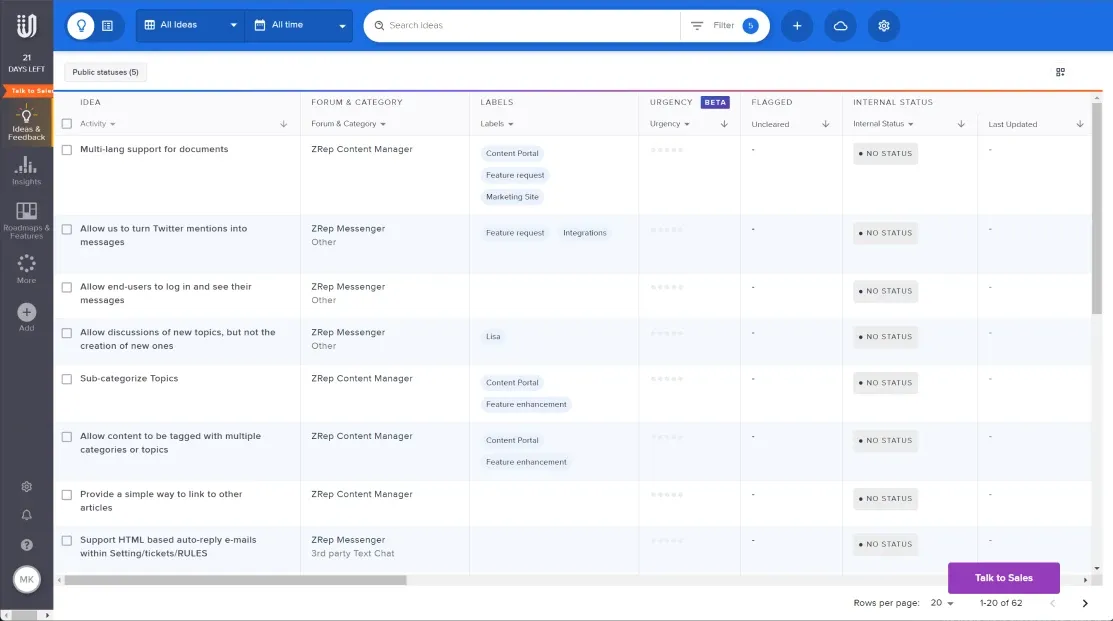
UserVoice supports enterprise feedback management by giving teams shared customer and revenue context. It also helps close the feedback loop with replies and automated follow-ups. Both tools support revenue-based prioritization, so compare their reporting and integrations against your team's needs.
Canny vs. UserVoice: ease of use
Canny usability
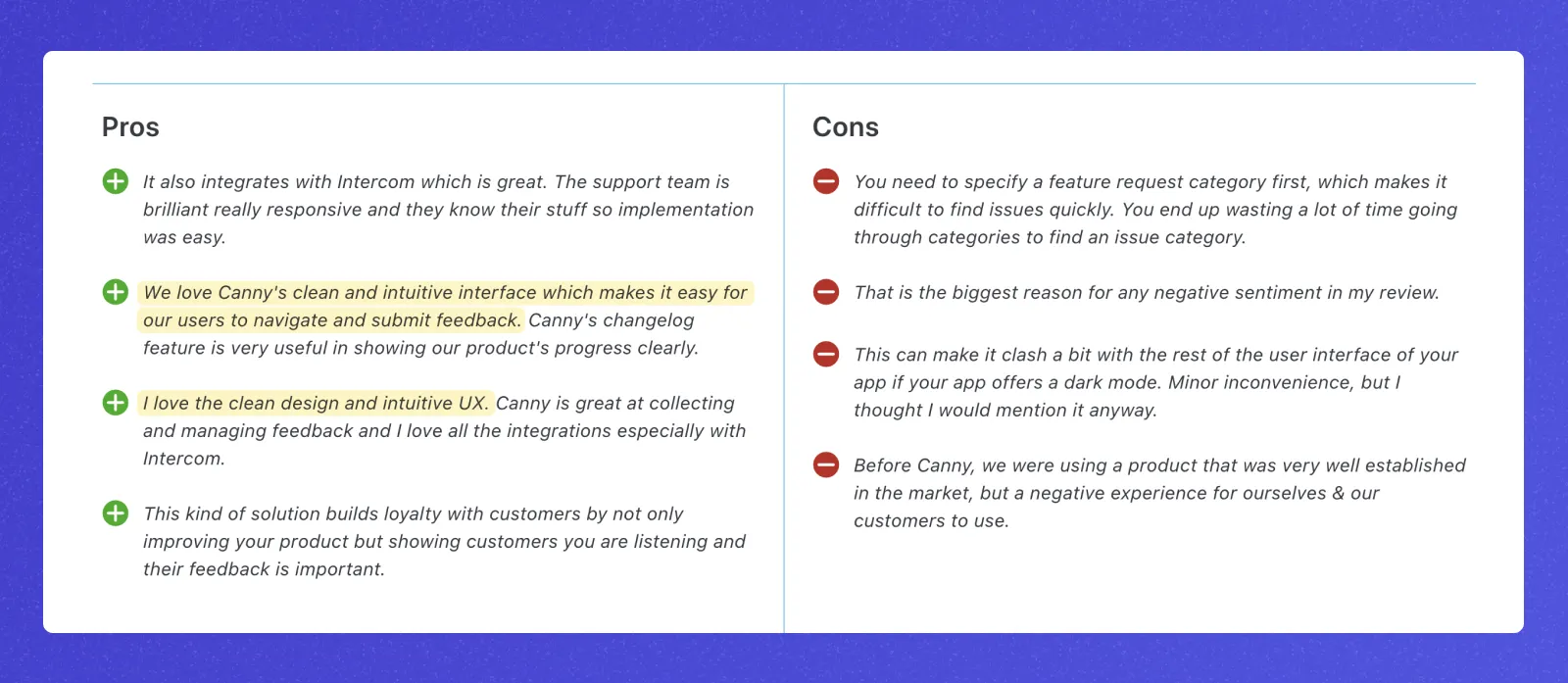
Canny is easy to get started with and offers a free plan without a sales call. G2 reviewers praise its ease of use and feedback organization, though some find customization and filtering limited.
To not bring out every Canny review separately, here are some of the most common reviews from Capterra:
UserVoice usability
UserVoice offers guided onboarding, with most teams launching in 4-6 weeks. G2 reviewers praise its feedback management, but some report a learning curve with advanced features.
Here are some of the most common complaints that customers have:
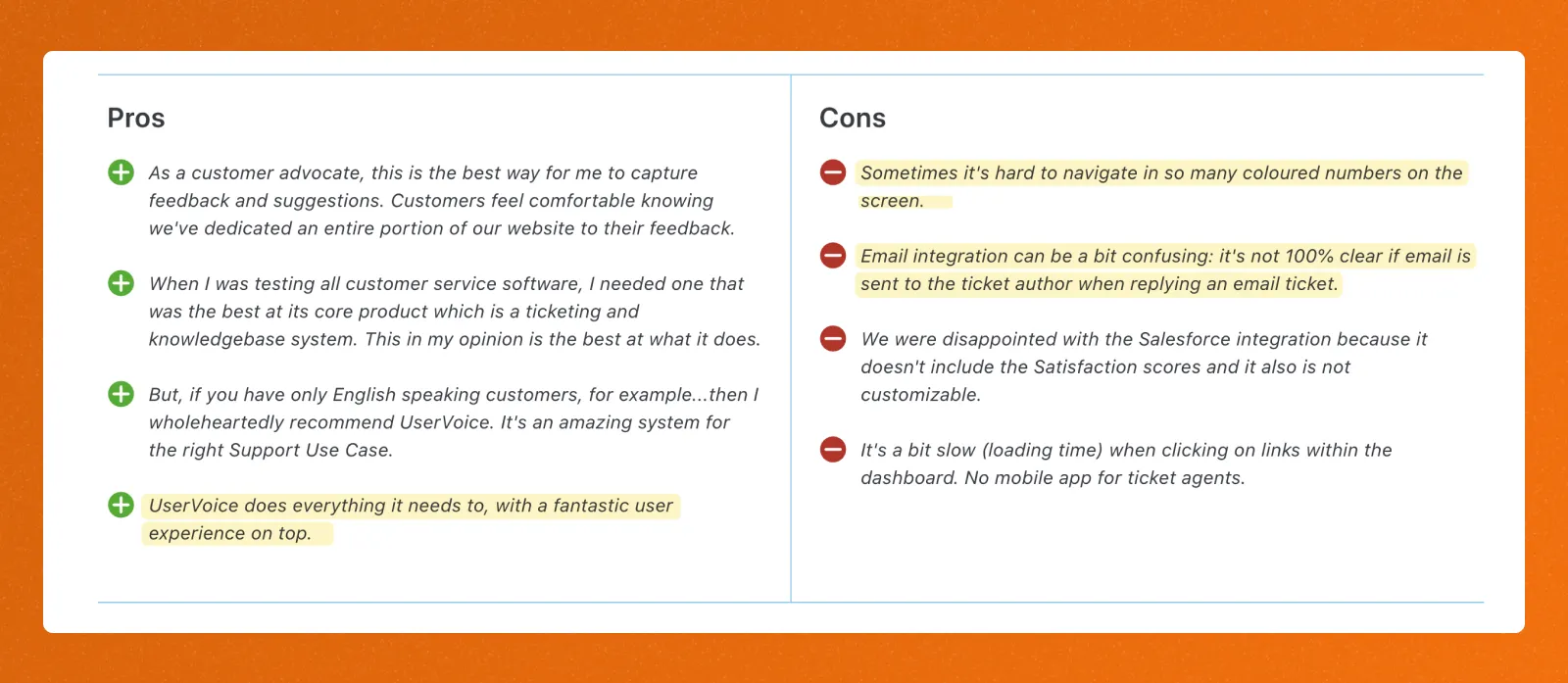
Plus some more:
- Hard to discern between internal feedback and feedback provided on behalf of your customers (Source)
- It's difficult to segment feedback and edit feedback that was already added in Uservoice (Source)
Overall, customers agree that UserVoice can be pretty clunky and difficult to use compared to more modern tools. Regarding the ease of use, Canny is the winner compared to the outdated and sometimes slow UI of UserVoice.
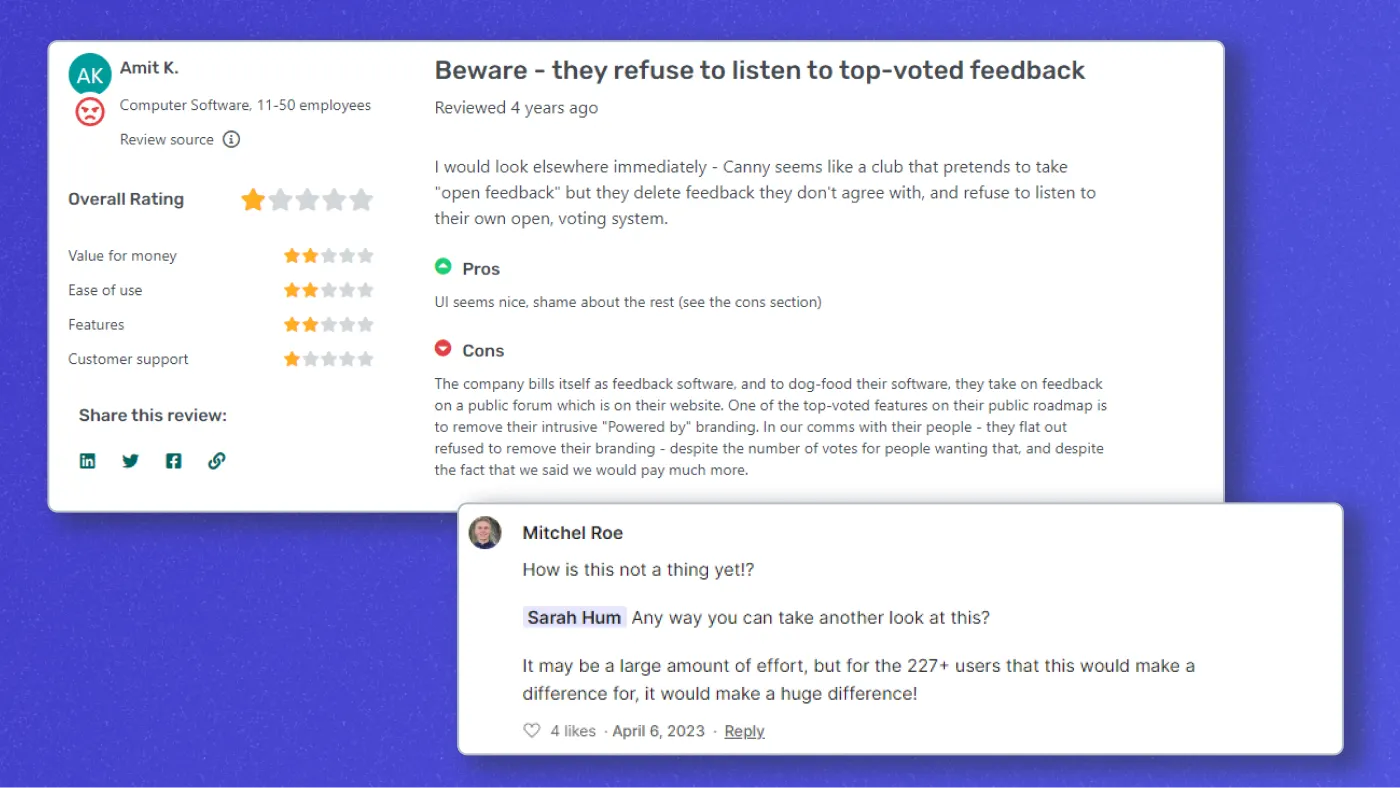
However, a large downside of Canny (as a side note) is that they don't improve their product very often and—ironically—don't listen to their own users' feedback suggestions. We've heard it multiple times, and here are some reviews of it:
Canny vs. UserVoice: pricing
Canny pricing
Canny pricing is known for its frequent changes. At the moment of writing, Canny has four available plans. 👇
| Plan | Price | Included users and key features |
|---|---|---|
| Free | $0 | 25 tracked users, 5 managers, unlimited feedback, and automatic feedback capture |
| Pro | From $79/month billed yearly or $99 monthly | Entry tier of 100 tracked users, 10 managers, PM integrations, and advanced privacy |
| Business | Custom | Advertised for 5,000+ tracked users, with CRM and identity-provider integrations |
A tracked user is someone associated with feedback through a post, vote, or comment. Actions recorded by a teammate or Autopilot on a customer's behalf also count.
Your bill can grow as more customers contribute. Without a spending limit, exceeding your allowance triggers a prorated upgrade to the next tier. With a limit, Canny stops tracking feedback from new users once the cap is reached.
Autopilot is included across the current plans. The starting Pro price is therefore a starting tier, not a flat price for an unlimited customer base.
All in all, compared to many Canny alternatives, it's still quite expensive for what it offers. Don't just take our word for it:

UserVoice pricing
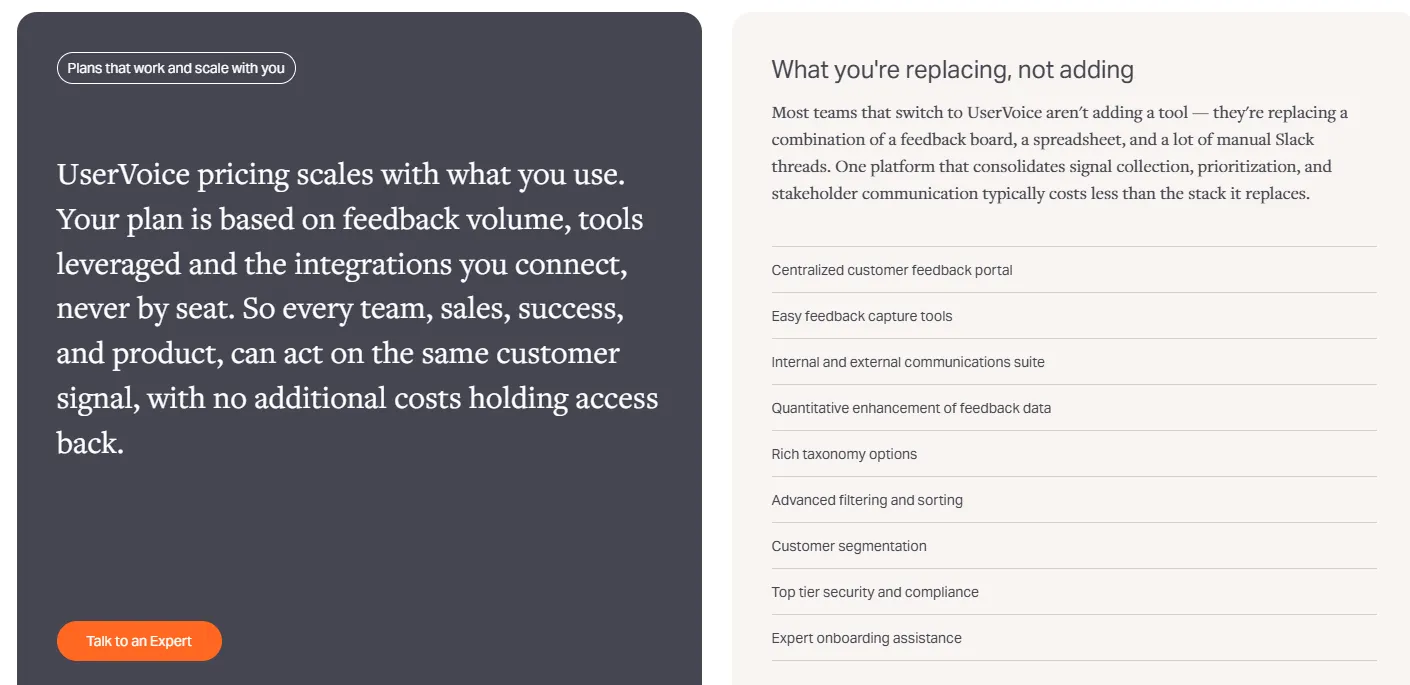
Your package depends on feedback volume, the tools you use, and the integrations you connect. UserVoice explicitly says it does not charge by seat, which matters when several departments need access.
A 30-day trial is available after a demo. Before committing, ask for the included feedback allowance, integration coverage, onboarding costs, and what happens when usage increases.
You cannot calculate an exact saving against Canny until you have that quote. Compare both options against the same requirements and expected usage, including your must-have CRM connections.
Our verdict: Canny makes its entry price easier to evaluate. UserVoice requires a tailored quote, so claims that one is always “half the price” of the other do not give you a reliable buying comparison.
So, which customer feedback tool is better?
Canny is the stronger starting point for a self-service evaluation. It offers a free plan, public Pro pricing, and a broad feedback workflow with AI capture, roadmaps, and product updates.
UserVoice is worth evaluating for a coordinated customer-intelligence program. Its shared account context, reporting, and guided onboarding can fit organizations rolling feedback management out across several teams.
Before choosing, test the questions that will determine day-to-day value:
- Capture: Can sales and support record feedback with the right customer context?
- Prioritization: Can product teams separate customer demand from revenue impact and make a defensible decision?
- Follow-up: Will customers hear back when their requested work ships?
- Cost: Does the quoted package cover your integrations and expected usage growth?
If neither fits your budget or workflow, compare other Canny alternatives before committing. A tool that combines feedback with the rest of your customer-facing work may be a better fit. 👇
Looking beyond Canny and UserVoice: try Featurebase
Featurebase is a modern feedback & support platform that helps product teams collect feedback, prioritize features, build roadmaps, and announce product updates - all in one place. It’s loved by thousands of product teams from companies like Lovable, Raycast, and n8n. 💫

Top features:
- Feedback forum – Public feedback forum where users can submit ideas and vote on features helping you know what customers want
- In-app widgets – Embed feedback, changelog, and help center widgets directly in your product
- Prioritize by revenue – Link feedback with customer revenue, company size, and much more to better understand the impact of ideas
- AI feedback categorization - Automatically group large volumes of feedback into product areas, projects, or themes with AI.
- Automated email updates – Automatically notify users when their requested features are implemented
- Roadmaps – Create internal & public product roadmaps to keep users informed and build engagement
- Product updates – Publish release notes with a changelog page, in-app widget, and emails
- Surveys (NPS, CSAT, etc) – Create targeted surveys to ask users anything and measure customer satisfaction.
- Automatic AI translations – Automatically translate all feedback and comments to your customers / teammates native languages
- Integrations – Connects with Slack, Linear, Jira, HubSpot, and more
Pricing: Free plan available with unlimited feedback collection. Paid plans start at $29/seat/month billed yearly.
Feature availability depends on your plan. For example, automatic AI tagging is included on Enterprise, while automatic AI translations start on Professional and have usage limits.
For teams comparing Canny and UserVoice, Featurebase brings feedback collection, product updates, support, and a help center together in one place to help you build products your users love.
It comes with a Free plan, and you can get started without a credit card, so there's no downside to trying it. 👇
Start collecting product feedback with Featurebase today for free
More comparisons:
- Canny alternatives
- Canny vs Productboard comparison
- Canny vs ProductPlan comparison
- Canny vs Aha! comparison
- Canny vs Featurebase
- UserVoice alternatives
- UserVoice vs Featurebase
FAQs
Canny is a candidate for teams moving their feedback portal, prioritization workflow, and customer updates out of UserVoice. Test your account relationships, reporting requirements, and integration access before deciding. A familiar voting interface alone does not establish that the rest of your workflow will transfer.
UserVoice advertises a 30-day trial arranged through its sales team, rather than a permanent free plan. Use that evaluation to involve the people who will submit, analyze, and act on feedback, so you can assess adoption before buying.
Canny automatically moves you to the next tier and prorates the additional charge unless you have set a spending limit. If that limit prevents an upgrade, it stops tracking feedback from new users. Check the allowance before importing historical feedback or expanding automated capture to more sources.
Yes, both Canny and UserVoice support connecting feedback to customer revenue. Compare how they treat several contacts from one account, existing customers versus prospects, and requests associated with lost opportunities. Those details determine whether the resulting priorities match your business.
Yes, but choose the import method around the history you need to preserve. Canny's CSV importer supports titles, descriptions, statuses, categories, and tags, with posts attributed to the importing admin. Its API supports assigning authorship and adding votes and comments on users' behalf, so preserving those relationships needs a more detailed migration.


