Blog ComparisonsCanny vs Productboard: What to Purchase in 2026?
Canny vs Productboard: What to Purchase in 2026?
Choosing between Canny and Productboard? Both tools are popular but come with tradeoffs.

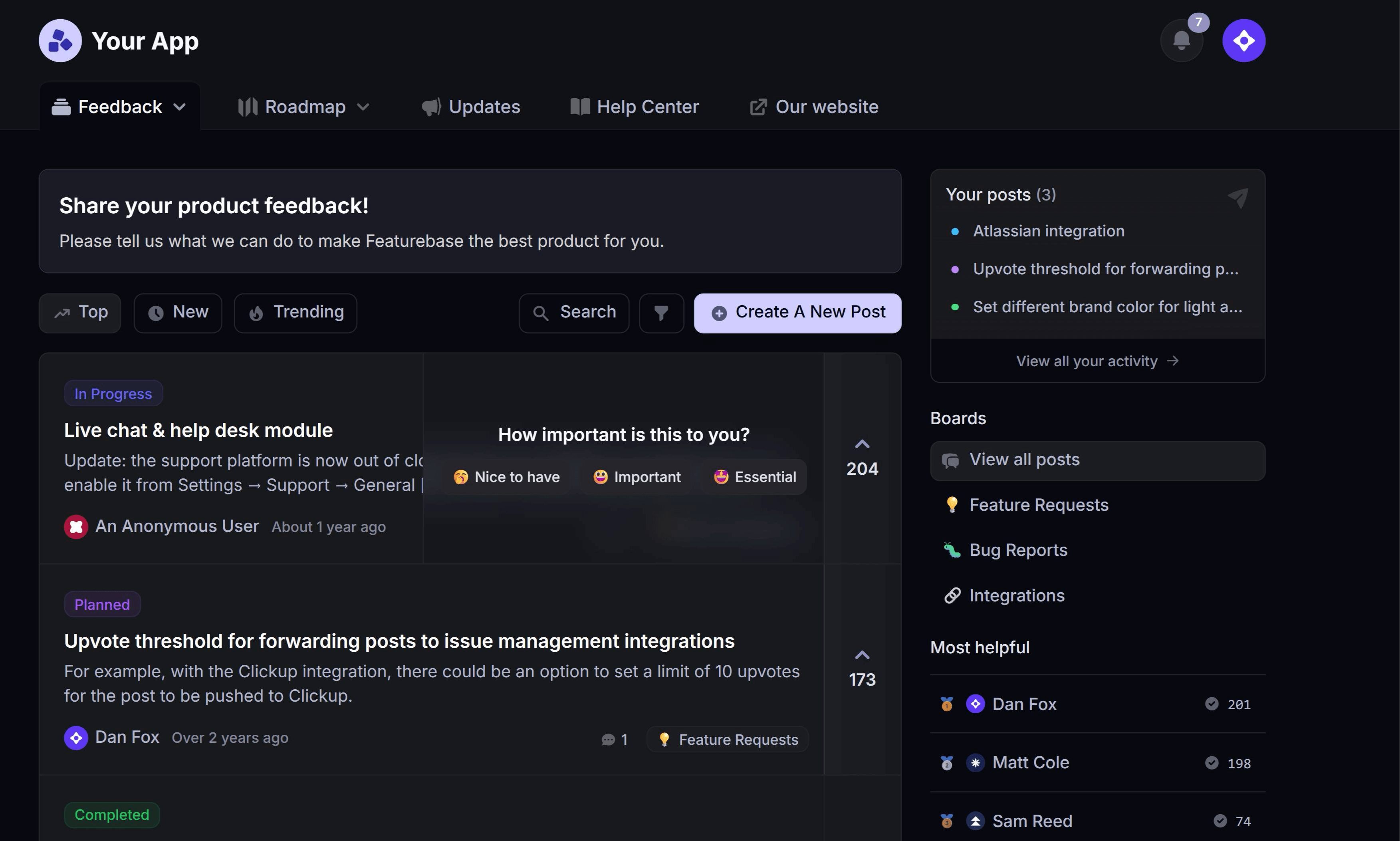

✨ Looking for feedback, roadmaps, and support in one place? Check out Featurebase →
No matter the type of business you run, you will eventually realize that not even the best features at the lowest price point will save your product if you don't listen to your customers.
Canny and Productboard both help you turn customer feedback into product decisions. But choosing between them means comparing 2 different workflows: managing customer requests and planning broader product strategy.
In this guide, I'll compare their feedback collection, AI, roadmaps, pricing, and user reviews so you can choose the right fit for your team. 👇
TL;DR - a short overview:
- Canny and Productboard are two powerful feedback management tools, but:
- Canny focuses on collecting and prioritizing customer feedback
- Productboard focuses on product management & roadmaps
- Canny’s most affordable plan starts at $79/month, billed annually, for 100 tracked users. Productboard pricing starts from $59/maker/month annually, with a 5-maker minimum
- User reviews: Canny is loved for simplicity but criticized for its steep pricing jumps and limited reporting options. Productboard shines in features but has a steeper learning curve and struggles with feedback collection.
- Both tools are solid options, but the right choice depends on whether you’re prioritizing feedback collection (Canny) or product management & roadmaps (Productboard).
That said, they are quite pricey and lack some helpful features. If you're after a more powerful tool, check out Featurebase (👋 that’s us). We’re an alternative to Productboard and Canny—but we'll back up everything in this comparison with customer reviews. 🤞
Canny | Productboard | |
|---|---|---|
Core focus | Feedback collection and prioritization | Product management and roadmap planning |
Feedback collection | Centralized feedback boards with voting and comments | Collects feedback from multiple sources like Zendesk, Slack, and Gong |
Feedback organization | Automatic grouping, deduplication, and source tracking | Organizes feedback into insights linked to features |
Prioritization | Based on votes and user demand | Advanced scoring with impact and user segmentation |
AI capabilities | AI summaries and basic deduplication | Insights organization and prioritization based on structured data |
Roadmaps | Public and private roadmaps with basic planning | Advanced roadmaps with strong alignment to product strategy |
Integrations | Integrates with tools like Gong, Help Scout, Zendesk, Jira | Deep integrations with Jira and other tools with two-way sync |
User involvement | Strong focus on user voting and engagement | More internal, product team driven prioritization |
Changelog | Built-in changelog for updates and releases | Supports closing the feedback loop but less changelog focused |
Ease of use | Simple and easy to get started | More complex, steeper learning curve |
Best for | Teams that want simple feedback collection and prioritization | Product teams managing complex roadmaps and product strategy |
Canny vs Productboard
Canny overview
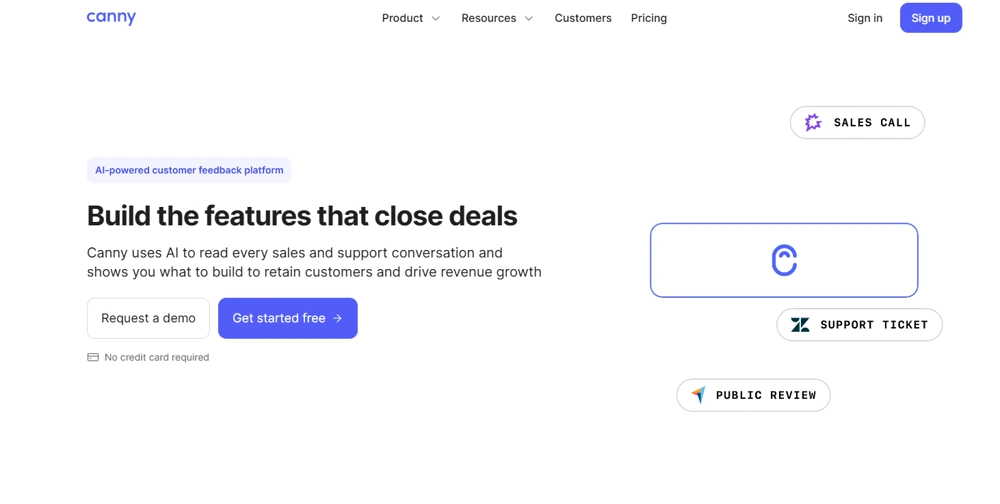
Canny is a customer feedback platform that allows businesses to collect and analyze customer feedback, gather and prioritize feature requests, build product roadmaps, and keep customers informed through public changelogs.
It brings all feedback into one place, so product and support teams can stop juggling spreadsheets, emails, and scattered notes. Users can submit ideas, vote on existing requests, and leave comments, giving teams clear insight into what matters most. This makes it easier to spot patterns, identify high-impact improvements, and make decisions based on real demand instead of guesswork.
Productboard overview
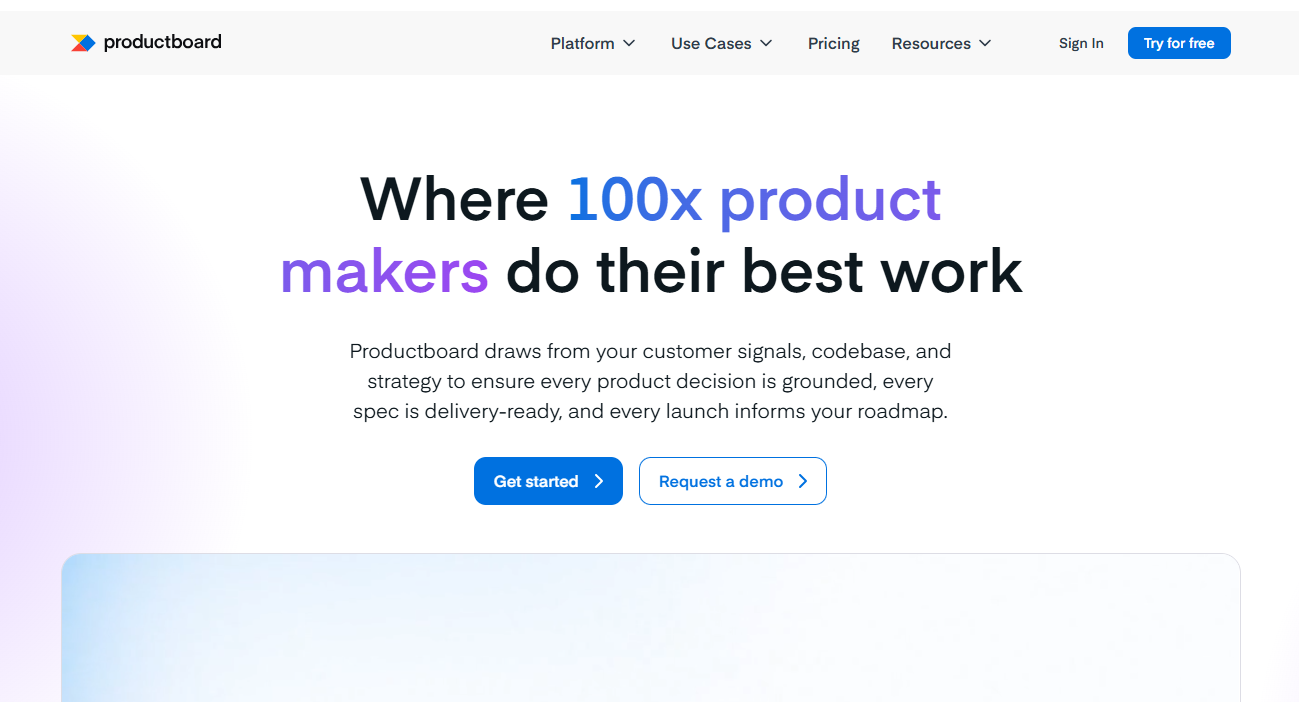
Productboard is a product management platform built for product teams that want to create dynamic roadmaps, align with go-to-market teams, launch coordinated product releases, uncover hidden insights, and successfully close the feedback loop.
It focuses heavily on helping teams understand customer needs at scale by centralizing feedback from multiple sources such as sales calls, support tickets, and user interviews.
Product managers can organize this customer data into insights, link it directly to features, and prioritize work based on business impact. With structured prioritization frameworks and team collaboration tools, Productboard helps teams move from raw feedback to clear product decisions without losing context along the way.
Regarding positioning, Canny is built for any team that wants to collect user feedback. On the other hand, Producboard primarily targets product management teams.
Canny vs Productboard: features
When comparing Canny and Productboard, the biggest differences show up in how they handle feedback collection, prioritization, and roadmap planning. While both tools aim to help product teams make better decisions, they take slightly different approaches in how features are structured and how insights are surfaced.
Canny focuses on simplicity and accessibility, making it easy to collect feedback, organize feature requests, and keep users in the loop. Productboard, on the other hand, places more emphasis on structured product management, with deeper prioritization frameworks and tighter alignment between customer insights and long-term planning.
Canny features
Canny has various features for collecting and managing customer feedback. It integrates with platforms such as Gong, Help Scout, and Zendesk. With Autopilot, feedback from connected sources can be captured, organized by topic, and deduplicated.
Autopilot goes beyond basic summaries. It can extract requests from sales and support conversations, connect them to customer context, and group related feedback so the team can review themes without sorting every conversation manually.
Canny also uses AI comment summaries to give you essential information at a glance. Its current Free and Pro plans include uncapped Autopilot credits, although feedback capture can still increase your tracked-user count.
You can set up a centralized feedback board where customers can add new feature requests or vote on existing ones. This facilitates feature prioritization and helps you quantify user insights. You can also link user accounts in Canny with those in your product.
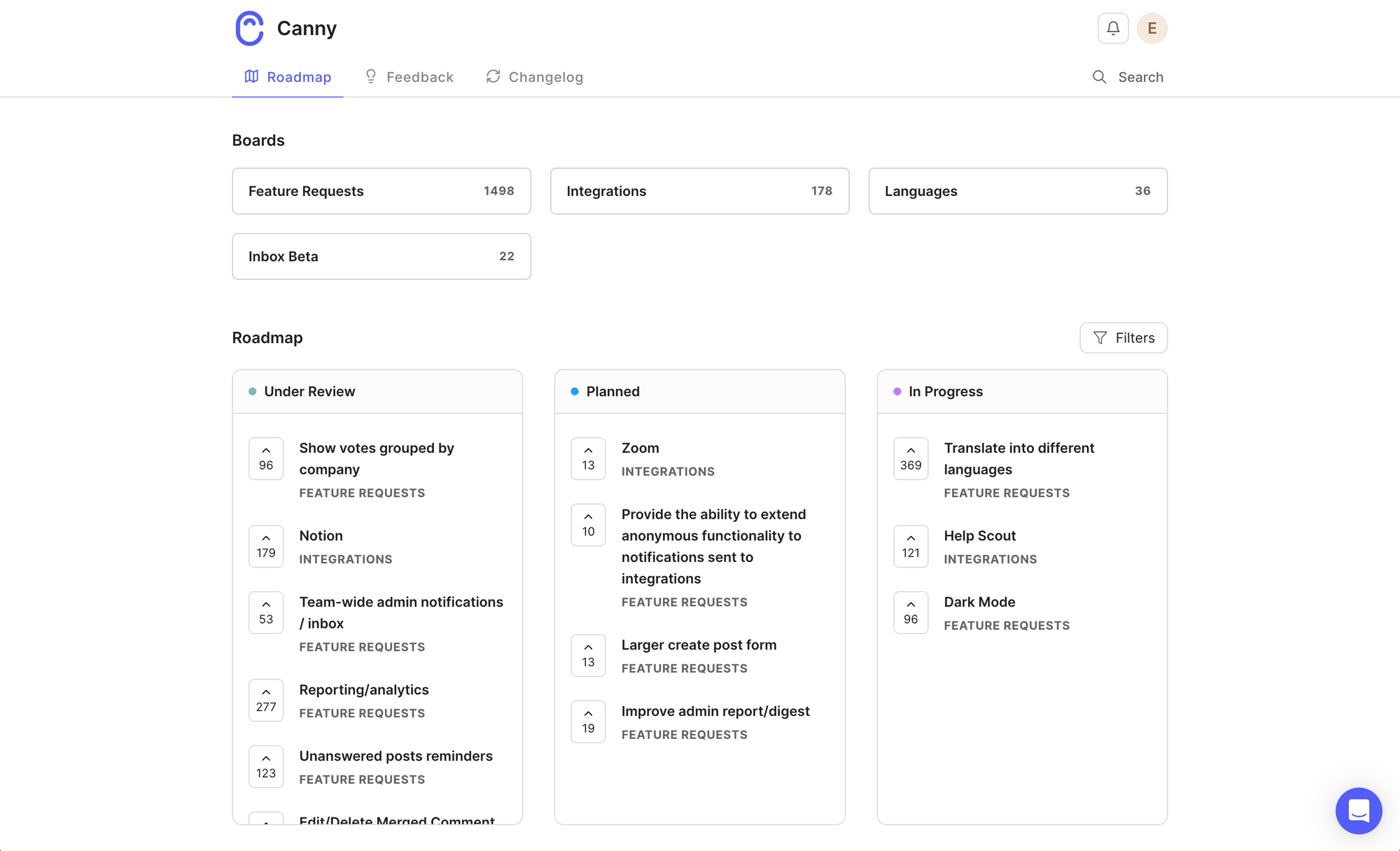
Votes give you a demand signal, but they aren't the only way to prioritize. Paid features such as segmentation help teams look at which groups are asking for a feature instead of relying entirely on its vote total.
You can build and manage public and private roadmaps, helping users get an overview of potential new features. The roadmaps can be integrated with project management tools such as Jira to keep the development team up to date with tasks and plans.
Last but not least, you can complete your feedback strategy by publishing a changelog with new releases and bug fixes.
The Slack workflow is also more capable now. With the integration connected, you can mention @Canny in a channel or thread to capture an idea or insight, update an owner or status, and create user or company records.
That lets a teammate capture a request on a customer's behalf with conversation context attached. Autopilot can then associate the insight with an existing idea or create a new one, reducing the copying and pasting between Slack and the feedback board. The @Canny workflow is available on all current plans.
Productboard features
Productboard has a range of features to keep your product launches on track, with the most important one being the roadmaps.
Productboard lets you build private and public roadmaps for internal stakeholders and customers. With a two-way integration with project management software like Jira, you can automatically update the roadmap when your dev team pushes a new feature to go live.
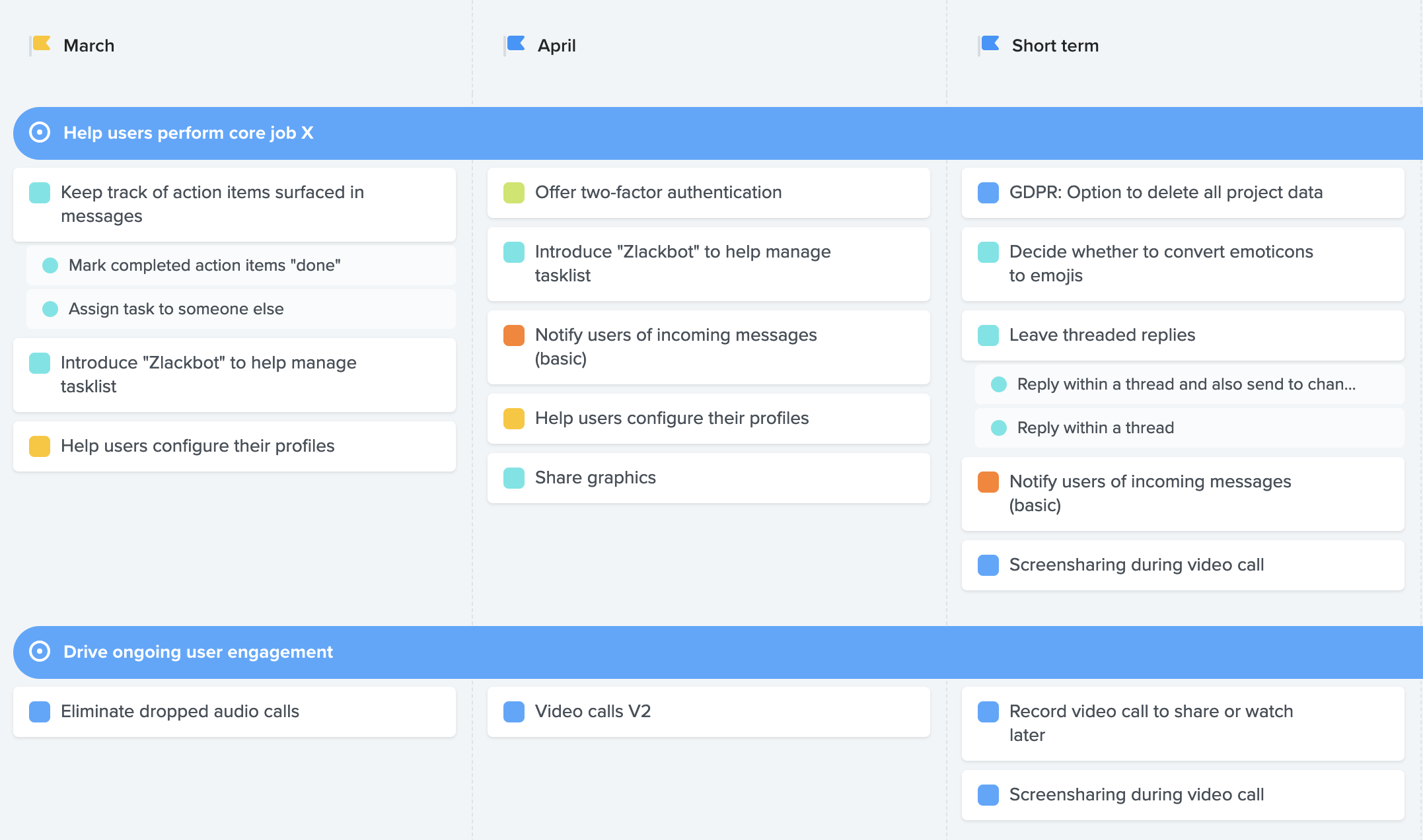
The Customer Insights portion of Productboard allows you to collect feedback from various touchpoints and put it into a centralized board. For example, you can get feedback from Zendesk, Gong, Slack, and others.
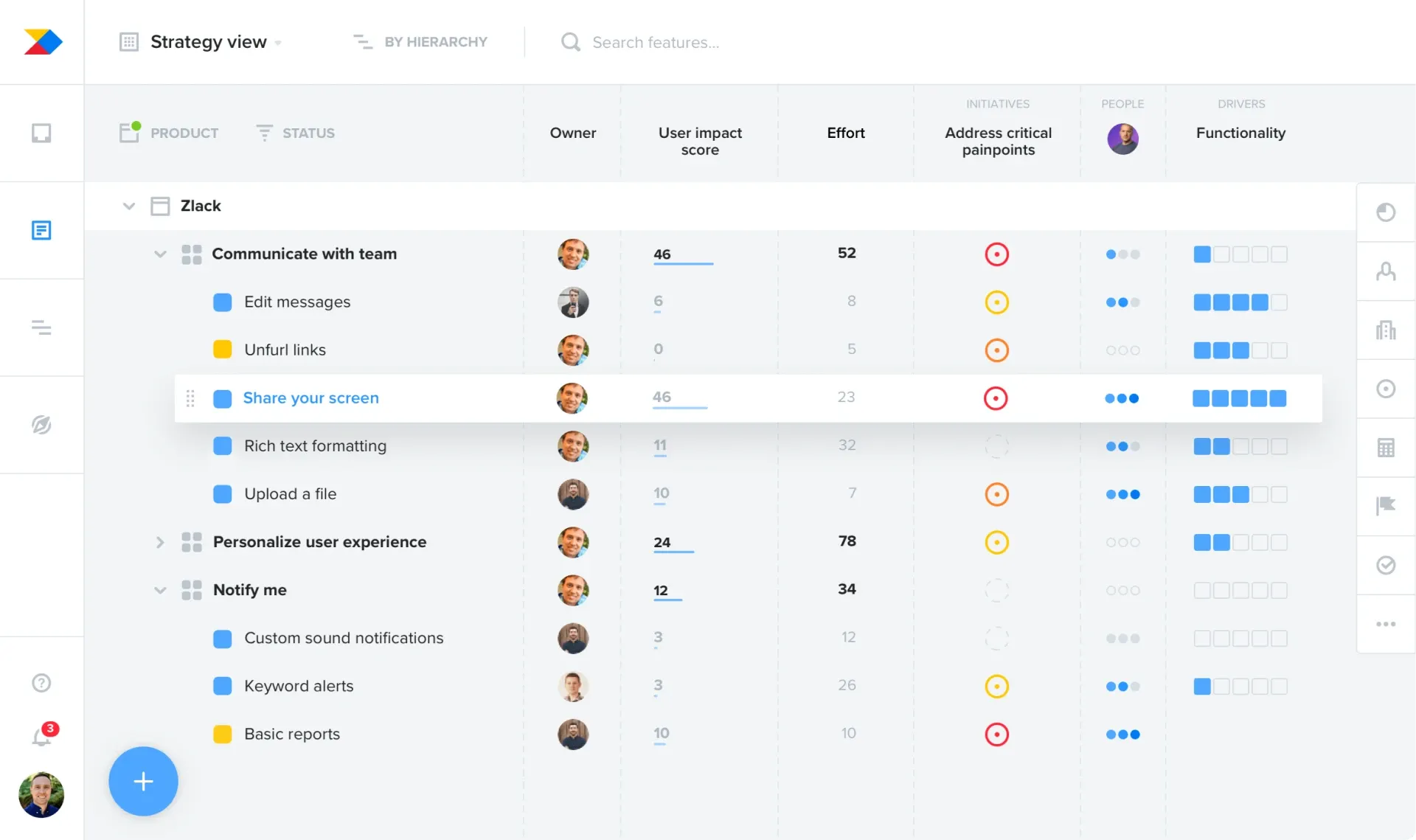
Based on who submits the feedback and what the topic is, Productboard helps you prioritize it and give it a score. Each user gets an impact score, allowing you to determine which features are the right fit for your long-term company goals.
Canny vs Productboard: pricing
This is one of the main differences between the two. Larger teams often end up going with Productboard because it's more affordable, while smaller teams that need to collect and manage feedback easily opt for Canny, despite the high price tag.
Canny pricing
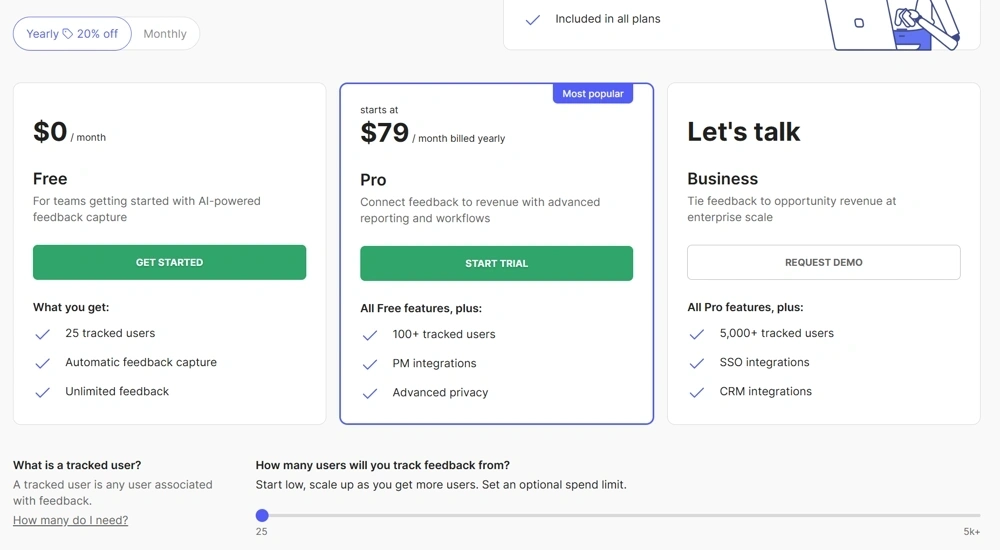
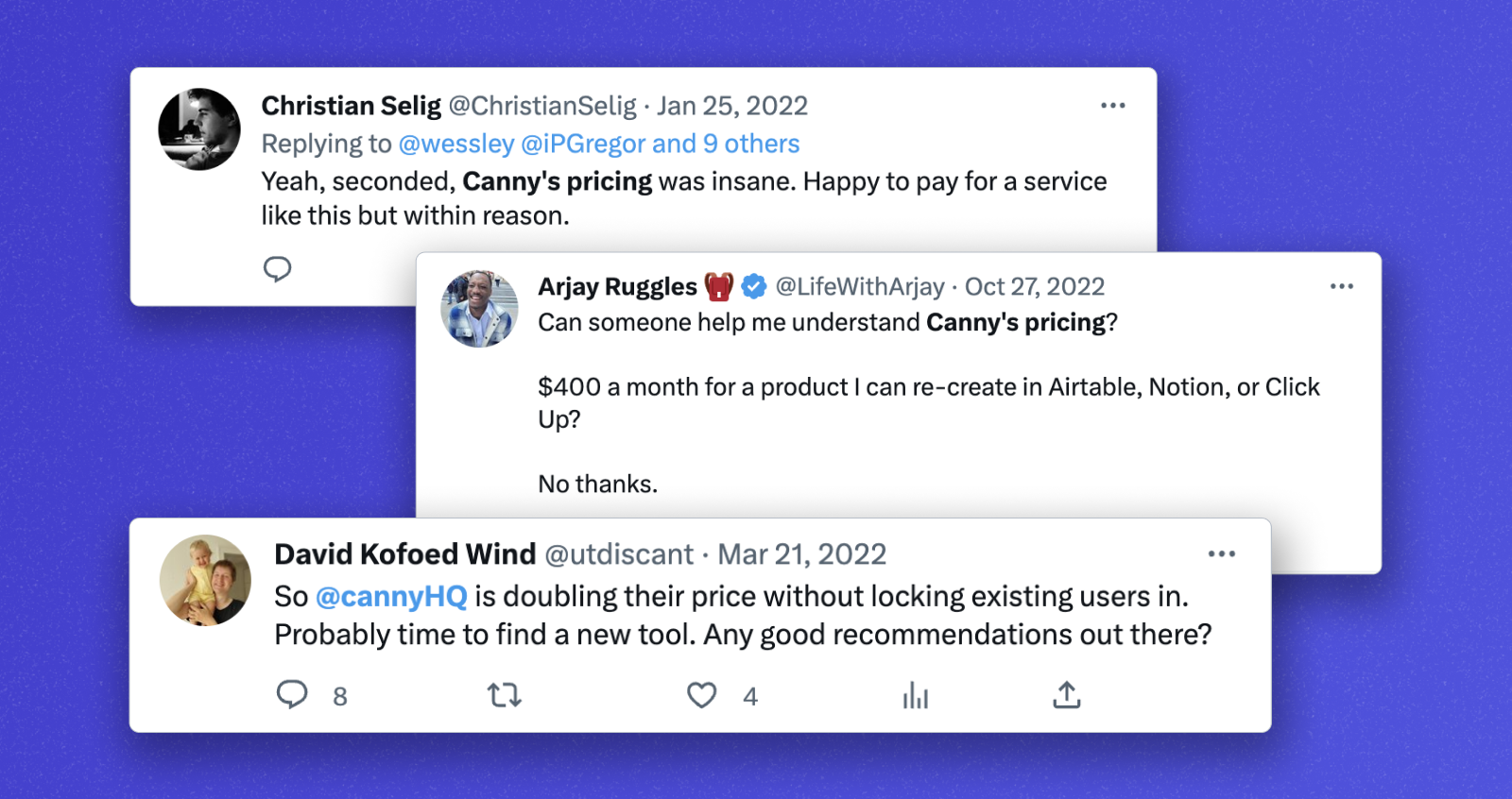
Canny pricing has 3 current plans: Free, Pro, and Business. Starter and Growth belong to its legacy pricing, so the old $79 Starter versus $359 Growth comparison no longer describes the current offer.
| Plan | Price | Included usage and key features |
|---|---|---|
| Free | $0 | 25 tracked users, 5 managers, unlimited posts and boards, Autopilot, roadmap, and changelog |
| Pro | From $79/month billed annually or $99/month billed monthly | 100 tracked users, 10 managers, project management integrations, custom domains, advanced privacy, segmentation, and automation |
| Business | Custom | Larger usage requirements and enterprise needs, with CRM integrations and advanced authentication subject to the package |
The Pro starting price is $948 per year. It includes 100 tracked users, rather than unlimited feedback contributors at a fixed price.
The number of people represented in your feedback determines the tier. Here are a few examples from Canny's published Pro pricing:
| Tracked users | Monthly equivalent, billed annually | Month-to-month price |
|---|---|---|
| 100 | $79 | $99 |
| 500 | $279 | $349 |
| 1,000 | $529 | $661 |
Without a spend cap, exceeding your allowance can move you to the next tracked-user tier with a prorated charge. A spend cap limits that spending, but Canny then stops tracking feedback from new users when the cap is reached.
Budget around participation, including feedback captured through integrations. The number of customers who visit your product isn't the same as the number represented in your feedback system.
Productboard pricing
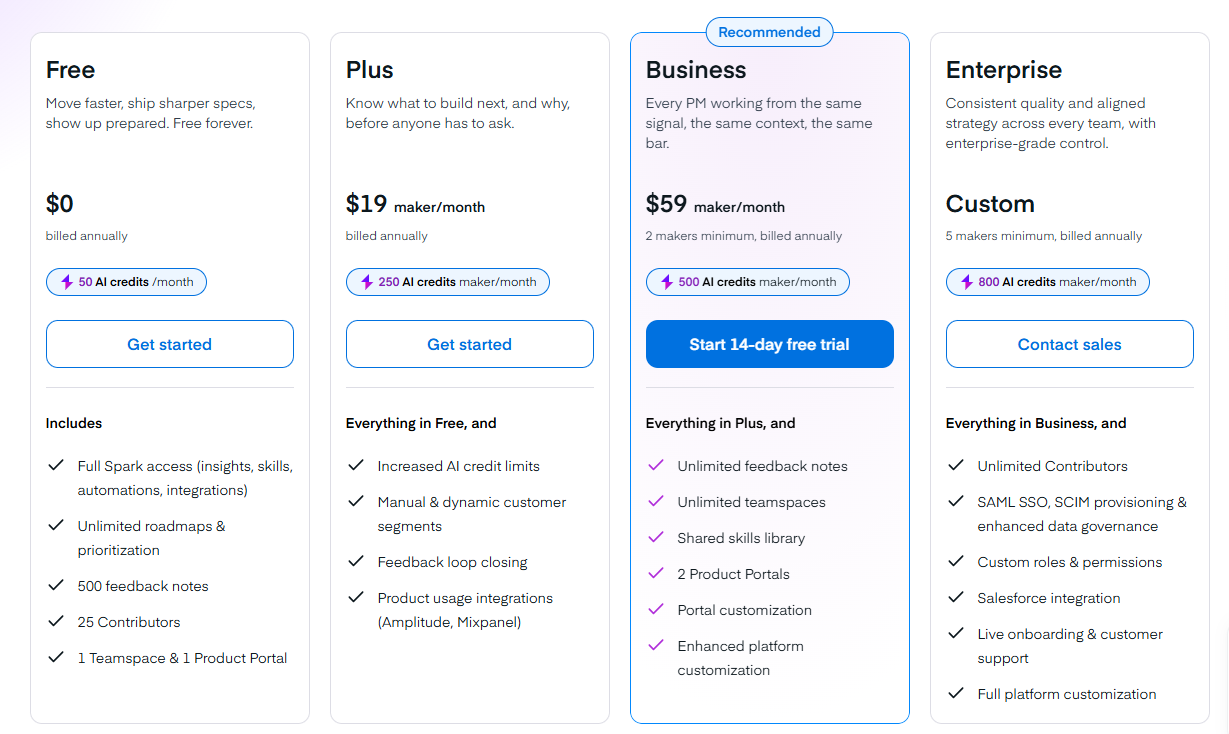
Productboard pricing needs a closer look than a single starting-price comparison. Its public materials currently show different offers, so confirm both the available plan and maker minimum for your workspace.
The displayed Business offer breaks down as follows:
| Plan | Annual billing | Monthly billing | Commitment and AI |
|---|---|---|---|
| Business | $59/maker/month | $75/maker/month | Displayed 5-maker minimum, 500 AI credits per maker/month |
| Enterprise | Custom | Custom | Enterprise controls and a larger AI allowance |
At that 5-maker minimum, Business costs $295/month billed annually, or $3,540 per year. Paying monthly makes the minimum $375/month.
Business includes unlimited feedback notes, roadmaps, and prioritization, alongside customer segmentation, dependency tracking, and custom prioritization formulas. Enterprise adds controls such as SSO and SCIM, with terms set through sales.
Productboard's public pricing materials have also shown Free and Plus self-serve offers, including Plus at $19/maker/month annually, as well as different Business minimums. Don't assume these offers are available to every buyer, or that the displayed 5-maker offer is the only purchasing route.
Compare the actual offer, not just the per-maker number. Check the required makers, billing period, included AI credits, and any top-up costs before committing.
Pricing verdict: Canny Pro has a lower starting commitment than the displayed Productboard Business offer. That advantage can narrow or reverse as tracked-user volume grows, while Productboard's cost rises with makers and any additional AI usage.
What users are saying
Reviews for both tools are mixed but Productboard has been around for longer, so it has more feedback to pick from and analyze.
Canny reviews
Canny reviews on G2 commonly praise its straightforward interface and the convenience of tracking feedback in one place. Reviews also highlight integrations and responsive support.
Some reviewers report trouble tracing merged ideas, managing duplicates, or getting the filtering and prioritization views they want. These are useful areas to test with your own backlog, particularly if you already have many overlapping requests.
The practical takeaway is to evaluate how Canny organizes real feedback from your team. A clean board matters, but so does finding the original customer context after requests have been grouped.
Productboard reviews
Most Productboard customers are happy with the tool as it allows them to centralize user feedback and build the right products for their target audience.
However, it can be difficult to make sense of the information provided. Productboard does not handle large data sets well and can have issues loading all the information for your team. Also, the dashboards can feel cluttered and disorganized.
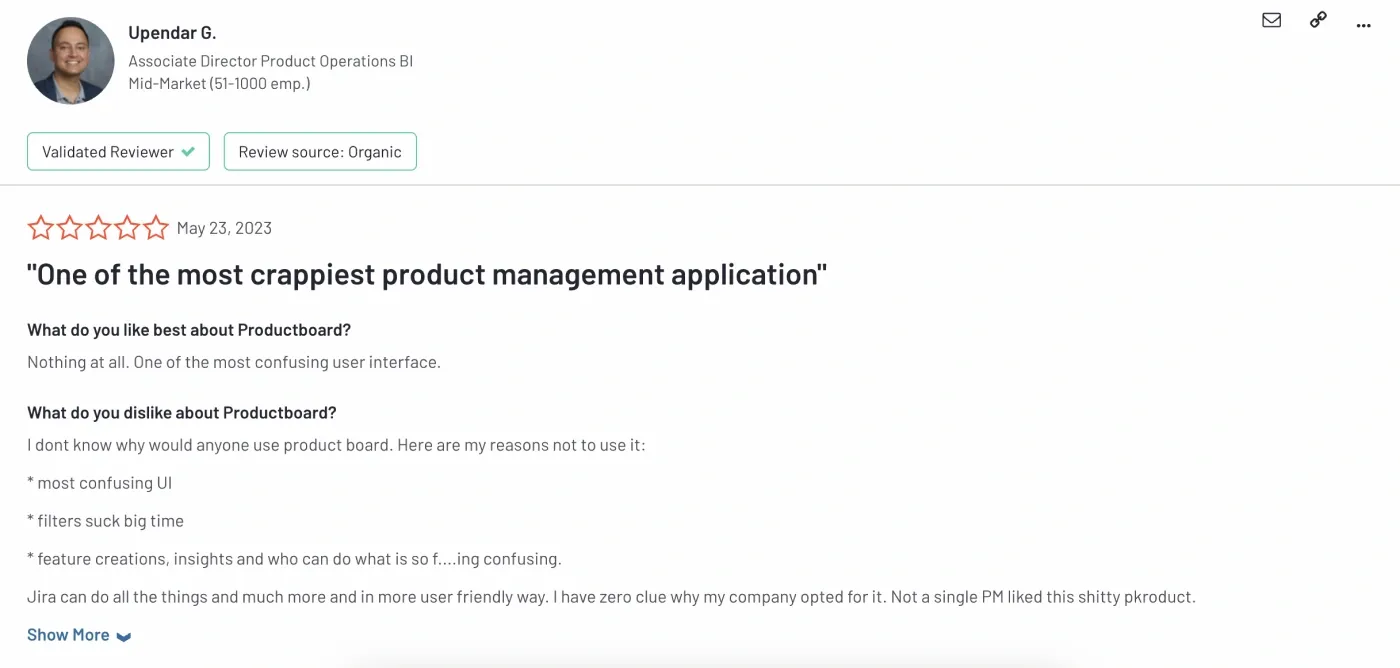
In general, most Productboard customers have no complaints about the product's features or value. Instead, it's all about the user experience, which is clunky and slow. The learning curve is steep, and if you're new to product management tools, it can take a while to master Productboard.
Canny vs Productboard: which should you choose?
Choose based on the workflow your team needs most, then check the cost at your expected usage.
- Choose Canny for feedback operations: It fits teams that want a customer-facing request board, voting, automated feedback capture, and a changelog without building a broader planning process around them.
- Choose Productboard for coordinated planning: It fits product teams that need structured insights, segmentation, prioritization formulas, and dependencies across several plans.
- Compare total costs before committing: Model Canny at your expected tracked-user count and Productboard at your required maker count. Include AI usage and the features your team actually needs.
Neither tool wins simply because your company is small or large. A small team can need complex planning, and a large company can still want a focused feedback workflow.

Turn feedback into products your users love
Centralize feedback, identify product opportunities, and build the right features
Looking beyond Canny and Productboard
Canny and Productboard both connect customer feedback to product decisions. If you also want support, surveys, and customer updates together, Featurebase is another option to consider.
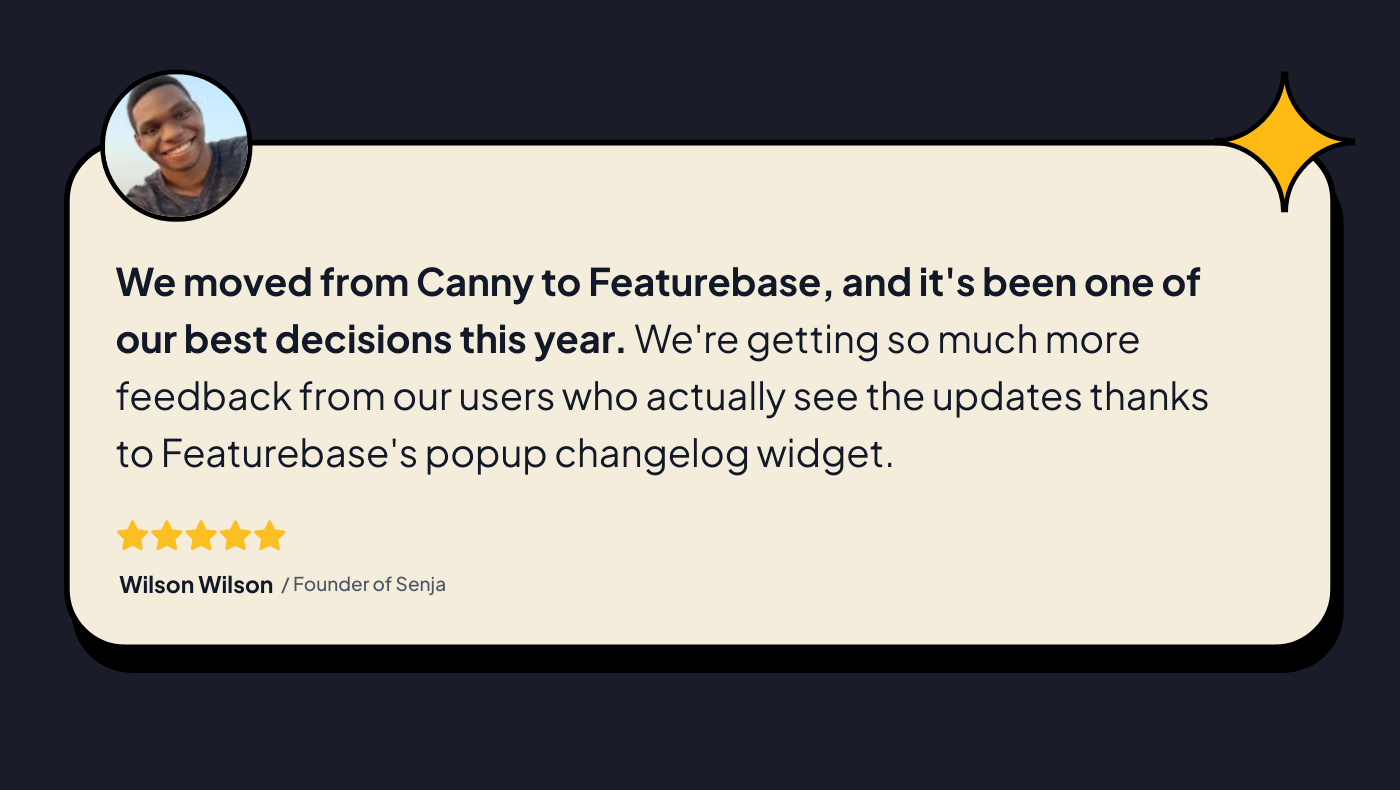
Featurebase is a modern feedback & support platform that helps product teams collect feedback, prioritize features, build roadmaps, and announce product updates – all in one place. It's loved by thousands of product teams from companies like Lovable, Raycast, and n8n. 💫
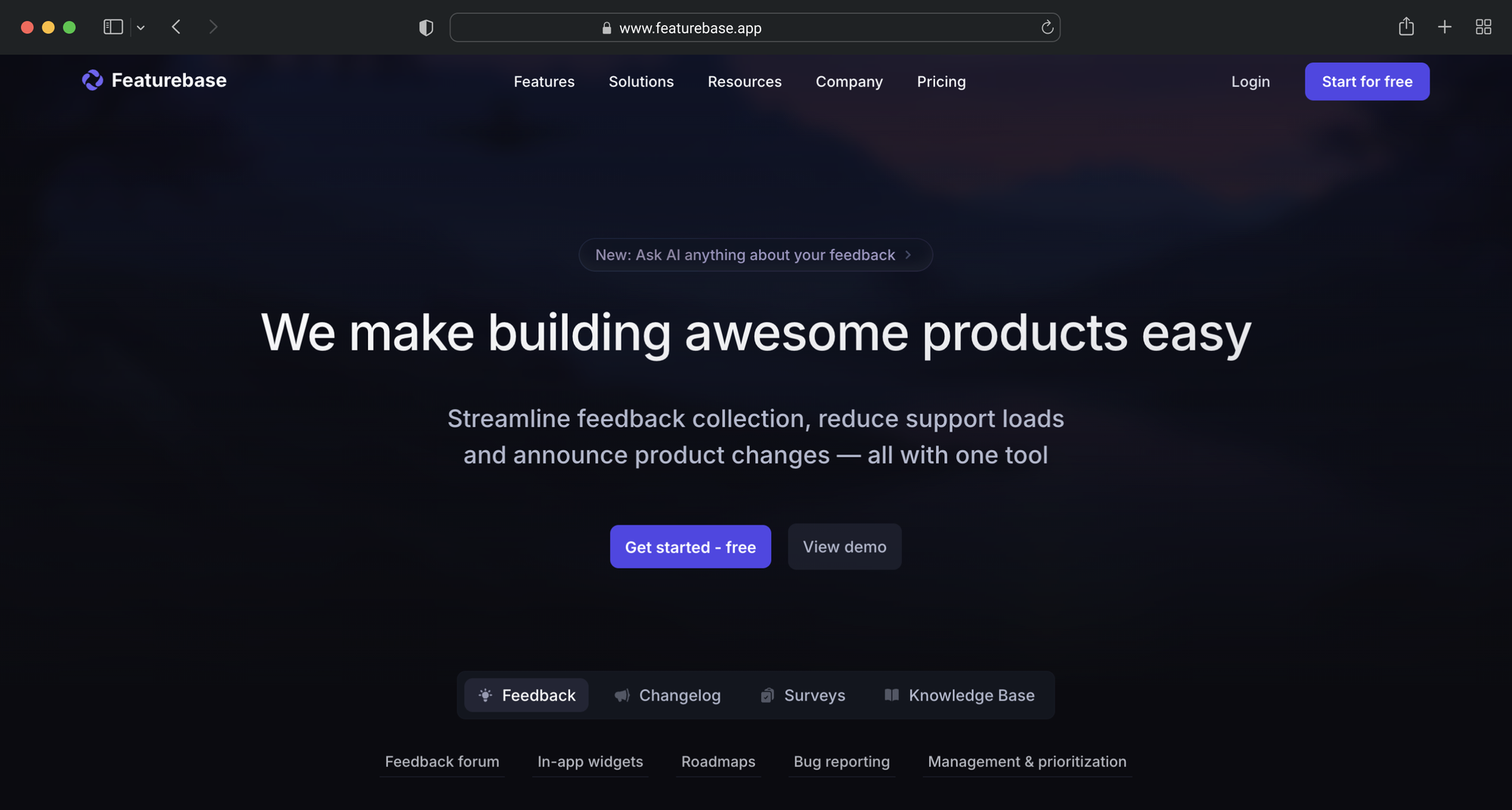
Top features:
- Feedback forum – Public feedback forum where users can submit ideas and vote on features helping you know what customers want
- In-app widgets – Embed feedback, changelog, and help center widgets directly in your product
- Prioritize by revenue – Link feedback with customer revenue, company size, and much more to better understand the impact of ideas
- AI feedback categorization – Automatically group large volumes of feedback into product areas, projects, or themes with AI
- Automated email updates – Automatically notify users when their requested features are implemented
- Roadmaps – Create internal & public product roadmaps to keep users informed and build engagement
- Product updates – Publish release notes with a changelog page, in-app widget, and emails
- Surveys (NPS, CSAT, etc.) – Create targeted surveys to ask users anything and measure customer satisfaction
- Automatic AI translations – Automatically translate feedback and comments into your customers' and teammates' native languages
- Integrations – Connects with Slack, Linear, Jira, HubSpot, and more
Pricing: Free plan available with unlimited feedback collection. Paid plans start at $29/seat/month billed annually. Feature availability varies by plan.
Instead of having 4+ different tools, Featurebase enables you to replace your customer-facing tools by bringing your feedback collection, product updates, support, and help center together in one place to help you build products your users love.
With a Free plan, there's no downside to trying it with your team's feedback before choosing a paid plan. 👇
✨ Start collecting product feedback with Featurebase today for free →
More comparisons:
- Canny alternatives
- Canny vs UserVoice comparison
- Canny vs Featurebase comparison
- Canny vs Aha! comparison
- Canny vs ProductPlan comparison
- Productboard alternatives
- Productboard vs ProductPlan comparison
- Productboard vs Aha! comparison
- Productboard vs Featurebase
FAQs
Can Canny replace Productboard?
Canny can replace Productboard for a team mainly using it to collect requests, prioritize feedback, and share a roadmap. Teams relying on deeper planning workflows, dependency tracking, and cross-team prioritization should check those requirements carefully before switching.
Do both tools support public and private roadmaps?
Yes, Canny and Productboard both support roadmaps for internal and external audiences. Compare the visibility controls included in your plan, since sharing a public roadmap and restricting access to specific customers are different requirements.
What counts as a tracked user in Canny?
A tracked user is a person with a post, vote, or comment attributed to them in Canny. That includes contributions recorded by the person directly, by an administrator on their behalf, or through Autopilot.
Does feedback collected by Autopilot affect Canny's bill?
Yes, feedback captured by Autopilot can add tracked users and move your workspace toward a higher pricing tier. Uncapped Autopilot credits on current Free and Pro plans don't mean unlimited tracked users are included.
Do Canny's free changelogs include notification emails?
No, Canny's Free plan includes a changelog, but changelog notification emails require a paid plan. Publishing a release note and emailing subscribers about it are separate capabilities.