Blog Customer ServiceCustomer Service Goals: 10 Examples + How to Set Them
Customer Service Goals: 10 Examples + How to Set Them
Learn how to set customer service goals that actually move the needle, with 10 measurable examples and a simple framework for hitting them.


"Increase customer satisfaction" isn't a goal. It's a wish.
The teams that actually improve their support don't write vague intentions on a whiteboard. They set goals that name a metric, a number, and a deadline, so everyone knows what winning looks like by Friday.
In this guide, I'll break down what customer service goals really are, how to set them with the SMART framework, and 10 measurable examples you can take to your team today. 👇
Key takeaways:
- A goal is an outcome, not a metric: "resolve issues faster" is a direction, but "cut first response time to under 1 hour by Q2" is a goal you can actually track and hit.
- SMART is the standard for a reason: specific, measurable, achievable, relevant, and time-bound goals beat fuzzy intentions every time.
- Tie every goal to a number you already track: if you can't pull it from a report, it's an aspiration, not a goal.
- Fewer goals, more focus: 3 to 5 primary goals per team is plenty. More than that and none of them gets real attention.
- The right tooling makes goals easier to hit: Featurebase✨ brings your inbox, AI agent, help center, and surveys together so you can measure and improve support in one place.
What are customer service goals?
Customer service goals are specific, measurable targets that guide how your team handles customer interactions. They turn a broad ambition like "be better at support" into concrete objectives your team can work toward and measure.
The part most teams get wrong is mixing up three different things. Keeping them separate is what makes a goal actually usable:
- The goal is the outcome you want, like faster replies, happier customers, or fewer repeat tickets.
- The metric is how you measure it, like first response time, CSAT, or repeat contact rate.
- The target is the number and deadline, like "cut first response time to under 1 hour by the end of Q2."
Put together, you get a real goal: "Reduce first response time on email from 4 hours to 1 hour by the end of Q2." Everyone reading that knows exactly what to aim for and when.
Why customer service goals matter
Good support isn't an accident. It comes from a deliberate customer service strategy and a team that knows what it's working toward, and goals are how you point everyone in the same direction.
Without them, two agents will define "good service" completely differently. One races to close tickets fast, the other spends 20 minutes on every conversation. You end up with inconsistent service and data you can't act on.
Goals fix that by doing a few things at once:
- Direction: everyone knows the plan, so agents can make confident decisions without checking in on every call.
- Fair management: measurable targets give managers an objective way to coach and review performance.
- Alignment: when goals ladder up to business outcomes, the whole team rows in the same direction.
And the business case is hard to ignore. Acquiring a new customer can cost 5 to 25 times more than keeping an existing one, and research from Bain shows that a 5% increase in retention can lift profits by 25% to 95%. Support is one of the biggest levers on whether customers stay, which makes service goals a growth investment, not just an ops checkbox.
How to set customer service goals (the SMART framework)
The most reliable way to write a goal that sticks is the SMART method. It's been around forever because it works, and it stops you from setting targets that are too vague to act on or too unrealistic to hit.
A SMART goal is:
- Specific - name exactly what you want to change
- Measurable - tie it to a number you can pull from a report
- Achievable - ambitious, but within reach of your team and tools
- Relevant - connected to a real business outcome
- Time-bound - has a deadline that creates urgency
Here's the difference it makes. "Improve customer satisfaction" fails every test. "Increase CSAT from 82% to 87% over the next quarter" passes all 5, and your team knows precisely what they're aiming for.
One warning: don't set goals you can't actually reach. A target of 100% satisfaction sounds great on paper, but the first negative review makes the whole team feel like they've failed. A 5% lift over a realistic timeline motivates your team far better than perfection nobody can hit.
10 customer service goal examples
These are 10 of the most useful goals for support teams, with the metric to track for each and a few ways to move it. Treat them as a menu, not a checklist. Pick the few that map to your biggest problems right now.
1. Cut first response time
First response time (FRT) measures how long a customer waits for their first human reply. It's one of the most visible signals of whether you respect a customer's time.
The trap is chasing speed at the cost of quality. A fast, unhelpful reply is worse than a slightly slower one that actually solves the problem, so set the target by channel (chat should be faster than email) and watch your reopen rate alongside it.
To improve FRT, staff up during peak hours, assign agents to specific channels to reduce context-switching, and use saved replies for your most common questions.
2. Raise first contact resolution rate
First contact resolution (FCR) is the share of issues you fully resolve in a single interaction, with no follow-up ticket or callback. It's one of the most important customer service KPIs to track, closely tied to customer effort and ticket cost, because every repeat contact is a customer telling you the first answer didn't land.
Define what "resolved" means first, usually no reopen within 7 days. A healthy target for a moderate-complexity SaaS team is an FCR above 70%.
You can lift it by improving your knowledge base, giving agents more authority to make decisions on the spot, and routing complex tickets to the right specialist the first time.
3. Improve CSAT
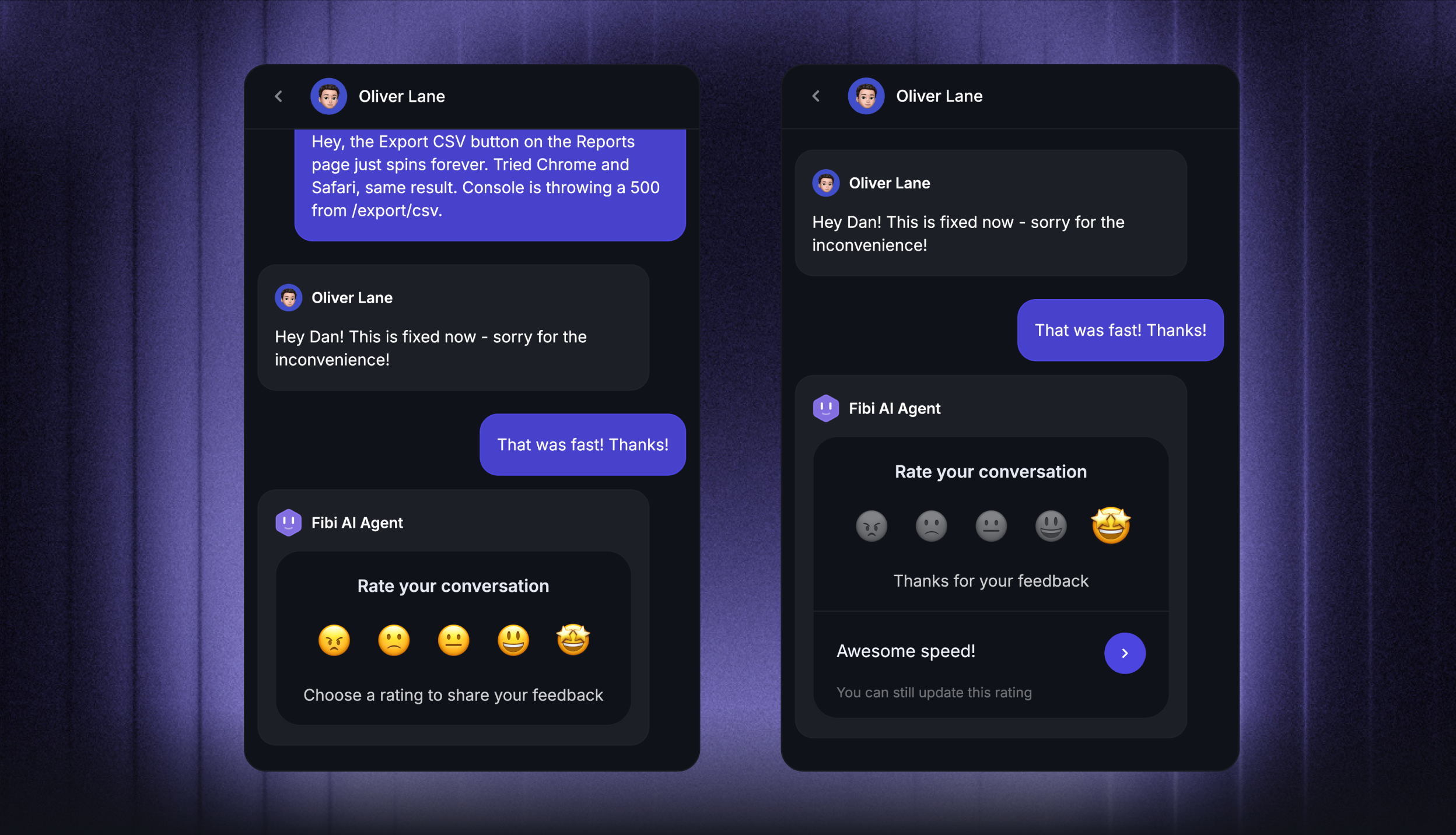
Customer satisfaction (CSAT) measures how happy customers are with a specific interaction, usually through a quick post-conversation survey. If your customers aren't satisfied with your support, nothing else on this list matters much.
The simplest way to measure it is with a short in-app survey. With Featurebase you can run NPS and CSAT surveys right inside your product and pair the score with an open-text follow-up, so you capture the why behind the number rather than just the rating.
Once you have the data, tag low scores by issue type and agent. The pattern matters more than the number, and it tells you exactly where to coach or fix a broken process.
4. Lift NPS
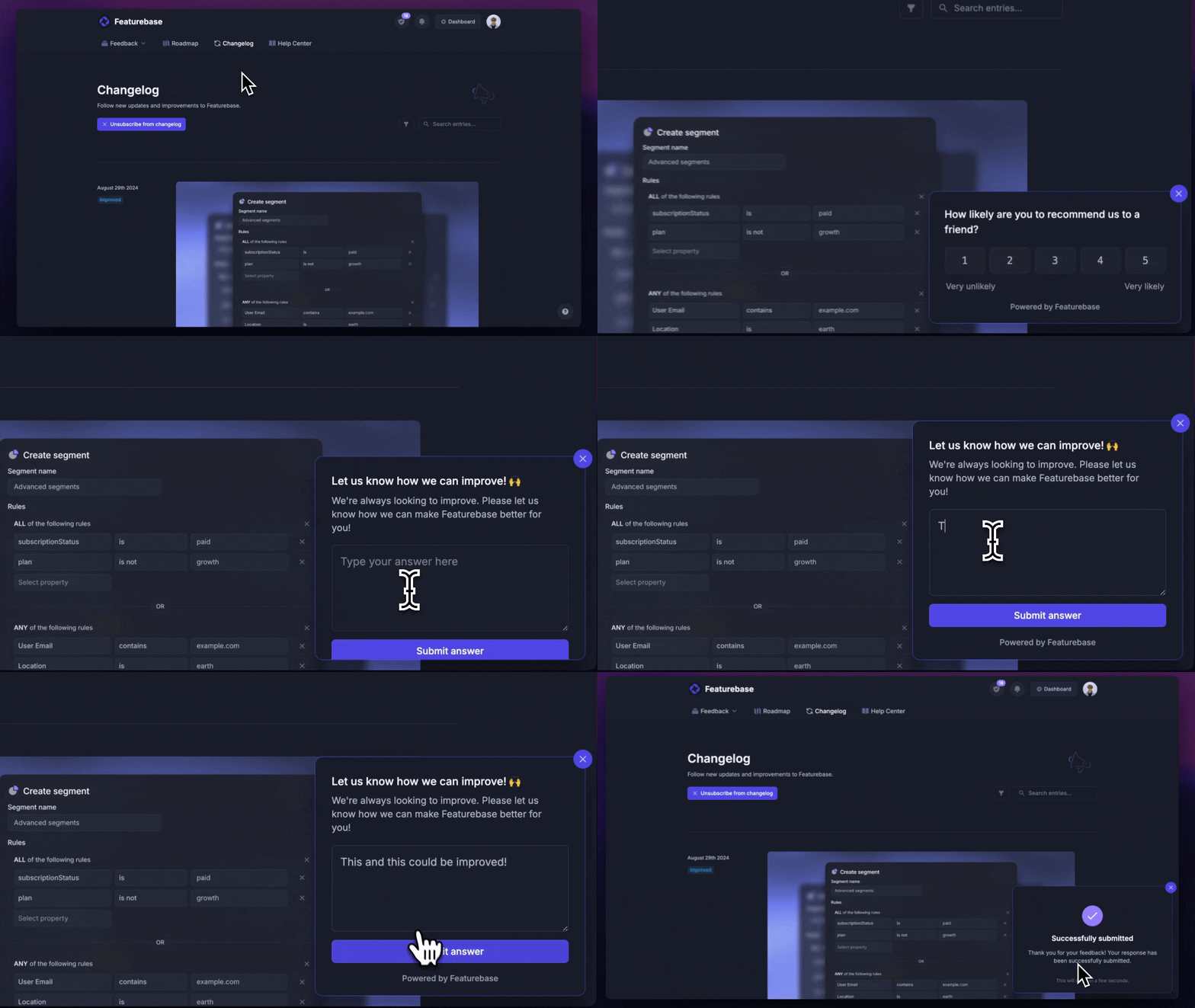
While CSAT reflects a single interaction, Net Promoter Score (NPS) measures how customers feel about your brand overall. Support has an outsized impact on it, because a great rescue or a botched escalation is what people remember.
Measure it with the standard "how likely are you to recommend us" survey, then track it quarter over quarter. A goal like "increase NPS from 30 to 40 by Q4" gives your whole team a shared north star.
The levers here overlap with the rest of the list: faster responses, higher resolution rates, and proactive follow-ups all feed a stronger NPS over time.
5. Reduce average resolution time
Average resolution time (ART) covers the full lifecycle of a ticket, from the moment it lands to the moment it closes. It's different from first response time, and if you optimize only for FRT, you can shave the first reply while the actual fix still drags on for days.
Track median resolution time by priority tier so a handful of gnarly tickets don't skew the average. Then hunt for dead time, like tickets sitting in a queue or bouncing between agents.
Cutting ART usually comes down to better routing, clearer internal docs, and removing the approval bottlenecks that leave tickets waiting.
6. Increase self-service and automated resolution
Customer self-service lets customers solve their own problems without waiting for an agent, and it's one of the highest-leverage goals on this list. Done right, it cuts volume and gives customers the instant answers they actually prefer for simple questions.
The mistake is measuring deflection alone. A deflected ticket isn't a solved one if the customer left frustrated. This is where an AI agent earns its place: Featurebase's Fibi AI Agent resolves common questions like password resets and billing lookups end-to-end, and an AI-powered help center serves instant answers, so the questions you deflect are genuinely resolved.
Track self-serve success rate and which tickets map to missing articles. Every recurring question is a knowledge gap you can close once and stop answering forever.
7. Lower cost per contact
Cost per contact (CPC) is the total cost of supporting customers divided by the number of contacts you handle. It's the goal that keeps support sustainable, because quality service still has to fit a budget.
To calculate it, add up labor, tools, and overhead, then divide by total contacts across every channel. That gives you a baseline to improve against.
You bring it down by steering simple questions to self-service, automating repetitive work, and raising first contact resolution so you're not paying to solve the same issue twice.
8. Reduce support-driven churn
Support doesn't own churn, but it absolutely influences it. Accounts that hit slow, unhelpful, or escalation-heavy support cancel at a noticeably higher rate, so reducing the support issues that push customers out is a clear customer retention lever worth owning.
Connect support signals to renewal health, like the number of escalations in the 90 days before a renewal date. That shows you where support is quietly costing you revenue.
The fixes are prioritizing high-severity tickets for at-risk accounts, following up after rough interactions, and flagging unhappy high-value customers before their renewal comes up.
9. Launch and grow an omnichannel presence
Customers expect to reach you on their channel of choice and pick up the conversation wherever they left off. An omnichannel support goal is about meeting them there without forcing them to repeat themselves.
Don't make the goal "launch omnichannel," which is too vague to measure. Break it into specific targets like "handle 50 support requests over live chat by the end of the quarter," then expand from there.
Measure channel volume, response time per channel, and whether context carries across channels. The real win is a connected experience, not just more places to message you.
10. Improve agent happiness and retention
Happy agents make happy customers. Burned-out, frustrated agents struggle to deliver empathetic service no matter how good your tools are, which makes team wellbeing a legitimate customer service goal.
Measure it with employee NPS or by tracking agent turnover and retention rates. If people are staying longer, that's usually a good sign.
You move it by investing in agent training, recognizing good work, removing tedious manual tasks, and protecting a reasonable workload so quality doesn't slip under volume.
How to roll out and track your goals
Setting the goal is the easy part. Here's a simple way to actually put it into motion.
Start by benchmarking. Pull the last 90 days of data so you know your real starting point, because a goal of "15-minute first response" is demotivating if you're currently sitting at 4 hours.
Then equip and explain. Give your team the tools to hit the target, and tell them why the goal exists. Agents adopt new metrics far more willingly when they understand how it connects to customer churn and business success.
Finally, launch small and review often. Pilot the goal with a few people, check the data weekly, celebrate wins, and discuss misses privately. If the whole team keeps missing a target, be willing to adjust the goal. Sometimes the problem is the goal, not the people.
Common goal-setting mistakes to avoid
Even good goals fall apart in predictable ways. Watch for these:
- Chasing speed while quality drops: optimizing first response time while first contact resolution slides just means faster replies that don't actually help.
- Reporting averages instead of medians: a few extreme tickets skew an average and hide what's really happening.
- No shared definition of "resolved": if agents, managers, and your system all count it differently, the metric is meaningless.
- One target for every channel: chat, email, and phone behave differently, so a single SLA across all of them sets someone up to fail.
- Targets with no staffing to back them: an FCR goal that quietly assumes 2 more hires you're not making is just wishful thinking.
The fix for most of these is the same: pick one owner and one source of truth for each number, so goal reviews stay operational instead of turning political.
The right tooling makes goals easier to hit
A goal is only as good as your ability to measure and move it, and that gets harder when your support data is scattered across separate tools for chat, email, your help center, and surveys. You end up exporting numbers from four places just to see whether you're on track.
Pulling those into one platform is what keeps the metrics behind your goals (first response time, first contact resolution, CSAT, self-service rate) visible in a single view, so you can check progress week to week instead of stitching reports together. It also puts the levers for hitting them right next to the numbers they affect: an AI agent to deflect repetitive questions, or surveys to capture the reason behind a score.
That's the gap Featurebase is built to close, bringing an AI-powered inbox, help center, surveys, and feedback tools into one workspace for product-led support teams. Whatever tooling you choose, the principle is the same: the easier it is to see a metric, the more likely your team is to actually move it.
Conclusion
Customer service goals only work when they name a metric, a number, and a deadline. Get specific, keep them realistic, track them weekly, and you'll turn vague ambitions into steady, measurable improvement.
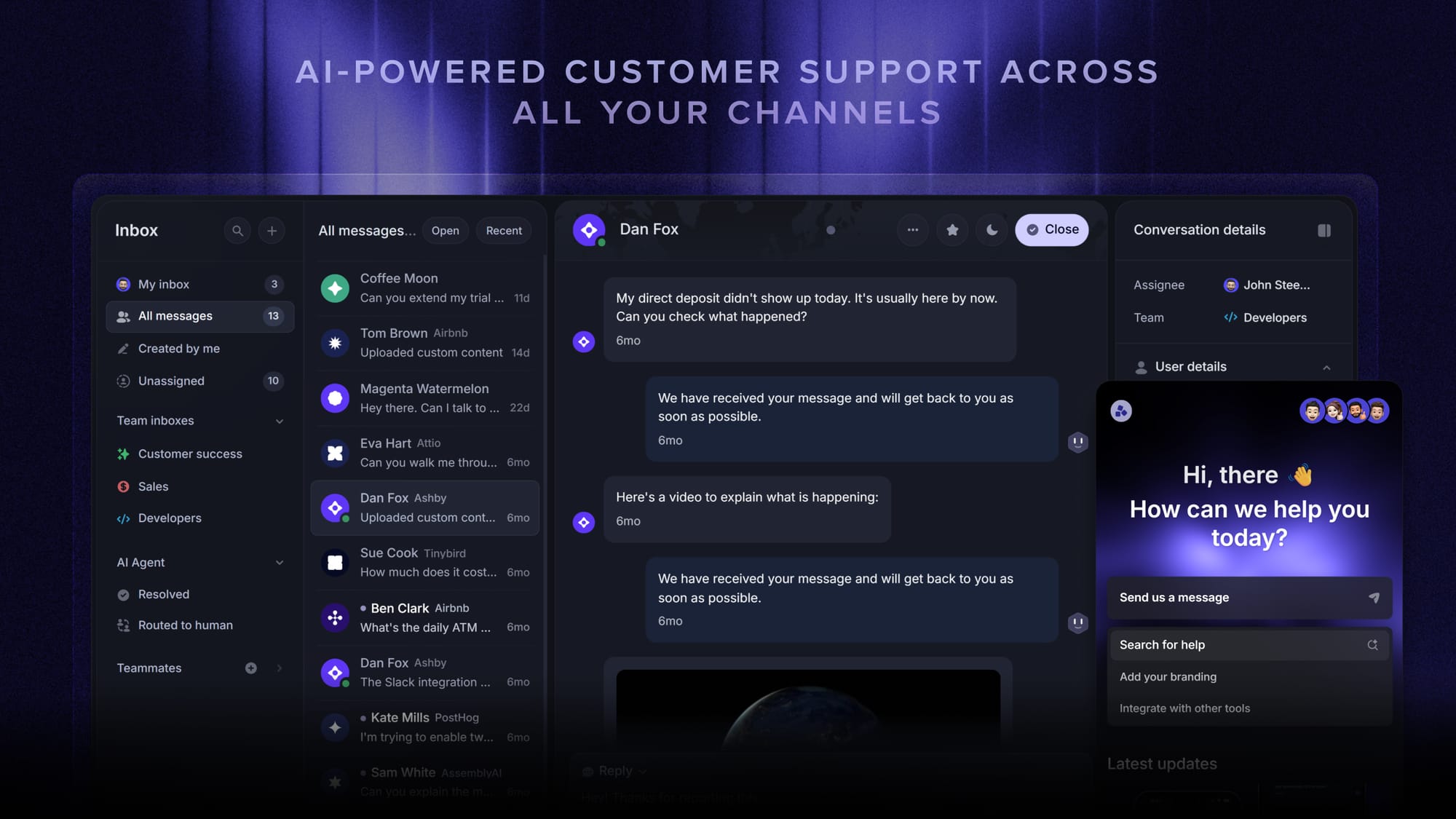
Featurebase is a modern customer support platform that helps you hit those goals from one place. It brings together an AI-powered inbox, an AI agent that resolves common questions automatically, a help center for self-service, and built-in NPS and CSAT surveys, so you can measure and move your support metrics without stitching tools together.
It comes with a Free plan, and the onboarding takes minutes, so there's no downside to trying it. 👇
✨ Automate your support with the fastest AI-enhanced Inbox today → Get started with Featurebase
Frequently asked questions
What are the 5 main goals of customer service?
The 5 core goals of customer service are increasing customer satisfaction, building long-term loyalty and retention, resolving issues quickly and accurately, running an efficient operation, and continuously improving based on feedback. Most specific goals you set will ladder up to one of these.
What's the difference between customer service goals, objectives, and KPIs?
A goal is the outcome you want, like faster support. An objective is the broader aim it supports, like improving retention. A KPI (key performance indicator) is the metric you track to know if you're getting there, like first response time or CSAT. In practice, the terms are often used interchangeably, but separating them keeps your targets clear.
What's an example of a SMART customer service goal?
A strong example is: "Increase first contact resolution rate from 65% to 75% within the next 2 quarters by improving our knowledge base and agent training." It's specific, measurable, realistic, tied to a business outcome, and has a clear deadline.
How many customer service goals should you set at once?
Aim for 3 to 5 primary goals per team. Treat anything beyond that as supporting indicators rather than headline targets. More than 5 and your team loses focus, since no single goal gets the attention it needs to actually move.
How often should you review customer service goals?
Review the underlying metrics weekly so you can catch drift early and coach in real time. Reset the actual targets quarterly, when you have enough data to see what's working and set the next realistic stretch. Big goals also benefit from monthly check-ins to keep them top of mind.
What are good customer service goals for a small support team?
Small teams should focus on a few high-impact goals: keeping first response time low, raising first contact resolution, and building out self-service so simple questions don't eat your day. A tool like Featurebase helps here with a free plan, an AI agent, and a help center, so a lean team can punch above its weight without a big budget.