Blog Customer FeedbackValue Proposition Definition: Examples & How to Write One
Value Proposition Definition: Examples & How to Write One
A clear value proposition definition with real examples, the components that make one work, and a simple way to write your own.


Most products don't fail because they're bad. They fail because customers never understood why they mattered.
You can have the faster, cheaper, better-designed product and still lose to a competitor with a clearer message. That gap is exactly what a value proposition closes.
Below, I'll define what a value proposition actually is, break down what makes one strong, walk you through writing your own, and share real examples worth learning from. 👇
Key takeaways
- A value proposition is a clear statement of the specific value a customer gets from your product and why it beats the alternatives.
- It's not a slogan or a mission statement: a slogan sells a feeling, a value proposition explains a concrete benefit.
- Strong ones share 3 traits: relevance, quantified value, and clear differentiation.
- The Value Proposition Canvas is the go-to framework for building one, matching what customers want to what you offer.
- The best value propositions come from real customer input, not guesswork. Featurebase✨ lets you collect and prioritize feedback so you know what customers actually value.
- The most common mistake is writing about your product instead of the customer's outcome.
What is a value proposition?
A value proposition is a clear statement that explains the value a customer gets from your product, who it's for, and why it's better than the alternatives. In a sentence or two, it answers the only question a prospect really cares about: "Why should I choose you?"
It's not a tagline or a clever line of copy. It's the core promise your whole business is built around: a specific benefit, for a specific person, delivered better than anyone else.
A good value proposition usually covers 3 things:
- Target customer - who it's for, and by implication who it isn't for
- Problem or need - the pain you remove or the gain you create
- Differentiation - why your solution beats the other options
Notice that two of those three are about the customer, not you. That's the whole game. A value proposition lives in the customer's world, framed around their outcome, not your feature list.
What makes a strong value proposition?
A strong value proposition is relevant, specific, and different. Weak ones are vague, generic, or all about the product.
Getting this right isn't a nice-to-have. When CB Insights analyzed 431 VC-backed startups that shut down, poor product-market fit was the second-biggest reason they failed at 43%, behind only running out of money. Two-thirds of those product-market-fit failures were companies that never found a market at all. A weak or absent value proposition is often the first symptom of that deeper problem: not knowing what customers actually need.
The strongest value propositions tend to share 3 traits:
- Relevance: it speaks to a problem the customer actually has and cares about solving. If it doesn't map to a real pain or desire, nothing else matters.
- Quantified value: it makes the benefit concrete. "Save 5 hours a week" lands harder than "boost productivity" because the customer can picture it.
- Differentiation: it makes clear why you, and not the cheaper or more familiar competitor. If a rival could paste your value proposition onto their own homepage, it isn't doing its job.
Miss any one of these and the whole thing wobbles. Relevant but undifferentiated, and you blend in. Different but irrelevant, and nobody cares.
Value proposition vs related terms
People mix these up constantly, and the confusion leads to messaging that tries to do everything and communicates nothing. Here's how a value proposition differs from the terms it gets tangled with:
- Value proposition vs unique selling proposition (USP): a USP is one specific feature or angle that sets you apart. A value proposition is broader, covering the total value the customer gets, of which your USP might be one part.
- Value proposition vs mission statement: a mission statement is about your company's purpose and long-term goal. A value proposition is about the customer's benefit, right now.
- Value proposition vs tagline or slogan: a slogan is a memorable line built for recall, like "Just Do It." A value proposition is built for clarity: it states the actual benefit, even when it's less catchy.
The simplest test: a value proposition should make a stranger understand what they get and why it's worth it. A slogan just makes them remember your name.
How to write a value proposition
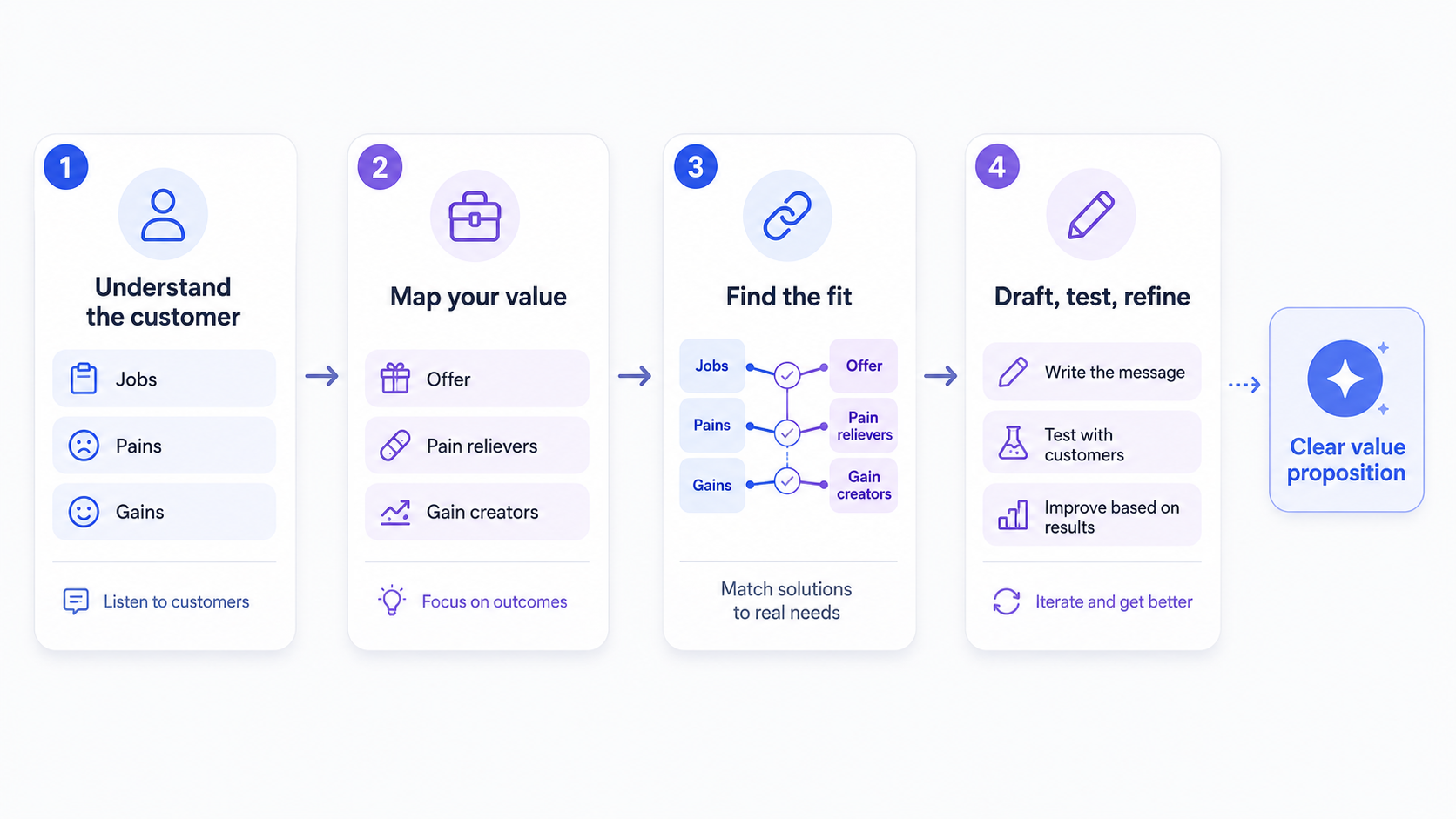
The most reliable way to build one is to start with the customer and work backward to your product, not the other way around. The framework most teams use for this is the Value Proposition Canvas, created by Strategyzer. It has two sides, the customer profile and your value map, and the goal is to make them fit together.
Start with the customer profile (jobs, pains, gains)
Before you write a single word about your product, map what your customer is trying to do. The customer profile has 3 parts:
- Jobs: the tasks your customer is trying to get done, whether functional, social, or emotional
- Pains: the frustrations, risks, and obstacles they hit while doing those jobs
- Gains: the outcomes and benefits they actually want, including the ones they'd never say out loud
The aim is to understand the customer so well that the value proposition almost writes itself. Most weak ones come from skipping this step and guessing.
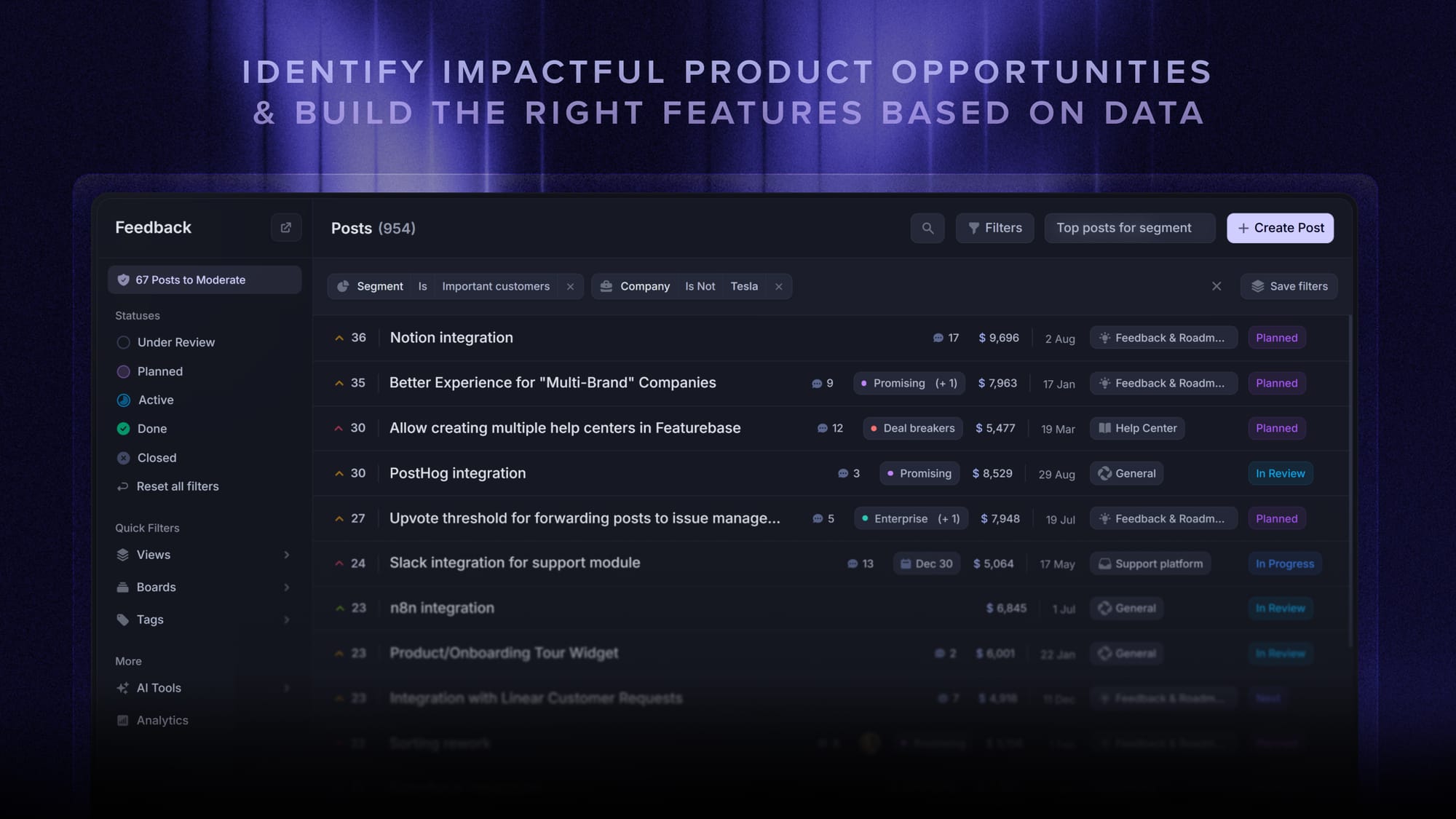
This is where I'd stop guessing and start listening. Support conversations, sales calls, reviews, and feature requests are full of the exact language customers use to describe their pains and gains. A tool like Featurebase lets you collect and centralize that feedback in one place, with a public voting board and in-app widgets, so you can see which problems come up most often and prioritize by the revenue behind each request.
Map your value (products, pain relievers, gain creators)
Once you understand the customer, map your offer against it. The value map also has 3 parts:
- Products and services: what you actually offer
- Pain relievers: how your product removes or reduces the customer's specific pains
- Gain creators: how your product delivers the gains they want
The magic is in the fit. Every pain reliever should connect to a real pain, and every gain creator to a real gain. Anything that doesn't map to something on the customer side is a feature you're probably overselling.
Draft, test, and refine the statement
Now turn that fit into a sentence or a short block. A simple template that works:
For [target customer] who [need or problem], [product] is a [category] that [key benefit]. Unlike [main alternative], we [key differentiator].
Don't fall in love with your first draft. Put it in front of real customers, run it as a headline, A/B test two versions, and watch what actually converts. Your value proposition is a hypothesis until customers tell you it's right.
5 value proposition examples worth learning from
Theory only goes so far, so here are five value propositions that work and why:
- Slack: Slack has long centered its pitch on being the place where work happens, replacing scattered email threads with organized channels. It works because it names a pain everyone feels (email overload) and a clear gain (one home for team communication), not a list of features.
- Stripe: Stripe promises developers a way to accept payments and run their business online with just a few lines of code. It's sharp because it speaks to one audience and quantifies the ease, rather than vaguely promising "powerful payments."
- Shopify: Shopify positions itself as everything you need to start, run, and grow a business in one platform. The differentiation is scope, and it maps neatly to the real journey a merchant goes through.
- Notion: Notion sells one connected workspace that replaces separate docs, wikis, and task tools. It leads with the pain of tool sprawl and the gain of having everything in one place, which is exactly what its audience is frustrated by.
- Uber: Uber's early value proposition boiled down to a ride at the tap of a button, with no cash and no waiting. Every word describes a concrete improvement over hailing a taxi.
The pattern across all five: they lead with the customer's outcome, name a real pain or gain, and make the benefit concrete. None of them lead with their technology.
Common value proposition mistakes to avoid
Even teams that understand the theory trip over the same few things. Watch for these:
- Writing about yourself instead of the customer: "We're an industry-leading platform" tells the customer nothing about their outcome. Lead with what they get, not what you are.
- Being too vague: "Better, faster, smarter" could describe anyone. If your value proposition would fit a competitor, it isn't specific enough.
- Listing features instead of benefits: a feature is what your product does. A benefit is what the customer gains. People buy the benefit.
- Trying to appeal to everyone: a value proposition aimed at everyone resonates with no one. Narrow it to your best-fit customer and let it be sharp.
- Never testing it: your opinion of your value proposition doesn't count, only the customer's does. Test it and let the data settle the argument.
Fix these and you're already ahead of most companies, which is a little depressing but also good news for you.

Turn feedback into products your users love
Centralize feedback, identify product opportunities, and build the right features
Conclusion
A value proposition is the clearest answer you can give to "why you?" Nail it, and everything downstream gets easier: your homepage, your ads, your sales pitch. Get it wrong, and even a great product struggles to land.
The throughline of everything above is simple. A strong value proposition comes from understanding what your customers actually value, which means listening to them instead of guessing.
Featurebase is a modern feedback tool that helps you collect feedback with a feature voting forum, surveys, embeddable widgets, and integrations. You can then connect that feedback to customer revenue and data, so you understand what your customers value most and can build your value proposition around it.
It comes with a Free plan for unlimited feedback, and the onboarding is quick and doesn't need a credit card, so there's no downside to trying it. 👇
✨ Start collecting & managing feedback with Featurebase for free →
FAQs
Which statement is the best description of a value proposition?
The best description is that a value proposition is a clear statement of the specific value a customer gets from your product and why it's better than the alternatives. It focuses on the customer's outcome, not your features, and it's specific enough that a competitor couldn't honestly claim the same thing. Think of it as the answer to "why should I buy from you?" in a sentence or two.
What are the 3 elements of a value proposition?
Most strong value propositions include 3 elements: relevance (it addresses a real customer problem), quantified value (it makes the benefit concrete and measurable), and differentiation (it explains why you beat the alternatives). Different frameworks phrase these in their own way, but nearly all of them boil down to the same idea. When a value proposition falls flat, a missing element is usually the reason.
What's the difference between a value proposition and a unique selling proposition?
A unique selling proposition (USP) is one specific feature or angle that sets you apart, like the fastest shipping or the only tool with a certain integration. A value proposition is broader: it's the total value a customer gets from choosing you, and your USP might be one piece of it. In short, the USP is a single differentiator, while the value proposition is the whole promise.
What is an employee value proposition?
An employee value proposition (EVP) is the value an employer offers staff in return for their work, including pay, benefits, culture, growth, and purpose. It's the same concept as a customer value proposition, just pointed at current and prospective employees instead of buyers. A strong EVP helps a company attract and keep talent the way a strong value proposition helps it win customers.
What is the purpose of a value proposition?
The purpose of a value proposition is to communicate, quickly and clearly, why a customer should choose you over the alternatives. It aligns your marketing, sales, and product messaging around a single promise, and it helps prospects decide whether you're worth their time within seconds. Done well, it attracts the right customers and gently repels the wrong ones.
How do you test whether your value proposition works?
Put it in front of real customers and watch what happens. Run it as a homepage headline, A/B test two versions, track conversion rates, and ask prospects to explain your product back to you in their own words. Collecting and reviewing customer feedback with a tool like Featurebase also shows you whether the value you're claiming matches the value customers actually talk about.