Blog Customer FeedbackValue Realization: How to Measure and Prove SaaS Value
Value Realization: How to Measure and Prove SaaS Value
Learn what value realization means, how to build a SaaS framework, and which metrics prove customer outcomes with a practical example you can adapt.


Your customer has finished onboarding, invited their team, and uses your product every week. But when renewal comes around, they still struggle to explain what improved.
Value realization connects what customers do in your product to the results they bought it for. Without that connection, even a busy account can struggle to justify another year.
In this guide, I’ll walk through a practical framework, the metrics worth tracking, and an example you can adapt to your own customers. 👇
Key takeaways
- Focus on purchase outcomes: Those outcomes might include faster work, fewer errors, or lower operating costs.
- Start with a baseline and target: Define what success looks like before implementation makes the original situation hard to measure.
- Validate business results: Usage and satisfaction are supporting signals. Confirm the actual outcome before claiming success or calculating ROI.
- Keep reviewing results: Customer priorities, workflows, and expectations change after onboarding.
- Featurebase✨ helps you gather customer feedback and understand what’s blocking progress toward those outcomes.
What is value realization?
Value realization is the process of achieving, measuring, and confirming the benefits a customer expects from a product or service. In SaaS, it connects the reason someone bought your software with improvements in how their business works.
For example, a customer might buy reporting software to prepare weekly reports faster. Creating an account is implementation. Producing accurate reports in less time is a realized benefit.
Your product’s value proposition sets an expectation. Value realization checks whether that expectation holds up in everyday use.
Value creation vs. value delivery vs. value realization
These concepts describe different parts of the same journey:
- Value creation: You build a capability that can solve a problem, such as automated reporting.
- Value delivery: You make that capability available and help the customer use it.
- Value realization: The customer achieves a meaningful result, such as spending less time preparing reports without sacrificing accuracy.
A feature can be available and widely used while the original problem persists. That’s why shipping software and completing onboarding aren’t enough to confirm business value.
Why value realization matters for SaaS teams
When customers can explain what your product helps them achieve, renewal conversations have a concrete starting point. You can discuss results, remaining gaps, and future goals instead of presenting a list of features they opened.
That makes value realization useful across several teams:
- Customer success: Agreed outcomes help CSMs focus their support and identify accounts that need attention.
- Product: Understanding blocked outcomes gives customer requests context and helps teams assess what to improve.
- Sales: Comparing promised benefits with actual results helps teams set realistic expectations for future customers.
It also strengthens your customer retention management. A customer who isn’t progressing toward their goals needs a different conversation from one who is succeeding but wants additional capabilities.
Realized value doesn’t guarantee renewal. Budgets, leadership changes, and competing priorities still matter. But documented results make the value discussion more specific and useful for both sides.
A 5-step value realization framework
A useful value realization framework gives both teams a shared way to define success, support adoption, and check results. Start with a single important customer outcome before building a larger program.
1. Agree on the customer’s desired outcome
Ask what the customer wants to change in their business. “Use the dashboard” is an activity. “Prepare the weekly management report faster” describes a result worth measuring.
Get input from the person doing the work and the stakeholder approving the purchase. Their priorities may differ, and both affect whether your product feels valuable.
Useful discovery questions include:
- What prompted you to look for a solution?
- What does this problem cost you in time, money, or effort?
- What would need to improve for you to consider the purchase worthwhile?
Record the answer in a shared customer success plan. Keep the original sales commitments visible so the post-sale team can address unrealistic expectations early.
2. Set a baseline, target, and owner
Before changing the workflow, document how it performs today. Choose a measurement window that reflects normal work, including any predictable variations in volume.
For each outcome, capture:
- Baseline: The current result, measured using a defined method.
- Target: The improvement the customer wants to achieve.
- Owner: The person responsible for providing evidence and coordinating action.
- Review date: When you will assess progress together.
Use the same metric definition before and after implementation. If the baseline includes preparation and corrections, the follow-up measurement should include both too.
The customer owns their business outcome. Your team owns the product guidance and commitments needed to support it. Make those responsibilities explicit.
3. Help customers adopt the right workflow
Build customer onboarding around the tasks that support the agreed outcome. A tour of every feature can wait if the customer needs a particular integration or workflow to get started.
Identify the smallest meaningful milestone they can reach first. For reporting software, that might be producing one accurate report from live data without rebuilding it manually.
Track time to value, using a clearly defined starting point and milestone. An initial win helps you assess early progress, but sustained business results may take longer to establish.
If progress stalls, investigate the cause. Missing data, unclear responsibilities, training gaps, and product limitations require different fixes.
4. Validate results with the customer
Compare the new result with the baseline, then ask the customer whether the difference reflects their experience. Check that the improvement applies to the workflow they actually care about.
Also ask what else changed. A staffing increase, lower workload, or new internal process might explain part of the result. Avoid assigning all improvement to your software without supporting evidence.
Bring a short value review to the conversation: the original goal, measured result, evidence source, remaining limitations, and next action. Let the customer confirm or challenge your interpretation.
5. Use feedback to improve the next outcome
Once a customer reaches a milestone, ask what still makes the work difficult. Their next priority might be expanding the workflow, improving accuracy, or removing a different bottleneck.
Keep a customer feedback loop running between those reviews. Collect the issue, clarify its impact, decide what to do, and tell the customer what changed.
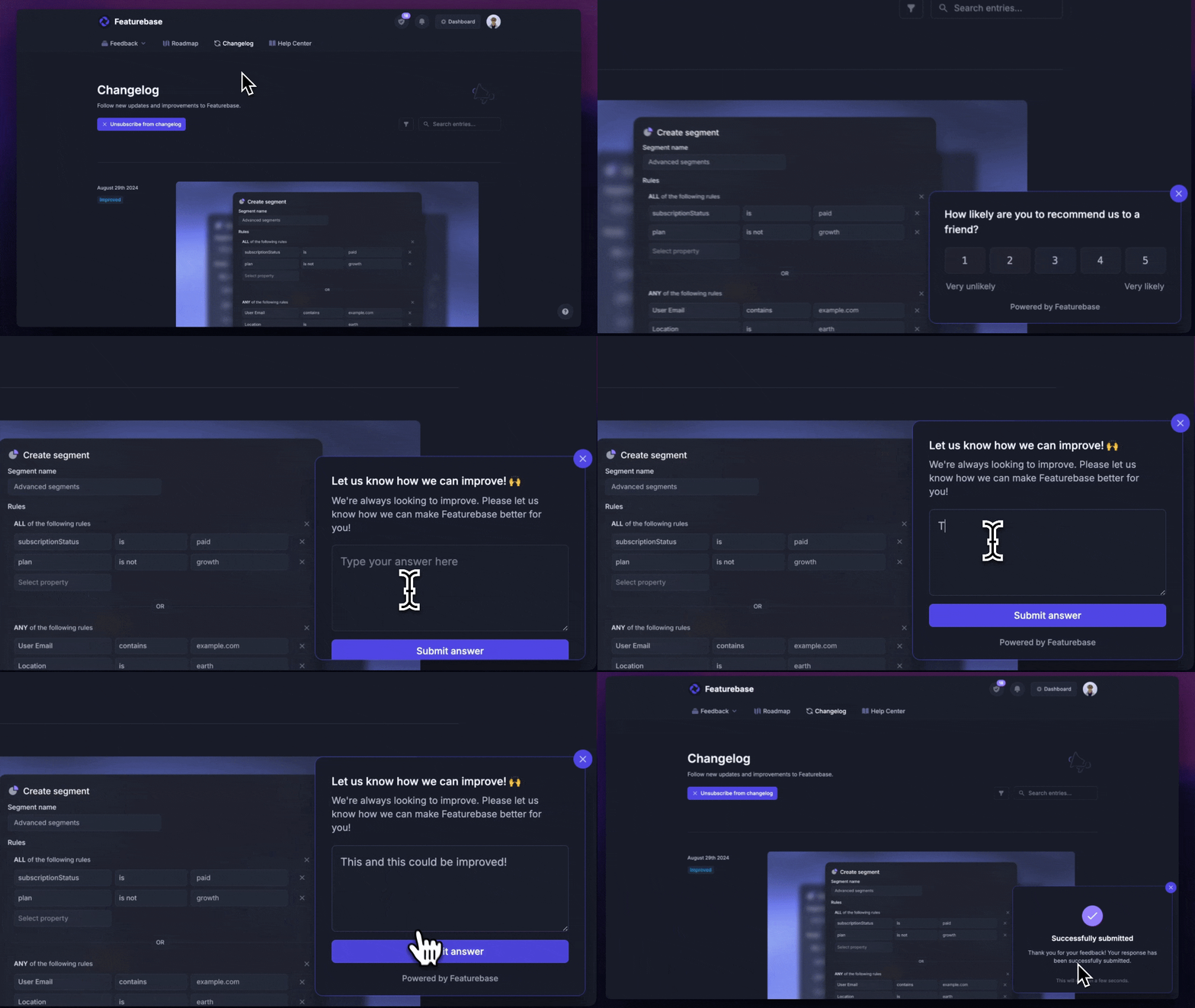
For example, Featurebase Surveys let you ask targeted in-app questions about onboarding, specific features, or workflows. Those responses help explain where customers get stuck and add context to the performance data you track elsewhere.
When you ship an improvement, check whether it helped the original outcome. Continuous improvement means revisiting results, not simply keeping the release calendar busy.
How to measure value realization
Choose metrics that connect directly to the agreed customer outcome. A small set with clear definitions is easier to act on than a dashboard full of unrelated activity.
Separate leading indicators from achieved outcomes
Leading indicators show whether the customer is moving toward success. Outcome measures show whether the intended improvement happened.
For example, feature adoption can tell you whether a team is using automated reports. It doesn’t establish whether reporting became faster or more accurate.
Useful customer success metrics can play different roles:
- Progress indicators: Workflow adoption, implementation milestones, and time to first value.
- Outcome measures: Hours per task, error rate, processing time, or actual expenditure.
- Customer perceptions: Satisfaction, effort scores, and direct feedback about whether the improvement matters.
Use these together. A positive satisfaction score adds context, while the outcome measurement provides evidence of the specific benefit.
Calculate financial value without overstating savings
Start with the operational improvement. For repeatable work, you can estimate released capacity using:
Time released = time saved per task × number of comparable tasks
Multiplying those hours by an agreed labor rate estimates their capacity value. It doesn’t automatically mean the customer spent less money. Actual cost savings require evidence of reduced expenditure, such as lower overtime or contractor costs.
Where benefits can reasonably be expressed in money, calculate return on investment over a consistent period:
ROI (%) = (realized financial benefits − total investment costs) ÷ total investment costs × 100
Include relevant implementation, training, and ongoing costs alongside the subscription. Agree on assumptions with the customer, avoid double-counting benefits, and keep estimates separate from verified results.
A value realization example
Imagine a customer buys reporting software to reduce weekly report preparation time. The following numbers are hypothetical, so treat them as a worked example rather than a benchmark.
Before implementation, preparing and checking the report takes 8 hours per week. The customer wants to reduce that to 4 hours while keeping accuracy stable.
After adoption, comparable reports take 3 hours per week. That releases 5 hours of capacity per week, and the customer confirms that correction rates haven’t increased.
Here’s how the shared measurement record could look:
| Field | Example |
|---|---|
| Customer outcome | Prepare weekly reports faster without reducing accuracy |
| Baseline | 8 hours per report across 4 comparable weeks |
| Target | 4 hours per report, with no increase in corrections |
| Observed result | 3 hours per report across the next 4 comparable weeks |
| Evidence | Time records, completed reports, and correction logs |
| Customer owner | Reporting team lead |
| Validation | Team lead confirms the process and quality checks are comparable |
| Next action | Check whether the improvement holds during month-end reporting |
Across the observed 4-week period, the team releases 20 hours. At an assumed labor rate of $40 per hour, that represents $800 in estimated capacity value.
If payroll and contractor expenditure stay the same, don’t call it $800 in cash savings. Instead, document how the team uses the released time, such as completing analysis that previously went unfinished.
The customer has achieved the time-saving target. Whether that translates into a positive financial return requires the investment costs and an agreed method of valuing the benefit.
Common value realization mistakes
Most problems become easier to address when expectations and evidence are visible early. Watch for these habits:
- Starting at renewal: Reconstructing a baseline months later makes value harder to demonstrate. Agree on outcomes during discovery and onboarding.
- Treating activity as success: Logins and completed training are useful signals, but they don’t confirm that the customer’s work improved.
- Reporting only averages: A healthy account-level average can hide a team or workflow that is struggling. Review relevant customer segments and use cases.
- Asking the wrong questions: A measured time saving may come with frustration or extra work elsewhere. Ask what got easier and what became harder to investigate the full experience.
- Keeping outdated goals: Reconfirm priorities when the customer’s team, strategy, or operating conditions change. Preserve the old goal and record why the new one matters.
Conclusion
Value realization starts with a customer outcome and ends with evidence the customer recognizes. Define the goal, measure the baseline, support adoption, and keep checking what improved.
Featurebase is a modern feedback & support platform that helps product teams collect feedback, prioritize features, build roadmaps, and announce product updates, all in one place. Its surveys help you understand customer needs and uncover the blockers behind your metrics.
It comes with a Free plan, and you can get started without a credit card. 👇
✨ Start collecting & managing feedback with Featurebase for free →
FAQs
How do you choose a value realization platform?
Look for support for shared success plans, customer-specific baselines, outcome reporting, and the data sources you already use. Test whether both your team and the customer can inspect the evidence behind a result. A smaller team may be able to start with its existing CRM, analytics tools, and a shared document.
Can customers realize value without a financial return?
Yes. A customer may achieve a goal involving reliability, accessibility, reduced effort, or better decision-making before a financial return is measurable. Define observable evidence for that benefit and keep it separate from financial ROI claims.
What if you have no reliable baseline?
Check historical records or agree on a short observation period before making further changes. If you must use a reconstructed estimate, document its source and uncertainty. Avoid presenting an estimated before-and-after difference as a verified result.
How should you handle conflicting stakeholder goals?
Ask the sponsor and affected teams to agree on the primary outcome and any constraints that must be protected. For example, faster reporting might be acceptable only if accuracy stays stable. Record unresolved trade-offs and who can make the decision rather than combining incompatible goals into one score.
Is value realization the same as net realizable value?
No. Value realization concerns achieving and confirming benefits from a product, service, or initiative. In inventory accounting, net realizable value estimates the amount a sale would bring in after the remaining costs to finish and sell the goods. It isn’t a customer success or retention metric.