Blog Customer Feedback60+ Survey Question Examples by Type and Use Case
60+ Survey Question Examples by Type and Use Case
60+ survey question examples grouped by type and use case, plus the writing rules that keep answers honest. Copy-ready questions for CSAT, NPS, product feedback, and more.


✨ Start running surveys & collecting feedback with Featurebase for free →
The hardest part of a survey isn't sending it. It's asking the right questions the right way, because a leading or double-barreled question quietly ruins your data before a single response lands.
This guide gives you the question types, 60+ copy-ready examples grouped by use case, and the writing rules that keep answers honest. 👇
Key takeaways
- There are 7 core survey question types: open-ended, multiple choice, dichotomous (yes/no), Likert scale, rating scale, ranking, and matrix. Each one does a different job.
- Match the question type to your goal: rating scales for quick scores like NPS, Likert scales for sentiment, open-ended for the "why" behind the numbers.
- The biggest data-killers are leading, loaded, and double-barreled questions. Keep every question neutral and focused on one thing.
- Short surveys win. Most effective surveys stay at 5 to 10 focused questions and take under 5 minutes.
- Ask in context. Feedback collected right after the moment it refers to is far more accurate than feedback asked weeks later.
- Featurebase✨ lets you run in-app NPS, CSAT, and product-feedback surveys that trigger at the right moment, with a free plan.
What makes a good survey question
Before the examples, it helps to know what separates a question that produces usable data from one that produces noise. Three principles cover most of it:
- Clear: A good question uses plain language your respondent understands instantly. Skip jargon, acronyms, and anything that needs a second read.
- Neutral: The wording should not nudge people toward an answer. "How would you rate our service?" is neutral. "How great was our service?" is not.
- Focused: Ask about one thing at a time. The moment a question covers two topics, the answer becomes impossible to interpret.
Get those three right and almost any question format will work. Get them wrong and even the best-designed survey collects data you can't trust.
The main types of survey questions (with examples)
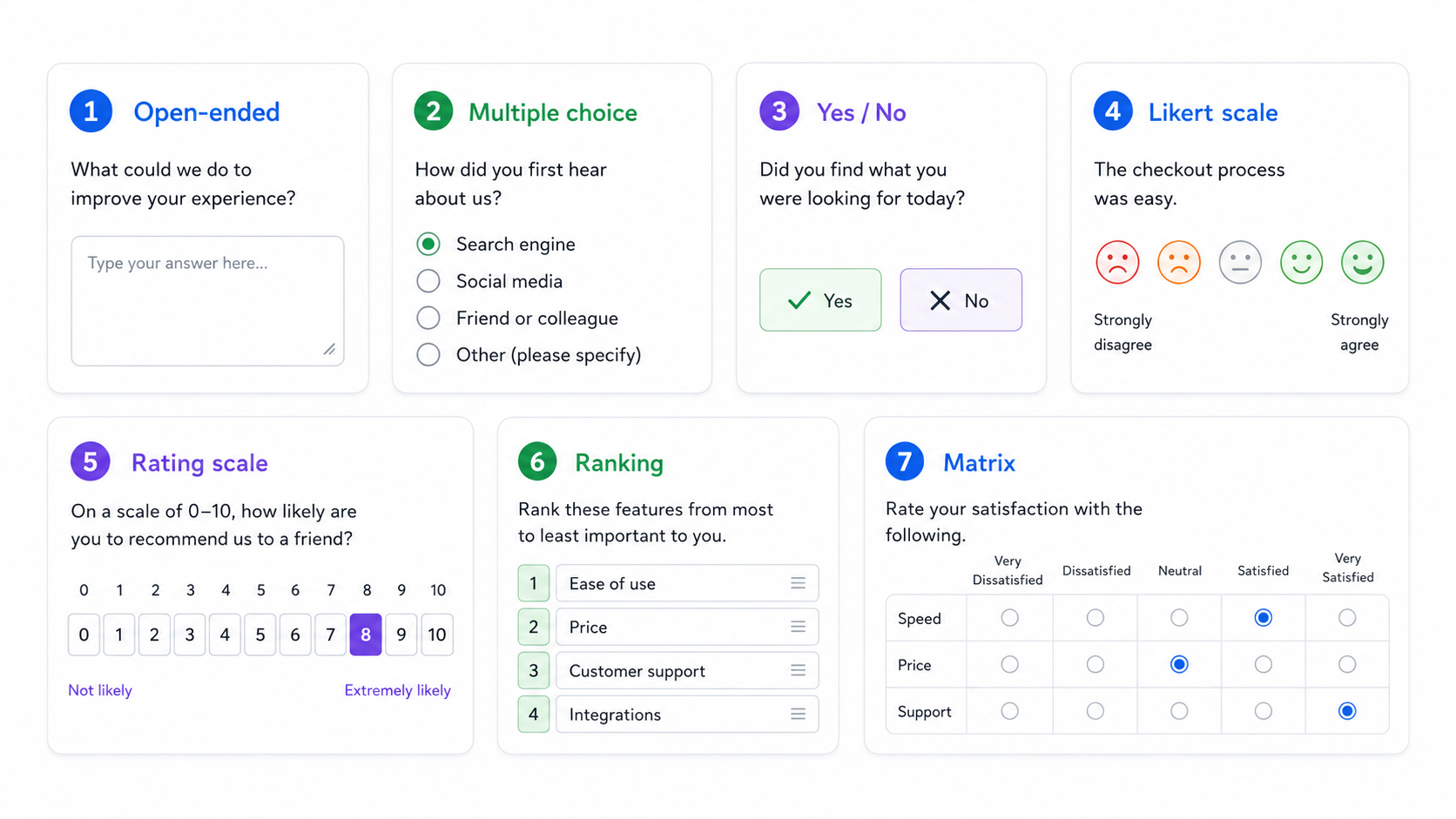
Every survey question fits into one of a handful of formats, and picking the right one is half the battle. Here are the 7 types you'll actually use, with an example of each:
- Open-ended: Respondents answer in their own words. Best for uncovering reasons and ideas you didn't think to ask about. Example: "What could we do to improve your experience?"
- Multiple choice: A single pick from a fixed list. Fast to answer and easy to analyze, ideal for facts and demographics. Example: "How did you first hear about us? (Search, social media, friend, other)"
- Dichotomous (yes/no): Exactly two options, like yes/no or true/false. Perfect for clear-cut screening questions. Example: "Did you find what you were looking for today?"
- Likert scale: Measures how strongly someone agrees with a statement, usually on a 5-point scale. Great for sentiment. Example: "The checkout process was easy. (Strongly disagree to strongly agree)"
- Rating scale: A numeric score, often 0-10, used for metrics like NPS. Best for tracking change over time. Example: "On a scale of 0-10, how likely are you to recommend us to a friend?"
- Ranking: Respondents order options by preference, which forces real trade-offs. Best for prioritizing. Example: "Rank these features from most to least important to you."
- Matrix: Several related statements share one rating scale in a grid. Space-saving when you're rating many similar items. Example: "Rate your satisfaction with our speed, price, and support."
A strong survey usually mixes a few of these. Closed-ended types (multiple choice, Likert, rating) give you clean numbers, while a well-placed open-ended question captures the qualitative feedback behind them.

Collect better answers with Featurebase
Create targeted NPS, CSAT, multiple-choice, or text response surveys for free
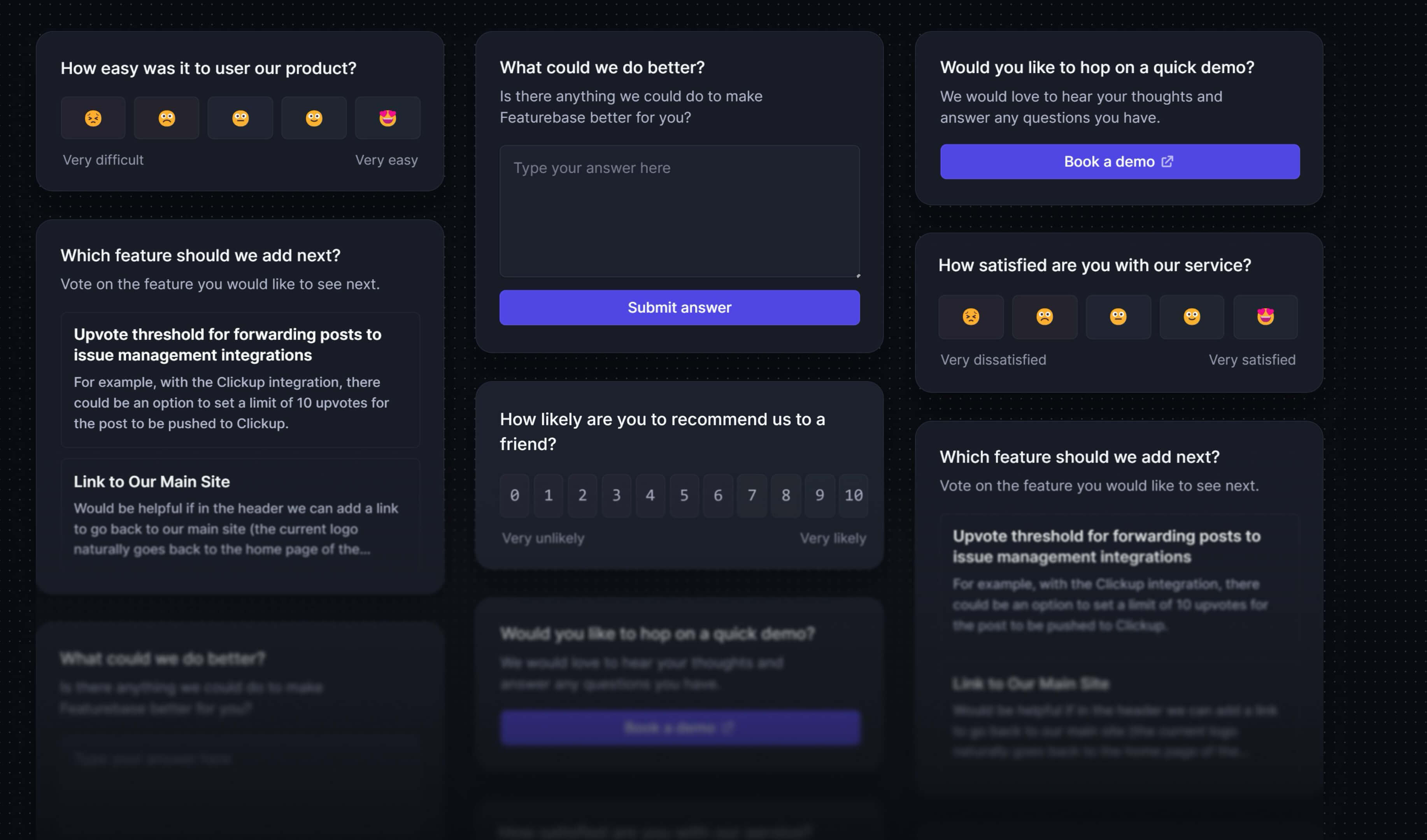
60+ survey question examples by use case
Below are ready-to-use questions grouped by what you're trying to learn. Mix and match them, then trim to the 5 to 10 that map directly to your goal.
Customer satisfaction survey questions (CSAT and NPS)
These blend a rating metric with an open-ended follow-up, the same pattern behind NPS and CSAT surveys.
- Overall, how satisfied are you with your experience? (Very dissatisfied to very satisfied)
- On a scale of 0-10, how likely are you to recommend us to a friend or colleague?
- How well did our product or service meet your expectations?
- How would you rate the value for money of what you received?
- How easy was it to get your issue resolved? (Very difficult to very easy)
- What is the main reason for the score you just gave?
- How satisfied are you with the quality of our product?
- How likely are you to continue using us over the next 6 months?
- What is one thing we could do to earn a higher score from you?
Product feedback survey questions
These help you steer the roadmap. Pair them with an always-on channel for product feedback so insights keep flowing between surveys.
- Which features do you use most often?
- Which features do you rarely or never use?
- What is the one feature you wish we had?
- How well does our product solve the problem you bought it for?
- If you could change one thing about the product, what would it be?
- How easy was it to get started with our product? (Very difficult to very easy)
- How often do you run into bugs or errors?
- What nearly stopped you from signing up?
- How would you feel if you could no longer use our product? (Very disappointed to not disappointed)
Customer service and support survey questions
- How satisfied are you with the support you received today?
- How easy was it to reach our team?
- Did we resolve your issue in a single conversation? (Yes/No)
- How knowledgeable was the person who helped you?
- How would you rate the speed of our response? (Poor to excellent)
- Did our team treat you with respect and understanding? (Yes/No)
- What could we have done to resolve your issue faster?
- How likely are you to reach out to our support team again if you need help?
Website and UX survey questions
Ask these on the page itself for the sharpest signal. On-page website feedback widgets are a good way to trigger them in the moment.
- How easy was it to find what you were looking for? (Very difficult to very easy)
- What were you trying to do on our site today?
- Were you able to complete your task? (Yes/No)
- What almost stopped you from completing it?
- How would you rate the overall design of our website? (Poor to excellent)
- How clear was the information on the page?
- Which part of the experience felt slow or confusing?
- How likely are you to return to our website? (0-10)
Employee engagement survey questions
Anonymity raises honesty here, so make responses safe to give. For more on this, see our guide to employee feedback.
- I feel my work is valued here. (Strongly disagree to strongly agree)
- How likely are you to recommend this company as a place to work? (0-10)
- I have the tools and resources I need to do my job well. (Strongly disagree to strongly agree)
- How supported do you feel by your direct manager?
- I have clear opportunities to grow in my role. (Strongly disagree to strongly agree)
- How well do the members of your team work together?
- What is one thing that would make your day-to-day work better?
- How comfortable do you feel sharing honest feedback with leadership?
Market research and demographic survey questions
These profile your audience and map how your brand is perceived, a core part of any voice-of-the-customer program.
- When you think of this category, which brand comes to mind first?
- How would you describe our brand in three words?
- What is your age range?
- What is your role or job title?
- What is your company size?
- How often do you buy products in this category?
- What matters most to you when choosing a product like ours? (Price, quality, brand, reviews)
- Which alternatives did you consider before choosing us?
- What would make you switch to a competitor?
Post-event and post-purchase survey questions
- Overall, how would you rate this event? (Poor to excellent)
- How well did the event meet your expectations?
- Was the length of the event too long, too short, or about right?
- How useful was the content presented?
- How likely are you to attend again in the future? (0-10)
- How satisfied are you with your recent purchase?
- How easy was the checkout process? (Very difficult to very easy)
- How satisfied are you with the delivery time?
- Is there anything about your purchase experience we could improve?
How to write survey questions that get honest answers
Good examples only take you so far. How you word and order your feedback questions decides whether the answers are worth anything. The most common mistakes fall into a few named traps, and each one is easy to avoid once you can spot it:
- Leading questions: These assume an answer and push people toward it. "How much did you love our new feature?" already decided the feature is lovable. Rewrite it as "How would you rate our new feature?"
- Loaded questions: These bury an assumption the respondent may not share. "Why do you think our prices are fair?" assumes they already agree. Ask whether they agree first, then why.
- Double-barreled questions: These ask two things but allow one answer. "How satisfied are you with our speed and price?" is really two questions. Split it into two.
- Vague questions: These are too broad to act on. "How do you feel about our service?" invites a shrug. "How satisfied are you with our response time?" gives you something to fix.
Beyond wording, two habits keep response quality high. Keep the survey short, since completion rates fall as questions pile up, and aim for 5 to 10 focused questions. And order thoughtfully: start with easy, engaging questions, group related ones together, and save demographic questions for the end so you don't lose people before they reach the questions that matter.
When and where to ask your survey questions
The best-written question still fails if it arrives at the wrong moment. Feedback is most accurate when you ask right after the experience it refers to, while the details are still fresh. A satisfaction question sent a week after a support chat measures memory, not the interaction.
Context matters as much as timing. Ask about a feature on the page where people use it, ask about onboarding once new users have had time to explore, and trigger post-purchase questions within a day of delivery. Matching the question to the moment is what turns a survey from an interruption into a natural part of the experience.
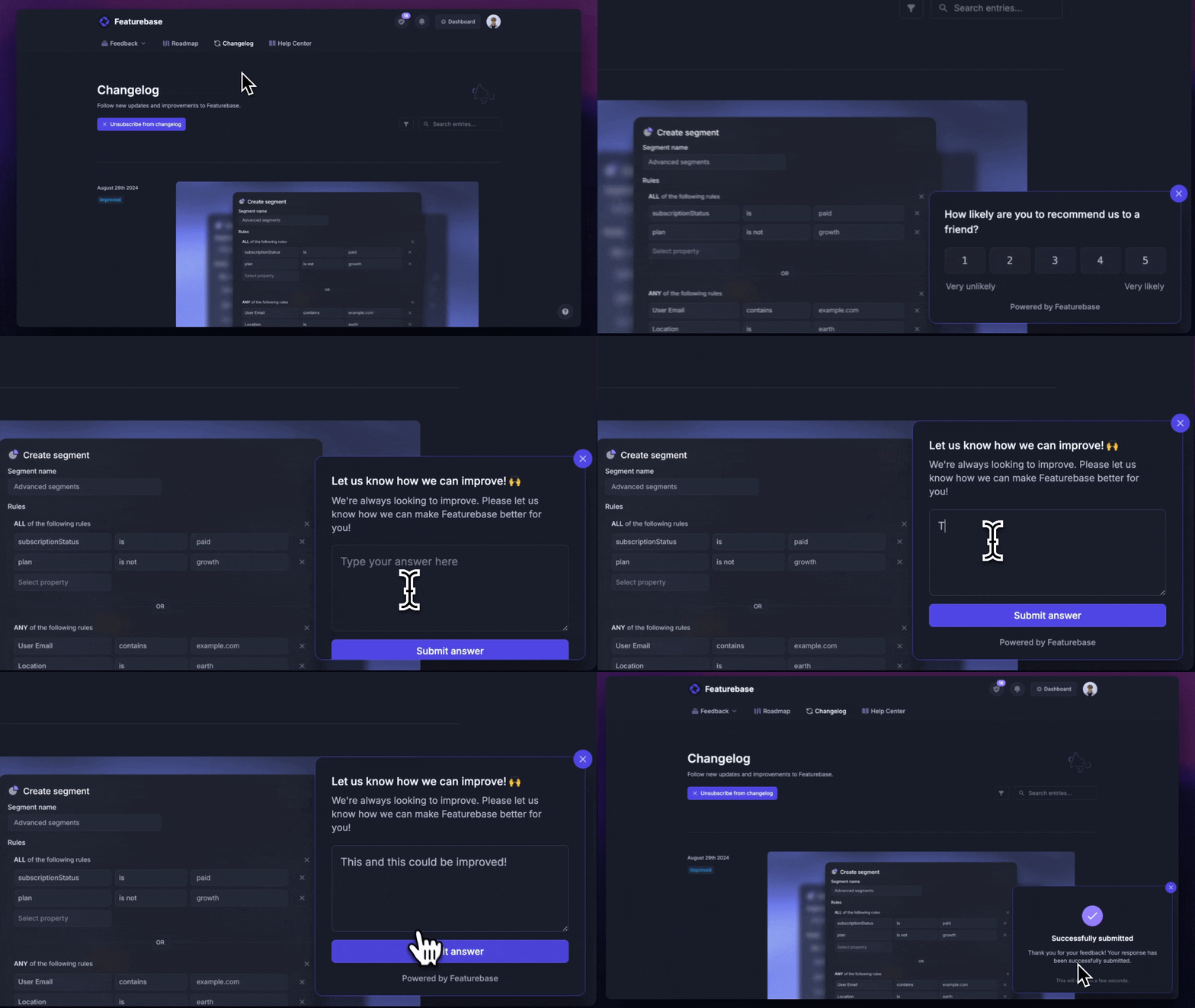
This is where in-app surveys earn their keep. With Featurebase, you can run NPS, CSAT, and feature-feedback surveys directly inside your product and trigger them by the page a customer is on, how long they've spent there, and which segment they belong to. You can also chain follow-up questions with conditional logic, so a low NPS score automatically leads to an open-ended "what went wrong?" instead of a generic thank-you.
Collect and act on survey feedback with Featurebase
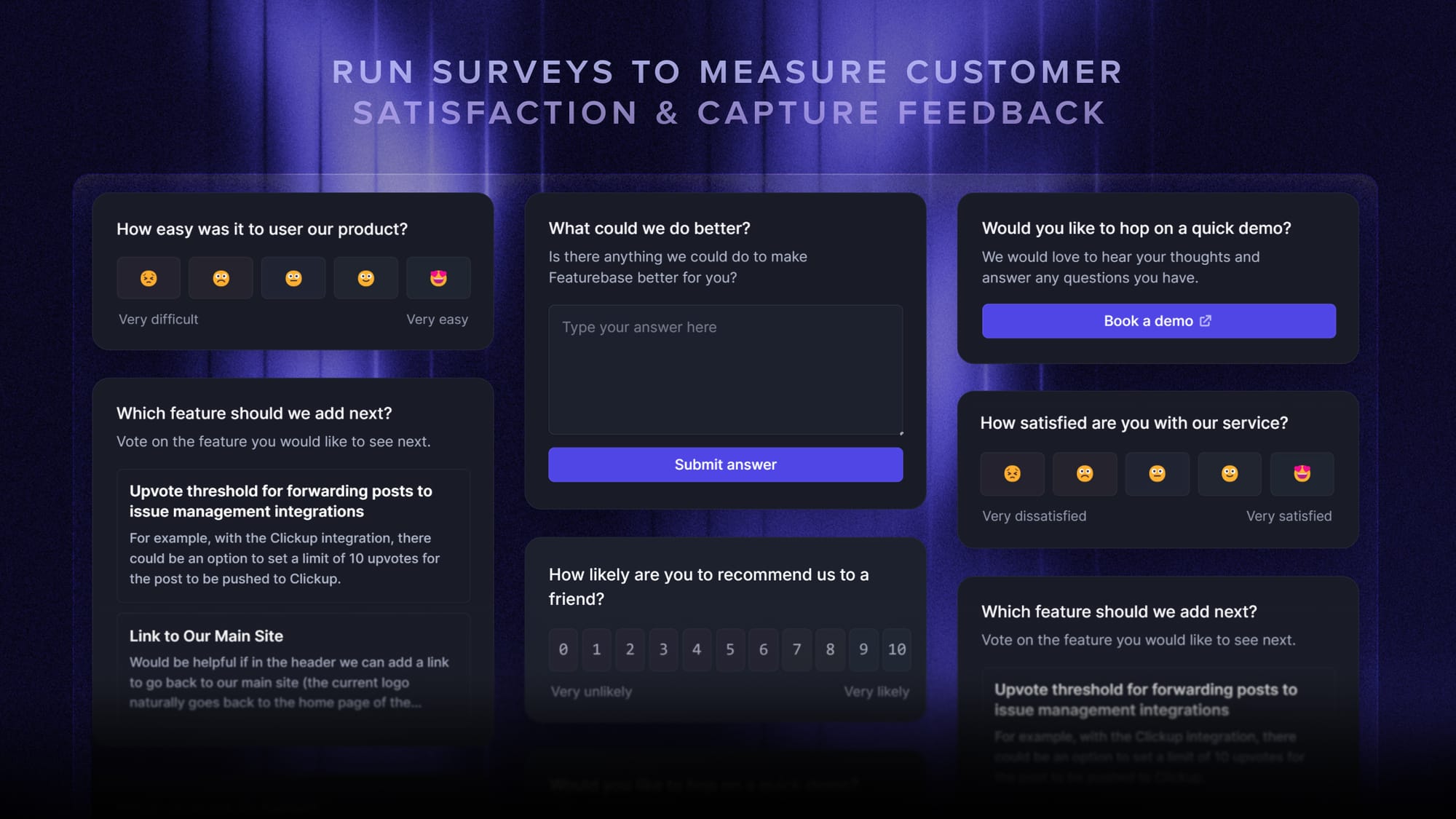
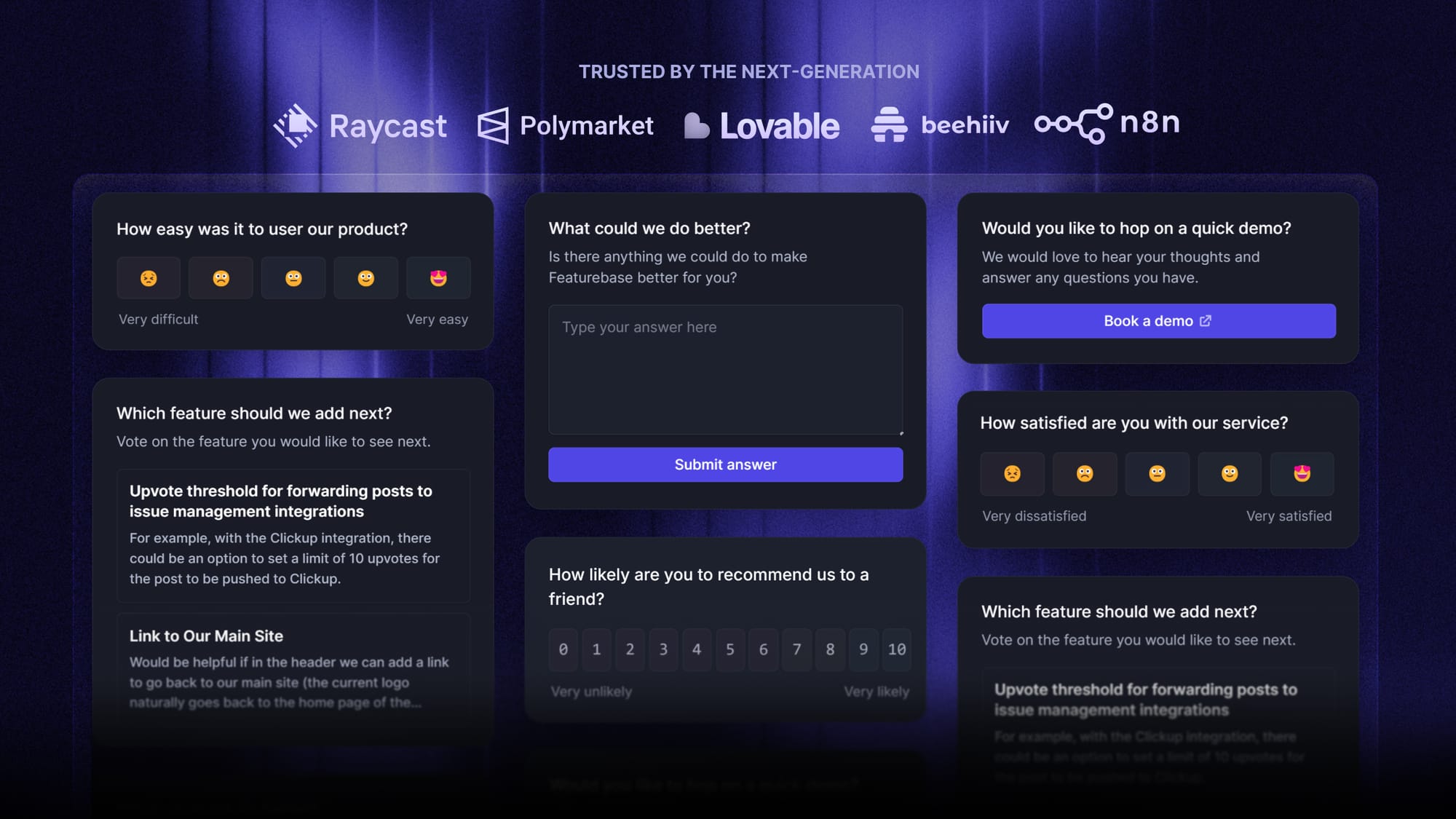
Featurebase is a modern feedback & support platform that helps product teams collect feedback through multi-step surveys, integrations, and a feedback portal, all in one place, to make better product decisions. It's loved by thousands of product teams from companies like Lovable, Raycast, and n8n. 💫
Top features:
- Surveys (NPS, CSAT, etc) – Create targeted no-code surveys to ask users anything and measure customer satisfaction.
- User targeting – Target specific user segments based on properties like plan, role, location, etc.
- Conditional multi-step surveys – Ask follow-up questions based on conditional logic and users' answers
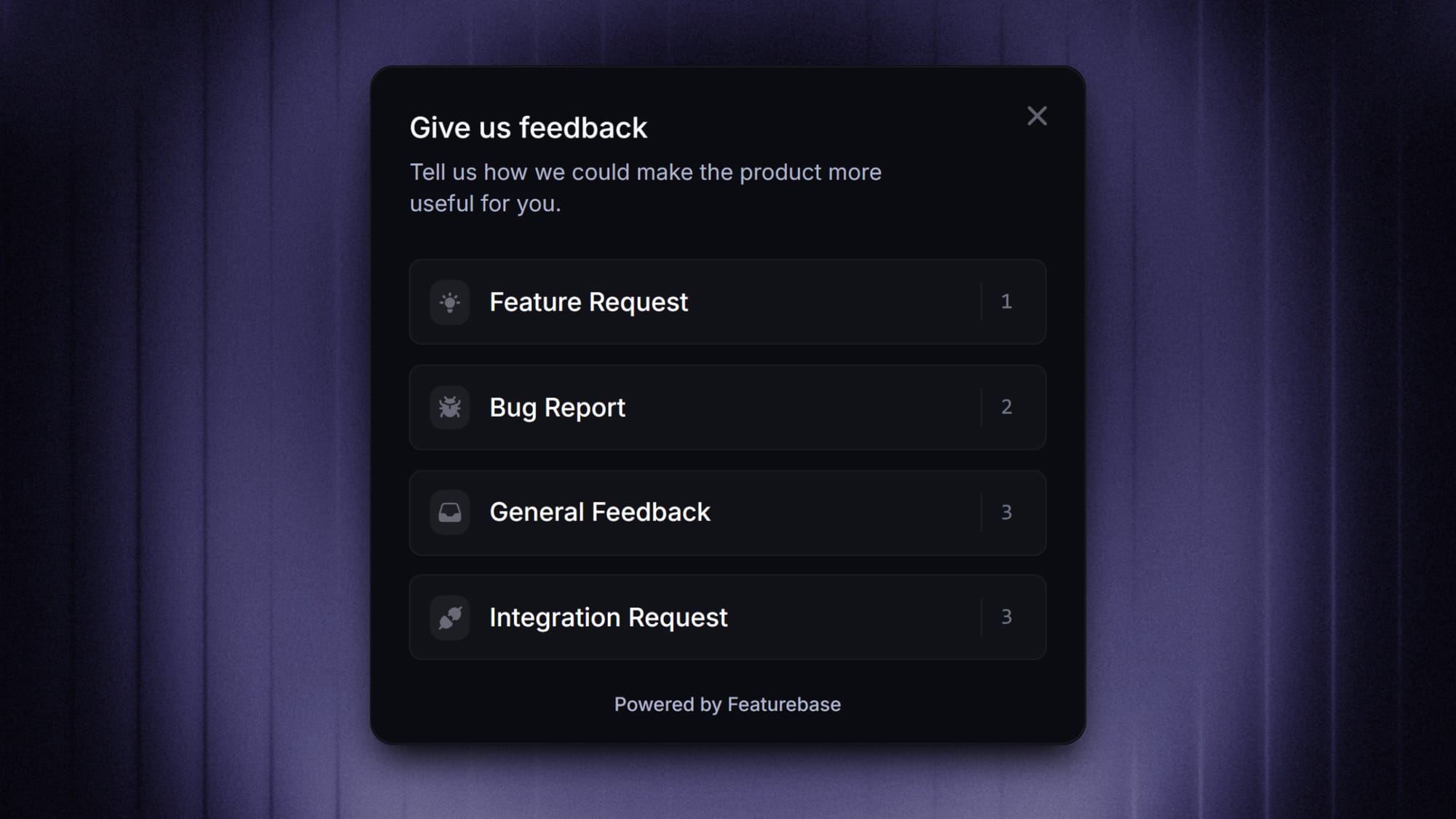
- In-app widgets – Collect ideas, bug reports, and suggestions directly from your website or webapp with an interactive widgets
- Feedback forum – Public feedback forum where users can submit ideas and vote on features helping you know what customers want
- Prioritize by revenue – Link feedback with customer revenue, company size, and much more to better understand the impact of ideas
- Integrations – Connects with Slack, Linear, Jira, HubSpot, and more
- Plus, help center, product roadmaps, release notes, and customer surveys – all in one place
Pricing: Free plan available with unlimited survey responses and feedback. Paid plans start at $29/seat/mo.
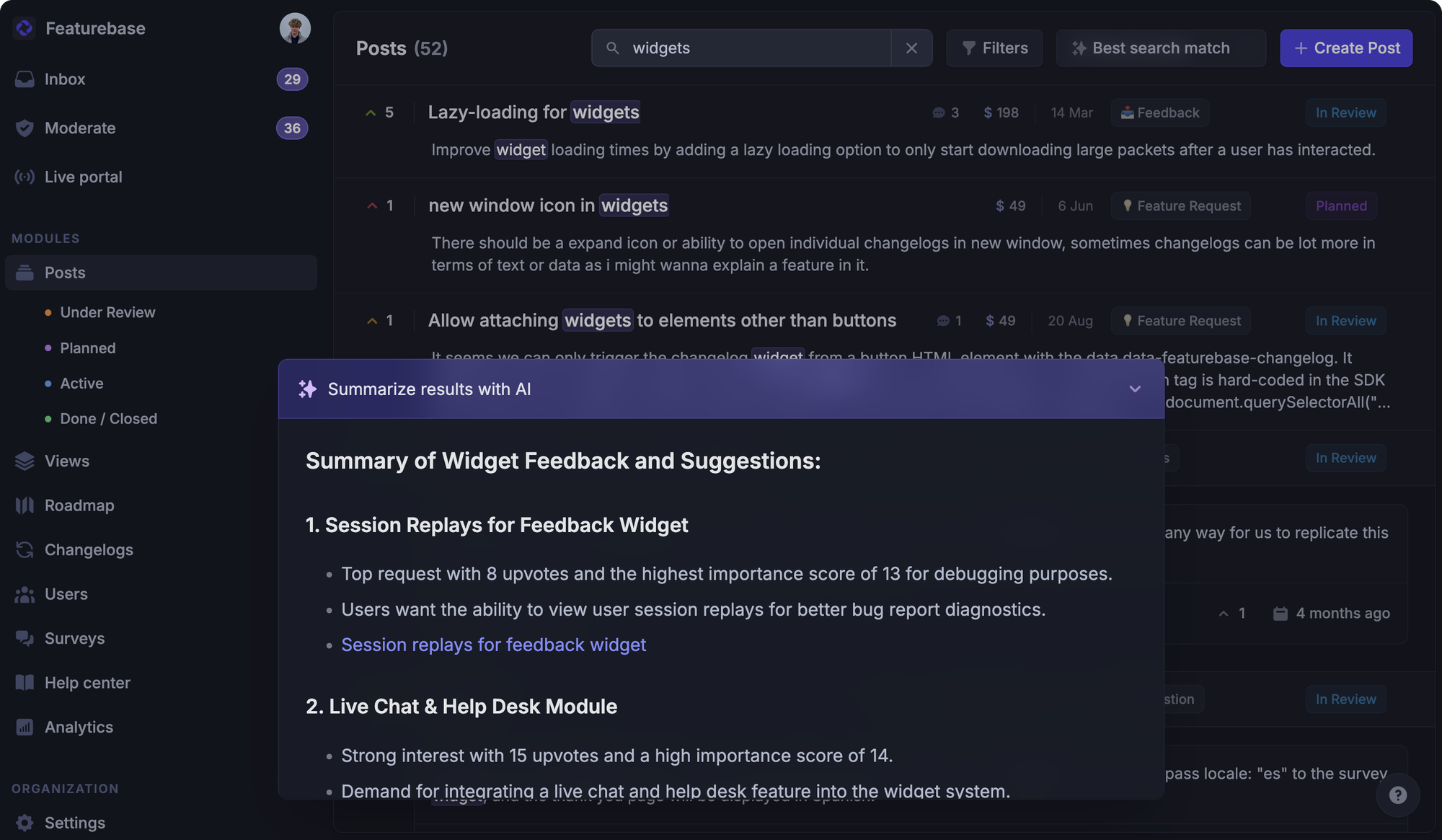
Instead of having 4+ different tools, Featurebase enables you to replace all your customer-facing tools by bringing your feedback collection, product updates, support, and help center together in one place, helping you build products your users love.
Conclusion
Great survey data starts with great questions. Pick the question type that fits your goal, keep every question clear, neutral, and focused on one thing, and ask at the moment the experience is still fresh. The 60+ examples above give you a running start, but the real skill is trimming to the handful that map directly to the decision you're trying to make.
Featurebase brings your surveys, feedback, and product updates into one place, so you can ask the right questions in-app and act on the answers without juggling separate tools. There's a free plan with unlimited survey responses, so there's no downside to trying it. 👇
✨ Start running surveys & collecting feedback with Featurebase for free →
FAQs
What are 5 good survey questions?
A solid 5-question starter set covers the essentials: "Overall, how satisfied are you with your experience?", "How likely are you to recommend us on a scale of 0-10?", "How easy was it to get your issue resolved?", "What is the main reason for your score?", and "What is one thing we could improve?" Together they capture satisfaction, loyalty, effort, and open-ended context in under a minute.
How many questions should a survey have?
Most effective surveys stay between 5 and 10 focused questions. Completion rates fall as the survey gets longer, and every extra question you add that you won't act on is a reason for someone to drop out. A good rule is to remove any question whose answer wouldn't change a decision.
How long should a survey take to complete?
Aim for under 5 minutes. Drop-off tends to climb once a survey passes the 7 to 8 minute mark, so shorter is almost always better. If you have a lot to learn, split it into a few short, well-targeted surveys instead of one long one.
What is a leading survey question?
A leading question is one worded to push respondents toward a particular answer. "How much did you enjoy our excellent support?" assumes the support was excellent and biases the result. The neutral version, "How would you rate our support?", lets people answer honestly and gives you data you can trust.
What is the difference between a Likert scale and a rating scale?
A Likert scale measures how strongly someone agrees with a statement using labeled options, like "strongly disagree" to "strongly agree," which makes it ideal for capturing sentiment. A rating scale asks for a numeric score, such as a 0-10 NPS question, which is better for quick metrics you can track over time.
What is the best tool for running in-app NPS and CSAT surveys?
Featurebase is a strong option for teams that want to run NPS, CSAT, and product-feedback surveys directly inside their product. It supports targeted in-app surveys, conditional multi-step follow-ups, and audience triggers, and it includes a free plan with unlimited survey responses, so you can start collecting feedback without adding another paid tool.