Blog Customer FeedbackHow to Build a Voice of the Customer Program
How to Build a Voice of the Customer Program
A voice of the customer program is how you turn scattered customer feedback into decisions your whole team can act on. Here's what one includes and how to build it.


Your customers are already telling you what they want. It's in support tickets, sales calls, reviews, NPS comments, and that one Slack thread nobody saved.
The problem isn't collecting feedback. It's that the feedback lives in 6 different places and no one owns connecting it.
A voice of the customer program fixes that. It's the system that turns scattered signals into decisions your product, support, and leadership teams can actually act on. Here's what a real program includes, why it matters, and how to build one step by step. 👇
Key takeaways:
- A voice of the customer (VoC) program is a structured system for collecting, analyzing, and acting on customer feedback across every channel, not just surveys.
- The hard part isn't gathering feedback. It's synthesizing it and closing the loop so customers see their input change the product.
- A strong program has 4 parts: unified collection, a way to analyze at scale, a link to business context, and a cadence for action.
- The biggest mistake teams make is collecting feedback and then doing nothing visible with it, which erodes trust fast.
- Featurebase✨ gives you a feedback forum, in-app widgets, roadmaps, and automated update emails to run your entire VoC loop in one place.
What is a voice of the customer program?
A voice of the customer (VoC) program is a structured way to capture, analyze, and act on what your customers are telling you across every channel and touchpoint.
That last part matters. Running a quarterly NPS survey isn't a VoC program. Neither is having a support queue or reading every G2 review. Those are inputs. A program is the system that connects them, finds the patterns, and turns them into action.
The goal isn't more data. Most teams already drown in it. The goal is to make the feedback you're already collecting actually useful, so decisions get made from what customers say instead of what someone in a meeting assumes.
Why a voice of the customer program matters
Because the alternative is guessing. Without a program, you build features 3 customers asked for loudly and miss the pattern 300 customers pointed to quietly.
Listening well pays off directly. According to Forrester's 2024 US Customer Experience Index, customer-obsessed organizations report 41% faster revenue growth and 51% better customer retention than their peers.
The catch is that almost nobody does it well. The same Forrester research found only 3% of companies qualify as truly customer-obsessed. That gap is the opportunity. A working VoC program is still a genuine competitive edge, and it delivers in a few concrete ways:
- Fewer wrong bets: You build what customers actually need instead of what feels right internally, so development time goes toward features that move retention and revenue.
- Earlier churn signals: Feedback surfaces friction and frustration weeks before it shows up as a cancellation, giving you time to act.
- Faster, aligned decisions: When product, support, and leadership work from the same picture of customer needs, prioritization stops being a debate.
- Stronger loyalty: Customers who see their feedback lead to real change stick around and tell other people about you.
What a voice of the customer program includes
A real program is more than a survey tool bolted onto a spreadsheet. It has 4 core parts, and skipping any of them is where most programs quietly fall apart:
- Unified feedback collection: Customers talk everywhere, through support, app reviews, sales calls, and community channels. A program brings all of it into one place so nothing slips through the cracks.
- A system for analysis: Raw feedback isn't insight. You need a way to categorize and analyze what's coming in so you can spot themes at scale, not just read individual comments one by one.
- A link to business context: Which feedback comes from your highest-value accounts? Which themes tie to churn? Connecting feedback to revenue and account data is what turns a nice-to-have into a prioritization engine.
- A cadence for action: The most important part isn't collection, it's what happens next. Strong programs have a regular rhythm for sharing insights with the teams who can act on them.
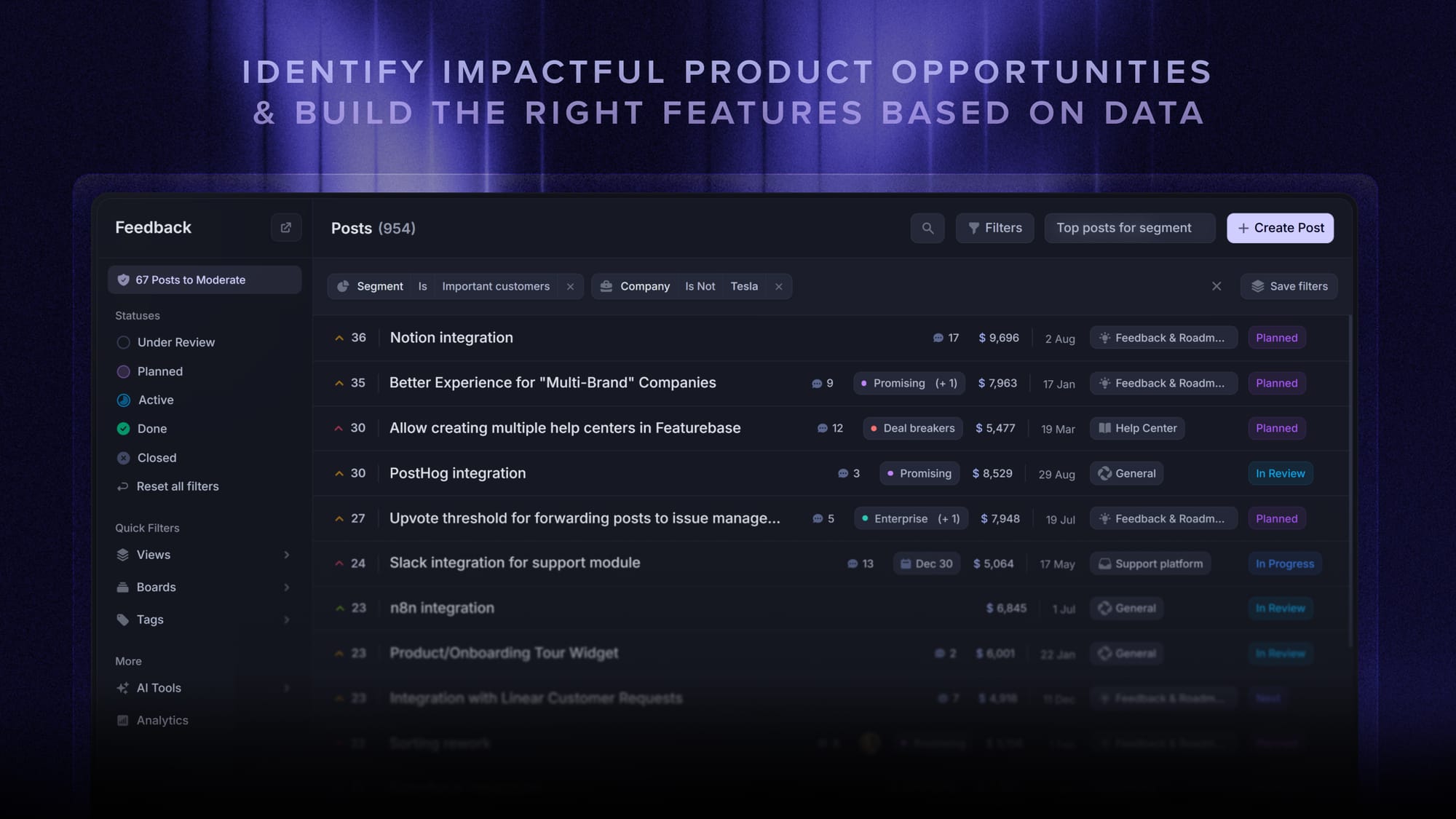
This is where the collection layer earns its keep. With Featurebase, you can run a public feedback forum where users submit and vote on ideas, and embed in-app widgets so people can send feedback and bug reports without leaving your product. Everything lands in one place instead of scattered across tools, which makes the analysis and action steps possible in the first place.
How to collect voice of the customer data
No single channel tells the whole story. The strongest programs pull from a mix of sources, balancing what customers say directly with how they actually behave. The main feedback channels worth tapping:
- Surveys: NPS, CSAT, and CES surveys give you structured, trackable metrics plus open-text comments for context. Keep them short and trigger them at the right moment in the journey.
- Support and sales conversations: Tickets, chats, and call notes are full of usability complaints, feature gaps, and expectations. Logging and analyzing them turns everyday conversations into insight.
- Reviews and social listening: Customers leave unfiltered opinions on sites like G2 and Capterra and across social media. Monitoring these captures sentiment you'd never get by waiting for feedback to come to you.
- In-product feedback: Widgets, feature-request boards, and quick in-app prompts capture sentiment in the moment, right where friction happens.
- Behavioral and usage data: Sometimes actions speak louder than words. Login frequency, feature adoption, and drop-off points reveal how customers experience value, or where they struggle.
The point isn't to use all of these on day one. It's to combine enough of them that you see both the "what" (behavior) and the "why" (sentiment).
How to build a voice of the customer program (step by step)
You don't need a perfect system on day one. You need a loop that runs and improves over time. Here's how to get one going.
1. Define what you're trying to learn
Start with the decisions you need to make, not the data you want to collect. Are you trying to reduce churn? Prioritize a roadmap? Improve onboarding? Your objective decides which feedback matters and which channels to prioritize. Collecting everything and hoping it tells a story is how programs stall.
2. Map where feedback already lives
Before adding anything new, find the feedback you already have. Support, sales, reviews, NPS, the app store, community channels. It's usually messier and more spread out than teams expect. Mapping it shows you the gaps and stops you from standing up yet another survey you don't need.
3. Segment the customers who matter most
All feedback is valuable, but not all of it is equal. Define your key customer segments by strategic value, and make sure you can identify them in your data. A churn-risk enterprise account's complaint should not carry the same weight as a one-off request from a free-tier trial.
4. Centralize and analyze
Pull your sources into one place so feedback stops living in silos. Then categorize it so you can spot recurring themes instead of reacting to individual comments. This is where AI-assisted categorization helps, grouping large volumes of feedback into product areas and themes automatically so patterns surface faster.
5. Assign ownership and act
Feedback that nobody owns goes nowhere. Decide who handles roadmap requests, who manages relationship follow-up, and who resolves technical issues. Then build a regular rhythm, monthly or per sprint, for turning insights into prioritized action.
6. Close the loop
Tell customers what changed because of their feedback. This "you asked, we delivered" step, also known as closing the feedback loop, is what separates a real program from a suggestion box. It proves their input matters and keeps them participating.
Common voice of the customer mistakes to avoid
Most VoC programs don't fail because of bad tools. They fail in predictable ways. The ones to watch for:
- Collecting without acting: This is the big one. Nothing erodes trust faster than asking for feedback and doing nothing visible with it. Customers stop responding when they sense it goes into a void.
- Chasing the score, not the why: An NPS number tells you something is wrong but not what. Over-focusing on the metric without digging into the open-text reasons behind it leads to shallow, unactionable insights.
- Keeping insights in silos: When feedback lives only inside product or only inside support, the rest of the company can't act on it. Customers don't care which team owns the problem, they care that it gets solved.
- Over-surveying: Bombarding customers with survey requests creates fatigue and tanks your response quality. Target the right people at the right moments instead of blasting everyone.
- No clear owner: Without accountability, feedback falls through the cracks because everyone assumes someone else is handling it.
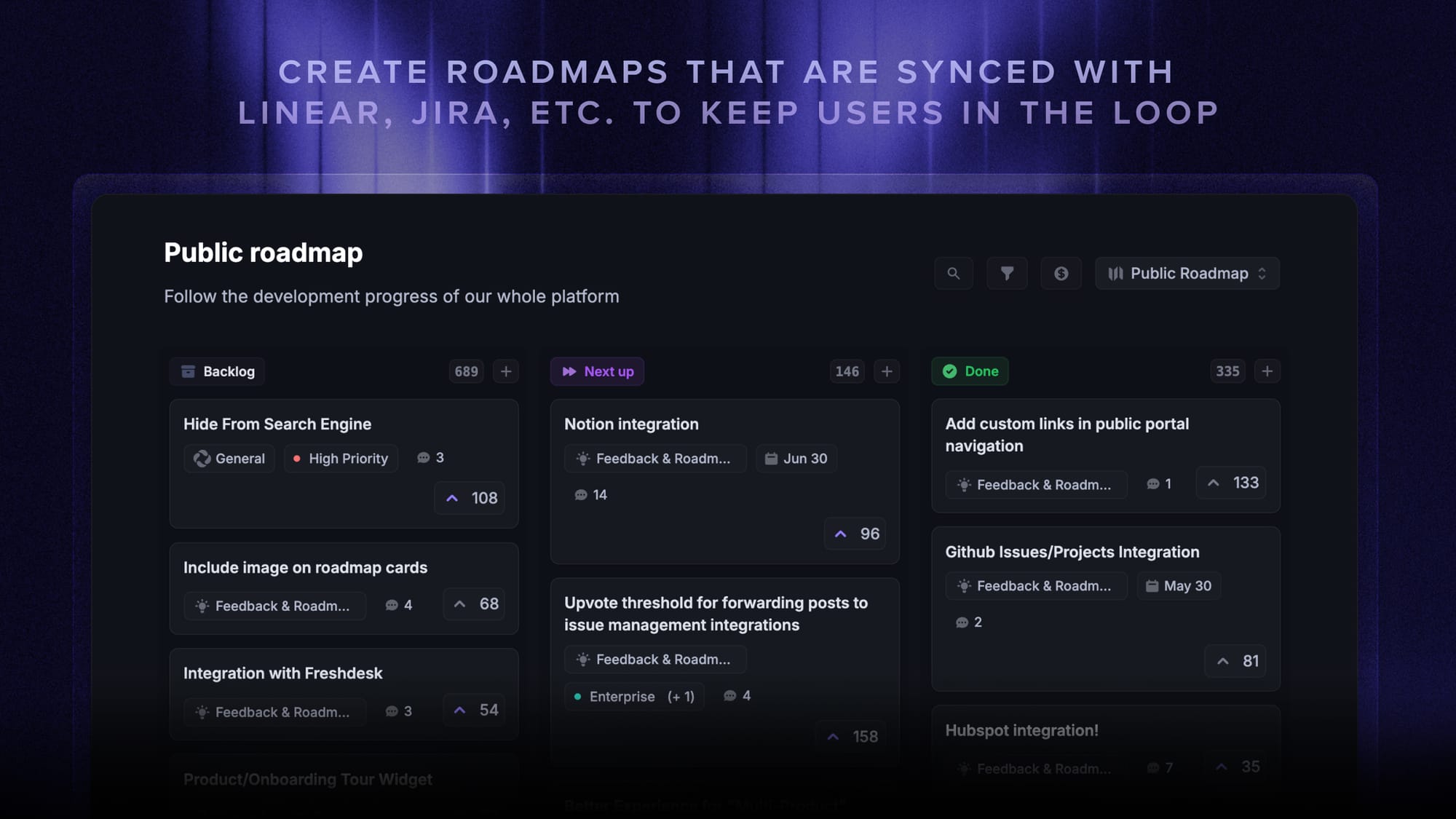
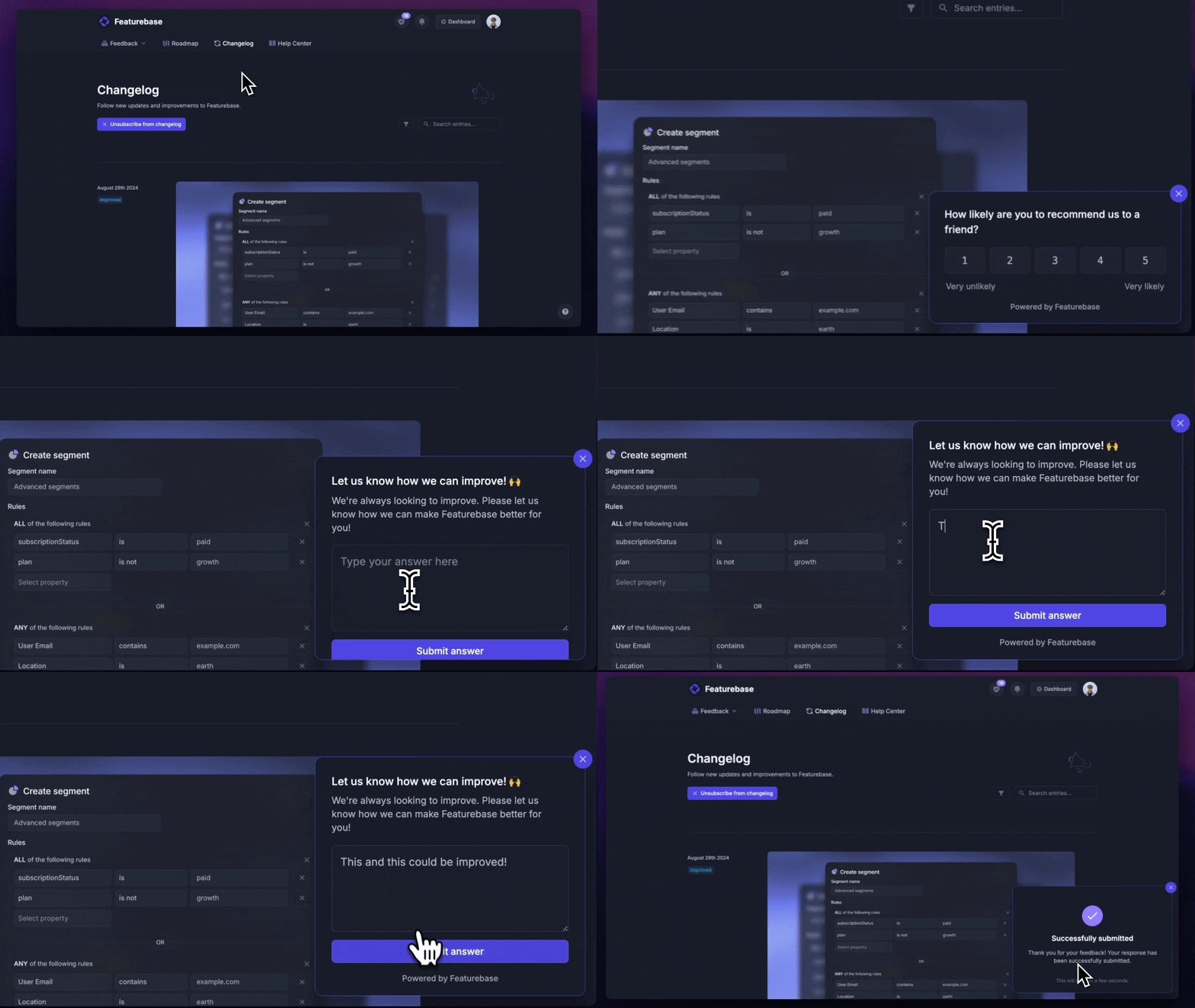
The closing-the-loop mistake is the one worth solving first, because it's the most visible to customers. With Featurebase, you can publish an internal or public roadmap so users see what's planned, and automatically email people when the feature they requested actually ships. That's the difference between a program customers trust and one they quietly give up on.
Turn customer feedback into action with Featurebase
A voice of the customer program is only as good as the action it drives. The listening is the easy part. The hard part is connecting scattered feedback, finding the themes, and closing the loop, all without stitching together 5 different tools.
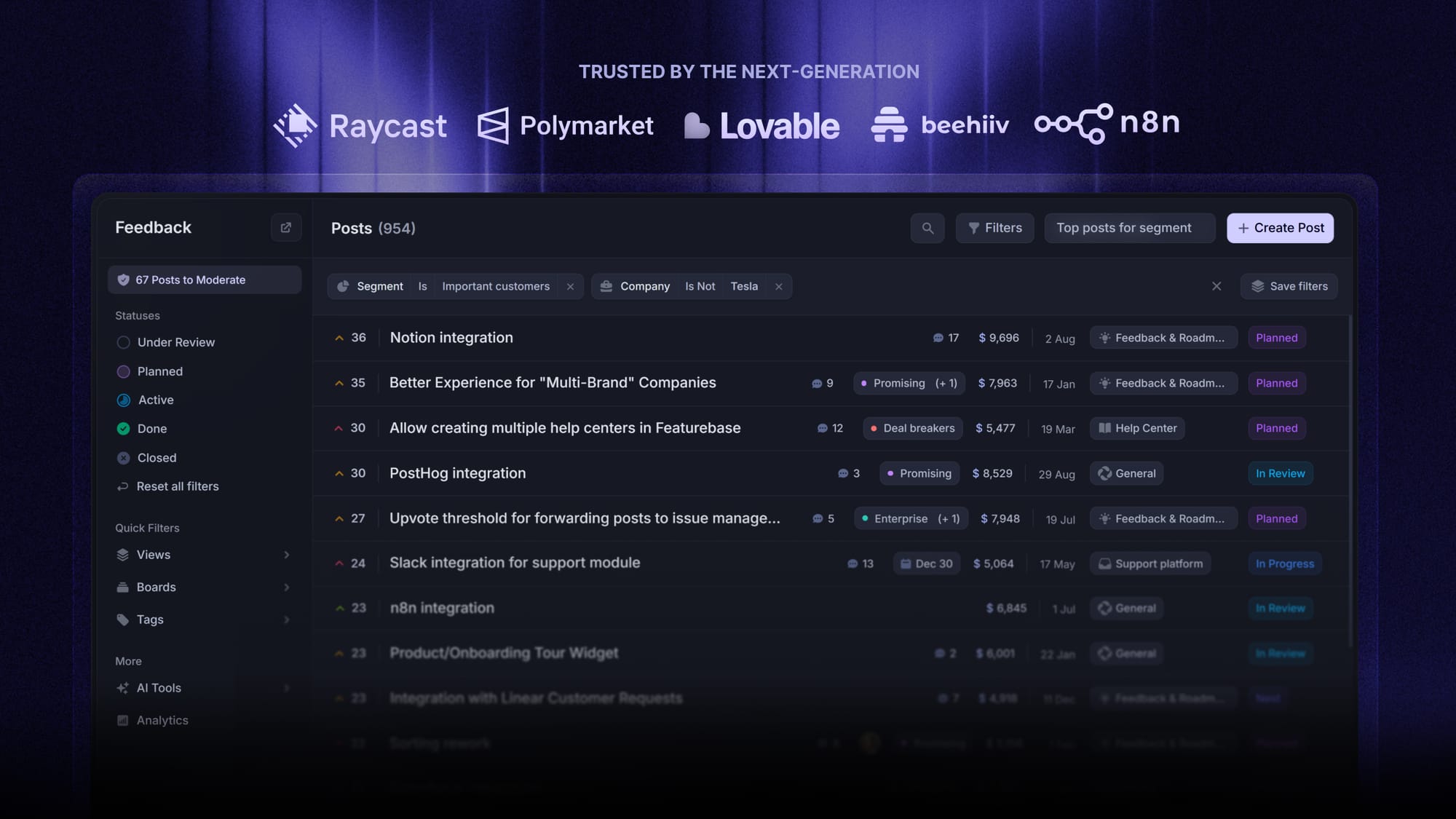
Featurebase is a modern feedback platform that helps product teams collect feedback, prioritize features, build roadmaps, and announce updates, all in one place. It's loved by thousands of product teams from companies like Lovable, Raycast, and n8n. 💫
Top features:
- Feedback forum – Public feedback forum where users can submit ideas and vote on features, so you know exactly what customers want
- In-app widgets – Embed feedback, changelog, and help center widgets directly in your product
- Prioritize by revenue – Link feedback to customer revenue, company size, and more to understand the real impact of each idea
- AI feedback categorization – Automatically group large volumes of feedback into product areas, projects, or themes with AI
- Automated email updates – Automatically notify users when their requested features are implemented
- Roadmaps – Create internal & public product roadmaps to keep users informed and build engagement
- Product updates – Publish release notes with a changelog page, in-app widget, and emails
- Surveys (NPS, CSAT, etc.) – Create targeted surveys to ask users anything and measure customer satisfaction
- Integrations – Connects with Slack, Linear, Jira, HubSpot, and more
It comes with affordable pricing and a Free plan that allows unlimited feedback. The onboarding is quick and doesn't require a credit card, so there's no downside to trying it. 👇
✨ Start collecting & managing feedback with Featurebase for free →
FAQs
What's the difference between voice of the customer and customer experience?
Voice of the customer (VoC) is the listening part: the practice of collecting and analyzing what customers say. Customer experience (CX) is the whole journey a customer has with your brand. VoC is one of the main inputs you use to understand and improve CX, but they aren't the same thing. Think of VoC as the microphone and CX as everything you do with what you hear.
What metrics should a voice of the customer program track?
The common quantitative metrics are Net Promoter Score (NPS), Customer Satisfaction (CSAT), and Customer Effort Score (CES). Each tracks a different signal, so most programs use a mix rather than relying on one. Just remember that no single score tells you why customers feel the way they do, so pair the numbers with qualitative themes from open-text feedback.
How long does it take to build a voice of the customer program?
You can get a basic loop running in a few weeks: pick one objective, connect a couple of feedback sources, and set a cadence for reviewing them. Reaching maturity, where feedback reliably shapes the roadmap across teams, usually takes a few quarters. The mistake is trying to build the perfect system upfront. Start small and expand as it proves its value.
Who should own the voice of the customer program?
A program needs one clear owner to keep it from stalling, often someone in product, CX, or customer success. But ownership doesn't mean doing everything alone. The owner coordinates input from support, sales, and leadership and makes sure feedback gets routed to whoever can act on it. Without a single accountable person, feedback tends to fall through the cracks.
What tools do you need for a voice of the customer program?
At minimum you need a way to collect feedback, a way to analyze it, and a way to act on it and close the loop. The voice of the customer tools you choose can be stitched together from separate survey, spreadsheet, and roadmap apps. Others use a single platform like Featurebase that combines a feedback forum, in-app widgets, roadmaps, and automated update emails, so the whole loop lives in one place. You can start lean and add sophistication as the program grows.
How is a voice of the customer program different from just sending surveys?
Surveys are one input. A program is the whole system around them. Sending an NPS survey tells you a score, but a VoC program connects that survey to support tickets, reviews, and product usage, finds the patterns across all of it, and drives action. The difference is synthesis and follow-through. Surveys ask the question, a program answers it and does something about it.