Blog Customer FeedbackNet Promoter Score Software: 10 Best Tools for 2026
Net Promoter Score Software: 10 Best Tools for 2026
Compare the 10 best NPS software tools for 2026 by price, free plans, and who each one is built for, so you can pick the right net promoter score platform fast.


✨ Start running surveys & collecting feedback with Featurebase for free →
Your NPS is a single number, but the tool you collect it with decides whether that number ever turns into action.
The best NPS software puts the survey in front of the right user at the right moment, then routes low scores to someone who can actually follow up. The wrong one leaves you with a dashboard nobody opens.
Below are the 10 best net promoter score platforms for 2026, ranked by who each one really fits. 👇
Key takeaways
| Tool | Best for | Free plan | Starting price |
|---|---|---|---|
| ✨Featurebase | Modern SaaS teams that want roadmaps, feedback, and updates in one place | Yes | $29/seat/mo |
| Productboard | Larger teams centralizing customer insights at scale | Yes | $19/maker/mo |
| Aha! | Enterprises needing deep strategy-to-roadmap planning | No (trial) | $59/user/mo |
| Jira Product Discovery | Teams already living in the Jira and Atlassian stack | Yes | $10/creator/mo |
| Canny | Teams that want a simple public feedback and voting board | Yes | $79/mo |
| airfocus | Teams that want modular, customizable prioritization | No | Custom |
| ProductPlan | Teams focused on clean visual roadmaps for stakeholders | No | Custom |
| Notion | Small teams wanting a flexible all-in-one workspace | Yes | $10/seat/mo |
| Craft.io | Teams wanting an end-to-end PM workspace with templates | No (trial) | $19/editor/mo |
What is NPS software?
Net Promoter Score software is a tool that sends NPS surveys, collects the 0-to-10 ratings, and turns them into a single score you can track over time. Instead of exporting spreadsheets and calculating by hand, the software handles delivery, scoring, segmentation, and follow-up in one place.
The survey itself is one question: "How likely are you to recommend us?" on a 0-to-10 scale. Responses split into three groups:
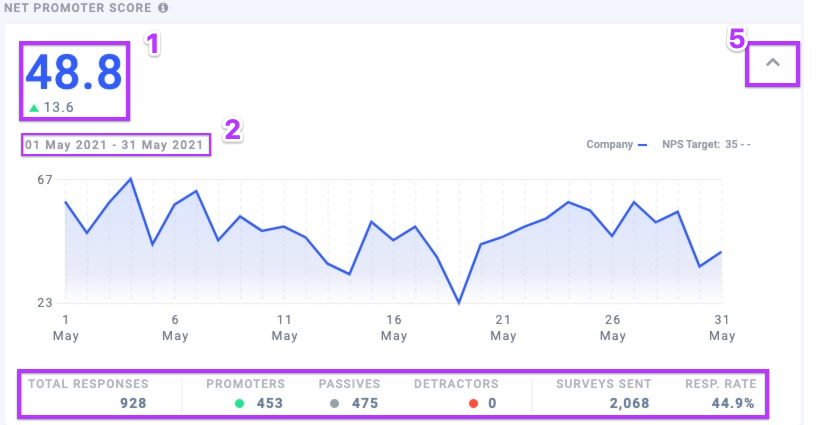
- Promoters are the 9s and 10s, your loyal advocates who drive referrals.
- Passives are the 7s and 8s, satisfied but not enthusiastic and easy to lose.
- Detractors are the 0s through 6, unhappy customers at real risk of churn.
Your score is the percentage of promoters minus the percentage of detractors, landing somewhere between -100 and +100. Good software calculates this automatically and updates it in real time as responses come in.
Why bother tracking it closely? Because the loyalty it measures maps directly to revenue. According to research from Bain & Company, the firm where NPS was invented, increasing customer retention rates by 5% increases profits by 25% to 95%. NPS is one of the earliest signals of whether that retention is trending up or down.
What to look for in NPS software
Most NPS tools collect a score. The differences show up in what happens before and after the survey. When you compare options, weigh these five things:
- Survey delivery channels: The best tools reach customers where they already are, whether that's in-app, by email, over SMS, or through a link. In-product surveys almost always get higher response rates than email blasts because you catch users in context.
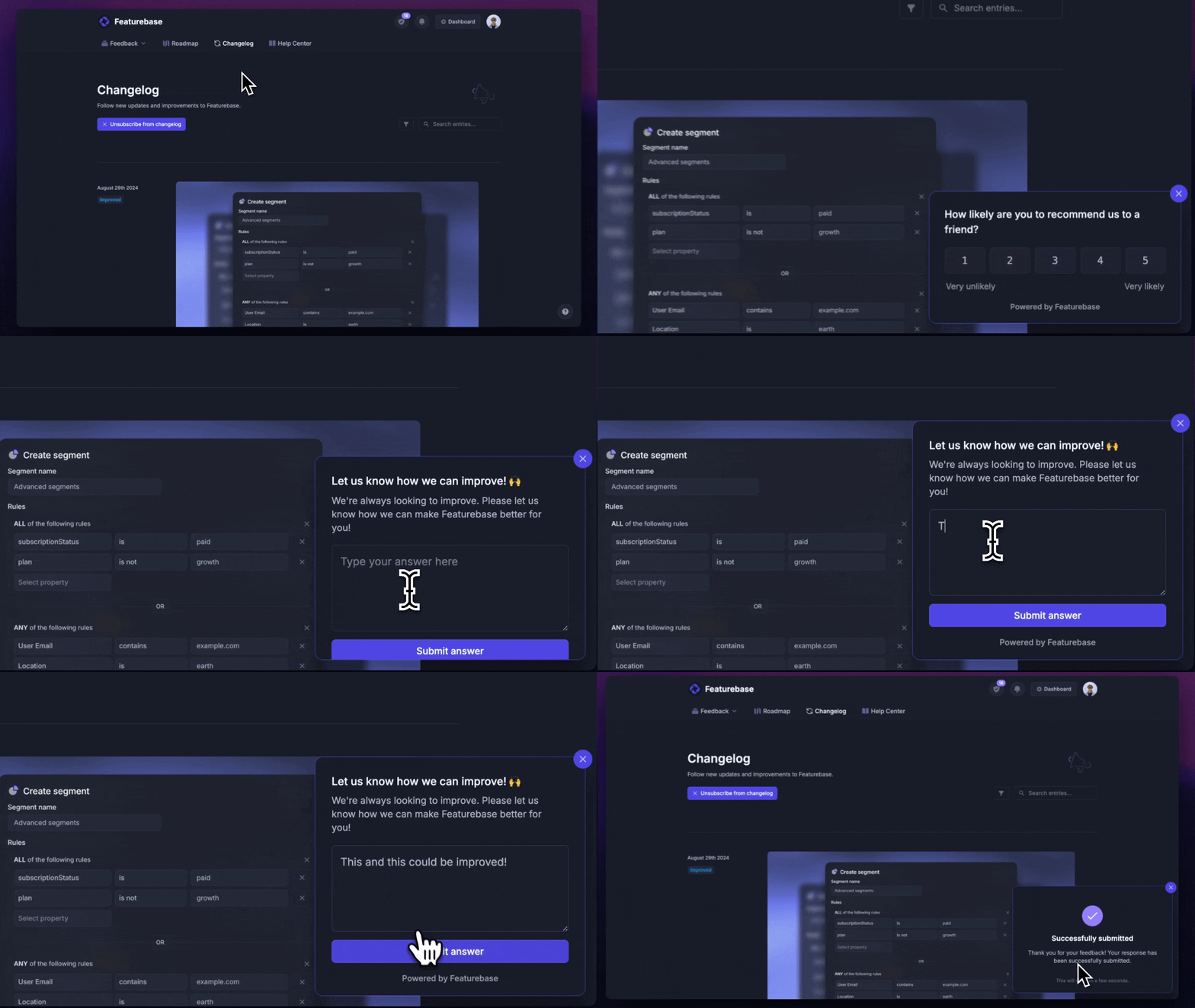
- Targeting and timing: You rarely want to survey everyone at once. Look for segmentation by plan, role, activity, or lifecycle stage so you can trigger NPS at meaningful moments, like after onboarding or a support interaction. With Featurebase, for example, you can target surveys to specific user segments so the right cohort sees the question at the right time.
- Closing the loop: A score is useless if nobody acts on it. Strong platforms route detractors to your team, trigger alerts, and let you reply or follow up so a low score becomes a saved account.
- Integrations: NPS data is most valuable next to everything else you know about a customer. Check for connections to your CRM, helpdesk, Slack, and product tools like Linear or Jira.
- Reporting and trends: You want to segment scores by cohort, watch the trend line over time, and read the open-text comments, not just stare at one number.
Price matters too, but it should be the last filter, not the first. A cheap tool that nobody on your team opens costs more than it saves.

Start running surveys & collecting feedback
Create targeted NPS, CSAT, multiple-choice, or text response surveys for free
The 10 best NPS software tools
Here are the 10 platforms worth shortlisting in 2026, starting with the most flexible all-in-one option and moving through specialists for support, enterprise, and ecommerce.
1. Featurebase✨
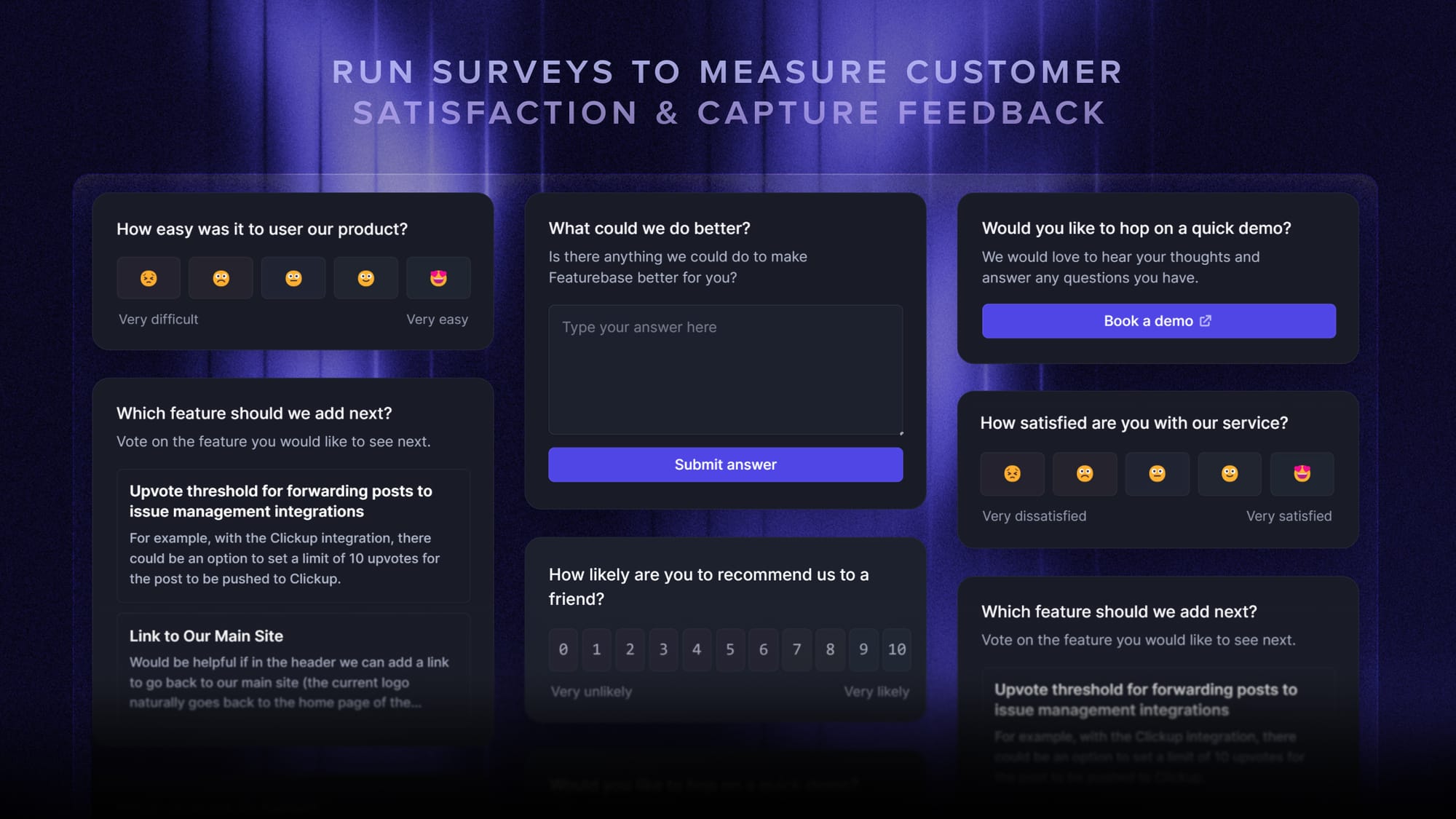
Featurebase is a feedback and product platform that runs NPS, CSAT, and other surveys alongside a full feedback forum, roadmap, and changelog. It's a strong fit for product-led SaaS teams that want their loyalty score sitting next to the feature requests and product feedback it should inform, rather than in a separate survey silo.
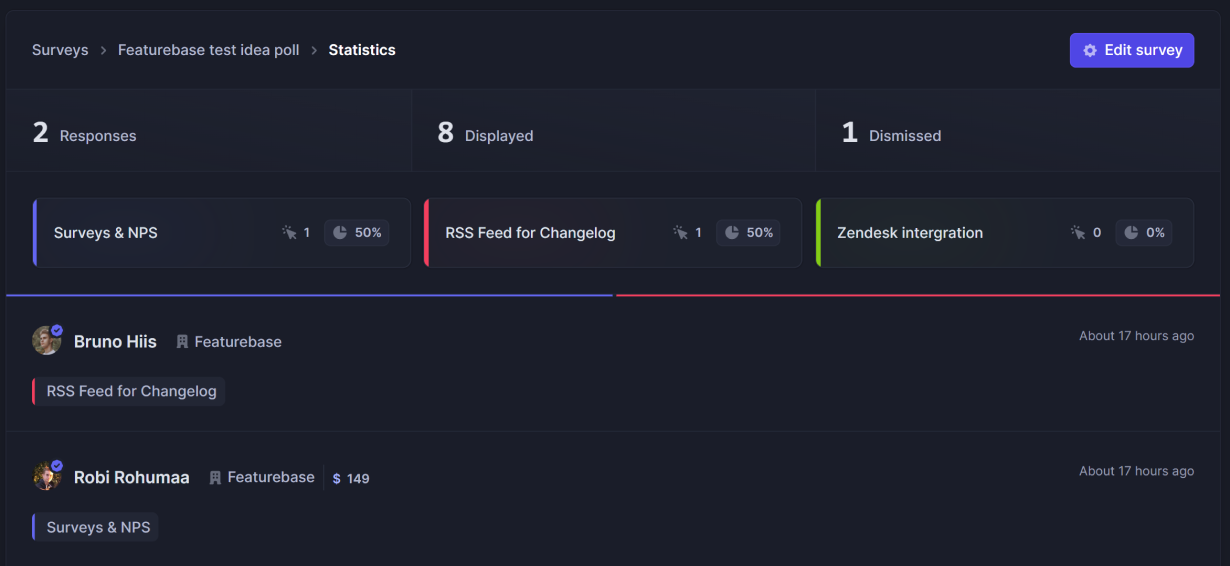
Because surveys live in the same place as your feedback boards, a detractor's comment can become a tracked feature request in a couple of clicks, and you can see which unhappy accounts are asking for what.
Top features:
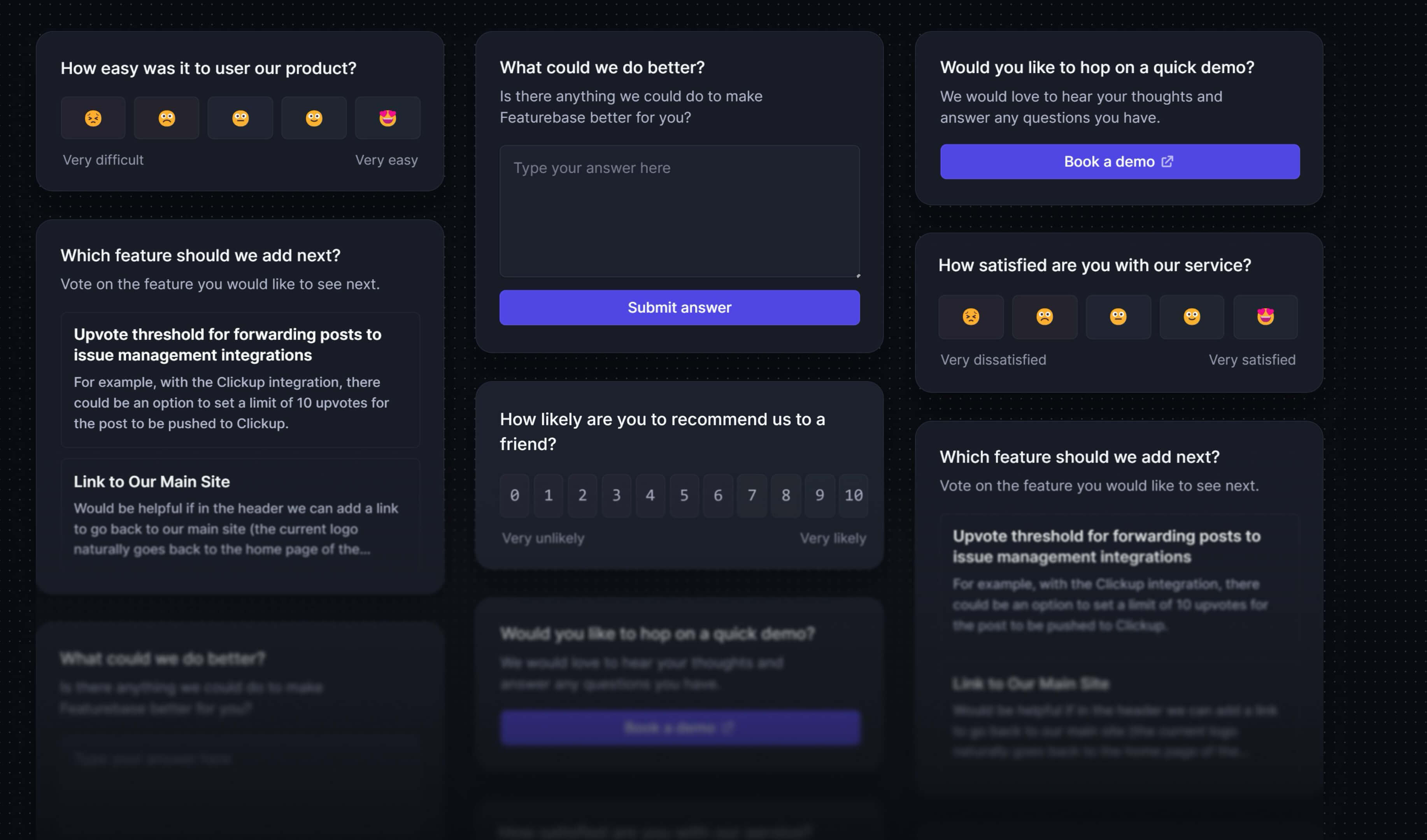
- Surveys (NPS, CSAT, etc.) – Create targeted no-code surveys to measure loyalty and satisfaction
- User targeting – Trigger surveys for specific segments based on plan, role, activity, or location
- Conditional multi-step surveys – Ask smart follow-up questions based on how someone answered
- In-app widgets – Collect scores, ideas, and bug reports directly inside your product
- Feedback forum – Let users submit and vote on ideas so you know what's behind the score
- Prioritize by revenue – Tie feedback to customer revenue and company size to see real impact
- Integrations – Connects with Slack, Linear, Jira, HubSpot, and more
Pricing: Free plan available with unlimited survey responses and feedback. Paid plans start at $29/seat/mo.
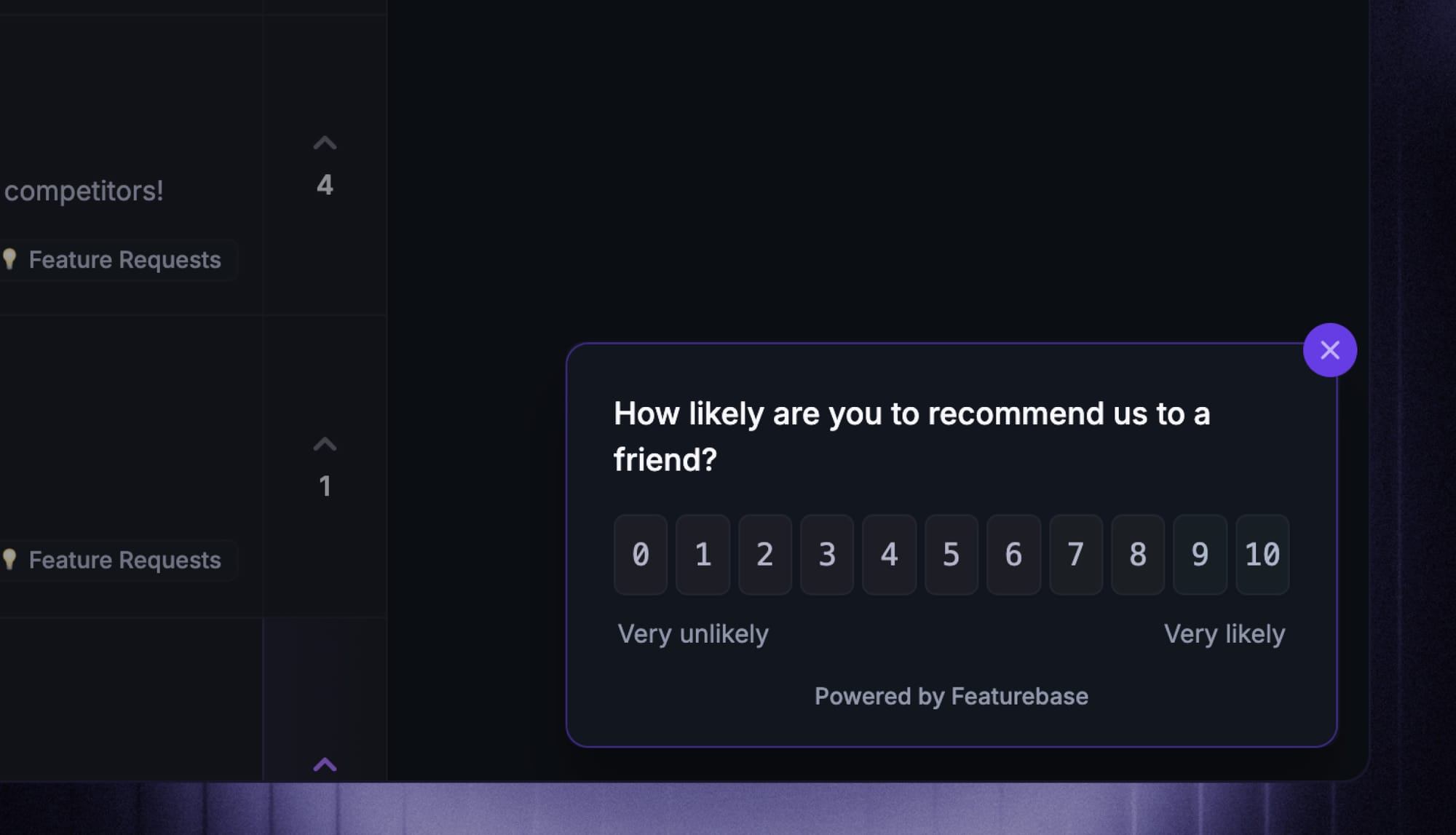
For teams that see NPS as the start of a feedback loop rather than a standalone metric, having surveys, voting, and roadmaps under one roof removes a lot of stitching between tools.
✨ Start running surveys & collecting feedback with Featurebase for free →
2. AskNicely
AskNicely is built for service and frontline businesses, like field services, franchises, and hospitality, where NPS feeds directly into coaching individual employees. Its standout is tying feedback back to specific team members and turning that into performance nudges.
Key features
- NPS, CSAT, and CES surveys over email, SMS, and web
- Frontline dashboards and coaching workflows for individual reps
- Review management and automated recognition
- Integrations with common CRM and support tools
Reviewers praise how quickly it automates survey sending and how clearly it surfaces results once it's set up. The common complaints are that pricing isn't built for small teams, integrations can feel shallow (users often want deeper HubSpot support), and NPS scoring is harder to customize than in survey-first tools.
Pricing: Quote-based only, sold on annual contracts that scale with response volume. There's no self-serve free trial, and add-ons like SSO are priced separately.
3. Retently
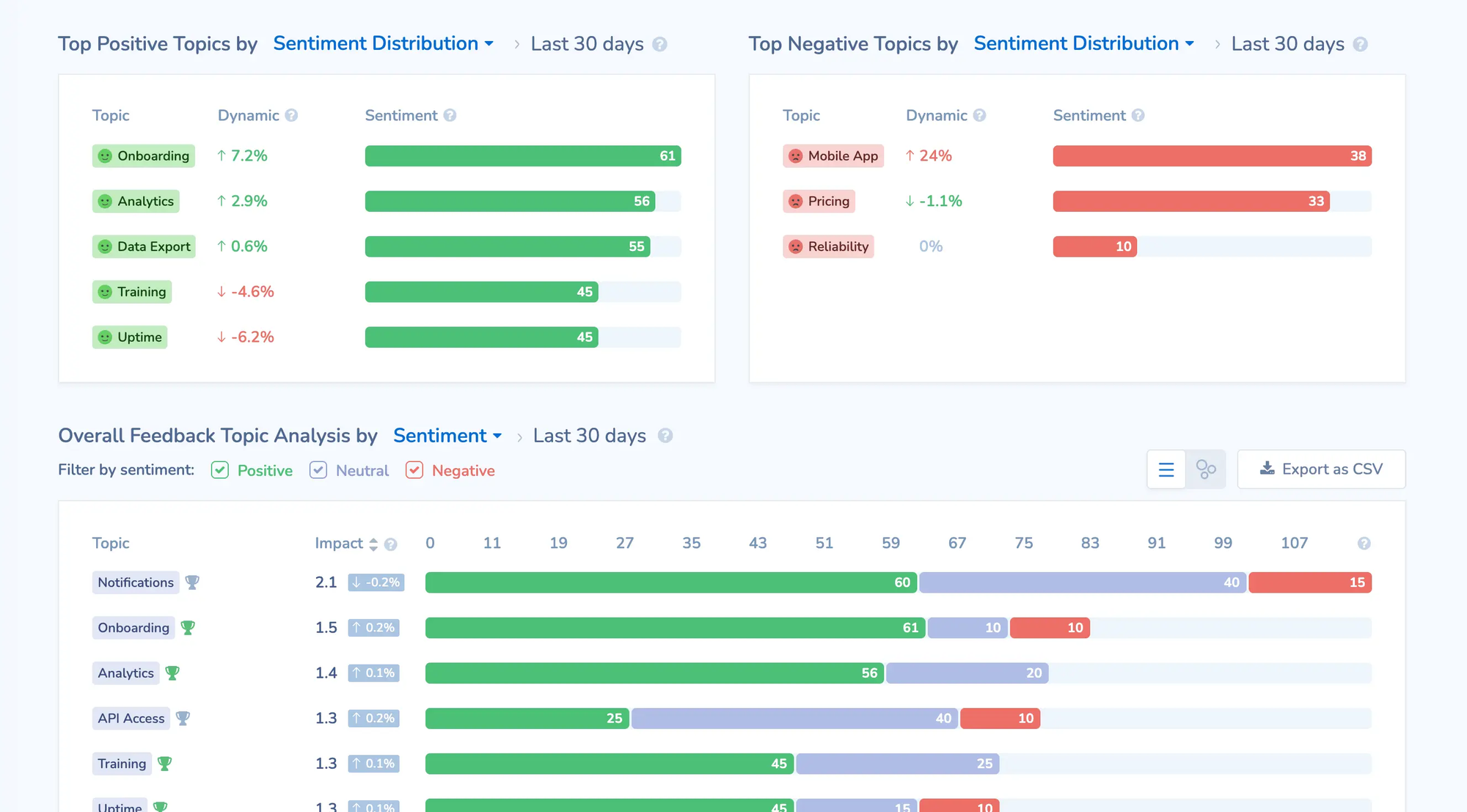
Retently is a dedicated NPS and CX platform aimed at ecommerce and SaaS teams that care most about closing the feedback loop. It's survey-first, with solid automation for follow-ups and tagging open-text responses.
Key features
- NPS, CSAT, and CES campaigns over email and in-app
- Automated follow-up sequences and response tagging
- Segmentation and trend tracking over time
- Integrations with tools like HubSpot, Intercom, and Slack
Users like the clean, intuitive interface and the responsive support team. On the downside, some reviewers report friction around trials and onboarding, and the cost climbs as you add seats and campaigns, which can make it a stretch for smaller teams.
Pricing: No free plan, but there's a 14-day free trial with no card required. Paid plans start at $99/mo for the Basic tier (2,500 surveys, 3 seats) and rise to $299/mo for Pro, with custom Enterprise pricing above that.
4. SurveySparrow
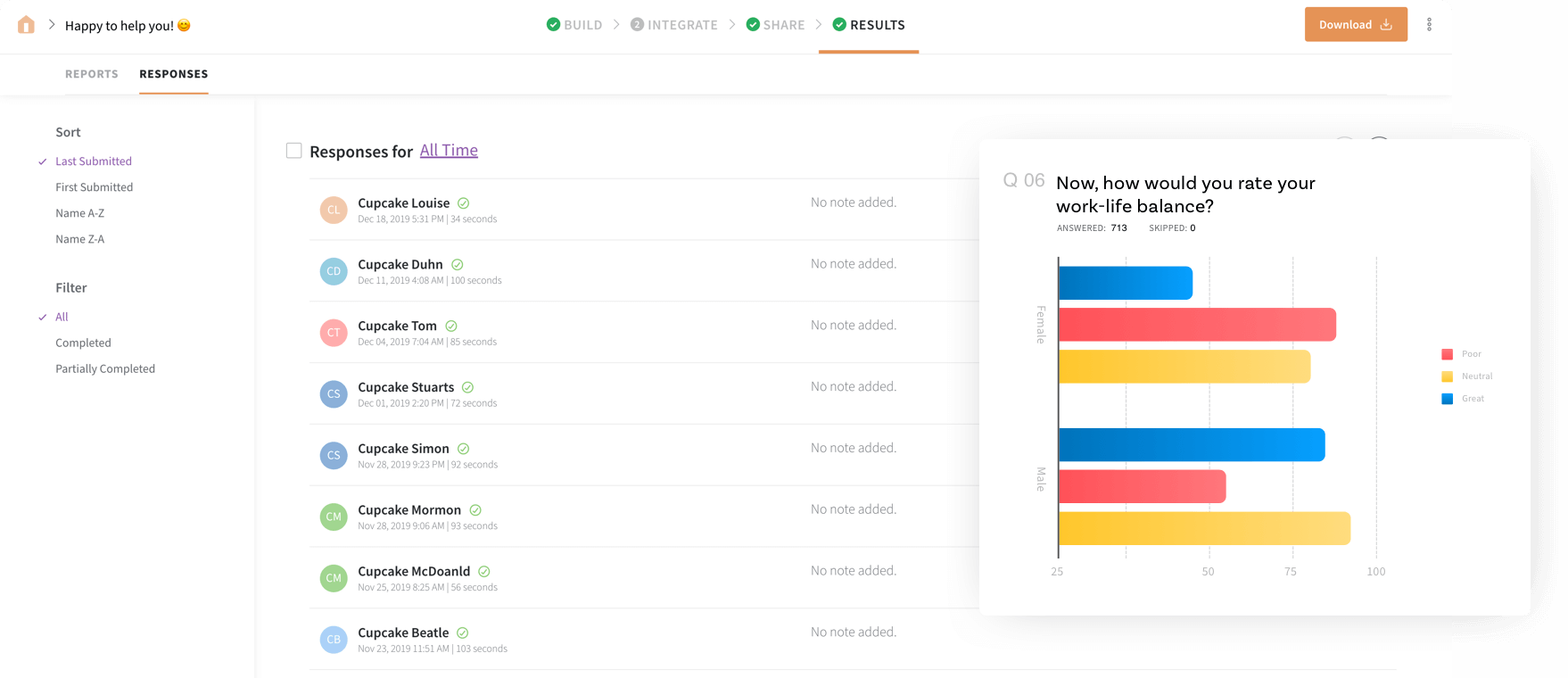
SurveySparrow's hook is conversational surveys that feel more like a chat than a form, which tends to lift completion rates. It's a good pick for teams that want NPS surveys to look polished and on-brand across web, email, and in-app.
Key features
- Conversational, chat-style survey UI
- NPS, CSAT, and CES templates with recurring survey schedules
- Multi-channel sharing across email, link, and in-app
- A wide integration library
The interface and survey experience get consistent praise. The trade-offs reviewers mention are that pricing tiers jump quickly, response limits on lower plans can be tight, and some users hit occasional bugs in more advanced setups.
Pricing: There's a free plan (75 responses per quarter, 1 user). Paid plans are billed annually across Basic, Starter, and Business tiers, with custom Enterprise pricing. Annual billing saves up to 40%.
5. Survicate
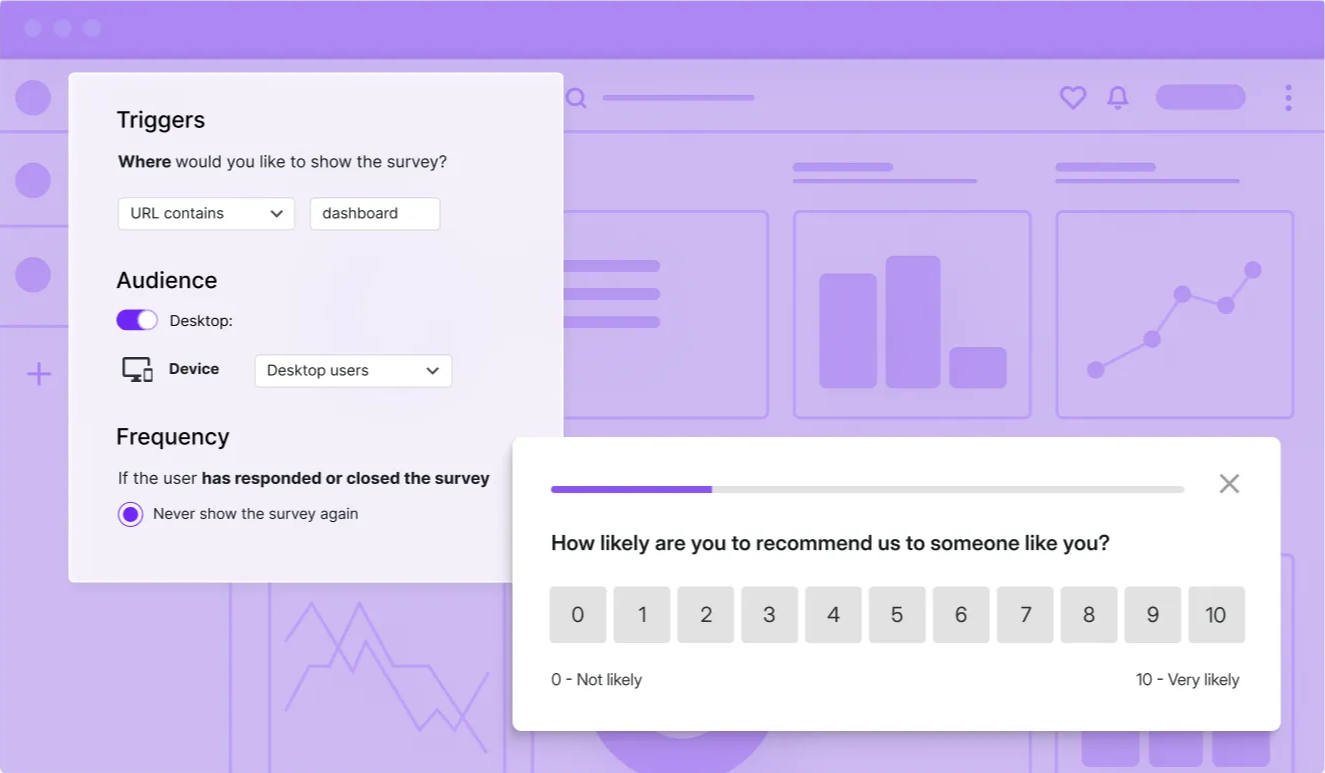
Survicate is a versatile survey platform that goes well beyond NPS, covering website, in-product, email, and link surveys. It suits marketing and product teams that want one tool for many survey types, not just loyalty tracking.
Key features
- NPS, CSAT, CES, and custom surveys across channels
- A large template library and quick setup
- 200+ integrations plus a research repository
- Targeting and audience filtering
Reviewers value how fast it is to launch in-product surveys and the breadth of integrations. The main gripe is cost: response pools are capped per plan, and overage or upgrades get expensive as your volume grows, with deeper reporting reserved for higher tiers.
Pricing: No free plan, but a 10-day trial (25 responses, no card). The Growth plan is $114/mo billed annually, Pro is $349/mo, and Enterprise is $569/mo, with custom response pools on the top tiers.
6. Qualtrics
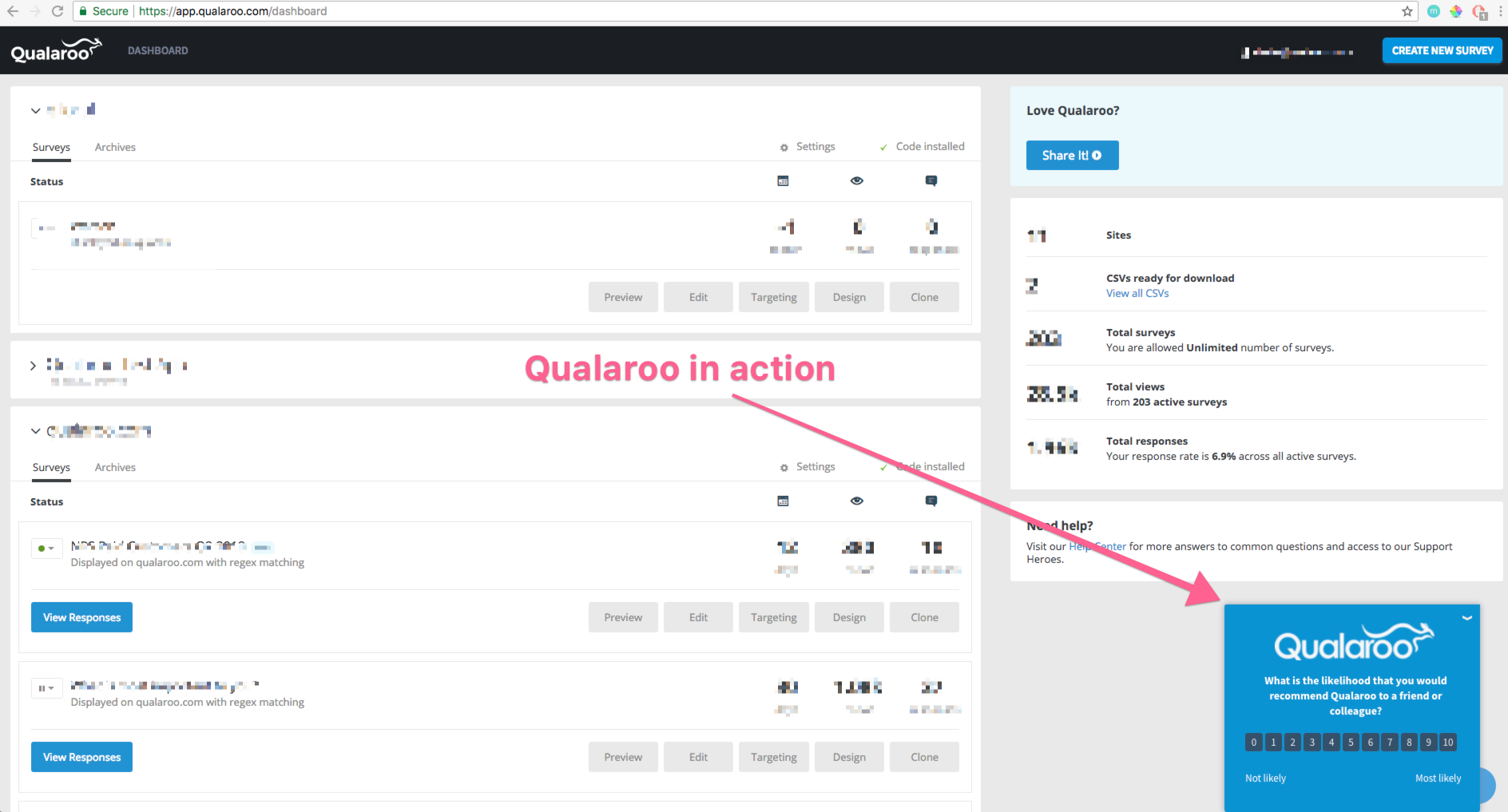
Qualtrics is the enterprise heavyweight. Its CustomerXM product handles NPS as one small piece of a much larger experience-management suite with advanced analytics, statistical modeling, and text analysis. It's built for large organizations with dedicated research or CX teams.
Key features
- NPS as part of a full experience-management platform
- Advanced analytics, driver analysis, and AI text insights
- Deep segmentation, dashboards, and enterprise governance
- Extensive integrations and enterprise security
There's no question it's powerful. The recurring reviewer complaints are the price, the opaque quote-based buying process, and a steep learning curve. For a team that only needs NPS, most of the platform goes unused, which is exactly why so many buyers look at lighter options.
Pricing: No public pricing. Qualtrics is quote-based on annual contracts, and third-party trackers put entry deals in the low thousands of dollars per year, scaling well into five figures for larger deployments. You can read a fuller breakdown in this Qualtrics pricing guide.
7. SurveyMonkey
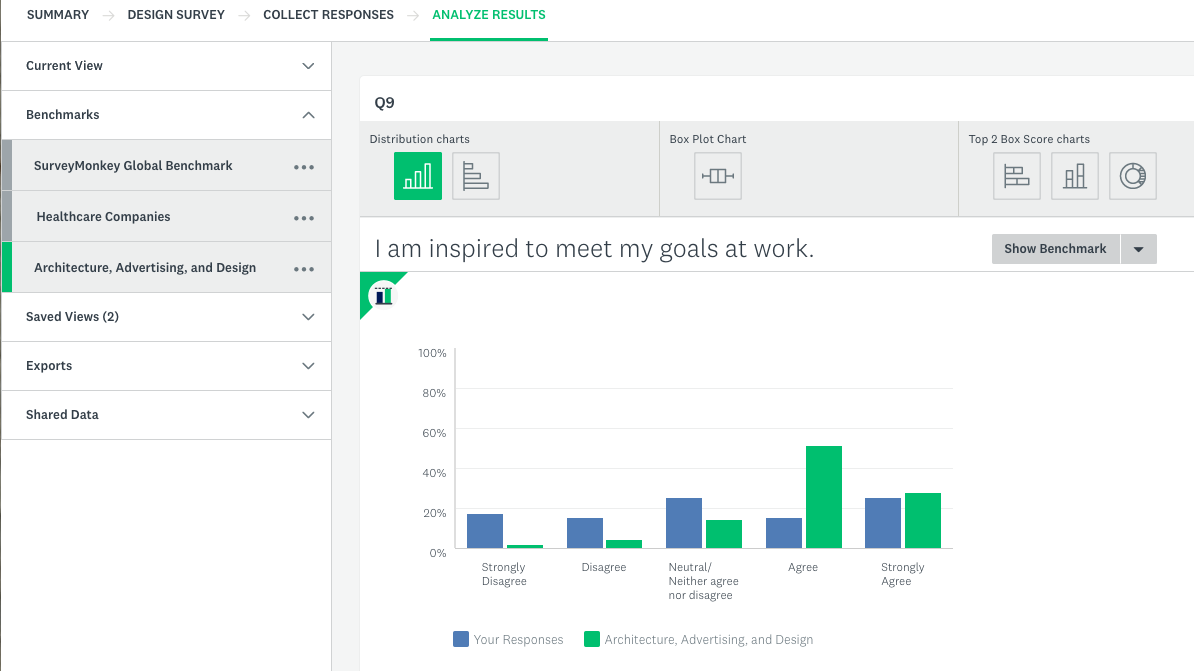
SurveyMonkey is the familiar generalist. Nearly everyone has used it, and it offers NPS templates alongside its huge library of general survey types. It's a reasonable default for teams that already run surveys there and just want to add an NPS question.
Key features
- NPS templates within a broad general-survey tool
- Large question bank and analysis features
- Many integrations and easy sharing
- Team collaboration on higher plans
Its familiarity and ease of use are the draw. The catch is that it isn't NPS-first: dedicated CX features and advanced analytics sit on higher tiers, pricing is per user with a 3-seat minimum on team plans, and closing-the-loop automation is thinner than in specialist tools.
Pricing: A free Basic plan exists (view up to 25 responses per survey). Team Advantage starts at $30/user/mo and Team Premier at $92/user/mo, both billed annually with a 3-user minimum, with custom Enterprise pricing. Our SurveyMonkey pricing guide breaks down each tier.
8. Zonka Feedback
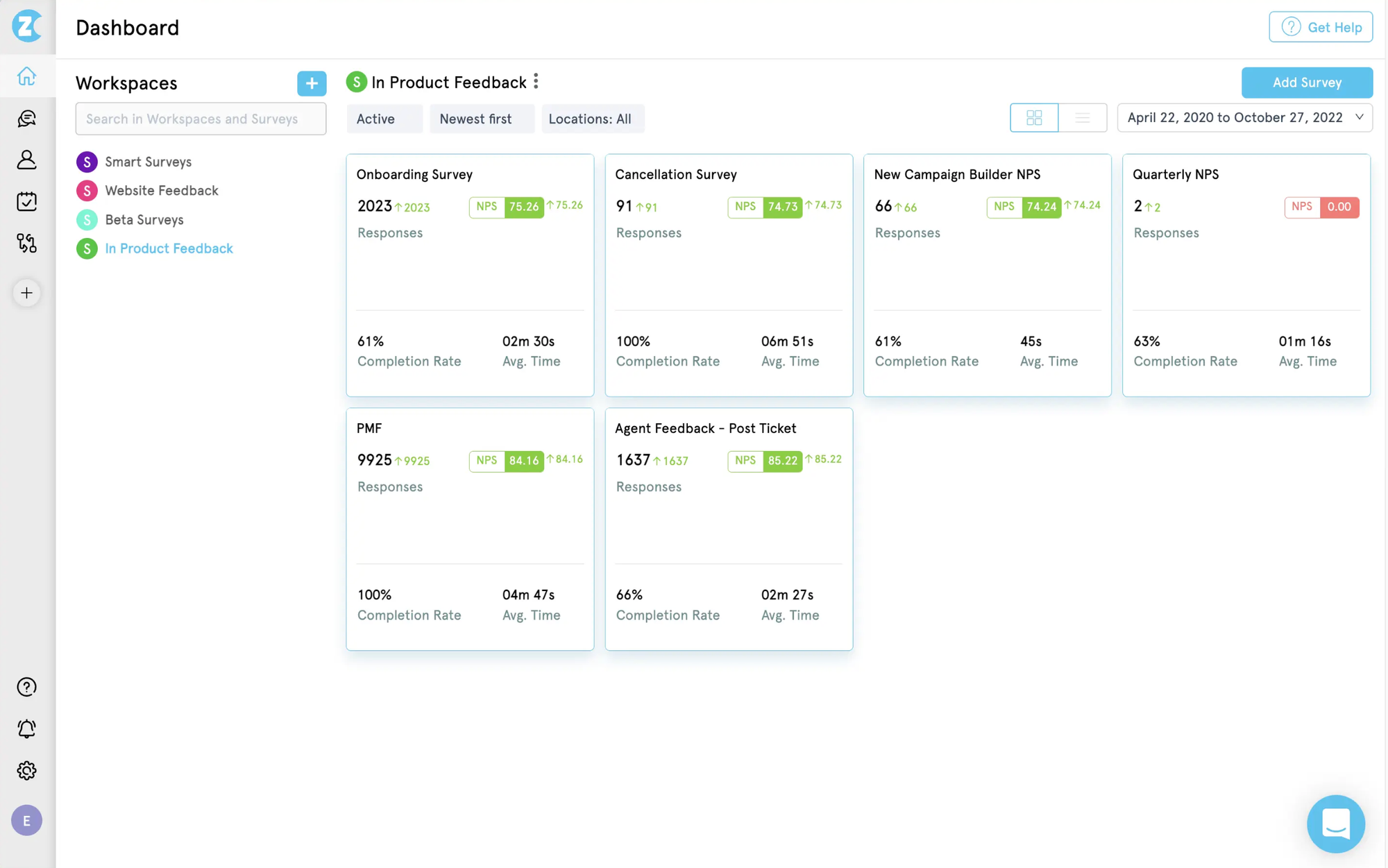
Zonka Feedback is a multi-channel CSAT and NPS tool strong in offline and in-person settings, like kiosks, tablets, and locations, on top of the usual email, SMS, and in-app surveys. It fits businesses that gather feedback across many physical and digital touchpoints.
Key features
- NPS, CSAT, and CES surveys across web, email, SMS, kiosk, and in-app
- Real-time alerts and response workflows
- White-label options and multi-location support
- AI-assisted feedback analysis on higher tiers
Users highlight the omnichannel reach and responsive support. The trade-offs are a UI that takes some learning and pricing that scales with response volume, which can climb fast for higher-traffic programs.
Pricing: No free plan, but a 14-day free trial. Paid plans are response-based and currently start around $199/mo, with an AI-focused tier above that and custom enterprise quotes.
9. SatisMeter
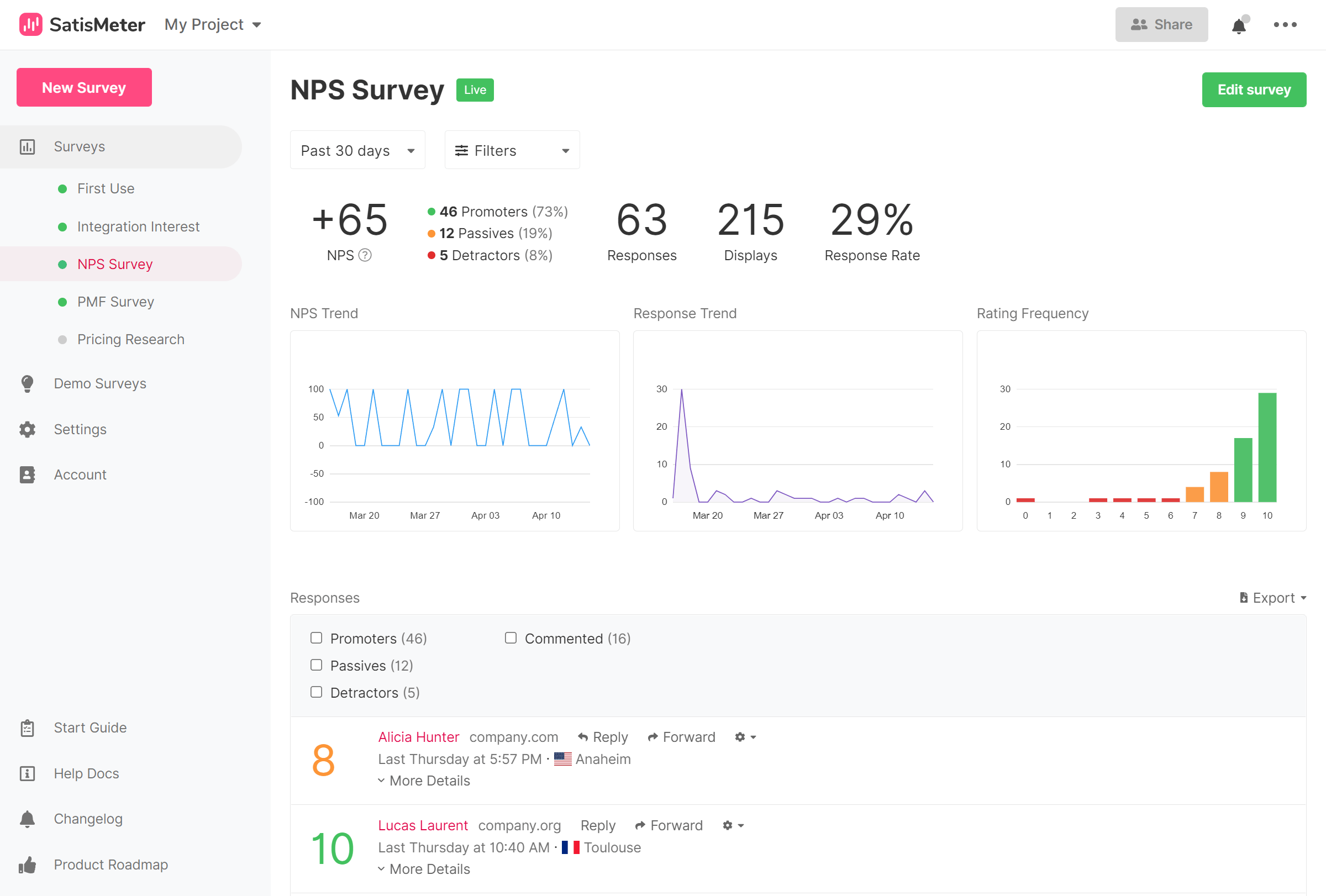
SatisMeter keeps things simple: lightweight, in-product NPS, CSAT, and CES surveys with event-based triggers, popular with subscription and SaaS businesses that want real-time feedback without a heavy platform. It's easy to install and get running quickly.
Key features
- In-app, email, and link surveys with event triggers
- NPS, CSAT, and CES with segmentation
- Integrations with Segment, Intercom, HubSpot, and Slack
- Simple dashboards and response routing
Reviewers like how fast it is to set up and how well the event-driven targeting works for SaaS. The limits show up in advanced reporting and a smaller integration set than the bigger platforms, so power users can outgrow it.
Pricing: Free plan available ($0/mo, 25 responses, roughly 250 active users). The Growth plan is $199/mo (1,000 responses, roughly 10,000 active users), with custom Enterprise pricing above that.
10. Nicereply
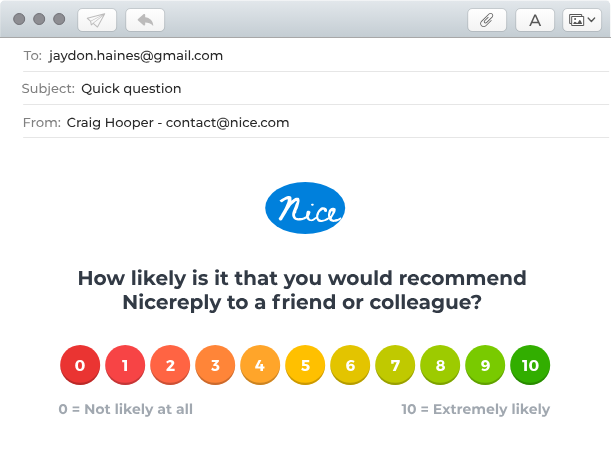
Nicereply is aimed at customer support teams that want CSAT, CES, and NPS in one place, tied directly to their helpdesk. If your NPS program lives next to support conversations rather than product analytics, it's a natural fit.
Key features
- CSAT, CES, and NPS surveys with unlimited active surveys
- Deep helpdesk integrations (Zendesk, Freshdesk, Help Scout, and more)
- Per-agent and per-team ratings
- Automated in-signature and post-resolution surveys
Reviewers call out the intuitive setup and the engaging rating experience for customers. The main consideration is focus: Nicereply is built around support-agent metrics, so it's less suited to product-led NPS, and pricing is tied to response volume and user seats.
Pricing: No free plan, but a 14-day free trial. The Starter plan is $59/mo billed annually (100 responses, 3 users), rising through Essential ($119/mo), Growth ($239/mo), and Business ($359/mo).
How to choose the right NPS software
Start from how you plan to collect and use the score, not from the feature list. A few quick filters narrow the field fast:
- If you're product-led SaaS, prioritize in-app surveys, targeting, and a tool that connects NPS to product feedback and roadmaps rather than leaving it in a silo.
- If you run a service or support operation, look at AskNicely or Nicereply, which tie feedback to individual reps and helpdesk conversations.
- If you're a large enterprise with a research team and budget, Qualtrics gives you analytical depth most others can't match.
- If you want simple and cheap, SatisMeter or a free plan gets you a working NPS program without a big commitment.
Whatever you pick, make sure closing the loop is easy. The score itself is trivial to calculate. The value is in what you do with the detractors.
Get the best feedback collection tool
Create targeted NPS, CSAT, multiple-choice, or text response surveys for free
Conclusion
The right NPS software is the one your team will actually keep using, and that usually means picking for how you collect feedback and who acts on it, not for the longest feature list.
Featurebase is a feedback and product platform that lets you run NPS and CSAT surveys, target them to the right users, and turn responses into tracked feature requests, roadmaps, and product updates, all in one place. It's a good fit when you want your loyalty score to feed real product decisions instead of sitting in a separate survey tool.
There's a free plan with unlimited survey responses, onboarding takes minutes, and no credit card is needed, so there's no downside to trying it. 👇
✨ Start running surveys & collecting feedback with Featurebase for free →
FAQs
What is a good NPS score?
Any score above 0 means you have more promoters than detractors, which is net-positive. As a rough guide, above 30 is good, above 50 is excellent, and above 70 is world-class. Benchmarks vary widely by industry, so it's more useful to track your own trend over time than to chase a universal number.
Is there free NPS software?
Yes. Several tools offer free tiers, including Featurebase, which has a free plan with unlimited survey responses so you can run NPS surveys without paying upfront. SatisMeter and SurveyMonkey also offer free plans, though they cap responses. Free tiers are a good way to validate your survey flow before committing to a paid plan.
How often should you send NPS surveys?
For relationship NPS, which measures overall loyalty, quarterly is a common cadence. For transactional NPS, which measures a specific interaction, trigger the survey right after the event, like a purchase or a support ticket. The key is to avoid over-surveying: hitting the same customers too often drops response rates and annoys people.
What's the difference between NPS, CSAT, and CES?
They measure different things. NPS measures long-term loyalty by asking how likely someone is to recommend you. CSAT measures satisfaction with a specific experience, usually right after it happens. CES measures how much effort a customer had to expend to get something done. Many teams track all three, using each at the moment it fits best.
How much does NPS software cost?
It ranges widely. Free plans and lightweight tools start at $0, mid-market platforms typically run from around $50 to a few hundred dollars a month, and enterprise suites like Qualtrics are quote-based and can reach five figures a year. Most tools price on response volume, seats, or both, so your real cost depends on how many customers you survey.
How do you improve a low NPS score?
Start by closing the loop with detractors quickly. Reach out, understand what went wrong, and fix it before they churn. Then look for patterns in the open-text comments to find systemic issues worth prioritizing, and follow up with those customers once you've made changes. A low score is most useful as a to-do list, not a grade.