Finance AI Chatbot: 7 Best Tools and Use Cases in 2026
Compare 7 finance AI chatbot tools for customer support, banking, budgeting, and investment research, with pricing, use cases, and key limitations.


On this page
A finance AI chatbot can answer billing questions, explain a budget, or help research a stock. But those jobs need different tools and data access.
I'll compare 7 options by their use cases, pricing, and limitations, so you can choose the right fit for your team or your own finances. 👇
Key takeaways
| Tool | Best for | Main capability | Entry pricing | Main trade-off |
|---|---|---|---|---|
| Featurebase | Financial software support | Fibi, inbox, and help center | $29/seat/month annually + $0.49/AI resolution | Advanced workflows need a higher plan |
| Kore.ai | Banking workflows | Banking agents and integrations | Contract pricing | Implementation complexity |
| Voiceflow | Custom chat and voice agents | Visual workflow design | Business pricing on request | Ongoing agent maintenance |
| Botpress | Programmable agents | Workflows and API connections | Free tier, Plus $150/month annually | Usage limits |
| ChatGPT | Financial analysis | Documents and financial explanations | Free and paid plans | Answers need verification |
| Cleo | Personal budgeting | Spending insights and coaching | Pro $8.99/month | Consumer finance focus |
| WarrenAI | Investment research | Investing.com data analysis | Free credits, paid plans available | Credits vary by task |
Prices checked November 10, 2026. Annual prices require annual billing. Featurebase's free helpdesk excludes Fibi, and usage allowances differ between products.
What is a finance AI chatbot?
A finance AI chatbot uses natural language processing to help people understand financial information or interact with financial services. There are 3 main categories:
- Customer support platforms: Answer product questions and connect customers with support agents.
- Banking workflow platforms: Retrieve authorized account information and support approved service processes.
- Personal finance assistants: Explain spending, summarize reports, and support investment research.
A financial chatbot's capabilities depend on its sources and permissions. Reading your help center lets it explain a payment policy. Explaining a particular failed payment requires access to that customer's record.
Explaining a transaction and executing one require different permissions.
A conversational interface alone doesn't establish that a product can move money or approve applications. Choose the type of assistant first, then check the data access and controls needed for that job.
The 7 best finance AI chatbots
These options serve different jobs. I've compared their published capabilities and pricing, using customer review themes as supporting context.
1. Featurebase
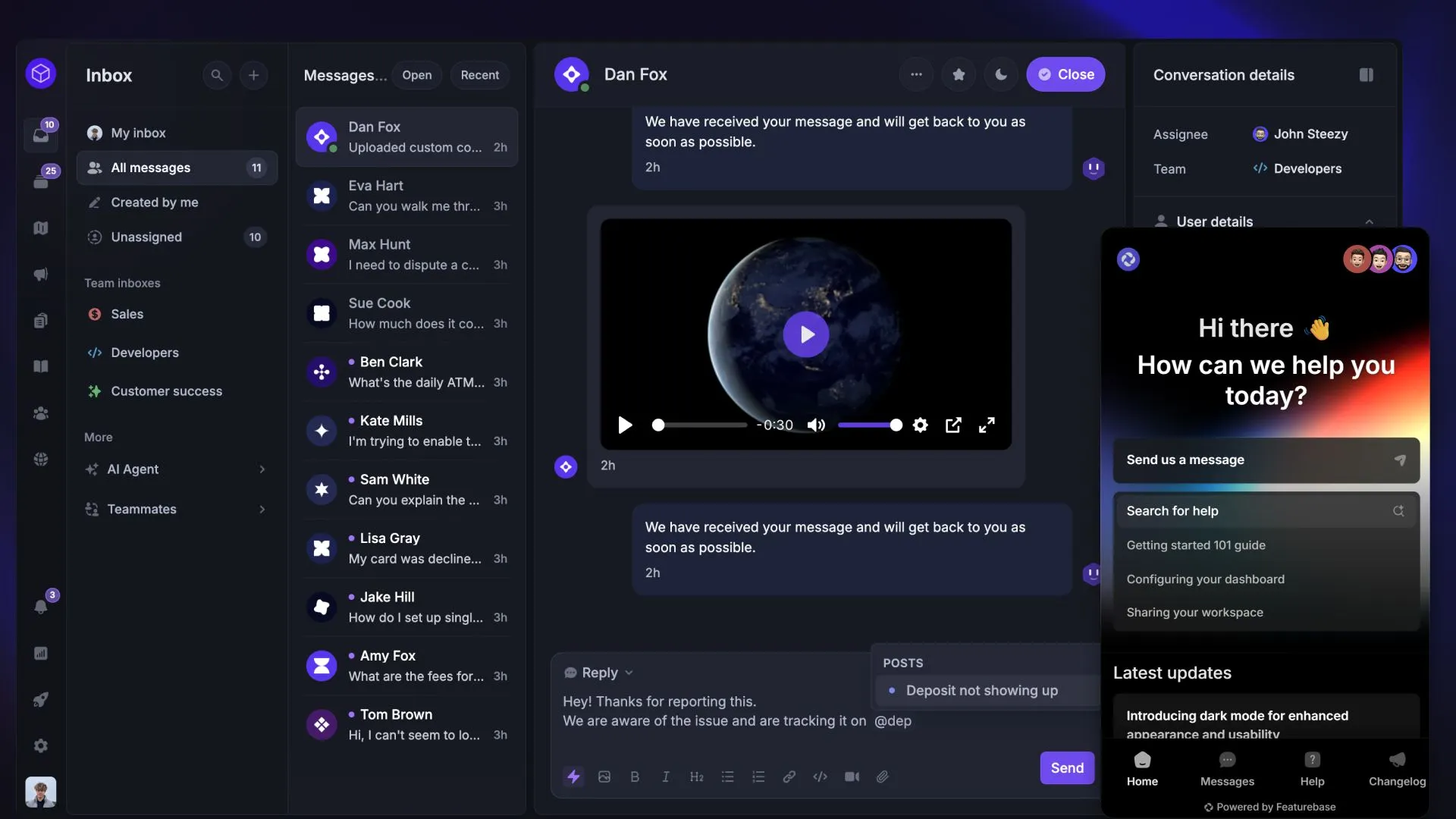
Featurebase is a modern AI customer support platform for product-led SaaS. It combines an omnichannel inbox, AI agents, a help center, and feedback management in one place.
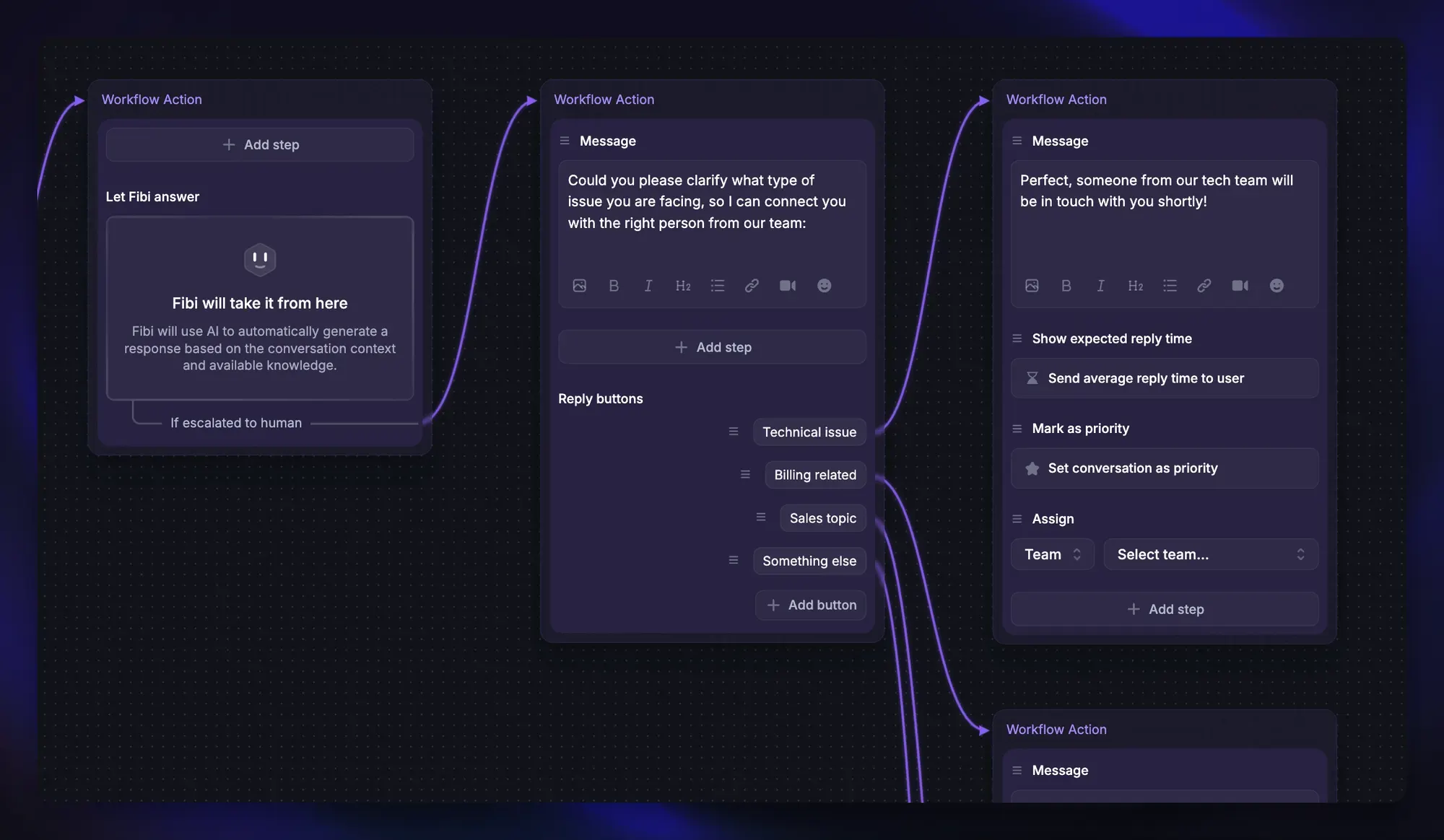
For financial software teams, Fibi AI Agent can answer product questions from approved content and pass conversations to teammates. An accounting app could use it to explain report exports or subscription policies. Account-specific answers require appropriate data connections and permissions.
Top features:
- Omnichannel inbox – Manage live chat, email, and Slack conversations together.
- Fibi AI Agent – Answer questions and run configured Custom Actions, including trial extensions or refunds.
- Help center with AI search – Provide multilingual self-service answers.
- Workflows & automations – Assign tickets, route conversations, and collect customer data.
- AI Copilot – Help teammates answer using internal knowledge.
- Multi-brand support – Manage multiple Help Centers and live chats.
- Automatic AI translations – Translate conversations and help articles.
- Service Level Agreements – Track response targets and conversations needing attention.
- Mobile app – Reply to customers and receive notifications on the go.
- Feedback & roadmap tools – Collect requests and share planned improvements.
- Product updates – Publish release notes through a changelog, widgets, and email.
- Integrations – Connect Slack, Linear, Jira, HubSpot, and more.
Pricing: Free includes 1 seat and unlimited conversations, without Fibi. Growth starts at $29/seat/month billed annually, plus $0.49 per AI resolution. Custom Actions, Workflows, SLAs, and Slack require Professional or higher. Multi-brand support requires Enterprise. Unlimited AI Copilot is an add-on.
Featurebase suits software teams bringing support, feedback, and customer communication together as demand grows.
2. Kore.ai
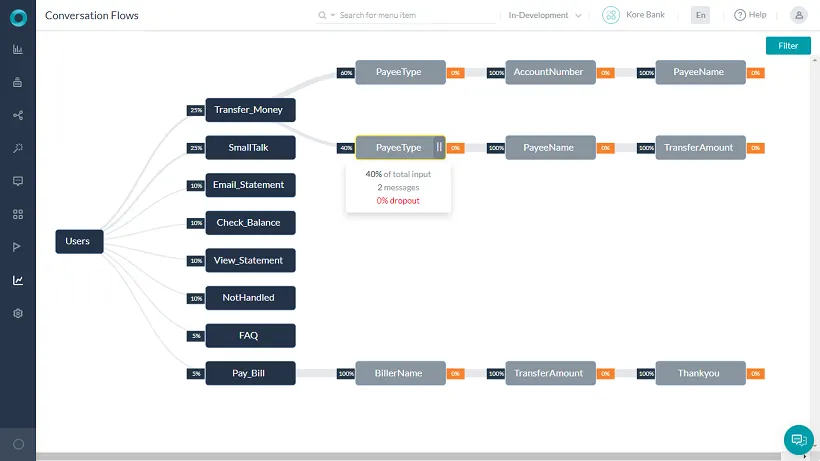
Kore.ai serves financial institutions building conversational AI in banking. Its retail banking offering connects account-servicing workflows with banking systems.
A service request can involve identity verification, policy checks, and escalation. Those dependencies matter when deciding whether you need a banking platform or a simpler support tool.
Top features
- Prebuilt banking capabilities and integrations.
- Policy controls and human involvement.
- Monitoring and audit capabilities.
Main trade-off: Implementation requires planning. Review feedback highlights a learning curve and challenges with debugging and documentation.
Pricing: Kore.ai pricing is contract-based. Request a quote covering channels, usage, implementation, and support.
I'd shortlist it when banking workflows and existing infrastructure drive the project.
3. Voiceflow
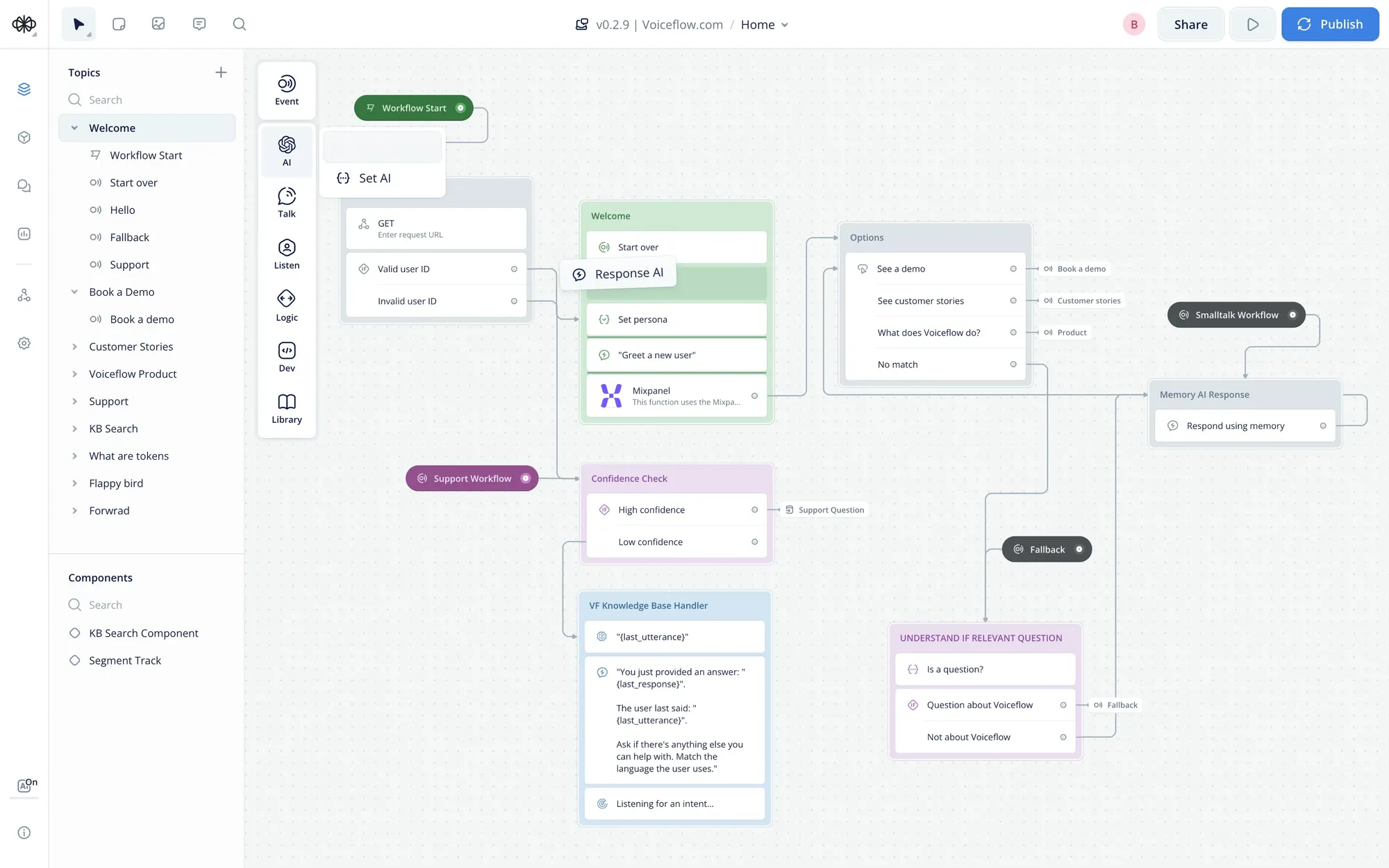
Voiceflow helps teams design custom chat and voice agents. It suits a financial services chatbot that needs knowledge-based answers alongside tightly defined workflows.
For example, you might let the agent explain a product freely while requiring a fixed sequence for collecting a service request.
Top features
- Visual conversation design and collaboration.
- Knowledge sources and API connections.
- Model choice, testing, and analytics.
Main trade-off: Advanced integrations need technical work, and someone must maintain the agent when policies change.
Pricing: Business pricing is available on request. Its separate agency and partner offering includes a free trial and usage-based billing.
Choose it when control over conversation design matters and your team can own ongoing improvements.
4. Botpress
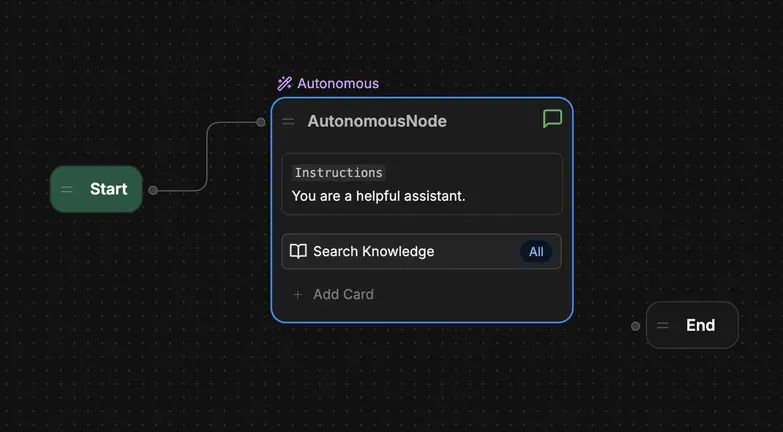
Botpress lets teams build a finance chatbot around their knowledge sources and software integrations.
An agent could explain a policy and then retrieve an authorized record. That second step depends on the integration and permissions your team builds.
Top features
- Visual workflows and custom agent behavior.
- API connections for retrieving information and taking actions.
- Human handoff with conversation context.
Main trade-off: Complex flows require development and maintenance. Review feedback also highlights documentation gaps.
Pricing: Botpress pricing includes a Free tier with 100 conversations. Plus costs $150/month billed annually, with 250 monthly conversations and $25 in AI usage included. Additional conversation packs and AI usage increase costs.
Estimate both conversation volume and model consumption before committing.
5. ChatGPT
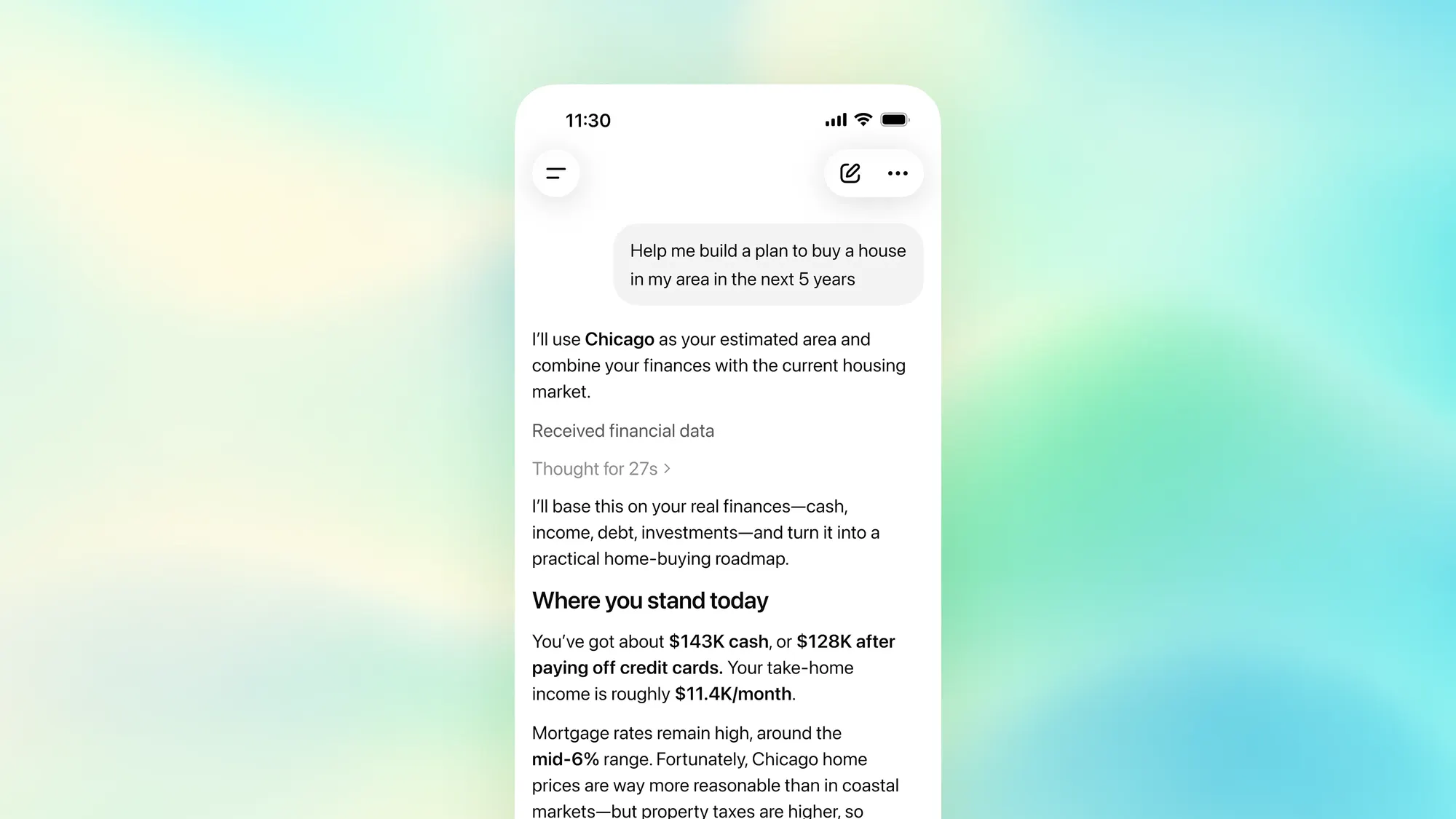
ChatGPT works as an AI financial assistant for explaining concepts, reviewing documents, and analyzing figures. Its connected personal finance experience offers read-only account access through Plaid for eligible US users.
That access supplies context without permission to change those accounts. You can also use documents you provide to compare figures or turn a dense report into questions for further investigation.
Top features
- Financial document summaries and data analysis.
- Explanations with follow-up questions.
- Web research and connected financial context where available.
Main trade-off: Answers can contain errors or miss context. Verify important calculations and review data controls before sharing sensitive information.
Pricing: Free and paid plans offer different limits and capabilities. Connected finance availability depends on eligibility and location.
It's useful for understanding information and preparing further research.
6. Cleo

Cleo is a personal finance chatbot for budgeting, spending insights, and money coaching. It suits individuals who want help understanding everyday financial habits.
Its consumer focus makes it a different purchase from a platform for building customer-facing banking workflows.
Top features
- Budgeting conversations and spending insights.
- Goal support and credit score coaching.
- Voice conversations and memory on Pro.
Main trade-off: Its usefulness depends on supported account connections. Check whether it works with your bank before subscribing.
Pricing: Cleo Pro costs $8.99/month. Other plans and financial products have separate terms.
Evaluate it on whether its explanations help you understand spending patterns and follow your goals.
7. WarrenAI
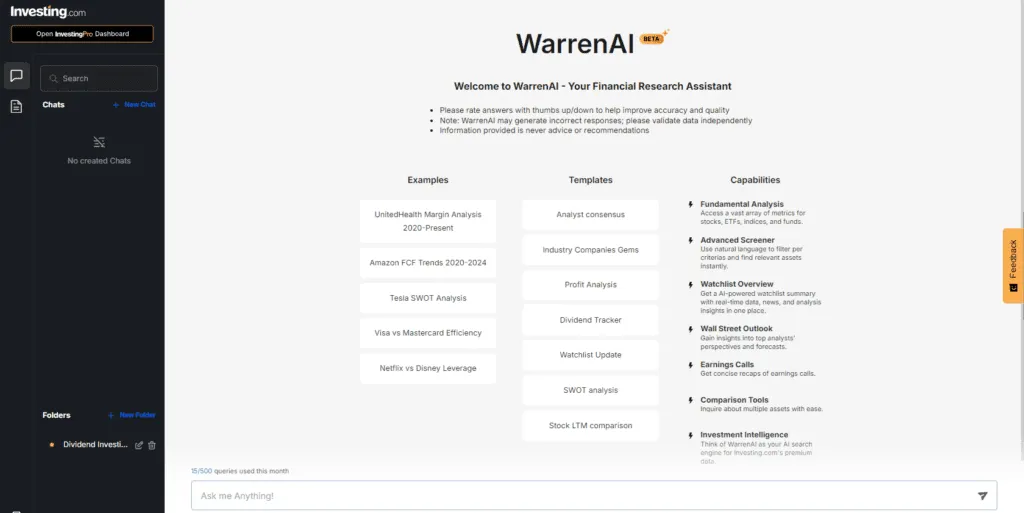
WarrenAI uses Investing.com's financial data to help users investigate companies and market questions.
Top features
- Company financials, news, and market information.
- Analyst and Senior Analyst research modes.
- Follow-up questions and visibility into the research process.
Main trade-off: Tasks consume credits at different rates, and individual derived calculations don't always have separate source links. Check the reporting periods and assumptions behind comparisons.
Pricing: Free accounts receive monthly credits. Paid plans provide more capacity, with credit usage varying by task and mode.
WarrenAI fits investment research, with findings checked against the underlying data before acting.
6 practical uses for finance AI chatbots
Useful applications start with a specific question and a trustworthy information source.
Answering product and billing questions
Answer repeat questions about subscriptions, reports, and integrations using your documentation. Reviewing unresolved conversations can reveal explanations missing from your help center.
Keep product guidance distinct from account status. Knowing the refund policy doesn't establish whether a particular customer's refund has been processed.
Helping customers complete onboarding
Support customer onboarding by explaining required information and next steps. Use approved guidance and established document-collection processes, then measure whether customers complete the task.

Retrieving account and payment information
Chatbots in banking can retrieve authorized records, such as a payment's status. Provide an escalation path when information is unavailable or needs investigation.
A customer asking about a transfer needs its latest status. A generic explanation of processing times may leave the question unresolved.
Explaining spending and budgets
Organize transactions and explain changes in spending. Let users inspect the underlying records, since missing accounts or misclassified purchases can distort the picture.
A useful question is, "Which categories account for the biggest increase this month?" Ask for the transactions supporting the answer.
Researching companies and investments
An AI chatbot for finance can summarize earnings material and compare reported figures. Specify reporting periods and verify important findings against original filings or data sources.
When comparing companies, check that profit measures use the same definition. Similar labels don't always describe equivalent calculations.
Summarizing financial documents
Extract changes or variances from reports and request page references. A specific prompt, such as identifying changes in operating expenses, produces an output that's easier to check.
Review totals against the source, especially for scanned tables. Use an approved environment for confidential material and share only what's needed.
How to choose a finance AI chatbot
I would evaluate 3 things before committing:
- Data access: Define whether the bot should explain information, retrieve records, or take actions. Grant only the permissions each task needs.
- Answer quality and handoff: Test ambiguous questions, missing information, and requests requiring a person. Check whether the teammate receives enough context to continue.
- Total chatbot costs: Include subscriptions, usage, integrations, and maintenance. Conversation charges and resolution charges measure different events.
Test with your own examples before buying. Include incomplete requests and cases that should reach a person, then check what happens when the information needed to answer is missing.
Also assign an owner for the knowledge sources. When a policy changes, someone must update the content and verify that the agent's answers change with it.
Human oversight remains common across AI in financial services. In the Bank of England/FCA's 2024 survey, only 2% of reported AI use cases involved fully autonomous decision-making. The survey covered 118 UK financial firms and all AI applications, not just chatbots.
Conclusion
Choose a finance AI chatbot around the job: customer support, banking workflows, budgeting, or investment research.
Featurebase brings AI support, a shared inbox, a help center, and feedback management together for software teams handling growing customer demand. Fibi answers from approved content, with teammates available for conversations needing human help.
Start with the Free helpdesk plan. Fibi is available on paid plans with separate resolution pricing. 👇
Automate your customer support with Featurebase
[illustration here]
Frequently asked questions
Buy when an existing product covers your workflow and integrations. Build on an agent platform when custom requirements justify the ongoing work of testing, monitoring, and maintaining it.
Request current assurance reports and contractual details about data privacy, storage, retention, access, and model training. Check their scope against the product and deployment you're buying. A certification badge alone doesn't establish that a vendor meets every requirement for your use case.
It can explain processes and collect information through approved workflows. Identity checks need an approved verification system, while disputes need clear escalation and case ownership.
Yes, when the tool fits a defined task and budget. Start with a narrow use case, such as product FAQs, and account for integration and maintenance requirements.
It can explain credit information but cannot guarantee improvement. The CFPB's credit guidance emphasizes timely payments, managing credit usage, and checking reports for errors.